

My article on the “The Social Dynamics of Collective Action: Evidence from the Diffusion of the Swing Riots, 1830–1831” has been published in the Journal of Politics @The_JOP journals.uchicago.edu/doi/10.1086/71… 

We ask three related questions: what is the information that drives the diffusion of social unrest? How is this information transmitted? And who responds to this information?
We collected data on the historical wave of unrest known as the English Swing riots of 1830–31. Our data include spatiotemporal information on each riot, local fairs, the stagecoach network, the location of local newspapers, arrests and petitions sent to parliament.
Our identification strategy exploits the relatively slow diffusion of the Swing riots: slow enough to show substantial spatiotemporal variation in occurrence, but fast enough for other factors to be controlled for by fixed effects, time effects and location-specific time trends.
We find that diffusion was large and that information about the riots traveled through personal and trade networks, but not through transport or media networks.
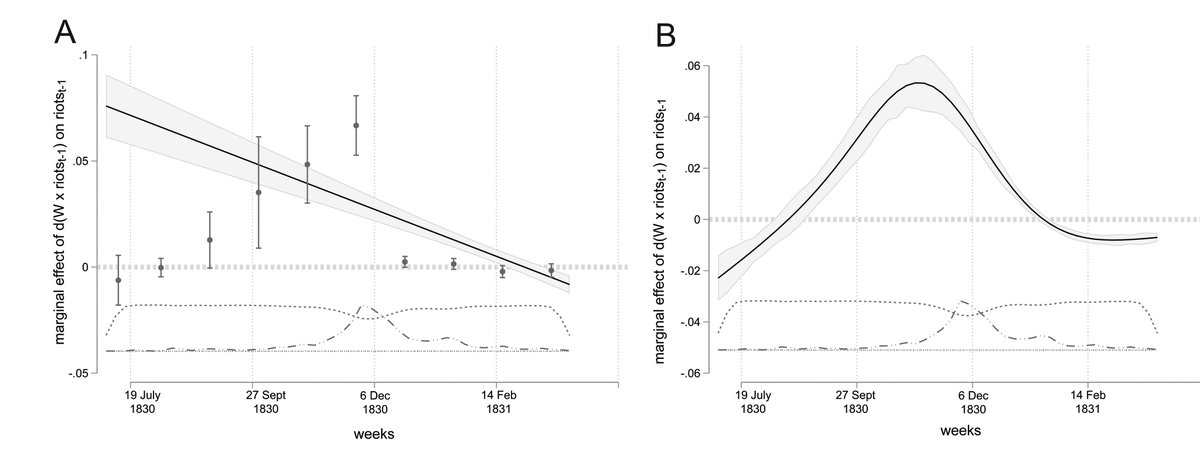
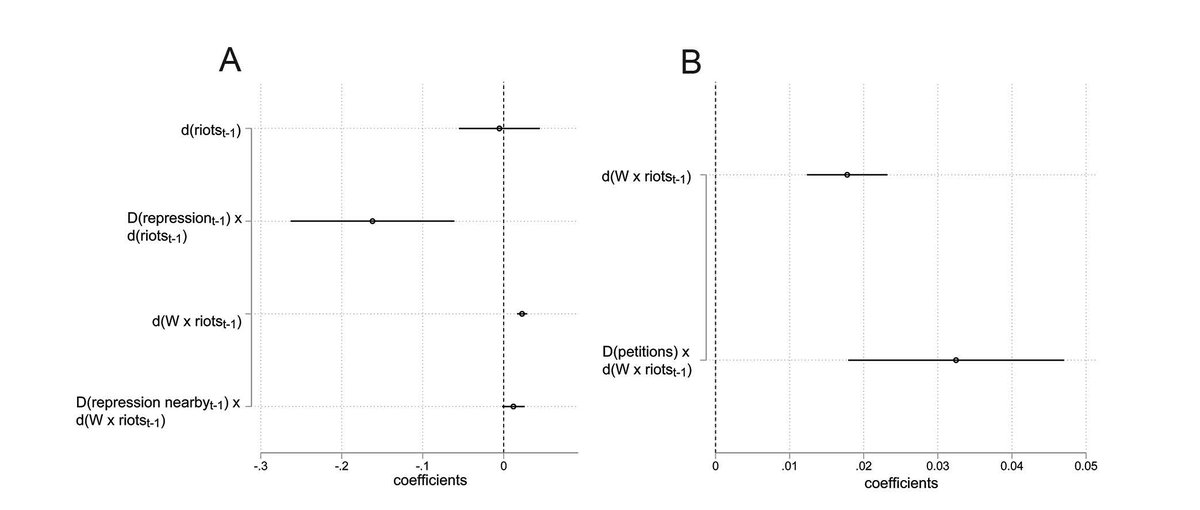
Local organizers helped facilitate the diffusion of the riots. Knowledge that riots in nearby areas had been repressed did not affect local rioting.
I am very grateful to everyone who provided comments and feedback on the (many) drafts and (many) seminar presentations!
• • •
Missing some Tweet in this thread? You can try to
force a refresh



