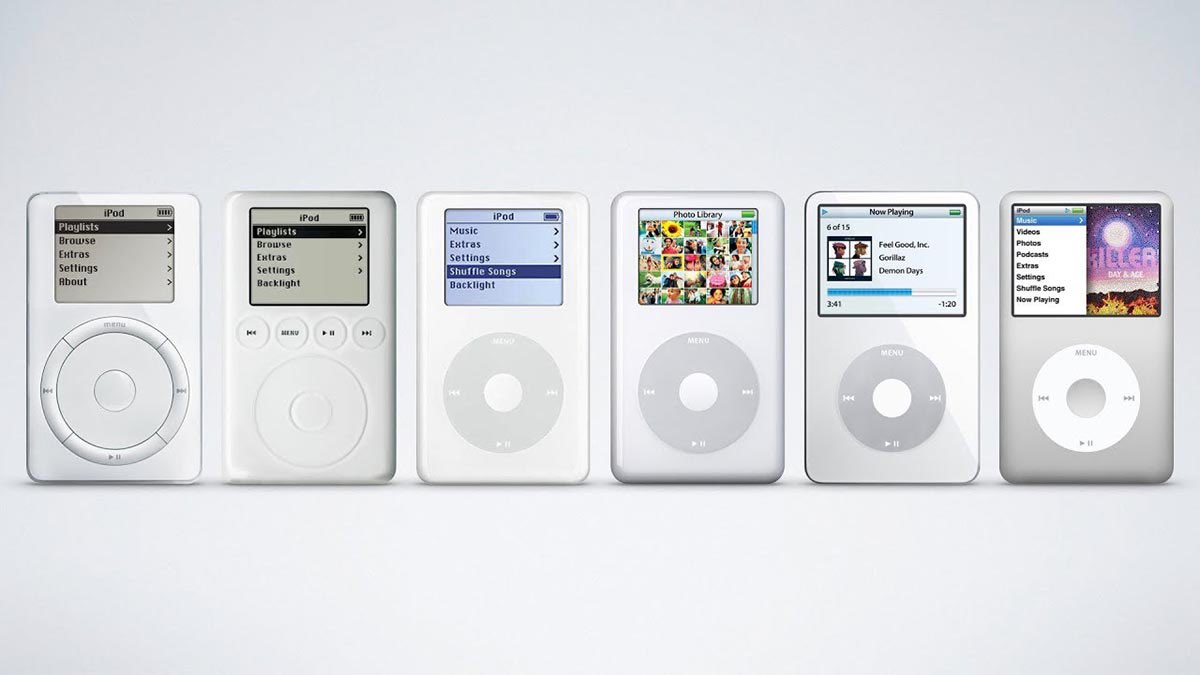
The iPod is 20 years old today! Here is the full history of development from Classic to Touch. Exactly 20 years ago, from the stage of a small Apple conference room, Steve Jobs presented a new vision of portable players and the entire music industry.
Following the compact iPod
Following the compact iPod
models, Apple created a convenient platform for buying iTunes digital music, and a few years later they were able to launch their own streaming service Apple Music. The range of players shifted the company's focus to mobile gadgets and made possible the further release of the
iPhone and iPad. Unfortunately, such a landmark product for Apple is almost forgotten and, most likely, will soon cease to be produced. The name "iPod" did not appear in the company immediately. This combination of letters, which is easy and ingenious from a marketing point of
view, did not occur to Steve Jobs or someone from the player's development team, or even to a full-time Apple employee.
Among the most popular meanings of the translation of the word “pod“ are ”pod“, ”cocoon“ and ”pendant". The Apple player has little to do with this. The name
Among the most popular meanings of the translation of the word “pod“ are ”pod“, ”cocoon“ and ”pendant". The Apple player has little to do with this. The name
has nothing to do with the popular English-language abbreviation "POD" from the phrase "port of destination" (destination port). During the launch of a completely new product for Apple, Jobs regularly conducted brainstorming sessions to come up with a concise name for the player
and a successful slogan for its promotion. For these purposes, the company even hired a group of freelance copywriters who regularly submitted a stack of ideas to Steve for consideration. The luckiest of all was the author Vinnie Chico (Vinnie Chieco). It was he who first
introduced the Apple computer as the main spacecraft, and then compared the player to a small capsule that periodically connects and disconnects from the computer. Such capsules were sometimes called “pod" in science fiction, the plot of the 2001 film Space Odyssey directed by
Stanley Kubrick appeared in the memory of Vinnie Chico. There, EVA pod capsules regularly docked with the powerful Discovery space Station. All that remained was to add the brand symbol "i” at the beginning of the name to draw a parallel with other products of the company. So the
name of a small rescue capsule from a 1968 science fiction film formed the basis of the Apple-patented trademark.
Later, the name of the Apple player became a household name, often so generically called all portable MP3 music players.
Interestingly, in 2007, The Global Language
Later, the name of the Apple player became a household name, often so generically called all portable MP3 music players.
Interestingly, in 2007, The Global Language
Monitor named the word “iPod" the most used word among English-language publications writing about technology over the past five years. In the following years, the palm was captured by the word “iPhone". The classic line of iPod players. 2001 - 2007. Back in early 2001, at the
Macworld exhibition in San Francisco, Steve Jobs presented the iTunes application. Then it was a single content management center on Apple computers, but the company understood that this was the first step for the future music ecosystem.
Not all users initially appreciated the
Not all users initially appreciated the
appearance of a bulky media combine, but after the autumn presentation of the player itself, everything fell into place. Over the next seven years, Apple released the main line of its own music players, which is commonly called the iPod Classic. The devices had a restrained
design and a familiar form factor with a control wheel and a rectangular display on top.
The gadgets were distinguished by a large volume of the built-in drive, which was achieved by installing capacious and compact HDD drives.
The first-generation iPod. 2001. So on October 23,
The gadgets were distinguished by a large volume of the built-in drive, which was achieved by installing capacious and compact HDD drives.
The first-generation iPod. 2001. So on October 23,

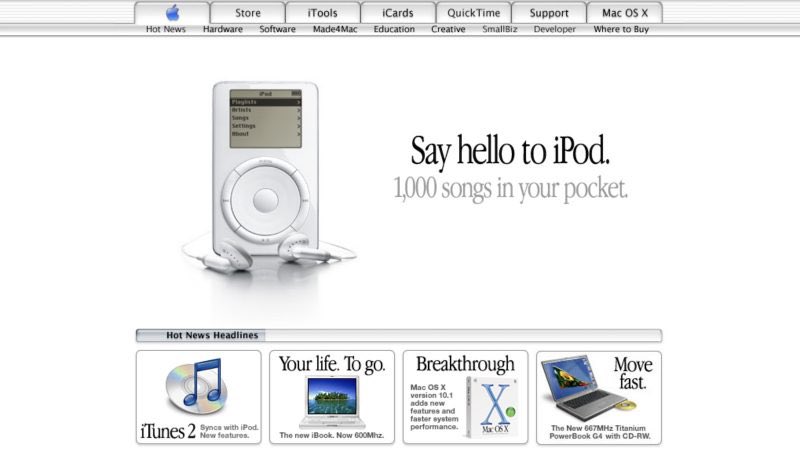
2001, at a special event, Steve Jobs showed the first iPod to the public. The slogan of the new gadget was the phrase "1000 songs in your pocket".
The player was compact enough for its time, the dimensions were comparable to a deck of playing cards. Most of the front panel of the
The player was compact enough for its time, the dimensions were comparable to a deck of playing cards. Most of the front panel of the
first iPod was occupied by a mechanical scroll wheel, four keys around the perimeter and a confirmation button in the center. Above was a two-inch monochrome display.
The device could work up to 10 hours without recharging. Modifications with a memory capacity of 5 and 10 GB were
The device could work up to 10 hours without recharging. Modifications with a memory capacity of 5 and 10 GB were
available to the user, a very thin HDD drive was used.
The cost of the player was from $ 400. A FireWire format port was used to synchronize with the computer. This is an outdated connector format today, which at one time was supported by Apple, Sony, Yamaha and several other
The cost of the player was from $ 400. A FireWire format port was used to synchronize with the computer. This is an outdated connector format today, which at one time was supported by Apple, Sony, Yamaha and several other
companies with minor differences. The standard successfully competed with USB, but Apple's licensing policy put an end to the further development of the connector. Kupertinovtsy demanded deductions for each installed controller chip in third-party computers or gadgets.
So by the
So by the
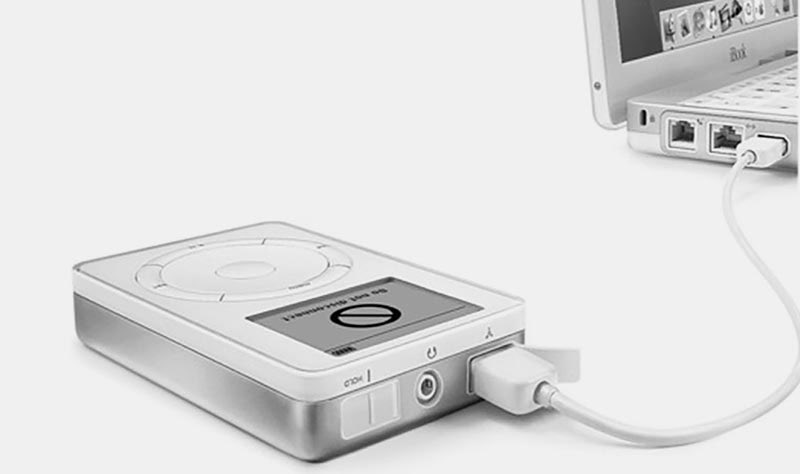
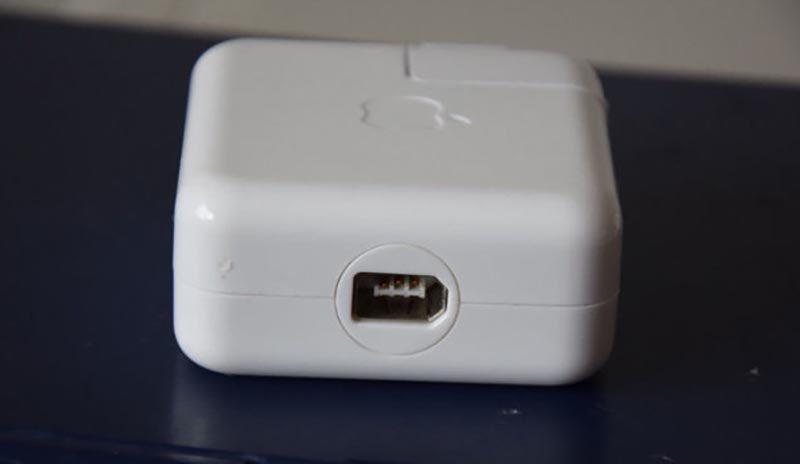
mid-2010s, FireWire was forgotten, and it was replaced by faster versions of USB and Thunderbolt. Although at the time of the presentation of the first iPod FireWire interface gave 30 times faster data transfer speed than USB.
So it took only 10 minutes to fully fill 5 GB of iPod
So it took only 10 minutes to fully fill 5 GB of iPod
memory via FireWire. The USB interface of that time transmitted a similar amount of data for about 5 hours. The first iPod was charged via the same FireWire from the computer during data exchange. If the user wanted to use the player without being tied to a computer, a special
Apple power supply with a FireWire connector was sold. Even then, the company had a strong desire to earn money by selling additional accessories.
Second-generation iPod. 2002. Less than six months later, Apple released the second generation of the legendary player. The start of sales took place on March 21, 2002. The device did not differ in size from its predecessor. The amount of internal memory has increased,
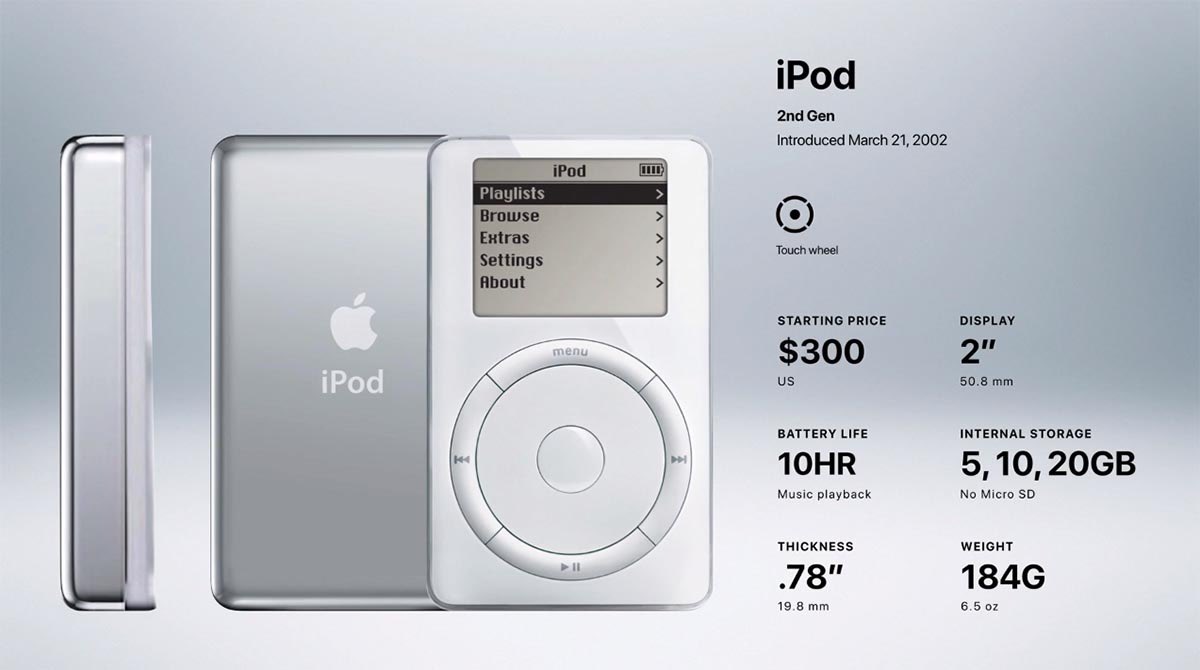
modifications with 5, 10 and 20 GB hard disk drives were available. The main innovation was the rejection of the mechanical scroll wheel and the appearance of a more convenient Touch Wheel. A special circular touch area made it even easier to interact with the player interface.
In the future, this element became the hallmark of the iPod line and formed the basis of the best trackpads installed in all MacBook models today. A landmark was the appearance of the iTunes application for the Windows operating system, which greatly expanded the circle of
potential iPod users. The first generation of the player could only be used with a Mac. The cost of the device has decreased, and the price of the basic version was $300.
iPod of the third generation. 2003. It took the developers more than a year to release the third-generation
iPod of the third generation. 2003. It took the developers more than a year to release the third-generation
iPod. The player was introduced in April 2003.
The gadget has become thinner and lighter than its predecessor, and instead began to work 2 hours less. Engineers removed the control buttons separately from the Touch Wheel, which became a very controversial decision. In the future,
The gadget has become thinner and lighter than its predecessor, and instead began to work 2 hours less. Engineers removed the control buttons separately from the Touch Wheel, which became a very controversial decision. In the future,
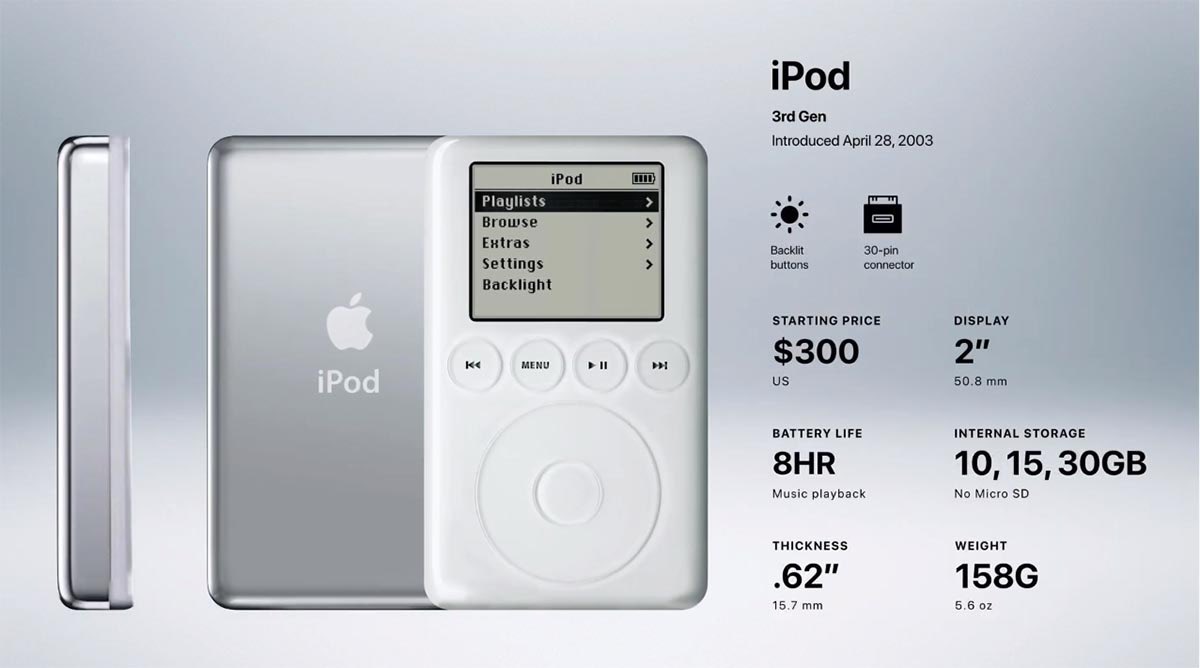
the control was returned to its previous form and no longer experimented with keys outside the touch area. To charge and sync with the computer, they decided to abandon FireWire and replaced it with a proprietary 30-pin Apple connector, which was later installed in the iPhone
and iPad.
Together with the new player, the Cupertinos launched the iTunes Store for convenient purchase of songs and albums by different artists. By the time the store was launched, about 250 thousand tracks were available to users. The cost of one song was 99 cents. Models with
Together with the new player, the Cupertinos launched the iTunes Store for convenient purchase of songs and albums by different artists. By the time the store was launched, about 250 thousand tracks were available to users. The cost of one song was 99 cents. Models with
drives from 10 to 40 GB were available for sale. The cost of the basic model, as a year earlier, was $ 300.
Fourth generation iPod and iPod Photo. 2004. In the summer of 2004, the fourth generation iPod was introduced. The main difference from all previous models was the
Fourth generation iPod and iPod Photo. 2004. In the summer of 2004, the fourth generation iPod was introduced. The main difference from all previous models was the

appearance of the Click Wheel control unit. Engineers have combined the Touch Wheel touchpad with four navigation buttons under it. This made it possible to no longer experiment with individual keys and brought the convenience of controlling the player to a new level. The player
has again become thinner than its predecessor, but the autonomy has increased. Users received up to 12 hours of music on a single charge. Limited versions of iPods with autographs of U2 band members were on sale, the glossy case of the players was painted black, and the controls
were contrasted with red. Together with such players, the Vertigo track was available for download for free. Two models with 20 and 40 GB drives were available to buyers of the basic model. The cost of the basic player was $300. iPod Photo was not the most successful offshoot of
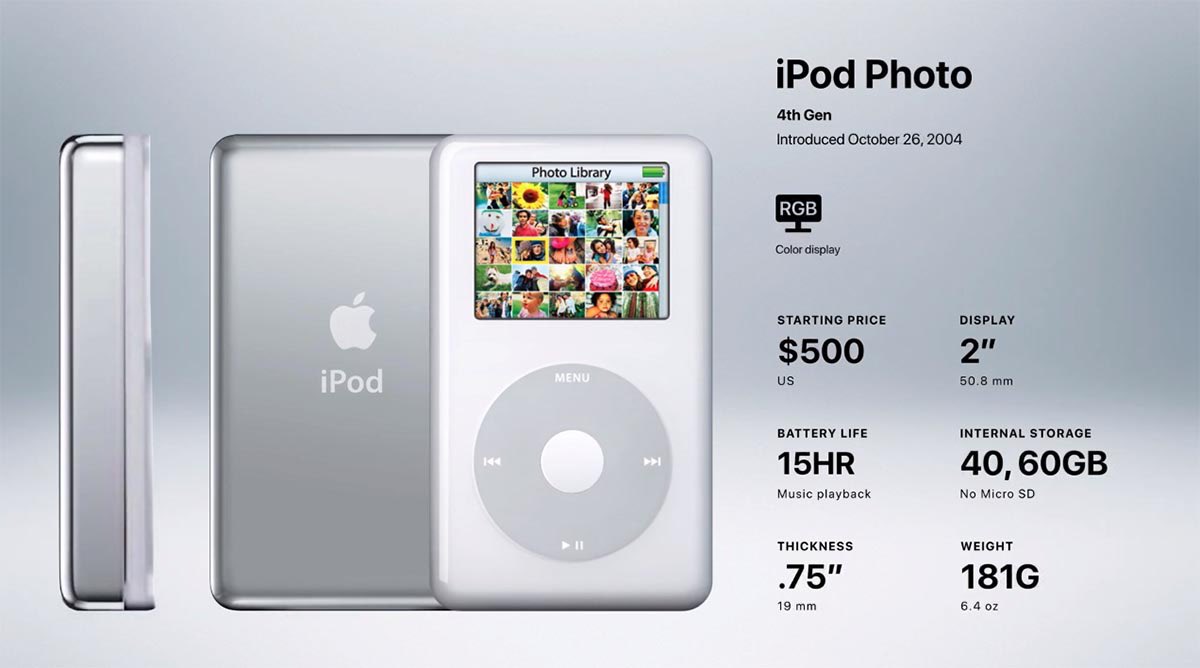
the main line of players. This is still the same iPod Classic 4th generation, but with a color RGB display. The developers believed that users would want to upload and view their own pictures on a small 2-inch screen. The gadget was slightly thicker than the usual "four", which
made it possible to install a more capacious battery. The device operated on a single charge for up to 15 hours. The model did not receive proper user support and similar players were no longer produced. At the start of sales, models with 20 and 60 GB drives were available, the
basic iPod Photo cost $ 500.
Fifth-generation iPod. 2005. In the fall of 2005, the 5th generation iPod was introduced.
The device already had a 2.5-inch display and learned how to play video. The gadget was almost twice as thin as its predecessor, but at the same time had similar
Fifth-generation iPod. 2005. In the fall of 2005, the 5th generation iPod was introduced.
The device already had a 2.5-inch display and learned how to play video. The gadget was almost twice as thin as its predecessor, but at the same time had similar
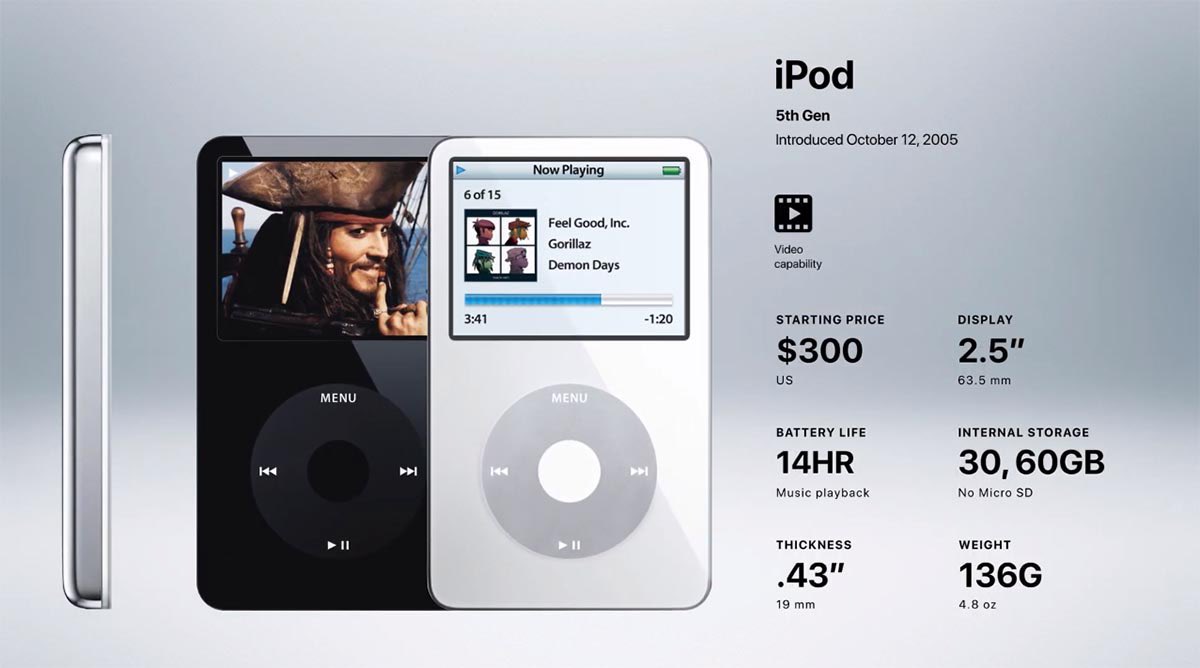
autonomy. The user could count on 15 hours of music playback. The player was available in black and white, and modifications with 30 and 60 GB drives were available to choose from. Later, a modification with an 80 GB disk was added. The initial version of the iPod 5 cost $300.
The sixth generation iPod. 2007. In the fall of 2007, Apple introduced the latest sixth generation of the classic iPod. The gadget differed from its predecessor with a slightly modified appearance, matte plastic on the front panel and updated software. Otherwise, it was still the
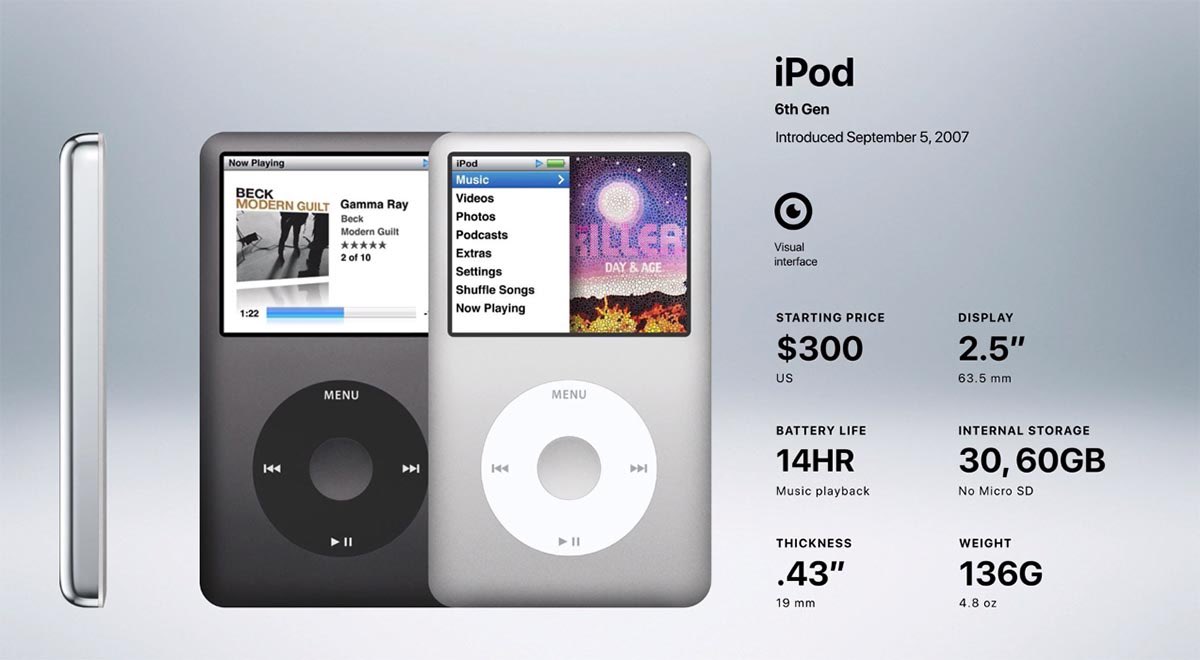
same player loved by many. In the basic modification, an 80 GB drive was installed, 120 and 160 GB versions were available. The price of the basic version was at $300. The player was successfully sold for several more years (after a slight improvement in the filling in 2008),
and on September 9, 2014, the iPod Classic was officially discontinued.
The iPod mini/nano line. 2004 - 2012. In the wake of the popularity of the main player in 2004, Cupertino decided to expand the audience of its music gadgets.
They have released more affordable youth-oriented
The iPod mini/nano line. 2004 - 2012. In the wake of the popularity of the main player in 2004, Cupertino decided to expand the audience of its music gadgets.
They have released more affordable youth-oriented
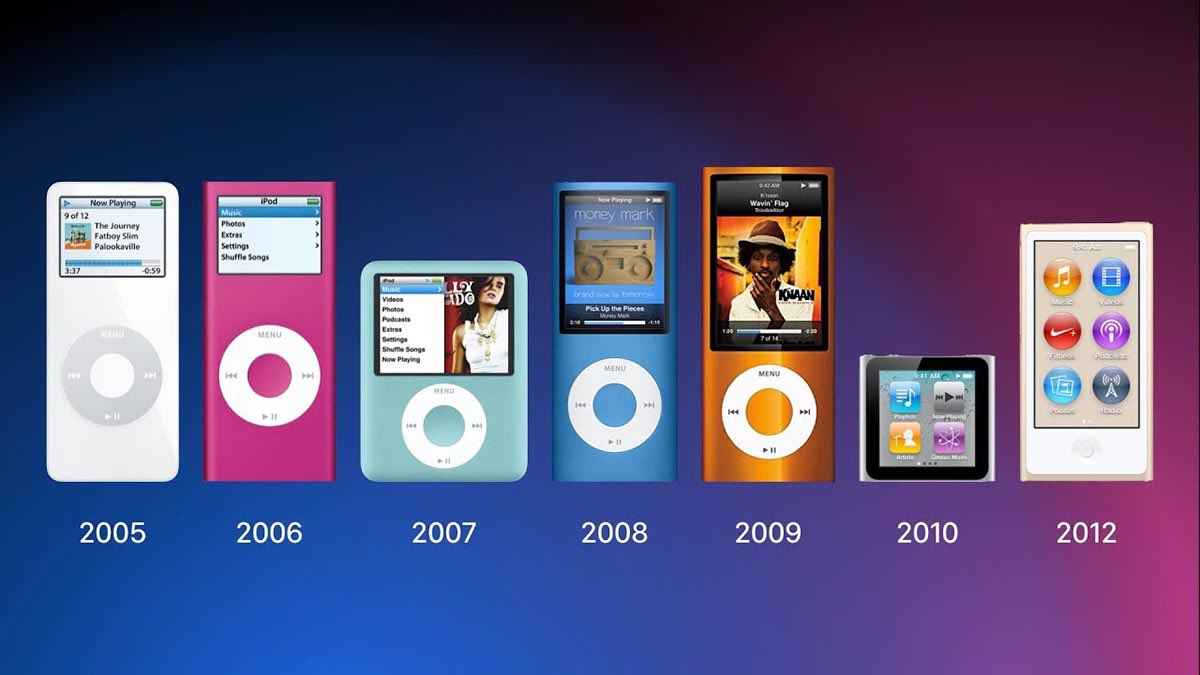
devices, although the first generation was positioned as a gadget for children. Many gadgets had several bright color options, almost every generation radically changed the size and even the form factor of the player. In this line there were both players of similar dimensions to
the Classic, and very different devices. There was a field for the craziest fantasies of developers and designers.
iPod mini of the first generation. 2004. The first "mini" was presented together with the iPod Classic of the 4th generation. The compact player had controls similar
iPod mini of the first generation. 2004. The first "mini" was presented together with the iPod Classic of the 4th generation. The compact player had controls similar
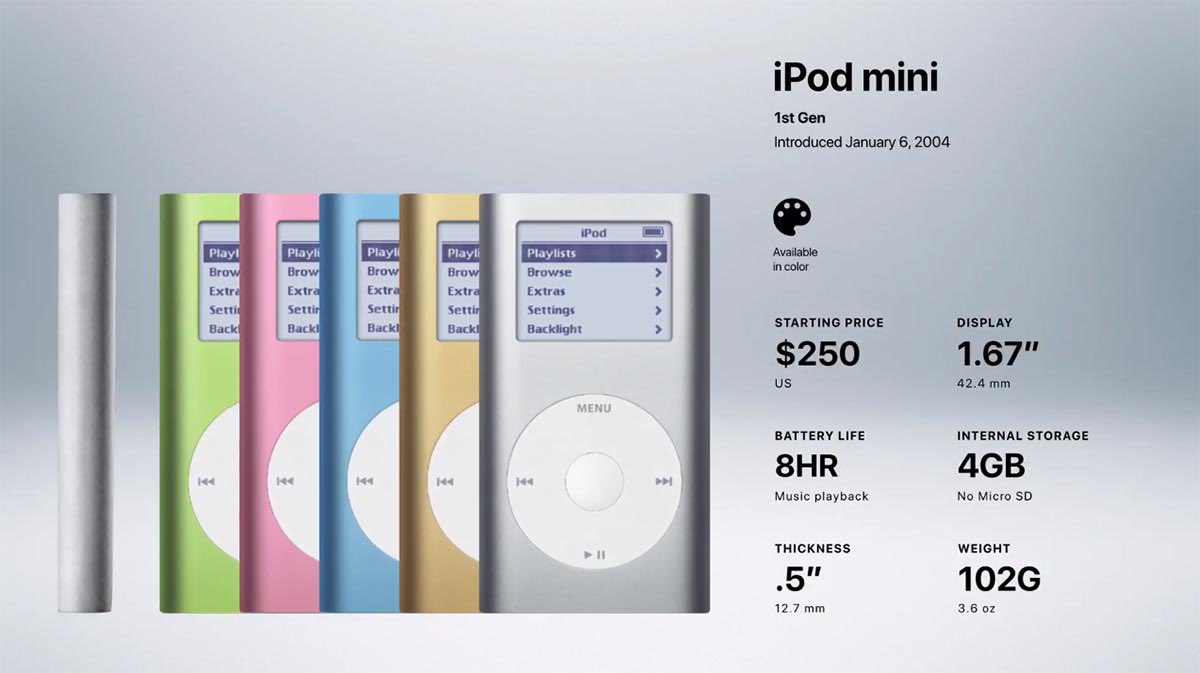
to the older brother, but was inferior in other parameters. The autonomy was several hours lower, the display was smaller, and the storage capacity was a modest 4 GB. But there were as many as five color options, which made all bored fans of the classics look in the direction of
the iPod mini.
The cost of the device at the start of sales is $ 250.
Second generation iPod mini. 2005. Just six months after the release of the first-generation iPod mini, Apple released a minor update of the line. The players received four new color options, added a device
The cost of the device at the start of sales is $ 250.
Second generation iPod mini. 2005. Just six months after the release of the first-generation iPod mini, Apple released a minor update of the line. The players received four new color options, added a device
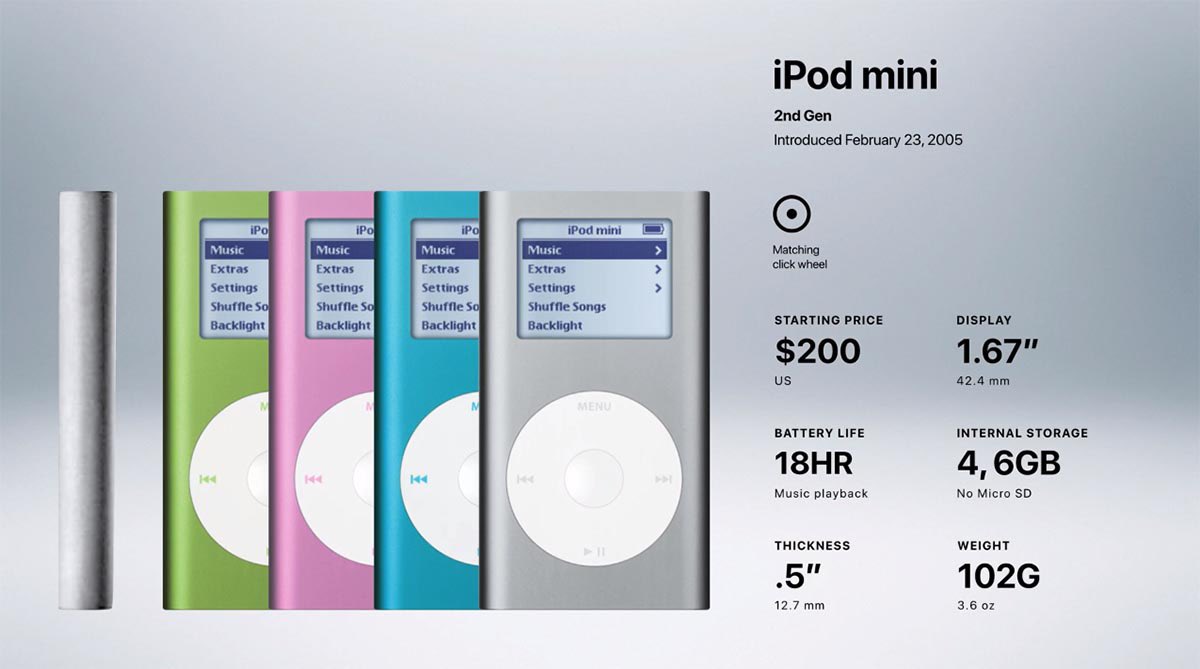
with a storage capacity of 6 GB.
The most pleasant thing was a significant increase in the autonomy of the "mini". In the music playback mode, he could live not 10, but as much as 18 hours.
The price of the device has dropped to $200.
iPod nano of the first generation. 2005.
The most pleasant thing was a significant increase in the autonomy of the "mini". In the music playback mode, he could live not 10, but as much as 18 hours.
The price of the device has dropped to $200.
iPod nano of the first generation. 2005.
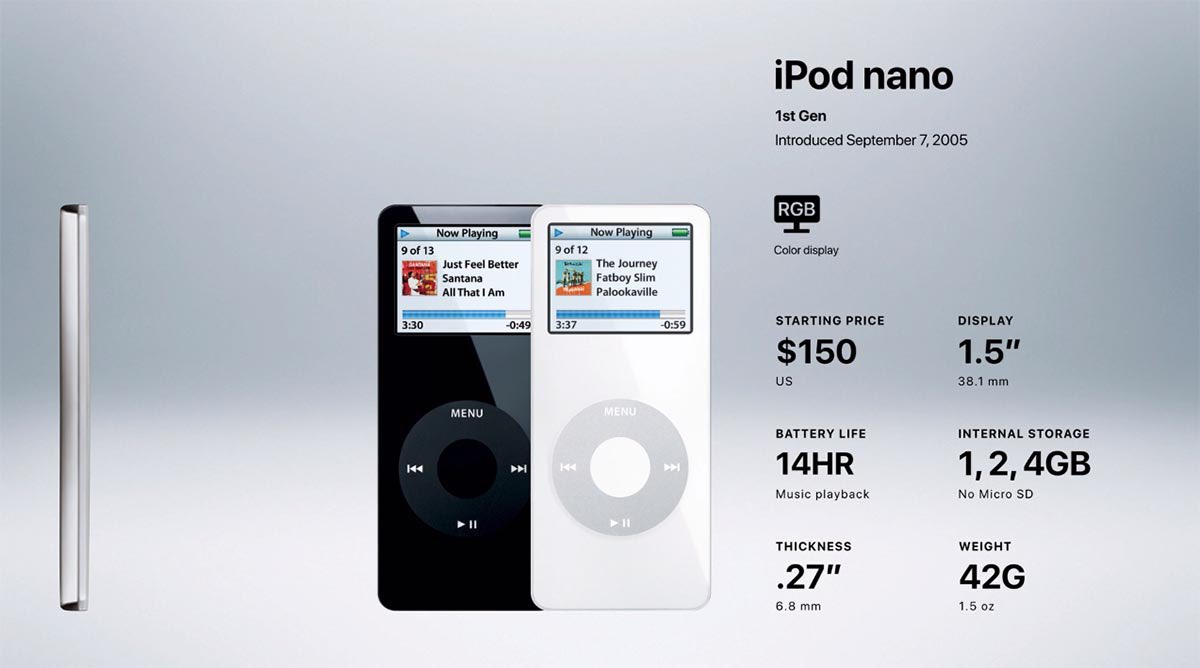
Already in the fall of 2005, changes took place in the line. The bright and colorful iPod mini has rapidly replaced the even more compact iPod nano. The name was deliberately changed to emphasize the miniature dimensions of the device.
The player has become significantly narrower
The player has become significantly narrower
and most importantly - thinner than its predecessor. The weight of the iPod has almost tripled. This became possible thanks to the transition to Flash drives.
The display has lost a little in the diagonal, but it has become colored and brighter. Unfortunately, only black and
The display has lost a little in the diagonal, but it has become colored and brighter. Unfortunately, only black and
white body colors were available.
Initially, devices with a 2 and 4 GB drive were sold, and later a 1 GB budget version was added. The gadget, with a modest size, allowed you to listen to music for up to 14 hours without recharging, and cost even cheaper - $ 150.
iPod nano second
Initially, devices with a 2 and 4 GB drive were sold, and later a 1 GB budget version was added. The gadget, with a modest size, allowed you to listen to music for up to 14 hours without recharging, and cost even cheaper - $ 150.
iPod nano second
generation. 2006. In the fall of 2006, an updated version of nano players was released. This time, the operating time without recharging was significantly increased with the same dimensions of the case. The player was able to play music for up to 24 hours.
The player received
The player received
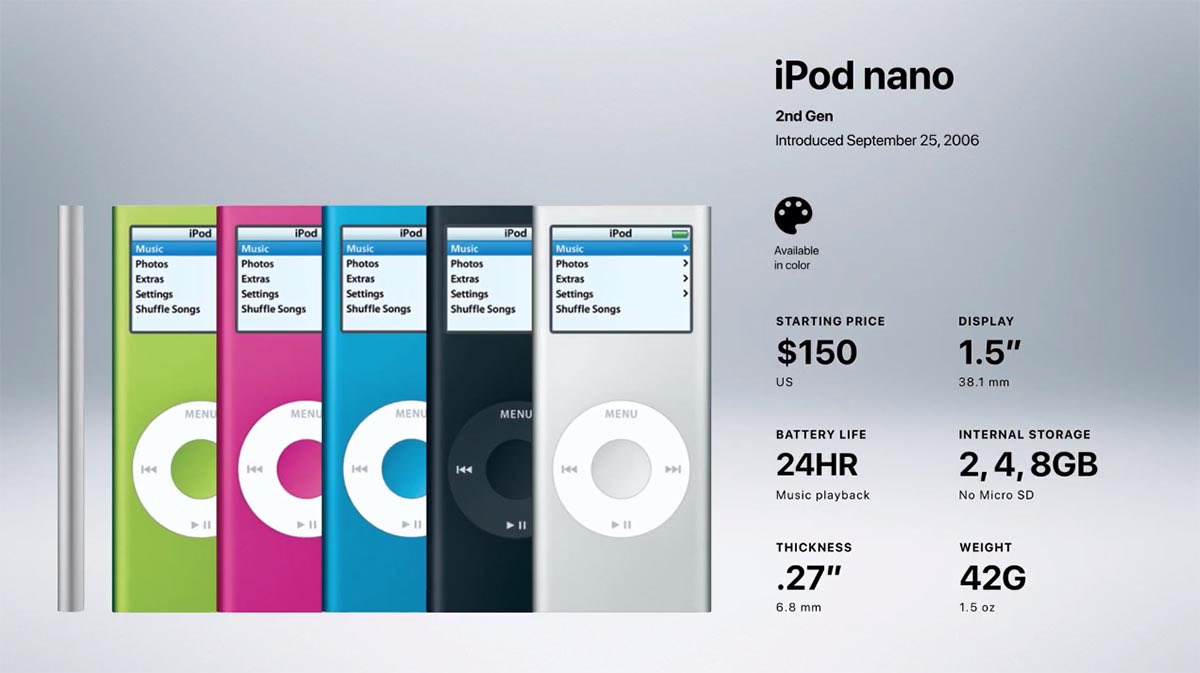
five bright colors of the case and 2, 4, 8 GB drives.
The cost remained the same - $ 150.
iPod nano of the third generation. 2007. In the fall of 2007, the line of iPod papo players received a serious redesign. The model inherited the proportions of the case from the Classic
The cost remained the same - $ 150.
iPod nano of the third generation. 2007. In the fall of 2007, the line of iPod papo players received a serious redesign. The model inherited the proportions of the case from the Classic

players and changed the aspect ratio of the display. For the first time, a 2-inch matrix was installed in nano, and the interface was slightly modified for user convenience.
Colorful covers of tracks and playlists have been built right into the main menu. Now it is possible to
Colorful covers of tracks and playlists have been built right into the main menu. Now it is possible to
play videos.
At the same time, the autonomy in the music listening mode remained at the same level.
Drives of 2 and 4 GB were available, and the price tag corresponded to the level of the previous model - $ 150.
iPod nano fourth generation. 2008.
A year later, the developers
At the same time, the autonomy in the music listening mode remained at the same level.
Drives of 2 and 4 GB were available, and the price tag corresponded to the level of the previous model - $ 150.
iPod nano fourth generation. 2008.
A year later, the developers

decided to return to the classic elongated design of the nano line again. The diagonal of the display has not changed.
There were nine bright colors of the case available to choose from, which became completely aluminum.
The device was equipped with an accelerometer to
There were nine bright colors of the case available to choose from, which became completely aluminum.
The device was equipped with an accelerometer to
automatically change the orientation of the display, and also added a “shake for mixing" chip, which allowed you to control playback with a convenient gesture.
iPod nano fifth generation. 2009. The next generation of the player was also not without experiments. The gadget was
iPod nano fifth generation. 2009. The next generation of the player was also not without experiments. The gadget was

introduced in the fall of 2009.
The main distinguishing feature of the device was the appearance of a camera. In order to do without thickening the gadget, I had to demolish the module with the display. As a result, the lens is located in the lower left corner of the gadget.
The main distinguishing feature of the device was the appearance of a camera. In order to do without thickening the gadget, I had to demolish the module with the display. As a result, the lens is located in the lower left corner of the gadget.
The camera was able to shoot videos in a resolution of 640x480 pixels and apply several preset filters on them. Given the lack of wireless modules for data transmission, the video had to be transferred to the computer via a cable. As a result, the idea was not the most successful
not everyone used the camera in the iPod.
A more interesting innovation was the addition of an FM receiver, which never appeared in the iPhone and was available only in several versions of the iPod.
In addition, the iPod nano 5 had a speaker for easy viewing of the captured
A more interesting innovation was the addition of an FM receiver, which never appeared in the iPhone and was available only in several versions of the iPod.
In addition, the iPod nano 5 had a speaker for easy viewing of the captured
videos and a built-in pedometer with the appropriate application.
Nine bright colors and two storage options were available: 8 and 16 GB.
The price of the base model was already the usual $150.
Nine bright colors and two storage options were available: 8 and 16 GB.
The price of the base model was already the usual $150.
iPod nano is the sixth generation. 2010. In September 2010, the Cupertinos showed perhaps the most daring experiment in the entire iPod line. The compact player became even smaller and fit into a small steel bar.
The player lost its external speaker and camera, but the square
The player lost its external speaker and camera, but the square
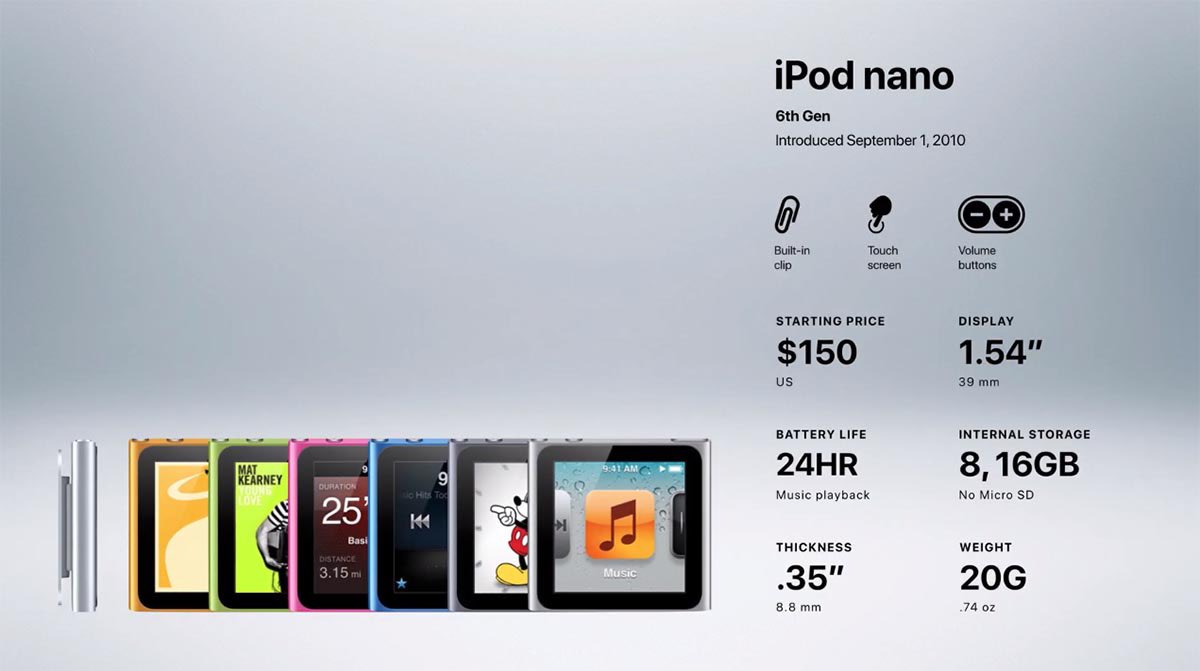
1.5-inch display got the possibility of touch control. The player shell has been radically redesigned for this type of interaction.
The case had a built-in clip for attaching to clothes, and volume control buttons were located on the end.
iPod nano 6 worked up to 24 hours in
The case had a built-in clip for attaching to clothes, and volume control buttons were located on the end.
iPod nano 6 worked up to 24 hours in
music playback mode and was available in 8 and 16 GB versions. Six bright colors of the case were available to customers.
Third-party manufacturers have released many accessories for this iPod model, some of them turned a compact player into a wristwatch. Released four years
Third-party manufacturers have released many accessories for this iPod model, some of them turned a compact player into a wristwatch. Released four years
later, the Apple Watch was really similar to this iPod nano player, especially the gadgets had a clock face with Mickey Mouse.
The cost of the player at the time of the start of sales was $ 150.
iPod nano seventh generation. 2012. In the last seventh generation of the player, the
The cost of the player at the time of the start of sales was $ 150.
iPod nano seventh generation. 2012. In the last seventh generation of the player, the
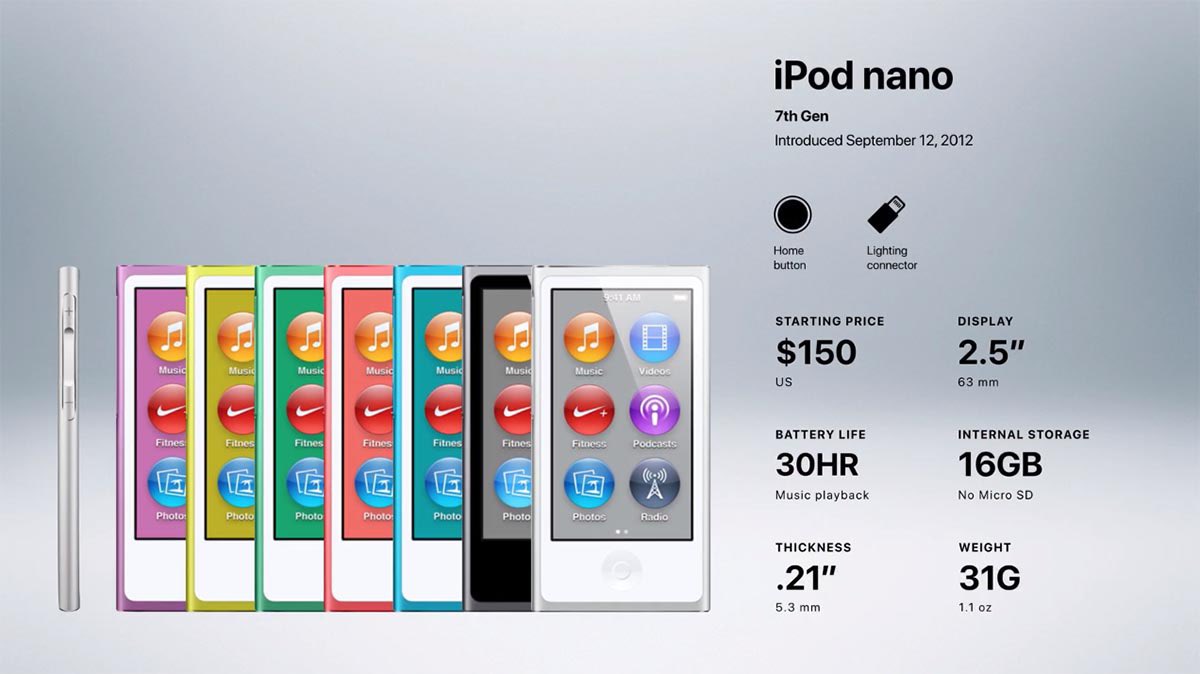
developers decided to return to the traditional vertical form factor.
The player received a large 2.5-inch display with multi-touch support. There is a small Home button under the screen, similar to the iPhone, and an outdated 40-pin connector replaced Lightning on the bottom
The player received a large 2.5-inch display with multi-touch support. There is a small Home button under the screen, similar to the iPhone, and an outdated 40-pin connector replaced Lightning on the bottom
end.
The model has a Bluetooth module for connecting a wireless headset. Applications for viewing videos and photos have been improved. There is a built-in fitness utility and an application for listening to podcasts.
The player's autonomy was 30 hours, and the storage capacity
The model has a Bluetooth module for connecting a wireless headset. Applications for viewing videos and photos have been improved. There is a built-in fitness utility and an application for listening to podcasts.
The player's autonomy was 30 hours, and the storage capacity
was 16 GB.
The price tag for the model has not been changed, this is already the usual $ 150 for the line.
Production of this model and the entire mini/nano line was discontinued on July 27, 2017.
This player even today looks quite modern. If the developers had added support for
The price tag for the model has not been changed, this is already the usual $ 150 for the line.
Production of this model and the entire mini/nano line was discontinued on July 27, 2017.
This player even today looks quite modern. If the developers had added support for
Apple Music and the ability to fully connect AirPods, such a device could be sold perfectly today.
The iPod Shuffle line. 2005 - 2009. The shortest, but at the same time the most unusual line of compact iPod players. The developers have made a bet on playing music without
The iPod Shuffle line. 2005 - 2009. The shortest, but at the same time the most unusual line of compact iPod players. The developers have made a bet on playing music without

unnecessary chips and features.
All the players were devoid of a display, and the control was blind. The devices were made in the form factor of a compact "clothespin", which was convenient to attach to clothes during walks or sports.
There were no additional features in the
All the players were devoid of a display, and the control was blind. The devices were made in the form factor of a compact "clothespin", which was convenient to attach to clothes during walks or sports.
There were no additional features in the
Shuffle models and they were intended for the most picky users.
iPod Shuffle of the first generation. 2005. In 2005, the Cupertinos continued experimenting with form factors and, following the compact iPod mini, a miniature iPod Shuffle appeared.
The idea of the player was to
iPod Shuffle of the first generation. 2005. In 2005, the Cupertinos continued experimenting with form factors and, following the compact iPod mini, a miniature iPod Shuffle appeared.
The idea of the player was to
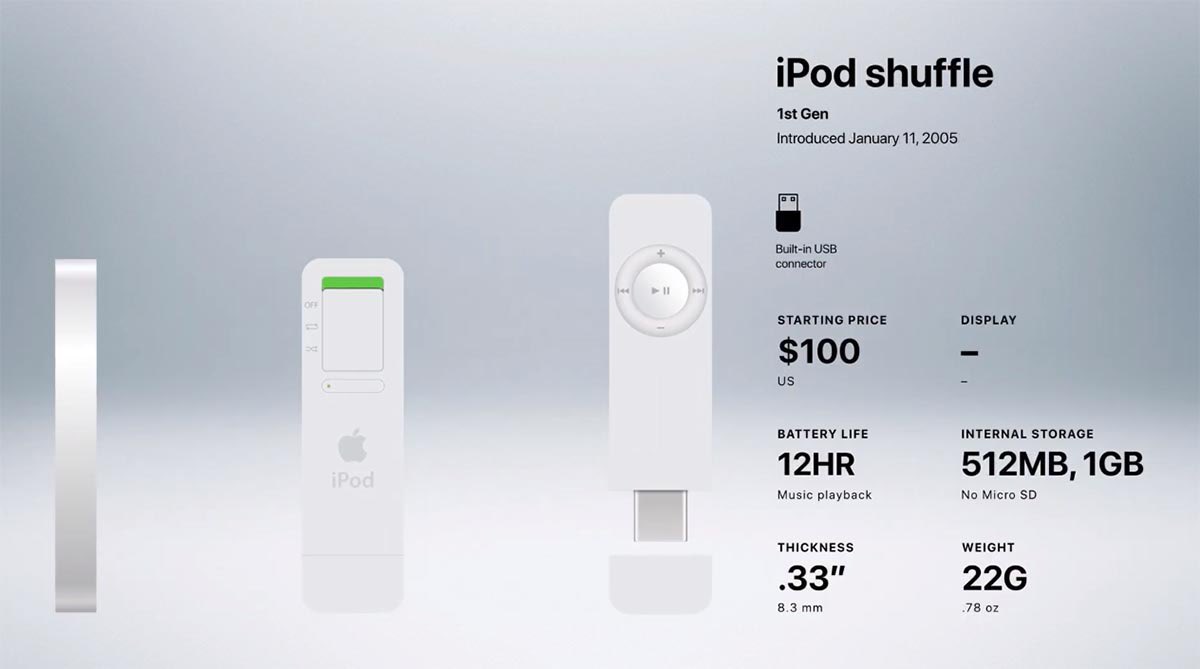
play all the tracks in turn or in random order. No playlists, compilations, or folder-by-folder playback.
Users were very interested in the idea and a third of the iPods sold in 2005 were Shuffle models.
The device was very compact and lightweight, and the built-in USB connector
Users were very interested in the idea and a third of the iPods sold in 2005 were Shuffle models.
The device was very compact and lightweight, and the built-in USB connector
made connecting to any computer simple and hassle-free.
The gadget was sold with two memory capacities: 512 MB and 1 GB. The price for the basic version was $100.
iPod Shuffle of the second generation. 2006. A year later, the Cupertinos presented an even simpler and more compact
The gadget was sold with two memory capacities: 512 MB and 1 GB. The price for the basic version was $100.
iPod Shuffle of the second generation. 2006. A year later, the Cupertinos presented an even simpler and more compact
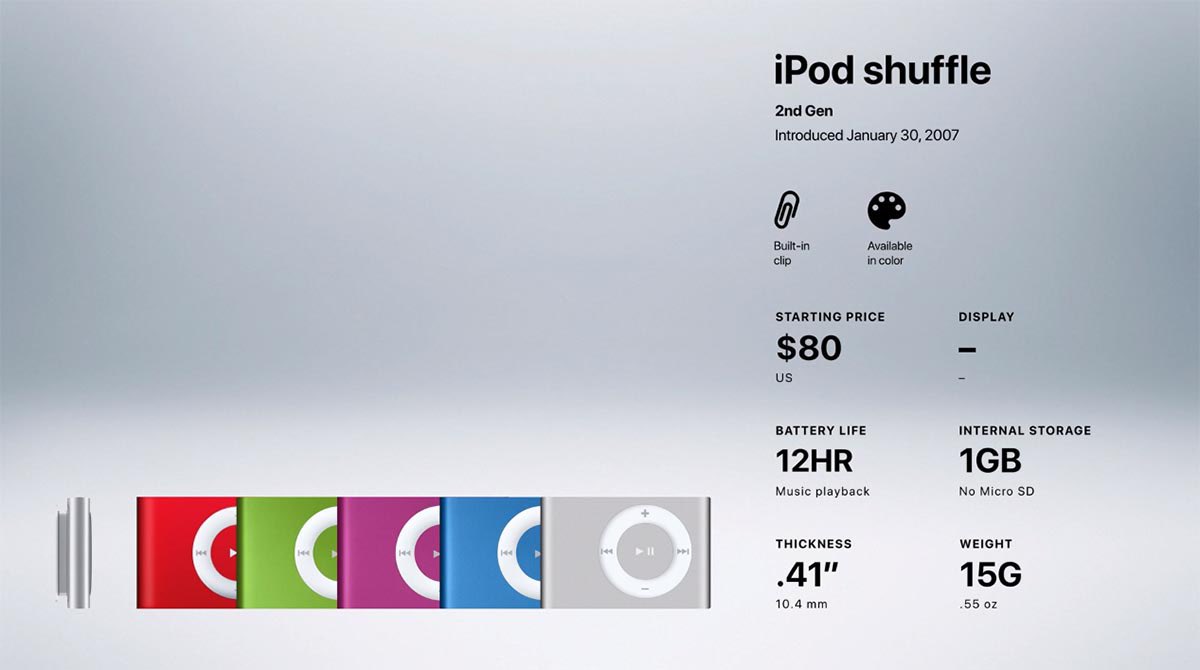
generation of Shuffle.
The player has almost halved, but at the same time it has maintained a stable 12 hours of music playback. For a more convenient mounting on the body, a clamp was provided. There were five color options to choose from.
A model with 1 GB of memory was
The player has almost halved, but at the same time it has maintained a stable 12 hours of music playback. For a more convenient mounting on the body, a clamp was provided. There were five color options to choose from.
A model with 1 GB of memory was
available and it cost only $80.
iPod Shuffle of the third generation. 2009. The next update had to wait more than three years. In the spring of 2009, Apple showed its most minimalistic player.
The thin elongated metal body was devoid of controls for volume control or track
iPod Shuffle of the third generation. 2009. The next update had to wait more than three years. In the spring of 2009, Apple showed its most minimalistic player.
The thin elongated metal body was devoid of controls for volume control or track

switching. The only switch on the end was responsible for turning on the repetition or mixing of compositions.
All control was carried out using the remote control on the headset. This made it extremely difficult to use the player with third-party headphones.
Modifications for 2
All control was carried out using the remote control on the headset. This made it extremely difficult to use the player with third-party headphones.
Modifications for 2
or 4 GB of memory were available. The basic version cost $60.
iPod Shuffle of the fourth generation. 2010. A year later, the developers came to their senses and returned the playback control buttons to the case of the next and last generation Shuffle.
The device turned out to be
iPod Shuffle of the fourth generation. 2010. A year later, the developers came to their senses and returned the playback control buttons to the case of the next and last generation Shuffle.
The device turned out to be
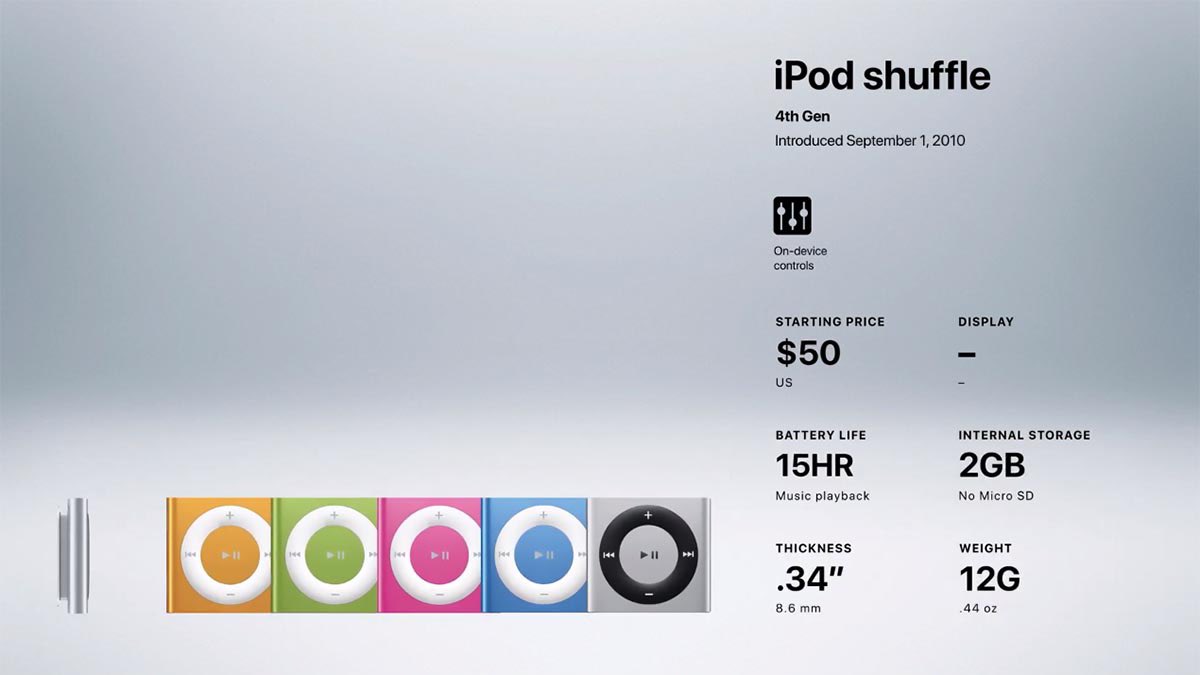
a compact remote control, to which headphones were connected. The gadget had good autonomy at the level of 15 hours of music playback.
There were five color options available and a single 2 GB model.
The device became the most affordable iPod player and was sold for $50.
There were five color options available and a single 2 GB model.
The device became the most affordable iPod player and was sold for $50.
The iPod Touch line. 2007 - to the present day. The most technologically advanced and long-playing line of Apple players, the latest generation of which is still on sale today.
The device began to be released simultaneously with iPhones, each new generation of iPod received a lot
The device began to be released simultaneously with iPhones, each new generation of iPod received a lot

of modern and relevant chips from the smartphone line. In addition, the gadgets are running a full-fledged iOS operating system with the ability to install applications from the App Store.
iPod touch players were perceived as an iPhone on minimalks without the ability to make
iPod touch players were perceived as an iPhone on minimalks without the ability to make
phone calls. The rest of the chips fell into the players almost in full.
At the same time, the Touch line has retained the classic design in a metal case, which was especially pleasant during the years of strange iPhone models, for example, during the days of plastic “soaps” 3G
At the same time, the Touch line has retained the classic design in a metal case, which was especially pleasant during the years of strange iPhone models, for example, during the days of plastic “soaps” 3G
and 3GS.
The first generation iPod Touch. 2007. The player was released simultaneously with the first-generation iPhone model and was almost a complete copy of it. The gadget did not have a camera and, of course, a cellular module.
At the same time, the iPod Touch had a 3.5-inch
The first generation iPod Touch. 2007. The player was released simultaneously with the first-generation iPhone model and was almost a complete copy of it. The gadget did not have a camera and, of course, a cellular module.
At the same time, the iPod Touch had a 3.5-inch
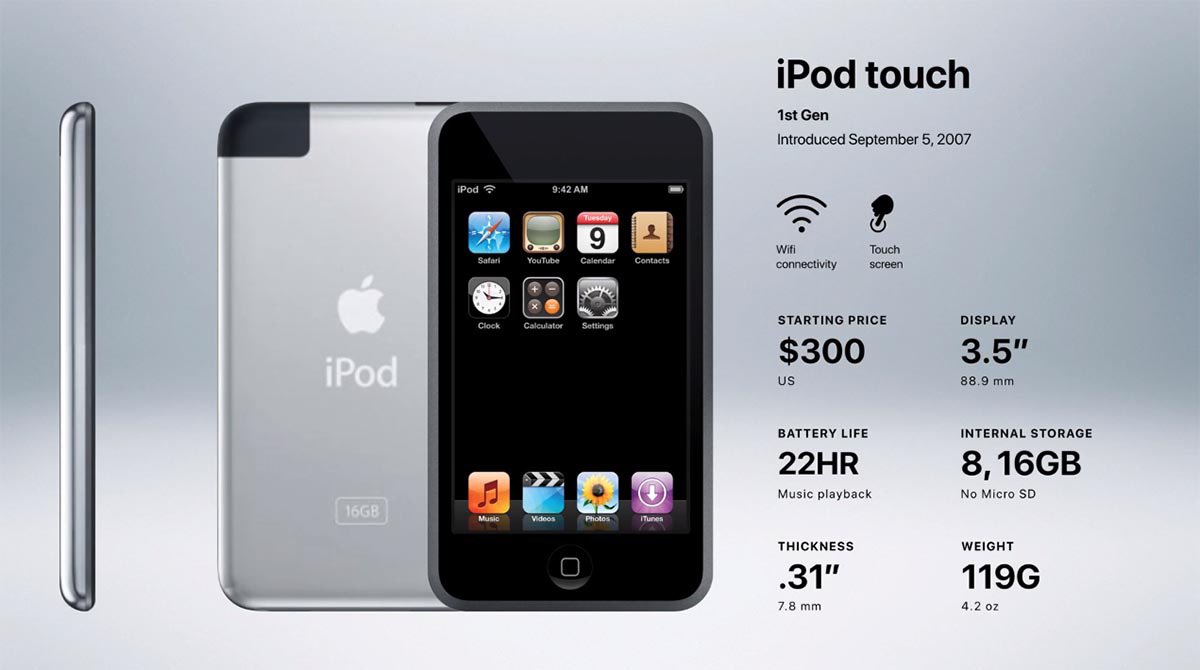
display with multi-touch support that was chic for its time. The device had Wi-Fi support, a good Safari mobile browser and most of the standard iOS apps.
At the same time, before the App Store appeared, it was extremely difficult to unlock the potential of the pumped player.
At the same time, before the App Store appeared, it was extremely difficult to unlock the potential of the pumped player.
Curiously, with the release of iOS 2.1, iPod Touch owners were offered to upgrade for $9.95.
Models with 8, 16 or 32 GB storage were available for sale. The basic version cost $300.
Second generation iPod Touch. 2008. The next generation of iPod Touch turned out to be minor.
Models with 8, 16 or 32 GB storage were available for sale. The basic version cost $300.
Second generation iPod Touch. 2008. The next generation of iPod Touch turned out to be minor.
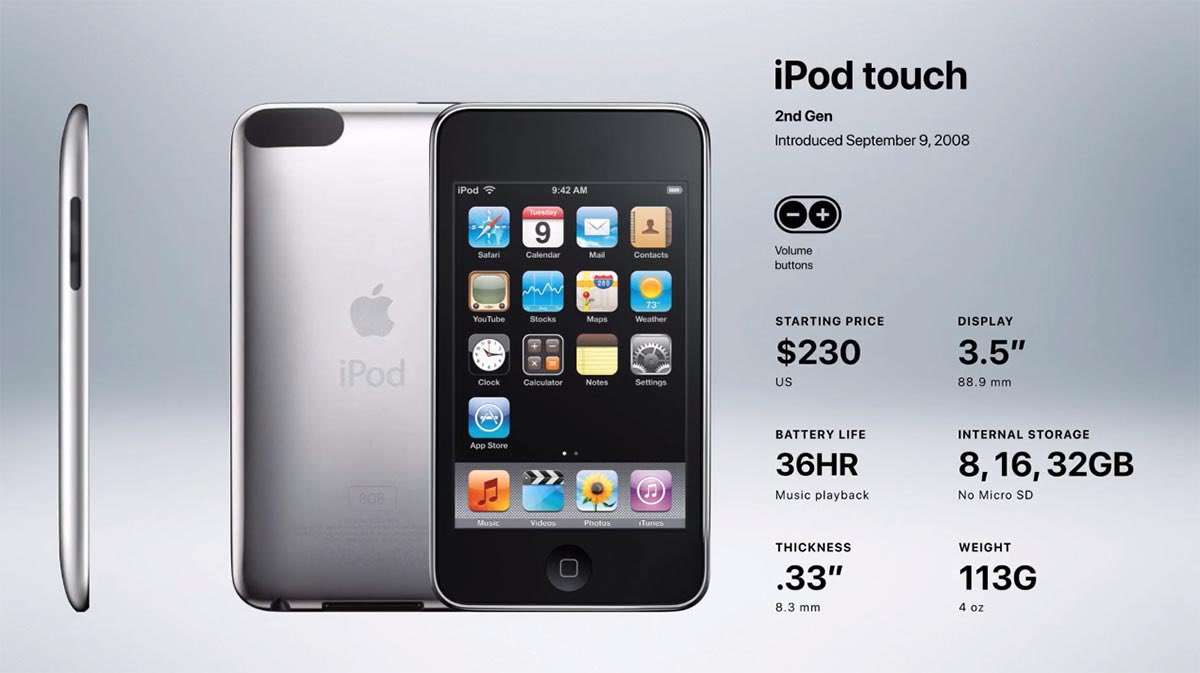
Slightly updated the filling and slightly changed the shape of the case. Volume control buttons appeared on the side end, and an external speaker was displayed above the display.
More changes were brought by the new iOS 2 operating system with a built-in app store.
Modifications
More changes were brought by the new iOS 2 operating system with a built-in app store.
Modifications
for 8, 16 or 32 GB of memory were available. The price for the most affordable version of the player started at $230.
Third generation iPod Touch. 2009. Another extremely minor update, as well as a parallel update of the iPhone 3GS. Most of the changes were covered “under the
Third generation iPod Touch. 2009. Another extremely minor update, as well as a parallel update of the iPhone 3GS. Most of the changes were covered “under the
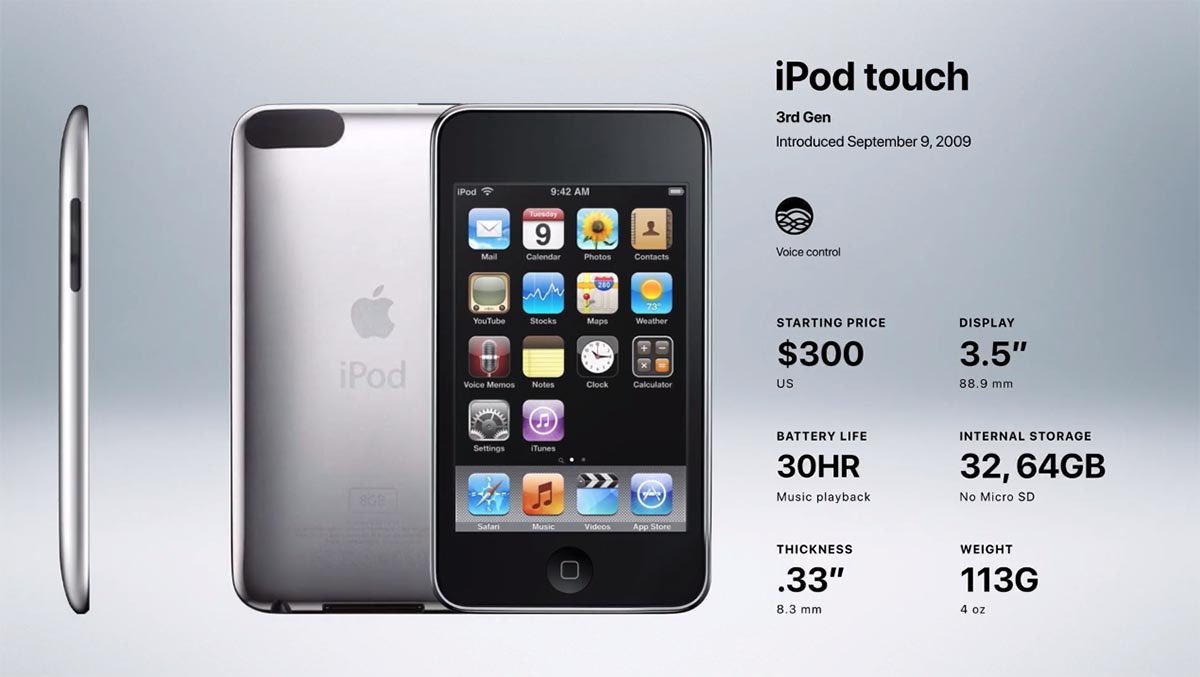
hood”, and outwardly it was still the same last year's player.
32 or 64 GB models were available to users. The cost of the younger model at the start of sales was $ 300.
iPod Touch fourth generation. 2010. The first major update in the iPod Touch line coincided with the release
32 or 64 GB models were available to users. The cost of the younger model at the start of sales was $ 300.
iPod Touch fourth generation. 2010. The first major update in the iPod Touch line coincided with the release
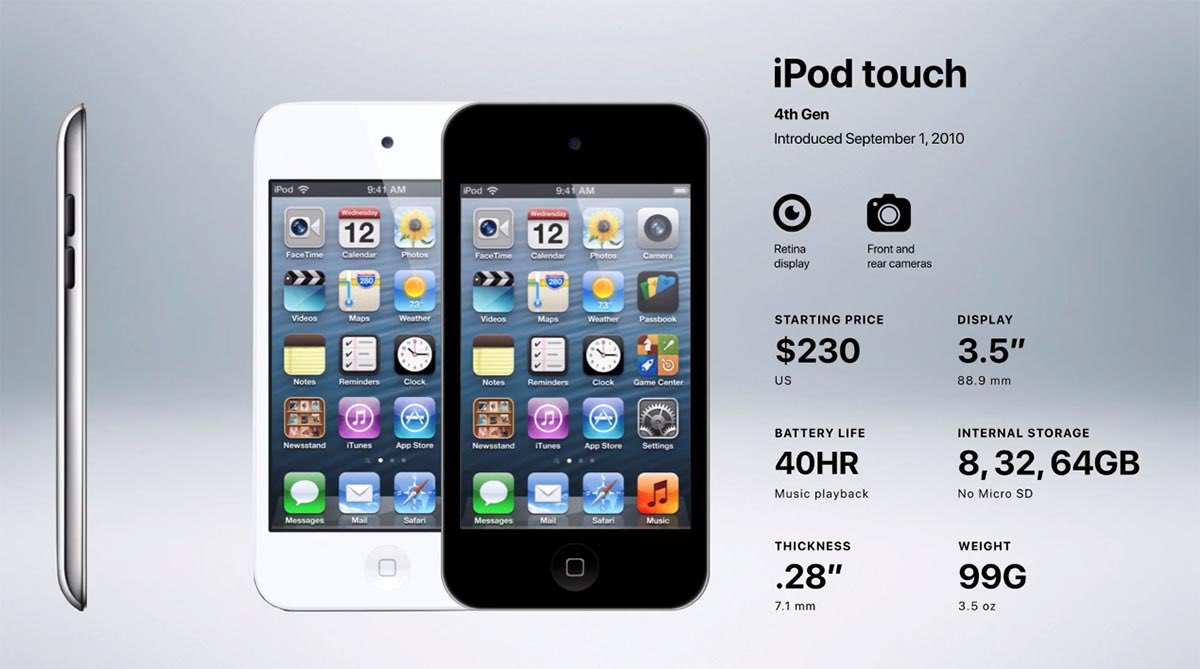
of the iPhone 4. The player, like the smartphone, received a new front panel in black and white colors.
The gadget was equipped with a higher-quality 3.5-inch Retina display and a front-facing camera for video calls. The device at the same time had drives of 8, 16 and 32 GB.
The
The gadget was equipped with a higher-quality 3.5-inch Retina display and a front-facing camera for video calls. The device at the same time had drives of 8, 16 and 32 GB.
The
price of the base model was not raised and left at $ 230.
iPod Touch fifth generation. 2012. The next generation of the iPod Touch had to wait two years. The appearance of the new model coincided with the presentation of the iPhone 5. The player received a 4-inch Retina screen
iPod Touch fifth generation. 2012. The next generation of the iPod Touch had to wait two years. The appearance of the new model coincided with the presentation of the iPhone 5. The player received a 4-inch Retina screen
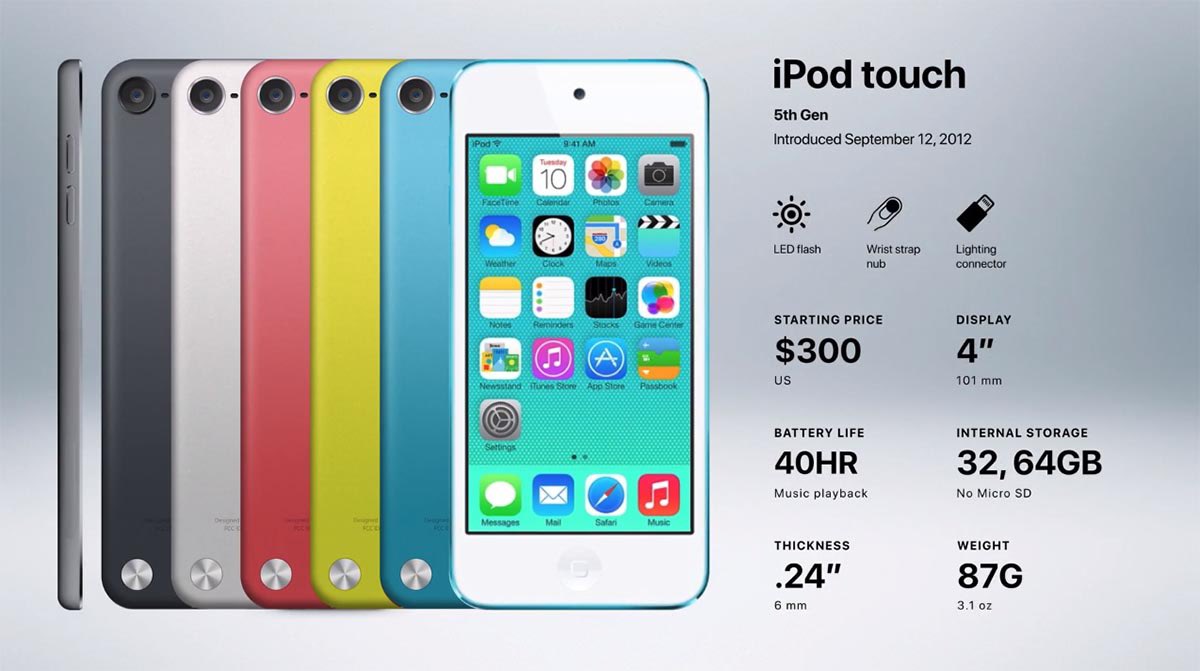
similar in size and resolution.
A powerful Apple A5 processor was installed inside, the main camera of the gadget was also improved, and a Lightning connector was added. Three bright color options have been added to the classic black and white colors.
A curious feature was the
A powerful Apple A5 processor was installed inside, the main camera of the gadget was also improved, and a Lightning connector was added. Three bright color options have been added to the classic black and white colors.
A curious feature was the
strap mount on the back of the case, which was removed in the next generations of the player.
There were two variants of the drive: 32 and 64 GB, the base model already cost $ 300.
The sixth generation iPod Touch. 2015. Three years later, the Cupertinos updated their most
There were two variants of the drive: 32 and 64 GB, the base model already cost $ 300.
The sixth generation iPod Touch. 2015. Three years later, the Cupertinos updated their most
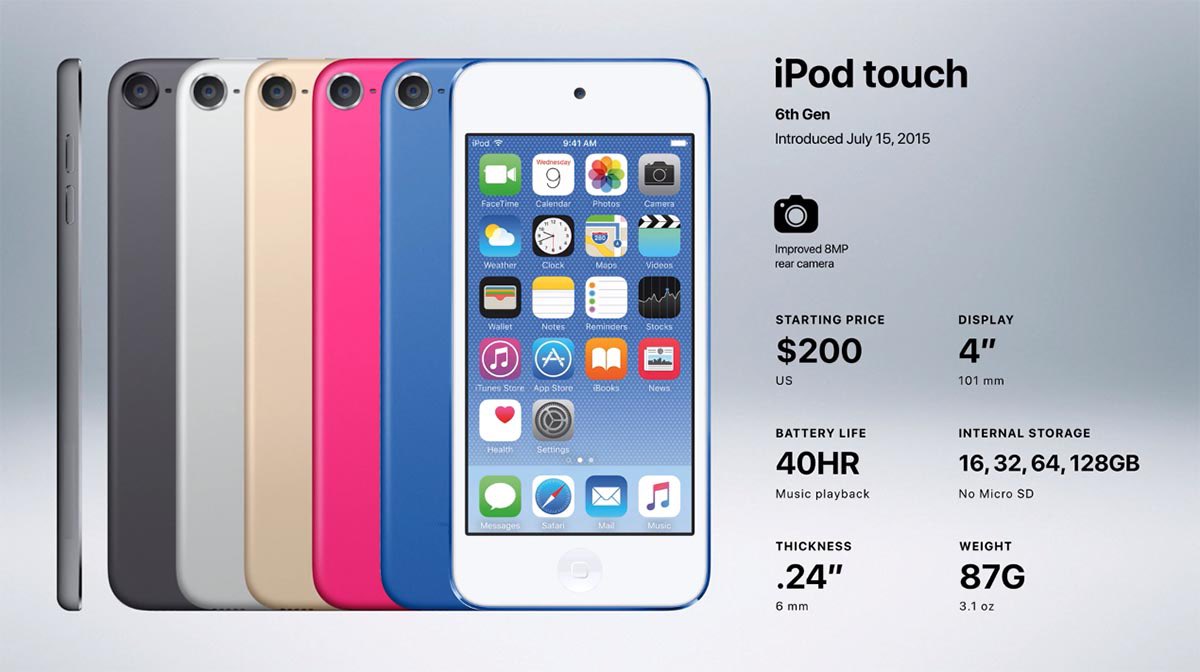
sophisticated player. The gadget was no different in size from its predecessor. The developers did not increase the display of the player after the appearance of the iPhone 6/6s.
The sixth-generation iPod touch received only an update “under the hood". The processor was replaced
The sixth-generation iPod touch received only an update “under the hood". The processor was replaced
with a modern Apple A8, the camera received an 8-megapixel sensor, and the Wi-Fi module learned to work in the 802.11ac standard.
The maximum configuration with a 128 GB drive is available to buyers of the bula.
The basic version with a 16 GB disk cost $200.
The maximum configuration with a 128 GB drive is available to buyers of the bula.
The basic version with a 16 GB disk cost $200.
Seventh generation iPod Touch. 2019. The last update of the player at the moment occurred in 2015. The new Touch is equipped with a powerful Apple A10 Fusion processor with an Apple M8 coprocessor.
All the current iOS chips became available on the player, but the display size
All the current iOS chips became available on the player, but the display size
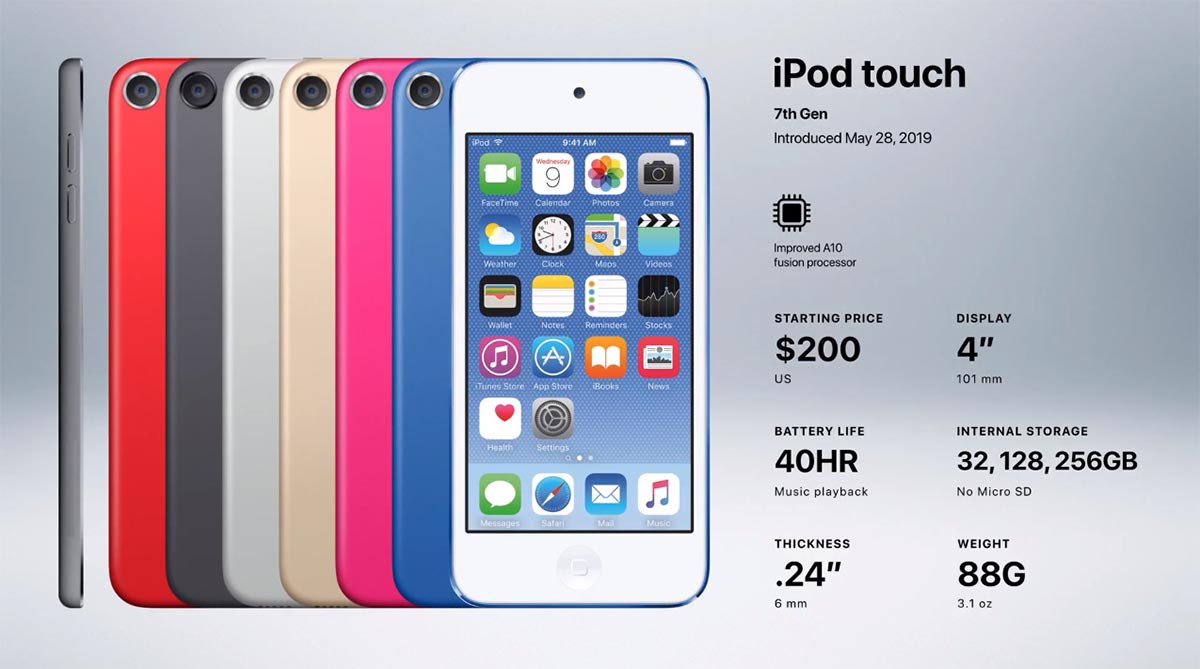
remained the same.
The gadget still receives iOS updates and most of the software chips of the Apple ecosystem.
On sale there are modifications for 32, 128 and 256 GB. The base model costs $200 in the USA. The popularity of iPod players fell on the period from 2004 to 2010. After
The gadget still receives iOS updates and most of the software chips of the Apple ecosystem.
On sale there are modifications for 32, 128 and 256 GB. The base model costs $200 in the USA. The popularity of iPod players fell on the period from 2004 to 2010. After
the release of the iPhone, he began to systematically "eat away” the player's audience and practically buried its sales after 2015.
This was facilitated not only by the development of technology and the iPhone line, but also by Apple's unwillingness to make at least some
This was facilitated not only by the development of technology and the iPhone line, but also by Apple's unwillingness to make at least some
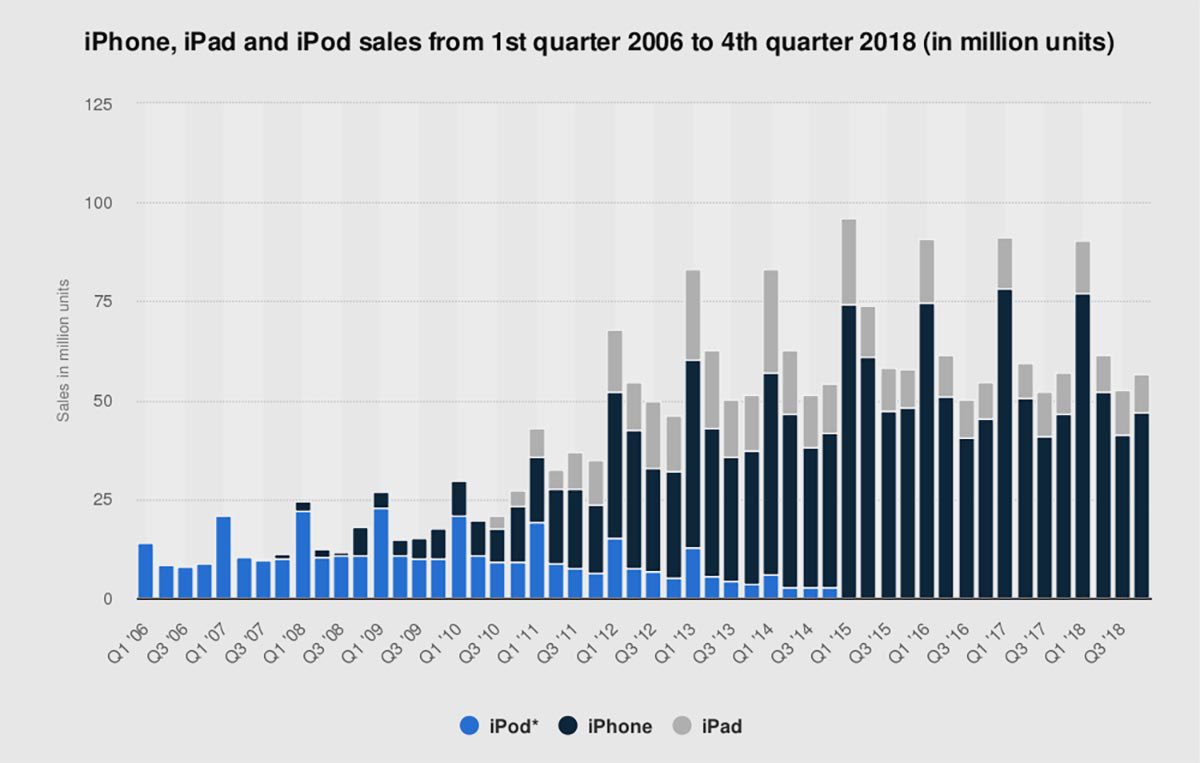
significant competitor for its smartphones. The players did not receive any valid updates, and the only ”live" Touch line was stuck in the 2012 design. Third-party designers have repeatedly offered interesting concepts of the new iPod in the style of the frameless iPhone X or the
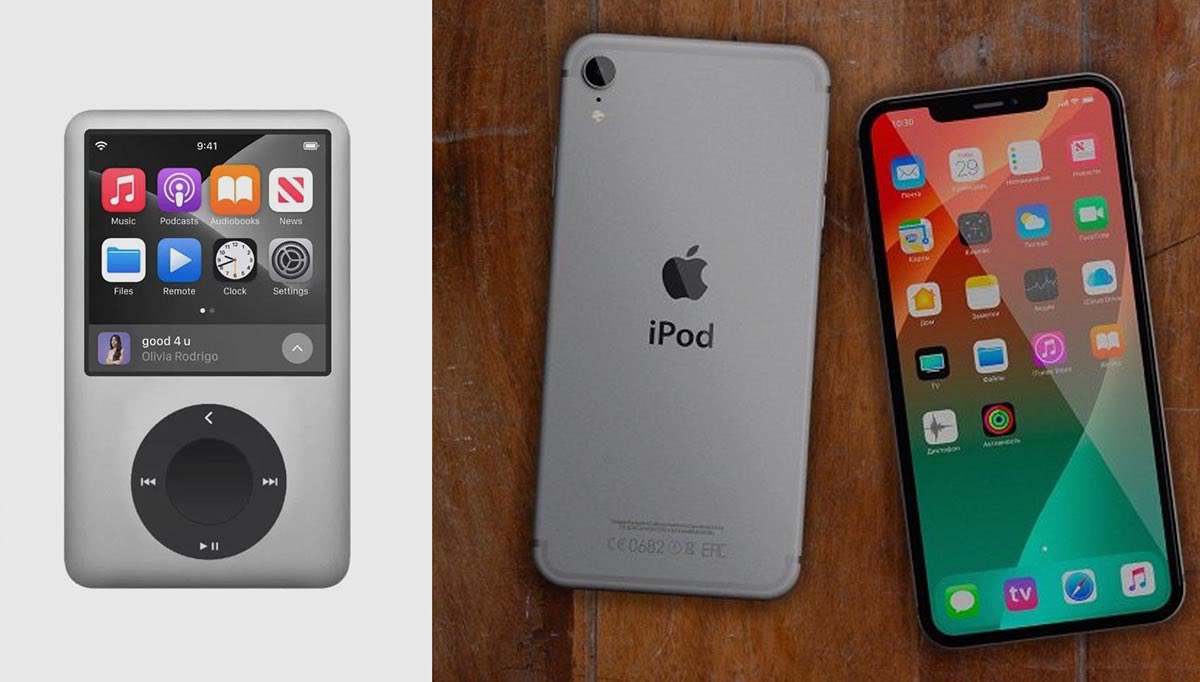
more advanced iPod Classic. If the player in the format of a full-fledged smartphone looks clearly superfluous today, then I would like to see an updated Classic or Nano.
No one expects a compact gadget on iOS with App Store support, a powerful processor and a good camera. For
No one expects a compact gadget on iOS with App Store support, a powerful processor and a good camera. For
many fans of the company, it would be lucky to get a player in the old familiar form factor with the ability to use Apple Music, connect AirPods and download content over Wi-Fi. But these are just concepts and they are not included in Apple's plans.
• • •
Missing some Tweet in this thread? You can try to
force a refresh