With countries unveiling their latest climate pledges for #COP26, I wanted to see how they stack up against national fair shares of the 1.5C carbon budget that take historical responsibility into account. A 🧵(with charts!🤓)
Here’s a global picture of cumulative CO2 emissions since 1850. Humanity passed the ‘safe’ 350 ppm CO2 boundary in 1988, and the 1.5C boundary is fast-approaching. The net zero curve by 2050 is equivalent to global emission cuts around 8% PER YEAR. Globally. 😱
But ‘humanity’ is misleading – Global North countries are more responsible for climate breakdown than the rest of the world. Lots of Global South countries are within fair shares of the climate boundary adjusted for population size, like Kenya.
India is in a similar situation. And virtually all low-income countries. These countries would have plenty of space to transition towards low-carbon infrastructure over the coming decades if high-emitting countries hadn’t appropriated more than their fair share.
The United States is known for excess, but it’s shocking to see the scale of it. Net zero by 2050 would still be more than 4 times over its fair share of the 1.5C boundary. The only fair path is via non-existent negative emissions (and/or reparations).
The UK and other wealthy countries have a very similar picture, with a Net Zero pathway overshooting fair shares of the 1.5C boundary by 3-4 times. I believe this is an important point to be raised at #COP26.
China, Brazil, and other middle-income countries would also tend to have space to decarbonise their economies over the coming decades while staying within fair shares of the 1.5C boundary. Or they would have if the climate crisis wasn’t already here.
So there you have it, my little contribution to #COP26. Net zero by 2050 may sound ambitious, but a look at historical responsibilities tells a different story. And since cumulative impacts are what drive climate breakdown, this story needs telling.
I haven’t written up this analysis yet (negative time technologies, pls!). It replicates this study by @jasonhickel: doi.org/10.1016/S2542-… and the projections are guided by @robjhyndman’s work: otexts.com/fpp2/. Questions and comments are welcome.

• • •

Missing some Tweet in this thread? You can try to force a refresh

 

Keep Current with Andrew Fanning (also @andrewlfanning.bsky.social)

Andrew Fanning (also @andrewlfanning.bsky.social) Profile picture

Stay in touch and get notified when new unrolls are available from this author!

Read all threads

This Thread may be Removed Anytime!

PDF

Twitter may remove this content at anytime! Save it as PDF for later use!

Try unrolling a thread yourself!

how to unroll video
  1. Follow @ThreadReaderApp to mention us!

  2. From a Twitter thread mention us with a keyword "unroll"
@threadreaderapp unroll

Practice here first or read more on our help page!

More from @AndrewLFanning

Mar 31, 2024
10 papers in ecological economics that changed me.

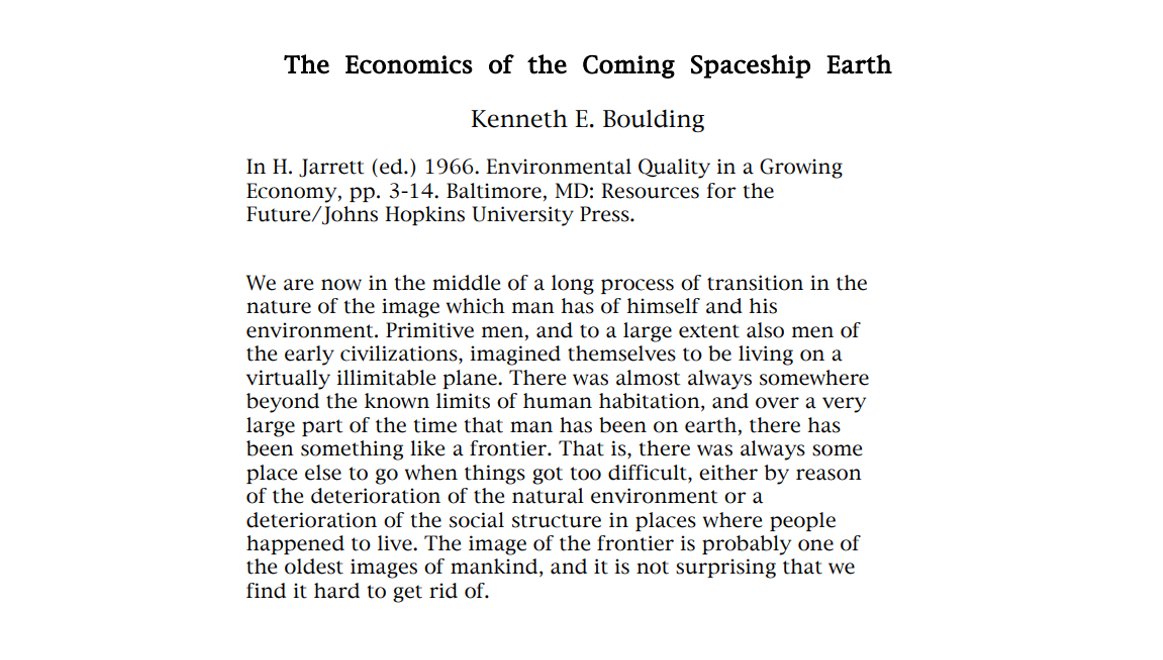
1. The Economics of the Coming Spaceship Earth (Boulding, 1966).
Concisely covers most core principles of ecological economics, comparing the “cowboy” economy we have with the “spaceman” economy we need.
eeeforum.org/wp-content/upl…
Image
2. In Defense of a Steady-State Economy (Daly, 1972)
This essay picks up, and masterfully refutes, many critiques and obfuscations from ‘growthmaniacs’ – drawing on the concept of a steady-state economy that Daly pioneered.
sci-hub.se/https://doi.or…
Image
3. Does Economic Growth Improve the Human Lot? Some Empirical Evidence (Easterlin, 1974)
Paradox: people on higher incomes are typically happier than lower-income people at a point in time, but income growth doesn't produce greater happiness over time.
sci-hub.se/https://doi.or…
Image
Read 10 tweets
Jun 5, 2023
📢BIG NEW PAPER📢
I'm thrilled to announce that we have a new study out in Nature Sustainability today.
We propose a compensation scheme across 168 countries based on excess CO₂ emissions beyond fair shares of global carbon budgets. A thread🧵1/
nature.com/articles/s4189… Image
The study is based on the idea that the atmosphere is a commons–a natural wealth for everyone to access equitably and sustainably.

We obtained remaining global carbon budgets for 1.5° and 2° from the IPCC and distributed fair shares across 168 countries, based on population. 2/
Then we compared each country’s fair share against how much CO2 that country has released historically from 1960, together with a business-as-usual scenario and an ambitious scenario where it decarbonises from current levels to ‘net zero’ by 2050. The results are striking. 3/ Image
Read 12 tweets
Jan 13, 2023
An impressive new study led by @jaredmstarr shows the massive and rage-inducing scale of carbon inequality.

They find that super-rich US households emit +2000x more CO2e than average low-income country households. I had to see what that looks like👇 1/
doi.org/10.1016/j.ecol… Image
@jaredmstarr That's not all. They find US household emissions for the bottom 99% *declined* by 14-23% from 1996-2019, depending on the decile.

Meanwhile, emissions by the top 0.1% *increased* by a staggering 50% to reach ~950 t CO2e (and the next 0.9% increased by 9%).🤯😱2/ Image
I should also mention these household emissions are consumption-based measures that account for international trade.

Highly recommended - there’s much more rigorous analysis and results in the well-written study (sadly behind a paywall). /fin doi.org/10.1016/j.ecol… Image
Read 5 tweets
Mar 18, 2022
This is such an odd piece from the editors of @Nature that it makes me wonder if they are being deliberately misleading or if it’s just poorly written. I’m so confused. A 🧵
nature.com/articles/d4158…
@Nature First, after a big paragraph on how poorly received the message of Limits to Growth was in the 1970s, they fail to mention the core “action” that Meadows et al call for to achieve ecological and economic stability. Read the book yourself here: clubofrome.org/publication/th…
@Nature @ClubOfRome This omission is, uh, convenient, because then they go on to blame researchers ever since (!) for “impeding action” by disagreeing on whether curbing economic growth should be part of halting irreversible environmental effects of human activity.
Read 6 tweets
Feb 16, 2022
Exploring post-growth futures in the EU – I took part in this remarkable event last week, hosted by @ThomasArnold19 at @EUScienceInnov @EU_Commission, with an all-star cast of speakers. Links to recording and materials 👇 and a🧵doughnuteconomics.org/stories/151
.@JEPaquetEU (DG R&I) 🔥opening:
"The question is not whether we need to re-invent a post-growth model ... The case for a post-growth model, I think, is won. The question for me is: how do we do that? I hope that you will focus very much not on *whether*, but much more on *how*."
Then Hans Bruyninckx and Mike Asquith @EUEnvironment set the scene brilliantly with insights from this excellent recent EEA report, led by Mike eea.europa.eu/publications/r….
Read 13 tweets
Nov 18, 2021
I’m SO glad to announce that we have a new study out in Nature Sustainability today.
nature.com/articles/s4189…

And at least as exciting: it’s accompanied by a major update to our interactive website at goodlife.leeds.ac.uk. Here is a brief highlights 🧵
The starting point is our 2018 study for a single year (with @DrDanONeill, @lamb_wf and @jksteinberger) doi.org/10.1038/s41893…

And this earlier study was inspired in turn by the global Doughnut of social and planetary boundaries, created by @kateraworth.
Our new study tracks nations’ social achievements and ecological sustainability since the early 1990s for nearly 150 countries, with projections to 2050 based on recent trends.
Read 16 tweets

Did Thread Reader help you today?

Support us! We are indie developers!


This site is made by just two indie developers on a laptop doing marketing, support and development! Read more about the story.

Become a Premium Member ($3/month or $30/year) and get exclusive features!

Become Premium

Don't want to be a Premium member but still want to support us?

Make a small donation by buying us coffee ($5) or help with server cost ($10)

Donate via Paypal

Or Donate anonymously using crypto!

Ethereum

0xfe58350B80634f60Fa6Dc149a72b4DFbc17D341E copy

Bitcoin

3ATGMxNzCUFzxpMCHL5sWSt4DVtS8UqXpi copy

Thank you for your support!

Follow Us!

:(