VIX Index vs VIX futures 101.
The VIX futures contracts are a market traded contract which prices investors expectations of future volatility. The VIX a index does this too. But it is not trade-able directly and has a built in calculation problem.
That problem exists because individual options contracts (which are market traded which is good) have a similar data problem that shows up in the calculated VIX index
What's the problem. Well the price/premium of options are priced by the market. The implied volatility is a calculation! The IV is not what is traded. The price is traded. So what happens on fridays and mondays
Let's say we are looking at a 28 day option on SPX on Friday. It's implied volatility is calculated using 28 days. On Monday it's IV is calculated using 3 less days. Assuming you are calculating the vol at the same time. Or 2.6 ish days less if calculating at the open.
The problem is that all days are not created equal. The market sets the price on Friday's close knowing that there is likely less market moving news over the weekend than what would happen during the week. The options premium reflects these less newsworthy days on Friday's close
The implied however is calculated assuming all days are the same. This results in an iv calculation that is lower due to the options premium being priced for less than the calendar says
On Monday the calendar and the future 25 days are back in sync. And options premium have decayed as if they had had less than two full days of decay. That means the calculated iv rises all else being equal
VIX uses those iv's to calculate the index and the futures don't. Use the futures!
• • •
Missing some Tweet in this thread? You can try to
force a refresh

Us naive Americans dont think about currency returns as part of our portfolios as we have the biggest and for decades best place to invest in equities.
Every other global investor cares about currency returns at basic level for their investing
The basic idea for investors or all nationalities should be simple and obvious to all. But we Americans just haven't had to care. Maybe we still don't but at least we should be aware. This 101 will explain what is obvious to all non Americans and then show how it works
The goal of all investors is simple. We want to maximize the risk adjusted return of our investments in the currency we expect to spend in the future.
As Americans we want to maximize our USD returns
If we are Japanese we want to maximize our Yen returns
Money creation and credit creation in the private sector 101 part 2.
Role of Repo.
In the prior thread I outline credit creation which can happen without banks and money creation which requires banks.
I also hinted at bank reserves role as being one of grease to the
system and NOT necessary for bank money creation but necessary for interbank deposit shifts. I also didn't discuss base money creation from the Fed and won't be dealing with that in this thread either.
Here I will discuss the specific role of Repo in today's financial system
The big takeaway is it is one of many important and necessary means of credit creation AND it has no role in money creation unless a bank is a party to the transaction.
That will take some weedy mechanics to prove. But before we do that let's talk about the entire economy
Money creation and credit creation in the private sector 101
There has been a lot of focus on the repo market lately. I get it. It's an important part of the capital markets in the credit creation process. But its growth and contraction is part of the credit creation process
The repo market where transactions are between hedge funds and money market investors, and those who desire leverage for whatever purpose is an important market in the credit creation process BUT is not part of the money creation process UNLESS a commercial bank or the Fed is
A party to the transaction. Because this is largely misunderstood by even some plumbing experts it's worth it for me to write out my understanding (maybe im wrong which would be awesome so I can learn). So here I go.
I've been studying various versions of balance sheet expansions over my career. I'd classify them as
Japanese first failed effort
UK's version
U.S. Version 1
U.S. version 2
ECB version
Japanese all in version 2
They are all fairly different in approach. The big takeaway 🧵
The developing Fed version that most are excited about is most akin to the Japanese first failed effort.
Here's a rough summary of each
In 2001-2006 Japan the BOJ initiated QE. In their version they offered significant lending to the Japanese banking system for good collateral
The balance sheet doubled in size at a pace of 35 Tn yen per year. However of that 35tn only 5 was direct asset purchase and most of that was Japanese Tbills. This is very similar to the BTFP program from SVB time and the current SRF. It was also sorta similar to ECB LTRO
Why do repo rates change and what do they have to do with reserves. This is a super technical issue and there are better folks to follow on this topic than me but I'll give it a go.
Firstly what are the two sides of a repo transaction and why do they want to interact.
One side is a guy with a bank deposit he wants to earn interest on. The other is a guy who wants to borrow money overnight and has assets he owns that he is willing to provide as collateral to the loan. We can go down a level on each side but for now let's keep it simple.
Most repo transactions are done with UST as the collateral and most UST collatarel used is TBills but. UST's are also highly common collateral but do to the marked to market risk they offer less borrowing capacity per unit of notional (higher haircut)
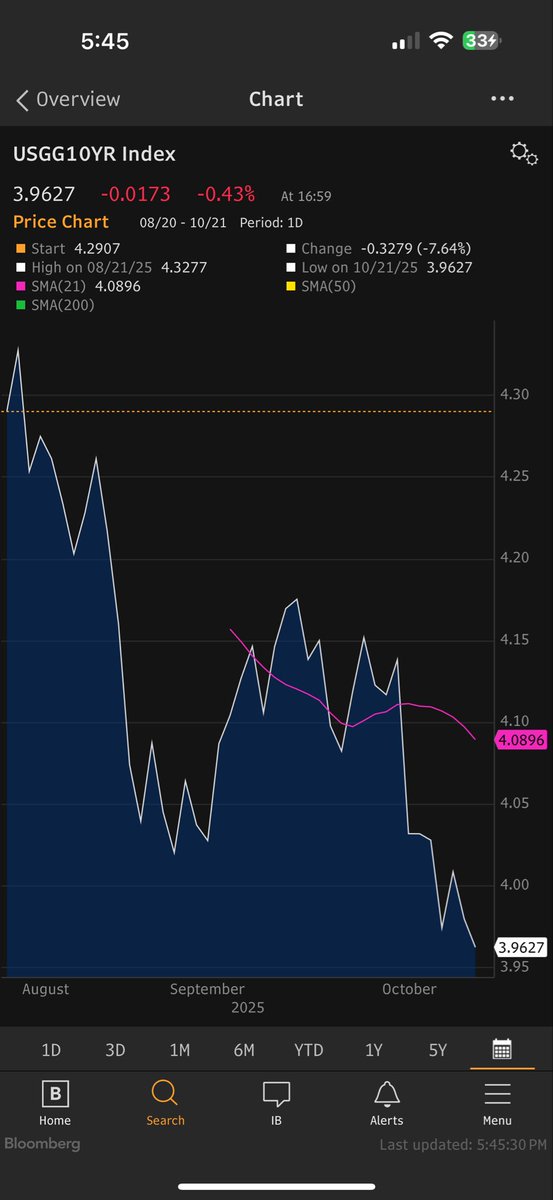
Some thoughts on 10 year notes since Powell guided for a restart of the cutting cycle at Jackson Hole. Trying to answer what the bond market is saying
Nominal yields have fallen 33bp
Note yields are driven lower by
1)Falling real GDP expectations
2)Falling Inflation expectations 3) Falling "risk" of owning assets 4) Improving supply/demand balance vs expectations.
In attributing nominal yield changes to these 4 things unfortunately market prices don't
Easily demonstrate these things. For instance 3&4 are only able to be measured via a model which estimates risk premiums or the expected return over holding cash
Even Breakeven inflation and real TIPS yields have risk premium buried in there market yields. However we can try