From selling snacks on the street to building a multi-billion-dollar empire

Mega-Thread on the story of Haldiram's

Would appreciate a Retweet or like as it helps us educate more investors and inspire us in producing more such content. Image
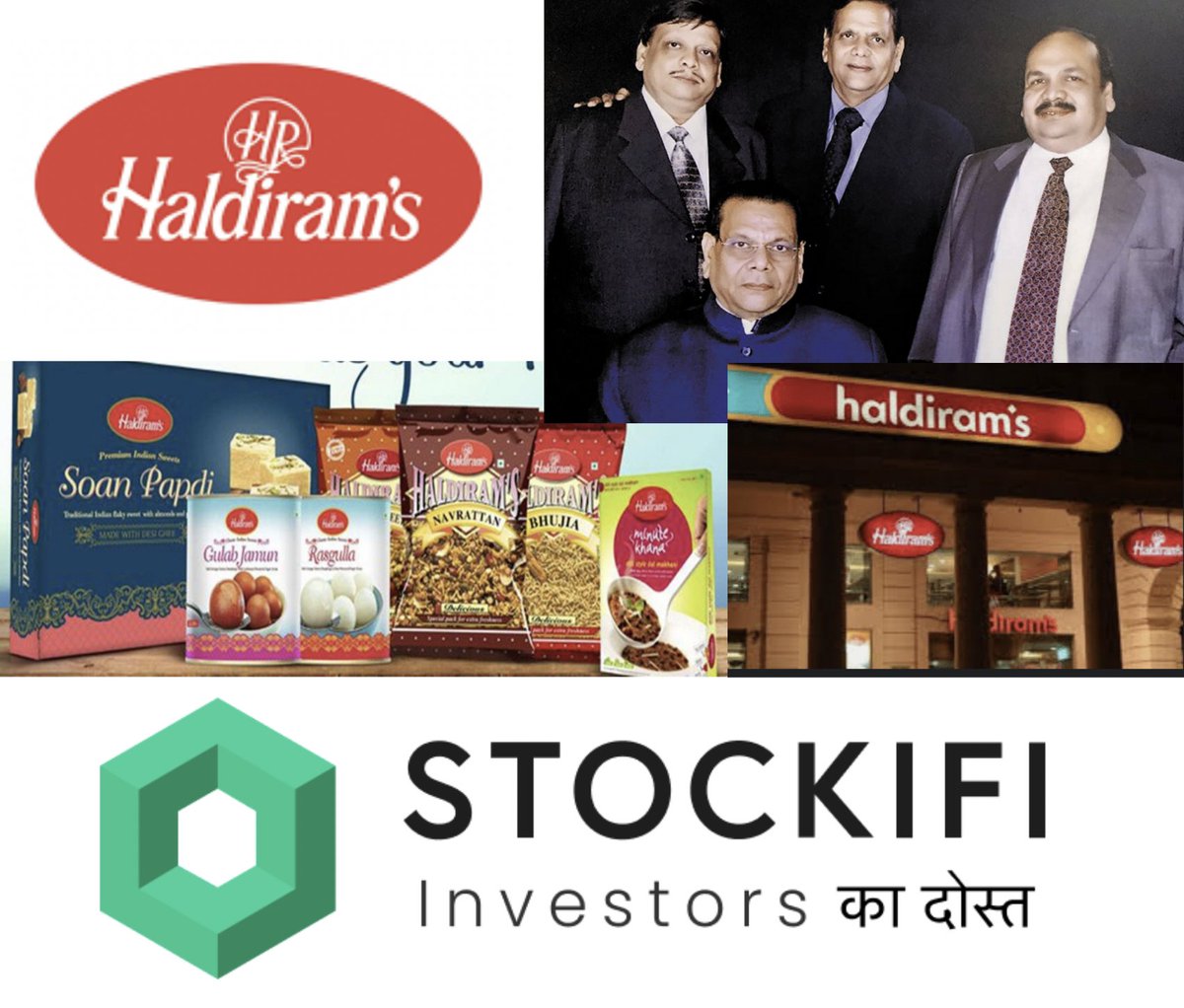
1) Ganga Bhisen Agarwal, affectionately known as Haldiram by her mother, started The Haldiram Empire in 1937 before India gained independence.

2) He was born into a Malwadi family in Bikaner and married Champa Devi.
3) He started out selling Bhujia, as per his aunt's recipe in his father's namkeen and snacks shop.

4) However, he and his wife later fled home owing to a family quarrel.

5) Later he started by selling on the street mong daal namkeen prepared by his wife.
6) Haldiram opened his first business in Bikaner in 1946. He began selling his Bikaneri Bhujia there.

7) He recreated the Bhujia by including moth flour and made it thinner. His sales and income improved dramatically because of all of these adjustments.
8) Later on, Haldiram attended a wedding in Kolkata, and only he got the idea to set up his shop there.

9) With this step, the first branching out of the Bikaner Bhujia business was started.
10) Haldiram's sons and grandsons joined him in the family company, which he later grew to greater heights.

11) Moreover, as the corporation grew, a disagreement arose among his younger generation over the Haldiram empire's geographical and trademark rights.
12) Moolchand, Rameshwar Lal, and Satidas, his three sons, are currently operating under Haldiram, Bikaji, Haldiram's Nagpur, Haldiram Bhujiawala, and others.

13) From 1985, Shiv Krishan Agarwal, Haldiram's grandson, and the previous CMD began working on the company's expansion.
14) They increased the shelf life and packaging of the products to international standards.

15) In 2003, the company began the process of developing convenience foods to be marketed to consumers.
16) Haldiram's portfolio now includes over 70 different namkeens and snacks and sweets, beverages, frozen meals, and quick-service restaurants.
17) There are about 400 items sold at Haldiram's. Namkeens, western snacks, Indian sweets, pastries, sherbets, and pickles like Gulab jammun and bhujia, papadum, are among the company's offerings.

18)Nagpur, Delhi, Kolkata, and Bikaner are the main manufacturing locations.
19) Haldiram operates a retail chain and several restaurants in Nagpur and Delhi.

20) Haldiram's products are currently shipped to Sri Lanka, United Kingdom, United States, Canada, the United Arab Emirates, Australia, New Zealand, Japan, Thailand, and other nations worldwide.
21) Foreign food businesses must go to Desi to succeed in the Indian market, no matter how big they are.

22)Whether it's McDonald's which added Burgers such as Mac Maharaj or the establishment of a Subway Jain counter in Ahmedabad, the company's first all-veg location.
23) As per the Brand Trust Report, Trust Research Advisory in 2014, Haldiram's was placed 55th among India's most trusted brands.

24)Haldiram's also just announced an exclusive master franchisee collaboration with Brioche Doree, the world's second-largest bakery business.
25) Only vegetarian food will be served in the brioche Doree cafes for the first time.

26) Haldiram's revenue surpassed 4000 crores in FY16, outpacing both Domino's and McDonald's combined.
27)In September 2017, Haldiram reclaimed its position as India's leading snack company, outselling PepsiCo's Lays, Kurkure, and Uncle chips.

28)It was also named the country's largest snack company, beating out all domestic and international rivals.
29) Haldiram has never invested much in marketing and promotion to expand the brand. They grew their business mostly through word of mouth.

30) But, due to fierce rivalry, they learned the value of marketing and advertising and began to attract their attention.
31) One of the large campaigns saw Haldirams partnering with the Bollywood film "Prem Ratan Dhan Payo" to host a promotional contest in which they handed 1.5 million snack packets.
32) Kelloggs, the world's second-largest snack company, is eyeing a 3-billion-dollar stake in Haldiram to diversify its portfolio beyond breakfast products and enter the Indian market, as it is difficult for a foreign player to create a desi snacks brand that can compete.
33) A fascinating point to notice is that, like Ganga Bhisan of Bikaner, Keith Kellogg of Michigan in the United States invented a culinary item more than a century ago: corn flakes.

34)Haldiram's sales in 2019 surpassed the $1 billion mark.
35)Haldiram's goods are presently sold in more than 80 countries throughout the world.

36)Haldiram's a hidden jewel of the Indian food industry is today bigger than Hindustan Unilever's packaged food division.

Would appreciate a Retweet as it helps us educate more investors.

• • •

Missing some Tweet in this thread? You can try to force a refresh

 

Keep Current with Abhijit Chokshi | Investors का दोस्त

Abhijit Chokshi | Investors का दोस्त Profile picture

Stay in touch and get notified when new unrolls are available from this author!

Read all threads

This Thread may be Removed Anytime!

PDF

Twitter may remove this content at anytime! Save it as PDF for later use!

Try unrolling a thread yourself!

how to unroll video
  1. Follow @ThreadReaderApp to mention us!

  2. From a Twitter thread mention us with a keyword "unroll"
@threadreaderapp unroll

Practice here first or read more on our help page!

More from @stockifiabhijit

Jan 10
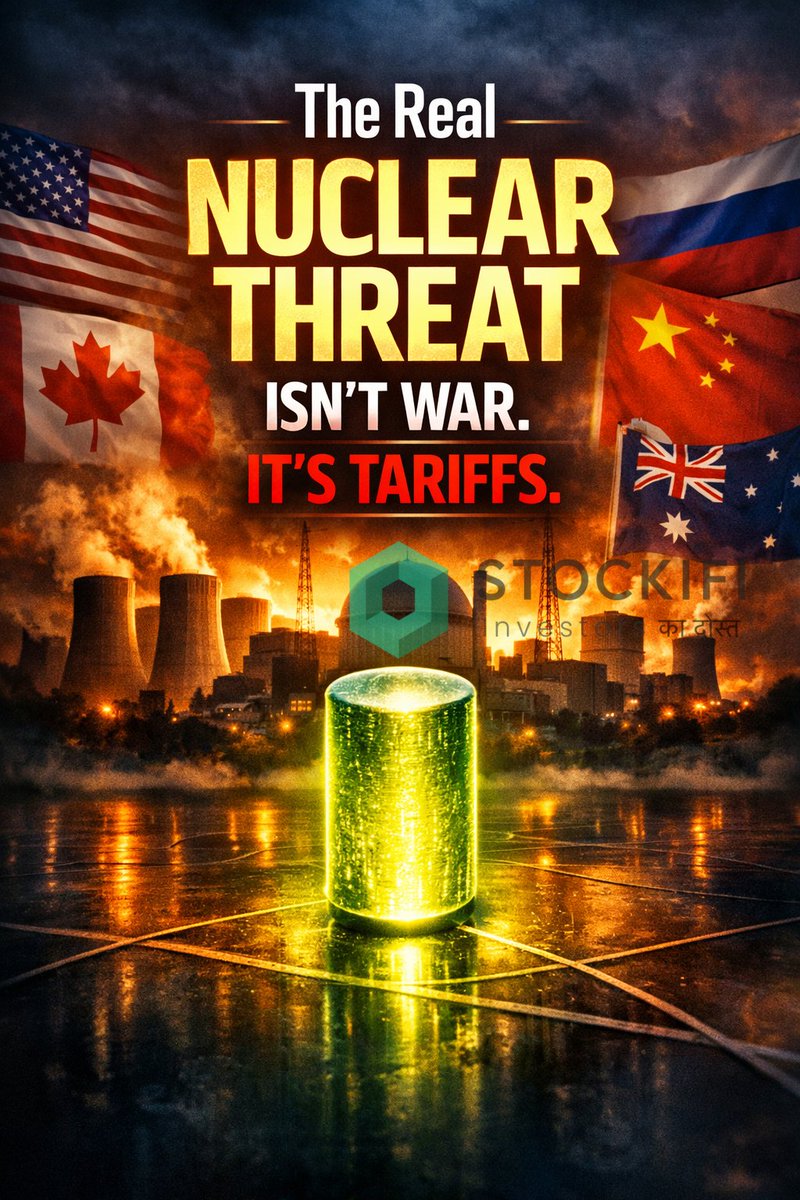
The Uranium Twist in Trump’s “500% Tariff” Gameplan

This story goes deeper than steel, EVs, or China.

Trump’s threat of a 500% tariff made global headlines.

Most assumed it was another China-bashing stunt about electric cars or trade deficits.

But quietly, something far more strategic is happening underneath:

The U.S. runs 20% of the world’s nuclear power.

It has 93 commercial reactors. But here’s the shocker:

The fuel that powers them? Not American.
Over 40% of enriched uranium has historically come from Russia and its allies.

America doesn’t lack nuclear power.

It lacks secure uranium.
Mining? Minimal.
Processing? Outsourced.
Enrichment? Barely exists at scale.

This is like owning 100 cars and having no fuel station of your own.

Let’s unravel the gameplan that no one’s talking about.

Bookmark and retweet this thread to revisit it later.Image
So what’s the Trump play?

Tariffs aren’t just for headlines.

They’re economic weapons—used not to raise revenue, but to break and rebuild supply chains.

And if he slaps tariffs on:

● Russian nuclear fuel
● Chinese uranium processing
● “Friendly but flaky” intermediaries (like Kazakhstan)

Then what happens?
Utilities get cornered.

They can’t depend on old supply routes anymore.

They’re forced to source uranium from:

● U.S.-based miners
● Canadian and Australian allies
● Strategic partners with tight contracts

Suddenly, uranium goes from commodity → geopolitical asset.

This isn’t just an energy story.
It’s a national security move.

Nuclear is the only scalable, non-carbon, baseload power the U.S. can deploy at scale.

And here’s the twist:
Read 7 tweets
Jan 7
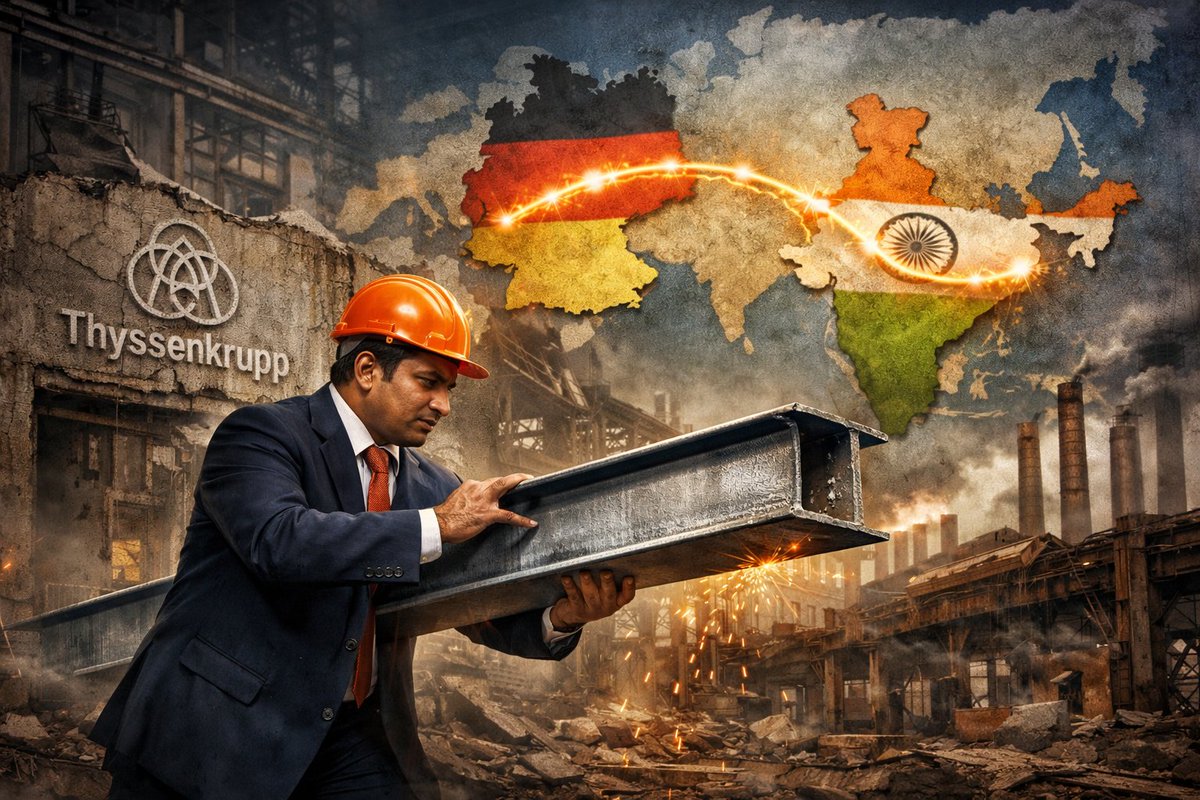
India may soon own the second-largest steelmaker in Europe.

Thyssenkrupp, the iconic German conglomerate, is in advanced discussions to sell its struggling steel division to India’s Jindal Group.

The scale of this deal is massive.

Thyssenkrupp Steel Europe isn’t just another steel plant.

It’s the industrial core of a nation that once built ships, submarines, and skyscrapers for the world.

For over a century, Germany’s steel sector was synonymous with engineering excellence and economic strength.

But today, that legacy is under pressure.

Here’s the full story:
Bookmark and retweet this thread to revisit it later.Image
Thyssenkrupp is facing a brutal mix of structural problems:

• A pension burden estimated at over ₹35,000 crore
• Aggressive carbon regulations from the EU
• Declining margins due to Chinese oversupply
• Powerful unions blocking cost restructuring
• And a product line that’s struggling to compete globally

The result? A steel division that’s bleeding cash and rapidly losing relevance.
Enter Jindal Steel International.

An Indian company with a global footprint—and a growing appetite.

Backed by the Naveen Jindal Group, this firm has already established steel operations across Oman, Africa, and the Middle East.

Its advantage: low-cost production, strong logistics, and a sharp focus on green steel innovation.

Jindal is now in talks to acquire a majority stake—around 60%—in Thyssenkrupp Steel Europe.

The transaction is being structured in phases:

• Initial majority control
• Joint operations during transition
• Complete buyout over time
Read 8 tweets
Dec 21, 2025
India’s wealth is dying silently.

FDs + Savings Accounts = ₹170 Lakh Crore

Mutual Funds + LIC + NPS + Others = ₹140 Lakh Crore

And yet, the majority still believe FDs are the safest bet.

But here’s the truth no bank will ever tell you.
Bookmark and retweet this thread to revisit it later.

→ Join Stockifi Community to download our latest Research Report for FREE

👉 Join Now t.me/stockifi
(Check Pinned PDF)Image
Let’s run the real numbers.

Average FD return today = 6.5%
Average inflation = 5.9%

Your real return = 0.6%

That’s before taxes.

After tax? Most FDs give you negative real returns.

You're not growing money.
You're paying the system to hold it.
Why do We love FDs then?

Because for decades, they worked.

In 1995 – FD returns were 12-14%
Inflation was 8%
You got a 4-6% real return.

That gap is gone now.

Today, your money isn’t compounding. It’s shrinking with interest.
Read 10 tweets
Dec 19, 2025
Tata has 29 listed companies.
Adani has 10.
Bajaj has 6.
All under the same group name.

This structure often kills value.
80% of group companies globally trade at a discount.

But post-demerger?
Valuations can jump 30–60% within a year.

A thread on India’s great demerger wave:

Bookmark and retweet this thread to revisit it later.Image
For decades, India’s biggest groups ran like empires.

One parent. Dozens of businesses.
All controlled under one umbrella.

It gave power, control, and stability.

But in stock markets? It created something dangerous:

Conglomerate Discount.

What’s a Conglomerate Discount?

Let’s say a business group has:

● ₹40,000 Cr in Steel
● ₹30,000 Cr in Power
● ₹30,000 Cr in Chemicals

Total: ₹1 Lakh Cr in value.

But the stock market says:
“Too complicated. Hard to value. Let’s just price you at ₹60,000 Cr.”

This is the conglomerate discount — when the whole is worth less than the sum of its parts.
Why does this happen?

Because investors hate complexity.

When one company runs 10 businesses:

● You can’t benchmark it easily
● You don’t know what’s dragging what
● Capital gets misallocated
● Profitable arms fund weaker ones
● Governance gets murky

So the market punishes it.
Read 6 tweets
Dec 18, 2025
India’s Debt-to-GDP ratio jumped to >60% during Covid.

That’s the highest in decades.
Enough to alarm global investors.

Now, it’s dropping

But What is Debt-to-GDP?

Imagine India as a working-class citizen:

• Your yearly income = GDP
• Your total loan balance = National debt
• Debt-to-GDP = Loan burden compared to earning power

If your income grows faster than your debt → you're safer.
If your debt grows faster than your income → you're trapped.

That’s exactly what happened during COVID.

Pre-COVID: Things were calm

Debt was growing, yes—but GDP was growing faster.

So the debt ratio was manageable.

Markets had confidence. Investors stayed calm.

But then came 2020.

Bookmark and retweet this thread to revisit it laterImage
Covid: Debt-to-GDP crossed 60%

India had to spend more (healthcare, relief packages) while earning less (GDP collapsed).

It’s like taking a huge personal loan when you’ve lost your job.

Result?

Debt-to-GDP ratio exploded. Above 60%. And global rating agencies started watching.

Post-Covid: Slow fix, big headache

Now that the economy is recovering, the govt is trying to walk a tightrope:

• Control new borrowings
• Keep GDP growing
• Avoid scaring investors
• While still spending on infra + welfare

Tricky, right?

That’s why FY26 matters.
So why is the Govt suddenly obsessed with this now?

Because of 3 invisible pressure points:

1. Rising Interest Payments = Budget is getting squeezed

In 2024, nearly 20% of govt revenue went into just paying interest on loans.

Not roads. Not hospitals. Just interest.

If this continues, we’ll be spending more on EMIs than on development.

That’s unsustainable.
Read 10 tweets
Dec 15, 2025
How Ratan Tata arranged ₹615 Crores overnight after a scam?

In the late 1990s, Tata Finance was a trusted name.

It wasn’t just another NBFC.
It was backed by the Tata legacy, run by Harvard-trained minds, and had deposits of ₹875 crores from 4 lakh Indians.

But in 2001, that trust was shattered as Tata Finance lost ₹525 crores in a scam.
Depositors panicked.

Ratan Tata arranged ₹615 crores overnight.

The full story of how he did it
And how it saved the Tata name forever:

Bookmark and retweet this thread to revisit it later.Image
At the heart of the collapse: a man named Dilip Pendse.

He was the Managing Director.
A finance wizard.
And a protégé of Ratan Tata himself.

But he made one move that turned the Tata empire into a crisis overnight.

Pendse funnelled ₹525 crores from Tata Finance into:

● Loans to its own affiliate
● Stock market bets under fake accounts
● Personal profit-seeking trades

Everything crashed.

When the markets fell, the money evaporated.
Depositors’ savings were gone.
The scam leaked to the media.

Suddenly, the name Tata—a brand associated with ethics for over a century—was on the front page for the wrong reasons.

For the first time, Ratan Tata’s reputation was on the line.

At this point, most corporates would hide behind:

● Legal battles
● "We are not liable" clauses
● Decade-long court cases

But Ratan Tata did something that stunned everyone.
Read 8 tweets

Did Thread Reader help you today?

Support us! We are indie developers!


This site is made by just two indie developers on a laptop doing marketing, support and development! Read more about the story.

Become a Premium Member ($3/month or $30/year) and get exclusive features!

Become Premium

Don't want to be a Premium member but still want to support us?

Make a small donation by buying us coffee ($5) or help with server cost ($10)

Donate via Paypal

Or Donate anonymously using crypto!

Ethereum

0xfe58350B80634f60Fa6Dc149a72b4DFbc17D341E copy

Bitcoin

3ATGMxNzCUFzxpMCHL5sWSt4DVtS8UqXpi copy

Thank you for your support!

Follow Us!

:(