🔥 WTA Chairman & CEO Steve Simon speaks out in support of Peng Shuai.
A small step in the right direction for international sports organizations to speak out against injustice and human rights violations in China.
1/n wtatennis.com/news/2350641/w…
A small step in the right direction for international sports organizations to speak out against injustice and human rights violations in China.
1/n wtatennis.com/news/2350641/w…
WTA Chairman & CEO Steve Simon’s comments could endanger the tour’s extensive business relationship with China, where the WTA has 11 tournaments and a lucrative, long-term deal to hold its tour finals in Shenzhen.
2/n
nytimes.com/2021/11/14/spo…
2/n
nytimes.com/2021/11/14/spo…
“I think everybody fully understands what’s at stake here on many different fronts as we’re going through it. I think we’re certainly, from players to board to council, fully united that the only acceptable approach is that of doing what is right. If at the end of
3/n
3/n
the day, we don’t see the appropriate results from this, we would be prepared to take that step and not operate our business in China if that’s what it came to.”
4/n
4/n
ATP, the governing body of men's tennis, backs WTA’s call for China to investigate allegations of sexual assault made by Peng Shuai against former Chinese vice premier Zhang Gaoli.
5/n
reuters.com/lifestyle/spor…
5/n
reuters.com/lifestyle/spor…
Stacey Allaster, the former CEO of WTA who negotiated millions of dollars of rights deals with China: “the tennis world has put Peng Shuai's health and safety ahead of business.”
6/n
reuters.com/lifestyle/spor…
6/n
reuters.com/lifestyle/spor…
According to 🇨🇳 state media CGTN, Peng Shuai has sent an email to WTA Chairman & CEO Steve Simon.
Note there’s a “cursor” on the third line of the “email”.
7/n
Note there’s a “cursor” on the third line of the “email”.
7/n

👇🏻 WTA Chairman & CEO Steve Simon’s response to Peng Shuai’s “email” as shown in the previous tweet
8/n
wtatennis.com/news/2356029/s…
8/n
wtatennis.com/news/2356029/s…
The purported email from Peng Shuai as revealed by 🇨🇳 mouthpiece CGTN looks more like a clumsy fake created by taking a screenshot of a Word doc in edit mode. The opening line “Hello everyone” is weird for an email supposed to be sent to Steve Simon.
9/n
bbc.com/news/world-asi…
9/n
bbc.com/news/world-asi…
China has now blocked CNN's broadcast signal to prevent further reporting about Peng Shuai...
10/n
cnn.com/videos/world/2…
10/n
cnn.com/videos/world/2…
🚨 How come such so-called “evidence” is always coming from 🇨🇳 state media or anyone other than Peng Shuai herself?
11/n
11/n

👇🏻 the Peng Shuai pics tweeted by Shen Shiwei of 🇨🇳 state media CGTN... CGTN again !
Is “彭帅2” Peng Shuai’s WeChat (weixin) id (screenshot in the lower right pic)?
12/n
Is “彭帅2” Peng Shuai’s WeChat (weixin) id (screenshot in the lower right pic)?
12/n


👇🏻 Peng Shuai’s weibo account, from which she posted her earlier accusation, has not been updated though. This doesn’t look right.
13/n
13/n


👇🏻 IOC’s statement:
“Experience shows that quiet diplomacy offers the best opportunity to find a solution for questions of such nature. This explains why the IOC will not comment any further at this stage.”
14/n
apnews.com/article/sports…
“Experience shows that quiet diplomacy offers the best opportunity to find a solution for questions of such nature. This explains why the IOC will not comment any further at this stage.”
14/n
apnews.com/article/sports…
“A lot of people will be watching carefully to see what happens with the WTA over the longer term... as it becomes increasingly untenable to operate in both China and the rest of the world, China may be the market that loses out.”
15/n
theguardian.com/world/2021/nov…
15/n
theguardian.com/world/2021/nov…
Novak Djokovic:
"I support the statement of WTA as an organization and also their president absolutely. The whole community, tennis community, needs to back her up and her family, make sure that she's safe and sound because if you would have
16/n
reuters.com/lifestyle/spor…
"I support the statement of WTA as an organization and also their president absolutely. The whole community, tennis community, needs to back her up and her family, make sure that she's safe and sound because if you would have
16/n
reuters.com/lifestyle/spor…
tournaments on the Chinese soil without resolving this situation, it would be a little bit strange.
It's important because this is horrifying. I mean, a person is missing.”
17/n
It's important because this is horrifying. I mean, a person is missing.”
17/n
🇨🇳 mouthpiece Hu Xijin of Global Times: “She will show up in public and participate in some activities soon.”
🤔
In Jan this year, Jack Ma re-appeared in a video of him attending an online meeting after disappearing for almost 3 months.
18/n
reuters.com/world/china/ch…
🤔
In Jan this year, Jack Ma re-appeared in a video of him attending an online meeting after disappearing for almost 3 months.
18/n
reuters.com/world/china/ch…
🇨🇳 mouthpiece Hu Xijin tweeted 2 video clips showing Peng Shuai in public participating in some activities as he “promised”.
🇨🇳 state media supplied such “evidence” again.
19/n
🇨🇳 state media supplied such “evidence” again.
19/n


👇🏻 video #1 of Peng Shuai from 🇨🇳 mouthpiece Hu Xijin
20/n
20/n
👇🏻 video #2 of Peng Shuai from Hu Xijin
21/n
21/n
WTA Chairman & CEO Steve Simon on the videos released by Hu Xijin:
“While it is positive to see her, it remains unclear if she is free and able to make decisions and take actions on her own, without coercion or external interference. This video
22/n
wtatennis.com/news/2361225/s…
“While it is positive to see her, it remains unclear if she is free and able to make decisions and take actions on her own, without coercion or external interference. This video
22/n
wtatennis.com/news/2361225/s…
alone is insufficient ... I remain concerned about Peng Shuai’s health and safety and that the allegation of sexual assault is being censored and swept under the rug. I have been clear about what needs to happen and our relationship with China is at a crossroads.”
23/n
23/n
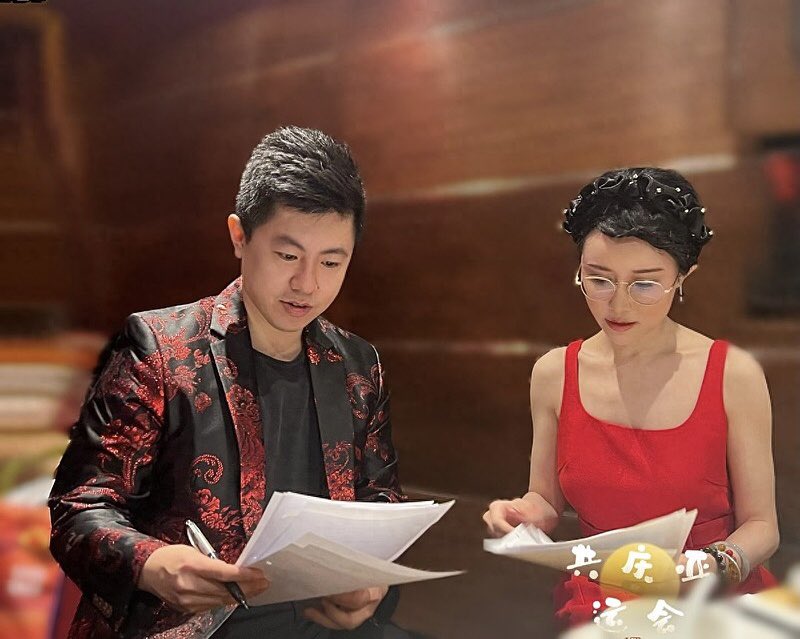
👇🏻 this person was one of the people at the table with Peng Shuai. He tweeted a shorter version of the video posted by Hu Xijin, plus three photos of himself with Peng Shuai and others.
The last time he tweeted was 2012, prior to these two tweets involving Peng Shuai.
24/n
The last time he tweeted was 2012, prior to these two tweets involving Peng Shuai.
24/n


👇🏻 丁力’s photos of Peng Shuai and others apparently at the restaurant shown in the video clips
25/n
25/n


👇🏻 the man speaking on the left in the dinner video is 张军慧 (Zhang Junhui), China Open’s Director of Tournaments.
26/n
26/n

👇🏻 丁力, the man who posted the photos of Peng Shuai in the restaurant above, is apparently the General Manager of Global D-Sports (德世界体育), the sports unit of Chinese electronics manufacturer Leyard (利亚德集团) which is also a sponsor of sports events in the country.
27/n
27/n


👇🏻 🇨🇳 state media CGTN’s Shen Shiwei shows us Peng Shuai’s whereabouts again!
Here Peng Shuai shows up in public and participates in some activities exactly as Hu Xijin promised yesterday!
Wait, why didn’t she take the opportunity to say something to the world? 🤔
28/n
Here Peng Shuai shows up in public and participates in some activities exactly as Hu Xijin promised yesterday!
Wait, why didn’t she take the opportunity to say something to the world? 🤔
28/n


👇🏻 video #1 from CGTN’s Shen Shiwei
29/n
29/n
👇🏻 video #2 from CGTN’s Shen Shiwei
30/n
30/n
👇🏻 a video clip of Peng Shuai at the same event posted by 🇨🇳 Hu Xijin
31/n
31/n
The biggest loophole in Beijing’s attempts to show the world Peng Shuai’s ok via the release of these pics and videos through third parties is that they also show us she’s not allowed to have direct, unrestricted contact with the world outside China via any form of media.
32/n
32/n
👇🏻 a short thread from @DemesDavid about the restaurant in the Peng Shuai dinner video and the building where the restaurant is located in
33/n
33/n
https://twitter.com/DemesDavid/status/1462206722177601537
👇🏻 Reuters’ coverage of Peng Shuai‘s appearance at the Sunday morning tennis event in Beijing mentioned above
34/n
reuters.com/world/china/te…
34/n
reuters.com/world/china/te…
👇🏻 one of the people in Peng Shuai’s dinner video is 李晓斌 (Li Xiaobin), China Open Promotions Ltd’s Party Committee Secretary & President (中国网球公开赛体育推广有限公司党委书记、总裁).
As the Party Secretary, Li wields more power than Zhang Junhui who’s also present.
35/n
As the Party Secretary, Li wields more power than Zhang Junhui who’s also present.
35/n


👇🏻 丁力 tweeted his pic with Peng Shuai taken at the event Sunday morning
36/n
36/n


👇🏻 China Open also posted pics showing Peng Shuai at the Fila Kids tennis event on Weibo
37/n
37/n


All the Peng Shuai videos released so far are about activities associated with the CCP: the dinner inside a government-owned building with China Open’s Party Secretary Li Xiaobin (李晓斌) present, and the tennis event, run and regulated by the state, Sunday morning.
38/n
38/n
So even if — just if — she wasn’t under any coercion or duress, these activities and the accompanying videos were all staged, cuz no one would risk angering the regime by posting or even shooting these videos without Beijing’s green light.
39/n
39/n
Peng Shuai had a 30-minute video call with pro-Beijing IOC President Thomas Bach, Chair of IOC Athletes’ Commission Emma Terho, and IOC Member in China Li Lingwei.
Beijing had prioritized IOC over WTA because of the upcoming Winter Olympics.
40/n
olympics.com/athlete365/voi…
Beijing had prioritized IOC over WTA because of the upcoming Winter Olympics.
40/n
olympics.com/athlete365/voi…
This video call with Peng Shuai doesn’t really tell us anything. Based on what the IOC officials revealed about their conversation with Peng, they didn’t ask any important questions. This was a pre-arranged call; Peng could be under surveillance; there could be people
41/n
41/n
around when the call took place or that could be a room in a special facility. WTA was the first organization that voiced their concerns about Peng’s disappearance and also the most vocal one, while IOC adopted what they called “quiet diplomacy”. Yet Beijing chose NOT to
42/n
42/n
directly allay WTA’s suspicions. IOC has long been a Beijing-friendly organization and their officials would undoubtedly ask politically correct questions while avoiding “sensitive” ones. In an officially scheduled call like this, Peng would obviously say the “right”
43/n
43/n
things without putting herself or her family at risk. Given Peng was “free” to have dinner with “friends” and attend a tennis event with lots of people, why didn’t Beijing get her in a press conference where she can freely speak to western journalists, diplomats and others
44/n
44/n
in person? That would at least be a bit more convincing (well, even that could still be staged under duress, etc.)
A furtively-arranged private video call with a pro-Beijing group is no evidence.
45/n
A furtively-arranged private video call with a pro-Beijing group is no evidence.
45/n
There’re many ways of silencing people without actually making physical threats or using violence.
👇🏻 Here Michael Corleone shows us how he made sure Frank Pentangeli didn’t say things that may incriminate the Corleone family.
46/n
👇🏻 Here Michael Corleone shows us how he made sure Frank Pentangeli didn’t say things that may incriminate the Corleone family.
46/n
WTA: "It was good to see Peng Shuai in recent videos, but they don't alleviate or address the WTA's concern about her well-being and ability to communicate without censorship or coercion. This video does not change our call for a full, fair and
48/n
reuters.com/lifestyle/spor…
48/n
reuters.com/lifestyle/spor…
transparent investigation, without censorship, into her allegation of sexual assault, which is the issue that gave rise to our initial concern."
49/n
49/n
👇🏻 IOC President Thomas Bach met then-Vice Premier Zhang Gaoli in Beijing on June 12, 2016.
Maybe they can set up a video call for Bach and Zhang?
50/n
beijing2022.cn/sv1/wog/wap.ht…
Maybe they can set up a video call for Bach and Zhang?
50/n
beijing2022.cn/sv1/wog/wap.ht…

“IOC is now actively playing a role in the Chinese government’s enforced disappearance, coercion and propaganda machinery.”
51/n
apnews.com/article/sports…
51/n
apnews.com/article/sports…
Amnesty International: “The IOC is entering dangerous waters. They should be extremely careful not to participate in any whitewash of possible human rights violations.”
52/n
reuters.com/lifestyle/spor…
52/n
reuters.com/lifestyle/spor…
👇🏻 how China censored CNN’s live TV broadcast about Peng Shuai
53/n
au.sports.yahoo.com/tennis-2021-ch…
53/n
au.sports.yahoo.com/tennis-2021-ch…
🇨🇳 state media and its journalists produced one piece of evidence after another to prove that Peng Shuai is safe and free. The world still doesn’t believe it.
🇨🇳’s propaganda machine doesn’t know how to craft narratives that stand up to scrutiny.
54/n
nytimes.com/2021/11/23/bus…
🇨🇳’s propaganda machine doesn’t know how to craft narratives that stand up to scrutiny.
54/n
nytimes.com/2021/11/23/bus…
Searching for Peng Shuai: the extreme nature of the restraints on speech about Peng, and the appropriation of her voice by the organs of external propaganda, should be sufficient proof she’s now subject to serious restraints on her personal freedom.
55/n
chinamediaproject.org/2021/11/23/sea…
55/n
chinamediaproject.org/2021/11/23/sea…

👇🏻 WSJ’s coverage of IOC President Thomas Bach’s previous working relationships with Zhang Gaoli (see tweet #50 in this thread)
56/n
wsj.com/articles/chine…
56/n
wsj.com/articles/chine…
🔥 丁力 (Ding Li) posted a new “email” Peng Shuai wrote to Steve Simon — in Chinese!
Peng claims she’s fine and doesn’t want to be disturbed. She even confirms she sent an email to 4 ppl including Simon and WTA’s Flora on Nov 17 (the one from CGTN with “Hello everyone”).
57/n
Peng claims she’s fine and doesn’t want to be disturbed. She even confirms she sent an email to 4 ppl including Simon and WTA’s Flora on Nov 17 (the one from CGTN with “Hello everyone”).
57/n


It’s funny that Ding Li questioned so seriously why Steve Simon didn’t reply to Peng Shuai’s email, as if that alleged “email” was irrefutable evidence of anything. 😂
And the new email in Chinese... 🤦🏻
58/n
And the new email in Chinese... 🤦🏻
58/n
🚨 “Privileged and confidential” communication — a legal term — is the interaction between two parties having a legally protected, private relationship. The party receiving privileged info must keep it private and confidential, unless the discloser waives the privilege.
59/n
59/n

👇🏻 BBC’s coverage of Ding Li’s latest tweet with a new email purportedly sent to WTA’s Steve Simon by Peng Shuai (see tweet #57 of this thread)
60/n
bbc.com/news/world-asi…
60/n
bbc.com/news/world-asi…
🔥 The WTA has suspended all tournaments in China, including Hong Kong, following the censorship of Chinese tennis star Peng Shuai's sexual assault allegation against Zhang Gaoli.
61/n
wsj.com/articles/wta-c…
61/n
wsj.com/articles/wta-c…
Steve Simon: “... with the full support of the WTA Board of Directors, I’m announcing the immediate suspension of all WTA tournaments in China, including Hong Kong.”
62/n
wtatennis.com/news/2384758/s…
62/n
wtatennis.com/news/2384758/s…
Djokovic: "I support fully the WTA's stance because we don't have enough information about Peng Shuai and her well-being. I think the position of the WTA is very bold and very courageous.”
64/n
rfi.fr/en/djokovic-sa…
64/n
rfi.fr/en/djokovic-sa…
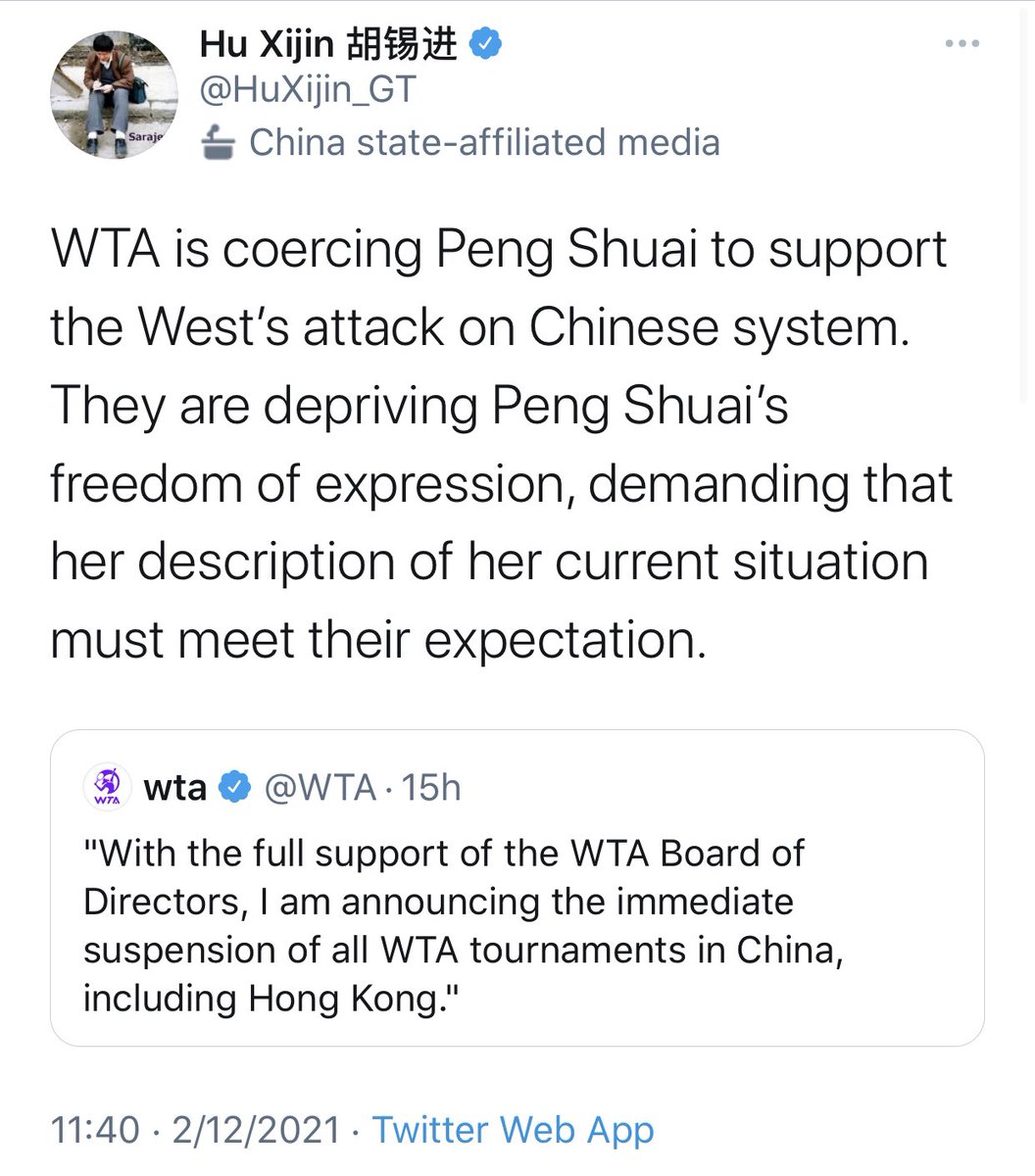
🇨🇳 mouthpieces Hu Xijin and Global Times lashed out at WTA and Steve Simon.
Given CCP’s vindictive and hideous nature, Beijing will certainly retaliate against WTA and Steve Simon. I wonder how they will go about doing it.
65/n
Given CCP’s vindictive and hideous nature, Beijing will certainly retaliate against WTA and Steve Simon. I wonder how they will go about doing it.
65/n


🔥 IOC held a second video call with Peng Shuai on Wed evening Swiss time, just before the WTA announced an immediate suspension of all tournaments in China.
IOC: “Peng appeared to be safe and well given the difficult situation she is in."
66/n
reuters.com/lifestyle/spor…
IOC: “Peng appeared to be safe and well given the difficult situation she is in."
66/n
reuters.com/lifestyle/spor…
👇🏻 IOC passes on Beijing’s message: Peng Shuai is fine cuz we say so!
67/n
67/n


Beijing now tries to punch Steve Simon and WTA into submission with its typical MO: threats, bullying and coercive language / tactics.
Steve Simon and WTA really have to brace for Beijing’s nasty retaliations even after Peng Shuai is finally freed.
68/n
bloomberg.com/news/articles/…
Steve Simon and WTA really have to brace for Beijing’s nasty retaliations even after Peng Shuai is finally freed.
68/n
bloomberg.com/news/articles/…
Inside China netizens have to work around the powerful censorship on social media if they need to reference Peng Shuai. Most people are probably not even aware of what’s been going on.
69/n
nytimes.com/2021/12/02/wor…
69/n
nytimes.com/2021/12/02/wor…
👇🏻 Safeguard Defenders’ open letter to IOC
I’m afraid this would most likely fall on deaf ears.
71/n
safeguarddefenders.com/en/blog/open-l…
I’m afraid this would most likely fall on deaf ears.
71/n
safeguarddefenders.com/en/blog/open-l…
Left pic: Shen Shiwei of 🇨🇳 CGTN speaks on behalf of Peng Shuai again!
Right pic: Shen tries to show us he’s smart but he can’t tell the difference between “suspending all tournaments in 2021” and “suspending all tournaments until WTA is satisfied Peng Shuai is fine”.
72/n
Right pic: Shen tries to show us he’s smart but he can’t tell the difference between “suspending all tournaments in 2021” and “suspending all tournaments until WTA is satisfied Peng Shuai is fine”.
72/n


Li Lingwei (李玲蔚), IOC member + VP of China’s NOC who attended the first IOC video call with Peng Shuai, was Director + Party Secretary of Tennis Administration Center of General Administration of Sport of China (Mar 2015 to Feb 2017).
Li’s been a CCP member since 1984.
74/n
Li’s been a CCP member since 1984.
74/n


Each time Peng Shuai appeared in public (in videos from state media / Ding Li), a CCP member / party committee secretary (党委书记) was always present:
Li Xiaobin - dinner and tennis event (tweets #25, #28, #29, #31 and #35 in this thread)
Li Lingwei - the IOC video call
75/n
Li Xiaobin - dinner and tennis event (tweets #25, #28, #29, #31 and #35 in this thread)
Li Lingwei - the IOC video call
75/n
Here’s an accurate English translation of Peng Shuai’s Weibo post on Nov 2.
76/n
thetimes.co.uk/article/e6f897…
76/n
thetimes.co.uk/article/e6f897…
ITF will not cancel any tournaments in China over concerns for Peng Shuai, because it does not want to “punish 1.4 billion people.”
How would canceling tennis tournaments punish 1.4 billion people?
77/n
theguardian.com/sport/2021/dec…
How would canceling tennis tournaments punish 1.4 billion people?
77/n
theguardian.com/sport/2021/dec…
It turns out that ITF president David Haggerty is an IOC member and on the board of US Olympic & Paralympic Committee. That’s why he’s echoing IOC’s call for quiet diplomacy and behind-the-scenes negotiations in Peng Shuai’s case.
78/n
apnews.com/article/sports…
78/n
apnews.com/article/sports…
WNBA’s Atlanta Dream tweeted a statement in support of Peng Shuai but there’s little immediate public reaction from major North American teams and leagues, many of which are heavily invested in China.
79/n
79/n
https://twitter.com/atlantadream/status/1468716382632218628?s=21

🇨🇳 mouthpiece Qingqing Chen of Global Times has news of Peng Shuai from a friend! Guess what? Yao Ming made a cameo appearance this time!
81/n
81/n


🇨🇳 mouthpiece Qingqing Chen got this video of Peng Shuai and Yao Ming from a ‘friend’!
82/n
82/n
👇🏻 pic of Peng Shuai, Yao Ming, Olympic sailing champion Xu Lijia and retired table tennis player Wang Liqin standing next to a banner for the "FIS Cross-Country Skiing China City Tour" with Shanghai's Yangpu Bridge in the background.
83/n
83/n

A reporter of Singapore-based Chinese-language newspaper Lianhe Zaobao (联合早报) “bumped into” Peng Shuai, Yao Ming and others at the International Ski Federation's cross-country skiing competition in Shanghai on Sun Dec 19, and interviewed Peng.
84/n
zaobao.com/realtime/china…
84/n
zaobao.com/realtime/china…
Of course we know in China you never “bump into” someone you’re not supposed to bump into unless you’ve been approved to bump into that someone.
👇🏻 English coverage of the Peng Shuai interview by Lianhe Zaobao’s sister newspaper The Strait Times
85/n
straitstimes.com/asia/east-asia…
👇🏻 English coverage of the Peng Shuai interview by Lianhe Zaobao’s sister newspaper The Strait Times
85/n
straitstimes.com/asia/east-asia…
👇🏻 Peng Shuai’s interview by Lianhe Zaobao
Peng Shuai denied she had made any accusation of sexual assault by Zhang Gaoli and claimed she wasn’t detained or under coercion. She also claimed she had sent emails to Steve Simon on her own accord.
86/n
Peng Shuai denied she had made any accusation of sexual assault by Zhang Gaoli and claimed she wasn’t detained or under coercion. She also claimed she had sent emails to Steve Simon on her own accord.
86/n
Ding Li (丁力) was there too! Is he stalking Peng Shuai or is he a special agent keeping an eye on her? 🤔
88/n
88/n


• • •
Missing some Tweet in this thread? You can try to
force a refresh