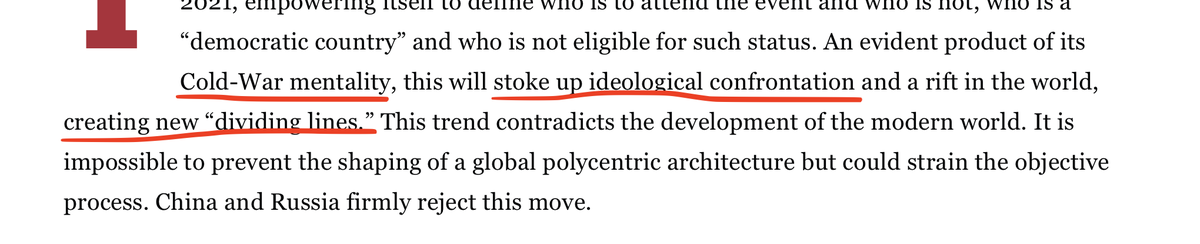
nationalinterest.org/feature/russia…. Oh my, the Russian and the Chinese ambassadors publish a joint op-ed against the forthcoming Summit for Democracy. Some juicy reading here, people.
So the basic premise is that the US should not hold such a summit because it will create unneeded ideological dividing lines.
BTW, the notion of "de-ideologizing" international politics goes back to Gorbachev. It was the cornerstone of his new thinking. By this he meant the rejection of Marxist-Leninist dogma that previously underpinned Soviet foreign policy. This here is also straight out of Gorbachev:

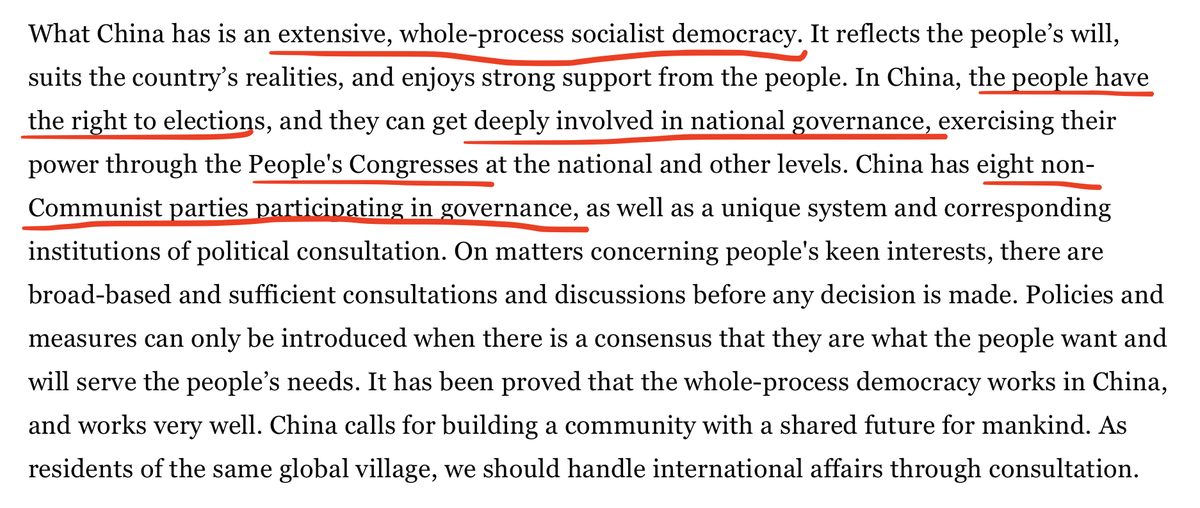
This here, though, will make you choke on your coffee. True, everyone knows that China has democracy with Chinese characteristics. It is also known as "dictatorship." Gorbachev flew of the window at this point. Also worth marking this paragraph as "fraud".
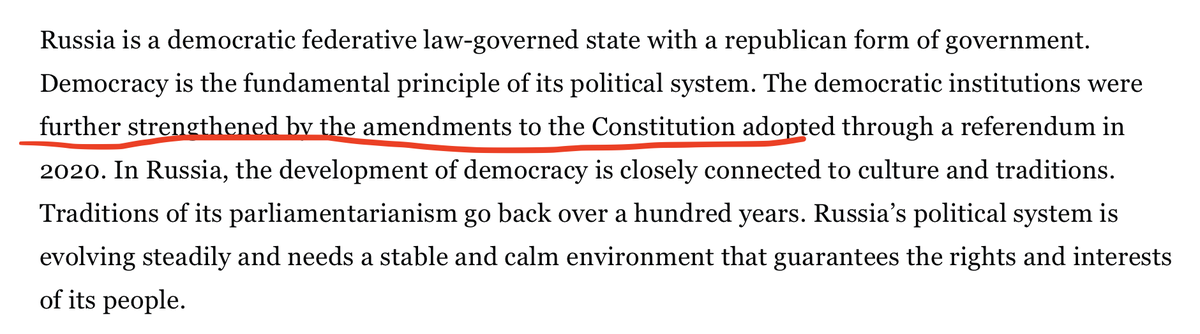
The next paragraph extols the virtues of Russia's democracy, which, to be sure, at least has elections (though of course everyone knows that they are fake). I don't mind the Chinese Ambassador lying about the nature of the Chinese system. Do mind the Russian ambassador's lies.
The next paragraph reflects Putin's long-time preoccupation with the "democratisation" of international relations, which is kind of ironic given how desperately Russia hangs on to its Security Council seat, and how it peddles "spheres of influence" in IR.

Everyone knows that fighting corruption is obviously anti-democratic 😂.
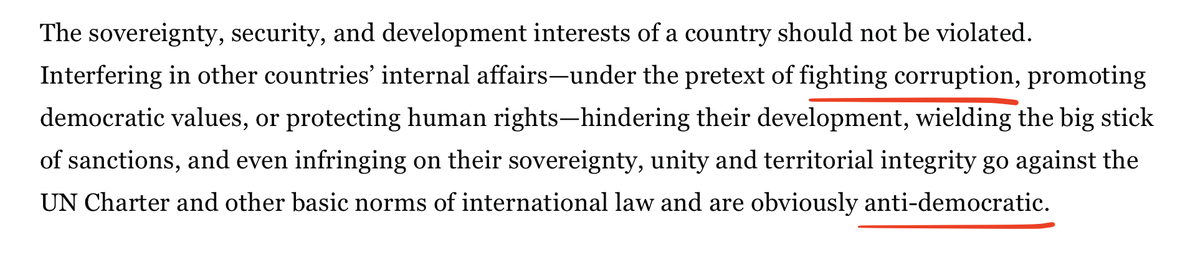
The key paragraph. We know that this is what they are most afraid of.

Interesting for a country that just recently annexed a part of another to talk about international law and the purposes of UN Charter.
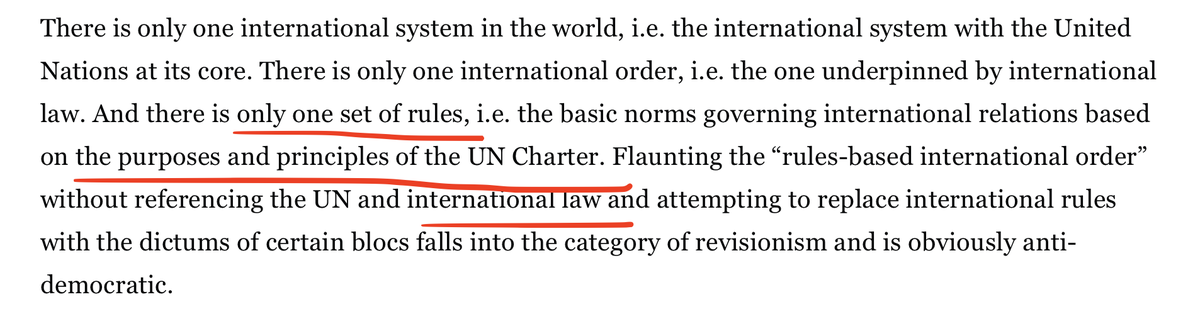
And the conclusion. In general, as @Nigelgd1 points out, it's not the content that's interesting (we've seen it all before) but it's interesting to see the Russians and the Chinese acting together against "value-based diplomacy."
• • •
Missing some Tweet in this thread? You can try to
force a refresh

So the long-awaited U.S. national security strategy is out: . It's a hell of a read. The craziest part is the one that deals with Europe, as you'd expect. It's called "Promoting European Greatness".whitehouse.gov/wp-content/upl…
So, the main problem facing Europe is "the real and more stark prospect of civilizational erasure." The culprits? The EU of course, which is busy suppressing liberties and importing migrants.
Well, this here is certainly worth reading this morning: . The biggest takeaway is that Witkoff leaned on Zelensky during the meeting with Trump to surrender Donbas to the Russians (because they speak Russian in Donbas, according to Witkoff).washingtonpost.com/politics/2025/…
I wonder if Trump and Putin already reached an agreement on this point in their phone call on Oct. 16, and Trump promised Putin to arm-twist Zelensky. I would think this is a definite possibility.
Kyiv is in a bind here. If Trump concludes that a Ukrainian withdrawal from Donbas is the only thing that is blocking an ever-lasting piece a la Gaza, he'll lean on Zelensky to do it, and Zelensky will have few options. He'll plead with the Europeans of course.
An interesting choice of a location (though previously discussed). Remarkable optics here. Budapest--with its decidedly "neutral" position in the war--is like the new Helsinki. Zelensky and the Europeans won't be thrilled but @PM_ViktorOrban stands tall and proud.
For Putin, a trip to Budapest is a finger in the EU's eye. Here he is, a criminal wanted by the ICC (Hungary btw is still a member of the ICC despite voting to withdraw), kicking Europe's door open with his boot. It'll be something else.
A bad idea? It depends. As we have seen, the U.S. has in fact provided substantial assistance to Ukraine over the last few months, and the Tomahawks and more sanctions are definitely an implied threat. Close coordination with Zelensky ahead of the meeting will help Kyiv.
My view on this is that it does not represent a new departure for Trump or the United States. Trump is doing here what he has already threatened to do many times: wash his hands of the whole Ukraine situation and let the Europeans sort it out.
As long as the Europeans are willing to purchase US weapons for Ukraine, he is willing to sell them. That's good. But the financial burden will fall on Europe, and Ukraine for its part will have to come up with the necessary manpower.
But there is no backstop. There is no promise of direct US support, just "good luck to all."
So here's the bizarre thing. Steve Witkoff, Marco Rubio et al are now arguing that Russia's acceptance of Art. 5-style guarantees for Ukraine is some kind of an incredible breakthrough that amounts, per Rubio, to Russia's major concession.
However, if you follow this story, as, for instance, Sam Charap and I have, over the years, you'll see that the idea of something *like* Art. 5 was being negotiated at Istanbul in 2002, and that the key obstacle was *not* Russia but U.S. unwillingness to offer such guarantees.
In other words, what today Trump is presenting as Russia's major concession is actually a major concession by the United States, because up to now the U.S. was unwilling to offer viable security guarantees to Ukraine. This below is from our recent piece for @ForeignAffairs.
A few reflections on where we are after another meeting in Istanbul. Since we now have both the Ukrainian and the Russian documents in full, I will do a full analysis on my Substack () tomorrow morning, so subscribe, but for now, here are some thoughts.profradchenko.substack.com
The fact that we have both documents already means that neither side is currently prepared to seriously negotiate. Recall we didn't have this at Istanbul 1.0: those were secret talks, and it was only much later that we obtained the leaked documents.
Now the positions are being leaked in real time, which means that they are not actual positions: just propaganda. Even so, is there any room at all for compromise?