Amid the discussion about Kingspan's sponsorship deal with Mercedes, here's a brief run through of what the Grenfell Tower Inquiry has revealed about them 🧵
https://twitter.com/MercedesAMGF1/status/1466014601028550662
Kingspan's K15 insulation product was only a very small part of the cladding system on Grenfell, and was only there because of a product substitution. But Kingspan's relevance to the story is larger than that. Lawyers for the families say the firm 'set the precedent'...
... for the use of combustible insulation on high rises.
In 2005, English regulations changed to allow cladding systems to be used on buildings if they passed a 'large scale test'. This opened up a potential backdoor route to use combustible insulation in these systems.
In 2005, English regulations changed to allow cladding systems to be used on buildings if they passed a 'large scale test'. This opened up a potential backdoor route to use combustible insulation in these systems.
Kingspan passed a test with K15 in 2005, as part of a system that used heavy cement fibre outer panels. This is not representative of a real world system. The test only covered that exact system. Nonetheless, it marketed the product as being suitable for use on high rises.
It then changed the chemical formula for the insulation to make it more efficient. When it ran new tests using the new insulation an internal report said it burned like a "raging inferno" and said the insulation was "burning on its own steam"
Kingspan kept these results secret, even from other parts of the business. It obtained certification from respected third party bodies that supported its claim that the product could be used on high rises. It was sold for use in hundreds of tall buildings.
One of these certifiers (the LABC) incorrectly said K15 "may be regarded" as being a material of limited combustibility. But when an internal Kingspan manager saw it he wrote FANBLOODYTASTIC. He would later boast that we "didn't even have to get any real ale down him"
Kingspan were occasionally challenged by industry figures who queried the fire safety claims. On one occassion, a manager wrote internally that a firm raising questions “go fuck themselves” or the firm would “sue the arse [off] them”
When the largest building control firm in the UK (the NHBC) threatened to stop accepting K15 for tall buildings, Kingspan called in its lawyers and threatened to sue for defamation in 2015
Grenfell largely used Celotex RS5000 as an insulation. This was a new product which a competitor had launched specifically to catch up with Kingspan's dominance of the high rise market.
While it is the aluminium cladding panels made by Arconic that were the "primary cause" of the rapid fire spread at Grenfell, the insulation is believed to have contributed to the fire and released a large quantity of toxic smoke including cyanide.
Even after the fire, Kingspan continued to lobby against a ban on combustible materials on high rises - instructing expensive PR firms to lobby MPs, wining and dining them and presenting evidence to select committees to show non-combustible options could also be dangerous
All of these revelations are a matter of public record thanks to the work of the inquiry. They would surely have appeared in any due diligence carried out by Mercedes before agreeing to the deal.
For completeness, Kingspan emphasises that it played no role in the design of the Grenfell cladding system. It says it has redone testing to support its prior fire safety claims. It has apologised for "process and conduct shortcomings" in its UK business.
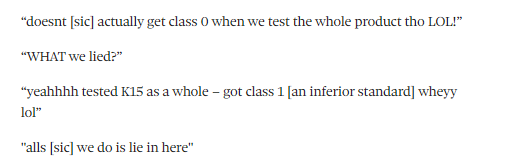
As an addendum (if anyone wants more) I actually left out the fact that the firm achieved another fire classification by testing the foil facing attached to the insulation, instead of the insulation itself.
“So on your technical reading of [the building guidance] you could staple a foil facer to a stick of dynamite and put it on a building of above 18 metres and call it Class 0?” asked the inquiry's lawyer.
Discussing this over text, two employees then had this conversation. "Alls we do is lie in here" 
And if anyone wants more of this sort of info, my wrap up of the monstrous corporate scandal covering the testing and sale of the cladding materials used on Grenfell is here: insidehousing.co.uk/insight/insigh…
• • •
Missing some Tweet in this thread? You can try to
force a refresh