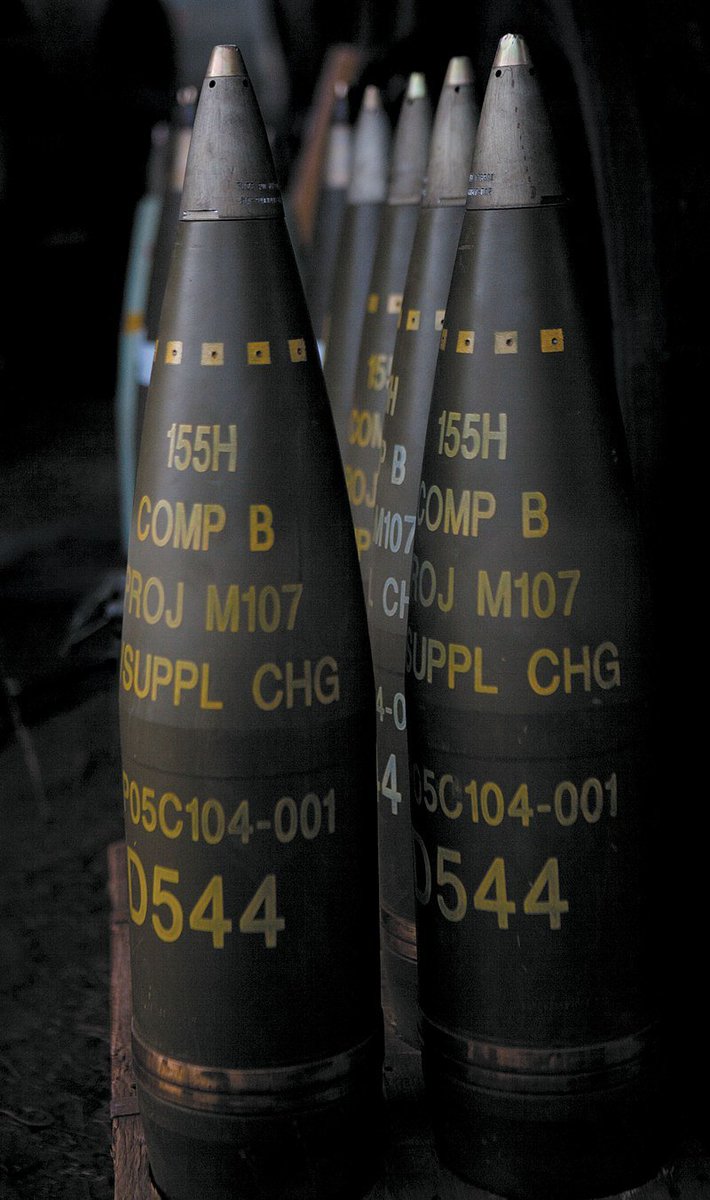
Lots of new attention to a problem that is rooted in Cold War history. NORAD is making a pitch for urgency and $$$ as we think about the unwritten check in Canada's defence policy - modernizing it.
But are hypersonics a game changer?
Hot take...the answer is, sometimes?
A 🧵
But are hypersonics a game changer?
Hot take...the answer is, sometimes?
A 🧵
https://twitter.com/CBCNews/status/1466089712809091074
Let's talk history. The architecture for NORAD was built over the 1950s when the threat was Soviet bombers sneaking over the Arctic. Through the 60s and 70s it evolved into space-based surveillance of ICBM launches. But lets not kid ourselves here about what the mission was...
NORAD could intercept as few as 20% of Soviet bombers, and had no counter-ICBM capability, so the whole point was to give 🇺🇸 a chance to launch their own bombers, ICBMs, and sub-launched missiles to destroy the USSR in retaliation.
You know, classic MAD, end of the world stuff
You know, classic MAD, end of the world stuff
Fun aside: From 1948-1955, the CA had an airborne Bde known as the 'Mobile Striking Force' that existed to muck out USSR airheads in the North which would have been required before the development of long-range bombers. By '55 though the Soviets didn't need to stop to refuel.
MAD has been the inescapable reality since the USSR got the bomb, but people are optimistic, so the West spent a lot of time (& 💰) trying to figure out doctrinal and technological ways around it - which gave us truly fantastic ideas like the nuclear bazooka.
...slow clap...
...slow clap...

Now in 1972 the US & USSR sign the Anti-Ballistic Missile Treaty, which puts limits on systems designed to defeat ICBMs. The theory is to limit the threat of war by making sure one side doesn't get too cocky about a fancy Anti-MAD technological development and make a go for WW3
But in 1983, feeling lucky after watching Rambo First Blood on VHS for the first time, the US announces it's going to (checks notes) build a space-laser based anti-ICBM system they claim doesn't violate the ABM treaty. Oh boy.
How does Russia feel about this?
How does Russia feel about this?
The USSR's response is to start developing hypersonic glide vehicles, or HGVs. These first class of hypersonics are designed to ride existing nuclear ICBM boosters to space, then skip through the atmosphere too fast to track and predict, and thus, evade Reagan's space lasers
Thankfully for the US Treasury, it turns out that space-lasers aren't feasible 2 years before the Gameboy comes out, oh, and the USSR collapses, so the hypersonic project goes on the backburner. Meanwhile China is now a full nuclear-power, but it claims to be a defensive one
In 2002, the US withdraws from the '72 ABM treaty, claiming that rogue states like North Korea and Iran are too great a threat to not pursue missile defence. 🇨🇦 declines to hop on, 🇷🇺 & 🇨🇳 do not want to see the MAD paradigm collapse, so they restart/start hypersonic development
Russia is probably worried about US technology allowing them to launch a nuclear decapitation strike and absorb any retaliation with an ABM shield.
China though just watched the US roll up Iraq in the Gulf War, and is focussed on anti-access to keep the US away from their turf.
China though just watched the US roll up Iraq in the Gulf War, and is focussed on anti-access to keep the US away from their turf.
The US is also building HGVs under the Prompt Global Strike Pgm, but this is about smacking fleeting targets, aka terrorists, without needing a fighter or armed UAV around. They have stealth bombers for anything else, so less urgency than their competitors.
Thanks again, GWOT.
Thanks again, GWOT.
So now we're back to NORAD, kind of. Are hypersonics a strategic threat?
A Nuclear HGV isn't much different than ICBM. Sure it may evade defences, but no realistic expectation to get all of US C2 & nukes - the triad will survive, if only the subs, and the world is still toast.
A Nuclear HGV isn't much different than ICBM. Sure it may evade defences, but no realistic expectation to get all of US C2 & nukes - the triad will survive, if only the subs, and the world is still toast.
Conventional could be a game changer - pinpoint strike to send a message, or allow < than nuclear war. The problem is, how do you contain the escalation? NORAD sees ICBM launch from space, but can't tell its not a nuke. Too dangerous a risk of retaliation, so not viable for war.
But that's war on the homeland - what about just in war?
HGVs are a bigger tactical & operational threat than strategic. If you pay attention - that's what 🇷🇺 & 🇨🇳 are actually testing. They working on air and ship launched hypersonic missiles to target US ships, not the CONUS
HGVs are a bigger tactical & operational threat than strategic. If you pay attention - that's what 🇷🇺 & 🇨🇳 are actually testing. They working on air and ship launched hypersonic missiles to target US ships, not the CONUS
Russia's ZIRCON is anti-shipping, which really means anti-Western Navy, which really means anti-US carrier groups. Russia has invested a lot in integrated air-defence but would still be vulnerable to naval power, which is a > reliable way to project power in the pacific.
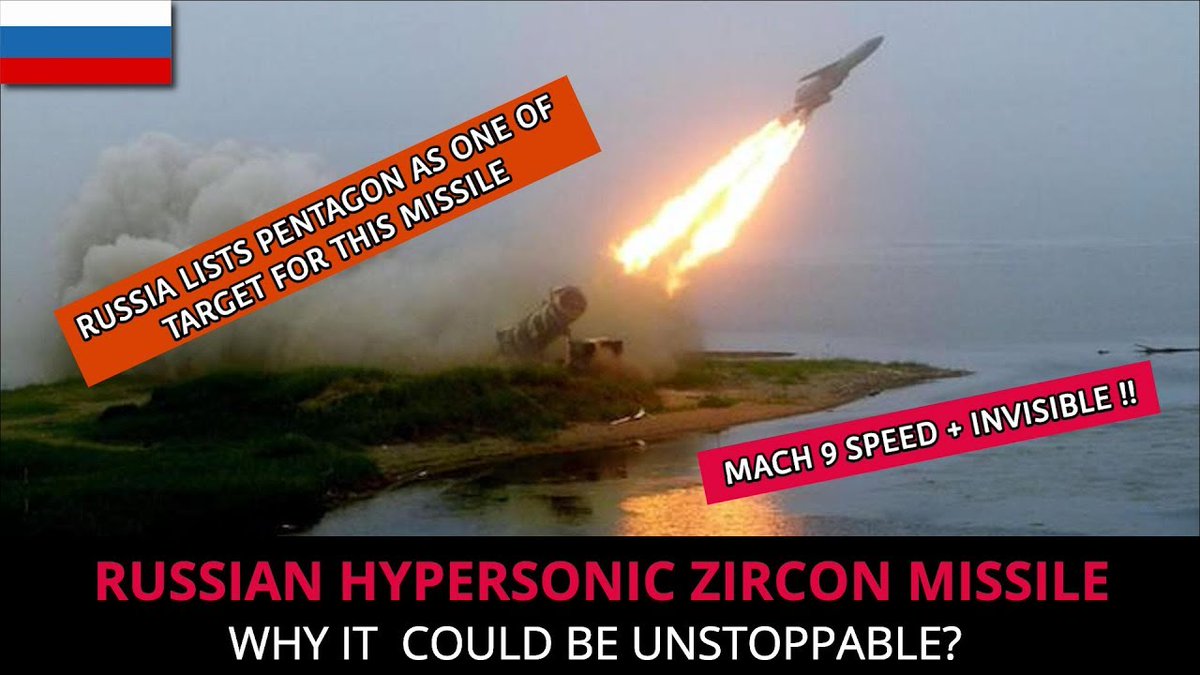
China is absolutely focused on an anti-access strategy to knock out US carrier groups, as well as forward air bases like Guam. It's unclear if they are confident in their own air defences, but they are focused on not letting US jets get a chance to find out
Great propaganda tho
Great propaganda tho
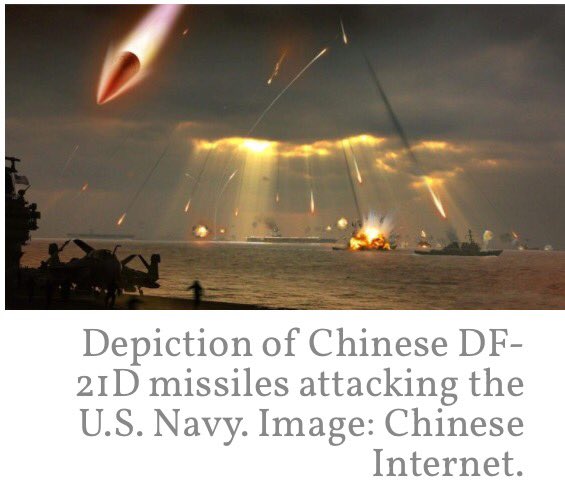
The important thing to take away from this is that neither Russia or China think they've got such a sneaky missile that they can blow up the White House and win at Earth. MAD still rules, and everyone knows it.
But is the US going to Nuke Beijing over losing a carrier?
But is the US going to Nuke Beijing over losing a carrier?
Most rational people imagine nuclear war as all or nothing, and it wouldn't be rational to end human existence over 6000 sailors on a CVN. Hypersonics are a credible threat for both Russia & China to keep the West away from their turf, but not a means to attack their homelands.
Sooner or later, there will be some unpleasant surprises when air or land launched HGVs are used, and we're going to learn some hard lessons about what is newly vulnerable in an operational theatre, but they are not going to change the fundamental strategic math of MAD.
So what should Canada do about hypersonics?
First off...
NORAD needs to be modernized, including all-domain awareness. We still need to be able to track hypersonics, yes, but also cyber-attacks, and threats to our joint digital infrastructure. All important and urgent projects.
First off...
NORAD needs to be modernized, including all-domain awareness. We still need to be able to track hypersonics, yes, but also cyber-attacks, and threats to our joint digital infrastructure. All important and urgent projects.
Strategic countermeasures though remain the threat of overwhelming retaliation, so no matter how icky 🇨🇦 feels about it, US nuclear subs still keep us safe at night.
Now, on the operational side?
We should be terrified. Ok fine, maybe just appropriately concerned.
Now, on the operational side?
We should be terrified. Ok fine, maybe just appropriately concerned.
But that's only because the massive expansion of air-breathing threats, from ISIS drones to Turkish UAVs to Iranian cruise missiles. If Canada wants to remain a credible military force, we need a multi-layered set of air defence systems.
And we need to talk about the home game
And we need to talk about the home game
It's all good to opt out of missile defence if we don't believe rogue state ICBMs threaten us, but we can't deny the expansion of other aerial threats and the liberalization of access to those systems, but one day we may need a tool to posture against Chinese aggression...
And unless we want our only option to be allowing a US Patriot Battery or THAAD to set up in BC, we're going to need to have some serious conversations about how we view the threat from specific regional actors, and how far we're willing to go to deter them
But until then?
But until then?
@threadreaderapp unroll
• • •
Missing some Tweet in this thread? You can try to
force a refresh