Super-interesting opinion from Mag. J. Harvey in the DDC: Can a judge deny a warrant application because the judge thinks the warrant will be executed in an unreasonable way? And if so, how can the judge know that ex ante?
Thread.
Op here: drive.google.com/file/d/1pVvonQ…
Thread.
Op here: drive.google.com/file/d/1pVvonQ…
In the case, the government has seized 26 cell phones (or has data extractions from their phones) from people in illegal gun cases. The govt wants to search them all for evidence of a common gun trafficking source.
Judge Harvey concludes that there was probable cause that evidence will be found on each phone, and the evidence to be searched is described with particularity as to each phone. (See Slip op. p3)
But MJ Harvey takes the view that there are three requirements of issuing a warrant, not two: (1) probable cause, (2) particularity, and -- and here's the unusual part -- (3) the overall reasonableness of the search that is expected to occur.
Of course, (1) and (2) are determined on the face of the warrant and application; they're the traditional requirements of issuing a warrant. But how do you know (3), which is a future event, depending on facts unknown? Trad not part of warrant review. And what's the standard?
As far as I can tell, M.J. Harvey does not say what the standard is, but he seems to place a burden on the government to show that each warrant will be executed reasonably.
Of the 26 phones, 4 were apparently abandoned, so no longer an REP in them. They can be searched.
Of the 26 phones, 4 were apparently abandoned, so no longer an REP in them. They can be searched.
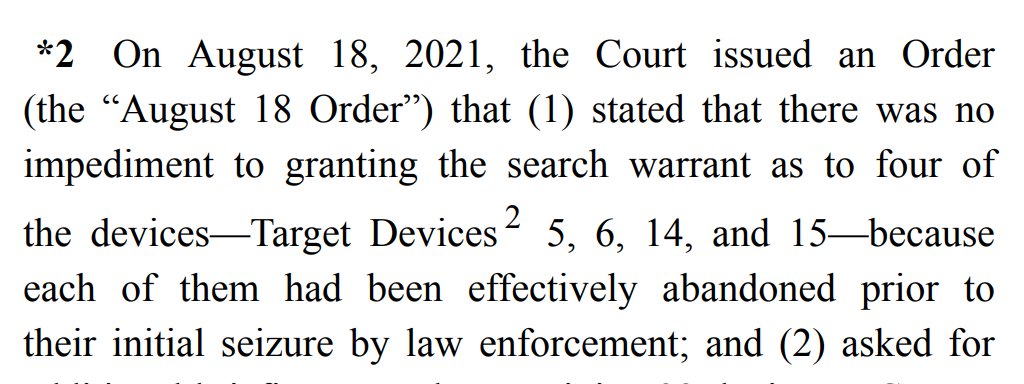
For the remaining phones, Judge Harvey engages in an analysis that is sort of an ex parte reconstruction of issues that you might imagine a defense counsel to argue in a hypothetical motion to suppress, assuming the searches go as planned.
In particular, Judge Harvey is concerned that the phones have been held in government custody for too long, and the government is now obtaining second warrants to search them for different evidence. (It's the Ganias problem, for those who follow computer search law.)
Judge Harvey offers a phone-by-phone reasonableness analysis, allowing some phones to be searched with a warrant but not others.

My take? I think this entire enterprise is well-intentioned, but wrong. Rule 41 is phrased as "must," not "may": When PC and partic are shown, the mag judge must issue the warrant. If there are other 4A problems elsewhere, that's on the executive branch -- as determined ex post.
Judge Harvey offers some caselaw that he contends imposes an obligation to ensure that the warrant will be executed in a reasonable way beyond probable cause and particularity. But I don't think that caselaw holds up.
Let's take this quote from Zurcher.
Let's take this quote from Zurcher.
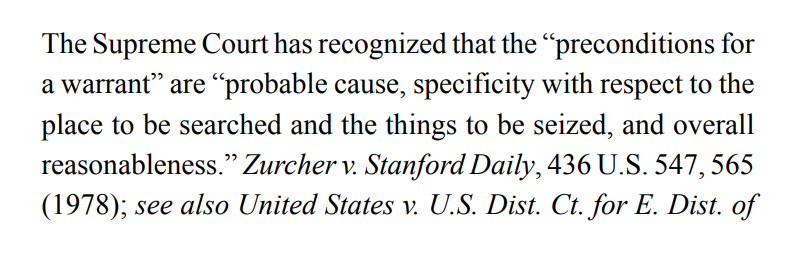
First, it was dicta. It was literally an aside made in the course of rejecting a different point.
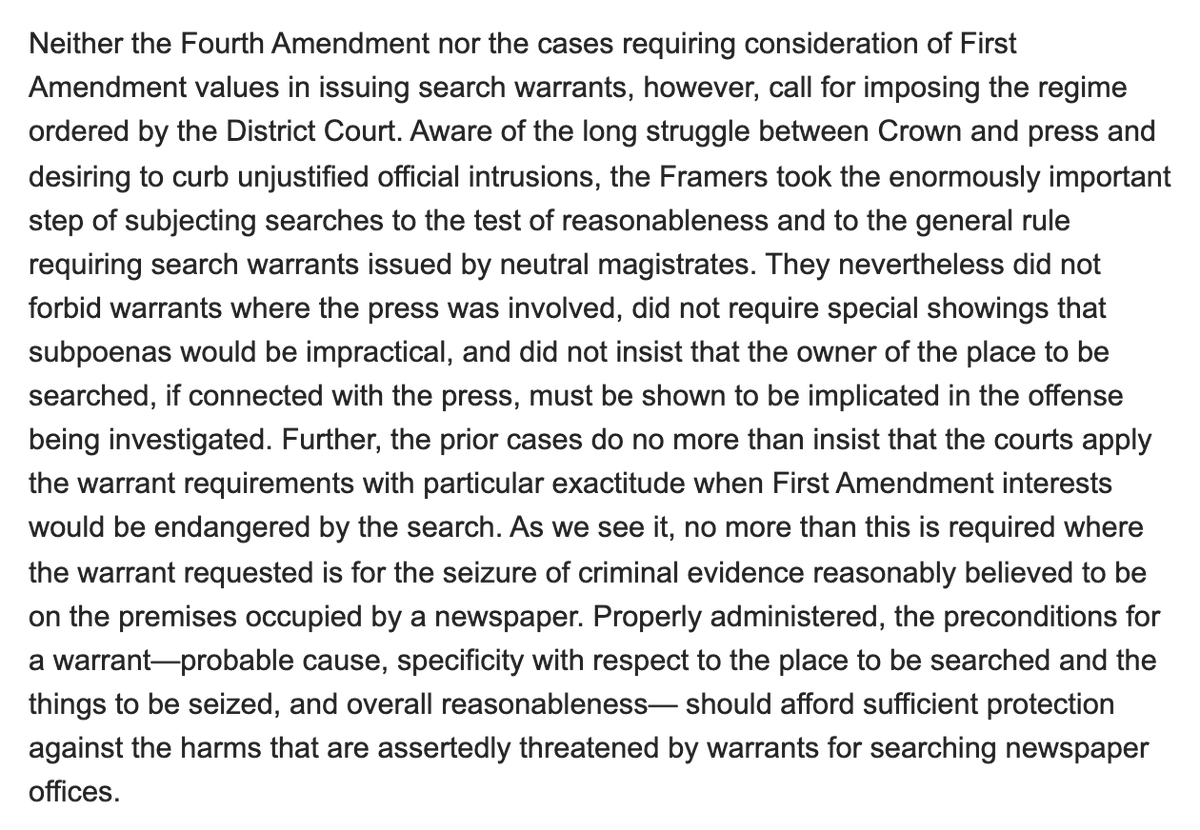
Second, it's hard to see how there's a ripe dispute at that point: The reasonableness of any search depends on unknown facts. You can't apply the law without a ripe dispute, I think. volokh.com/wp-content/upl…
Judge Harvey relies a lot on a 1979 DDC opinion, Blackie's House of Beef v. Castillo, that, as the court notes, was overturned on other grounds by the DC Circuit. It's true that the DDC opinion envisions a sort of managerial role for judges ex ante.
But I think that role is inconsistent with later Supreme Court caselaw on the 4th Amendment, like Lo-Ji Sales v. NY and US v. Grubbs.
I appreciate the good intentions, but I think the role of the magistrate judge in this kind of case is to issue the warrant if there's PC and particularity, and to let the executive branch take on the other issues elsewhere.
Judge Harvey does note what he sees as a benefit to ex ante review: It prevents Supreme Court caselaw from gutting 4th Amendment protections in practice.
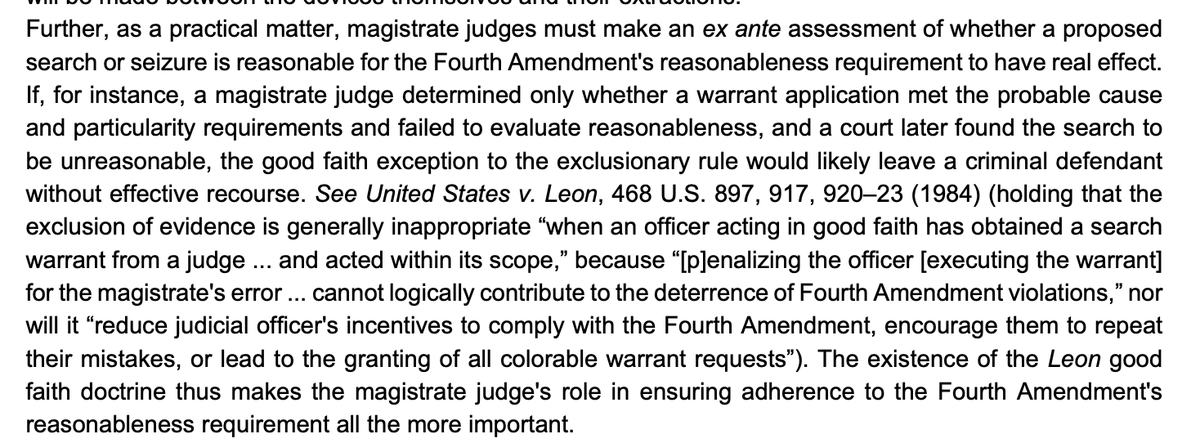
But I don't think this works. First, the kinds of reasonableness issues Judge Harvey is focused on are not about the warrant defect questions within the scope of Leon. Instead, they're about the detention, and the reasonableness rules for digital searches.
Second, even if Leon has some relevant implication, then that's on the Supreme Court. In a world of vertical stare decisis, I'm skeptical that lower court judges should be trying to account for what they see as possible implications of Supreme Court caselaw.
It will be interesting to see if DOJ seeks some kind of further review. As always, stay tuned.
• • •
Missing some Tweet in this thread? You can try to
force a refresh