The media and government are portraying a tragic tornado as a symptom of unprecedented climate disaster that eliminating fossil fuels will save us from—even though there is no tornado trend, and we have achieved unprecedented safety from climate thanks to fossil fuels.
THREAD
THREAD


Is the recent, deadly tornado in Kentucky a symptom of unprecedented climate disaster? The only scientific way to answer this question is to look for long-term trends in dangers from storms and other climate disasters. And if we do, we find that storm deaths are declining.

Has global warming been causing a disastrous increase in tornado frequency or intensity? Here's the data for the continental US, the most tornado-prone area on the planet, since the advent of comprehensive doppler-radar. There is no trend in tornado frequency or intensity.
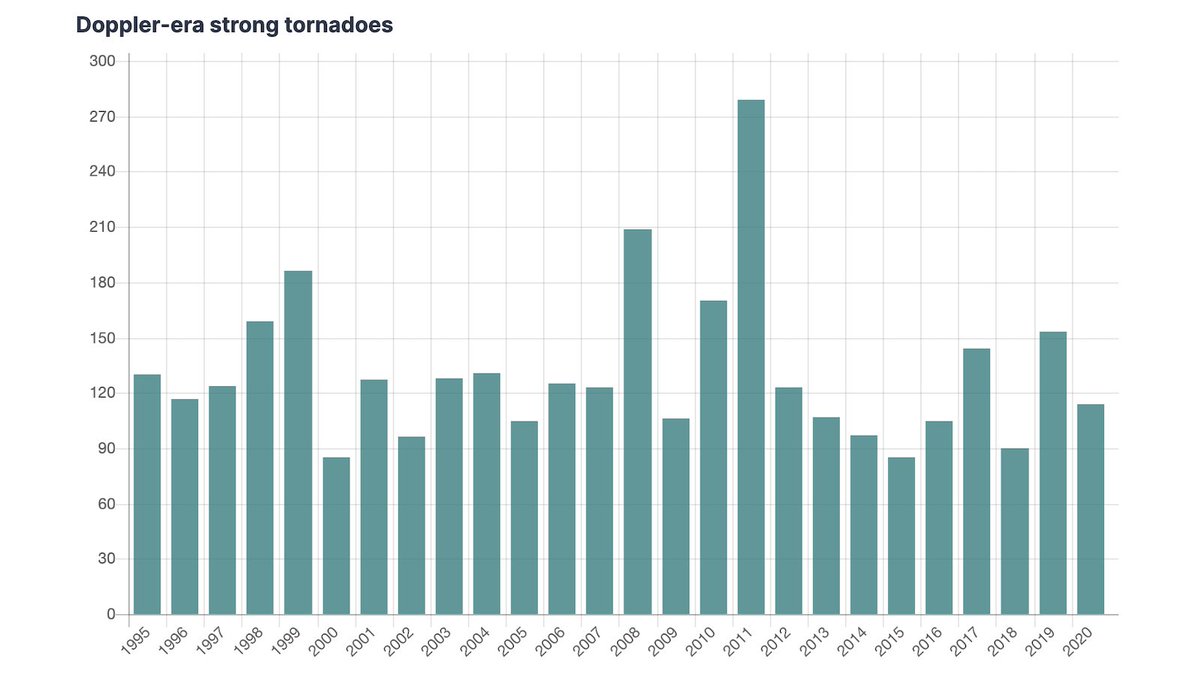
The latest report from the UN Intergovernmental Panel on Climate Change (IPCC) confirms the lack of a disastrous increase in tornado frequency or intensity: "In the United States... The mean annual number of tornadoes has remained relatively constant"

The tragically high death toll from the Kentucky tornado was due, not to some disastrous trend in tornadoes, but to specific factors such as the high population density of the region hit and the fact that it was nighttime (when people are less inclined to grasp the full danger).
Fossil fuels have made us far safer from storms and other climate disasters by providing the low-cost, reliable energy we need to build and power sturdy buildings, warning systems, evacuation vehicles, etc.
Climate disaster deaths have decreased *98%* over the last century.
Climate disaster deaths have decreased *98%* over the last century.
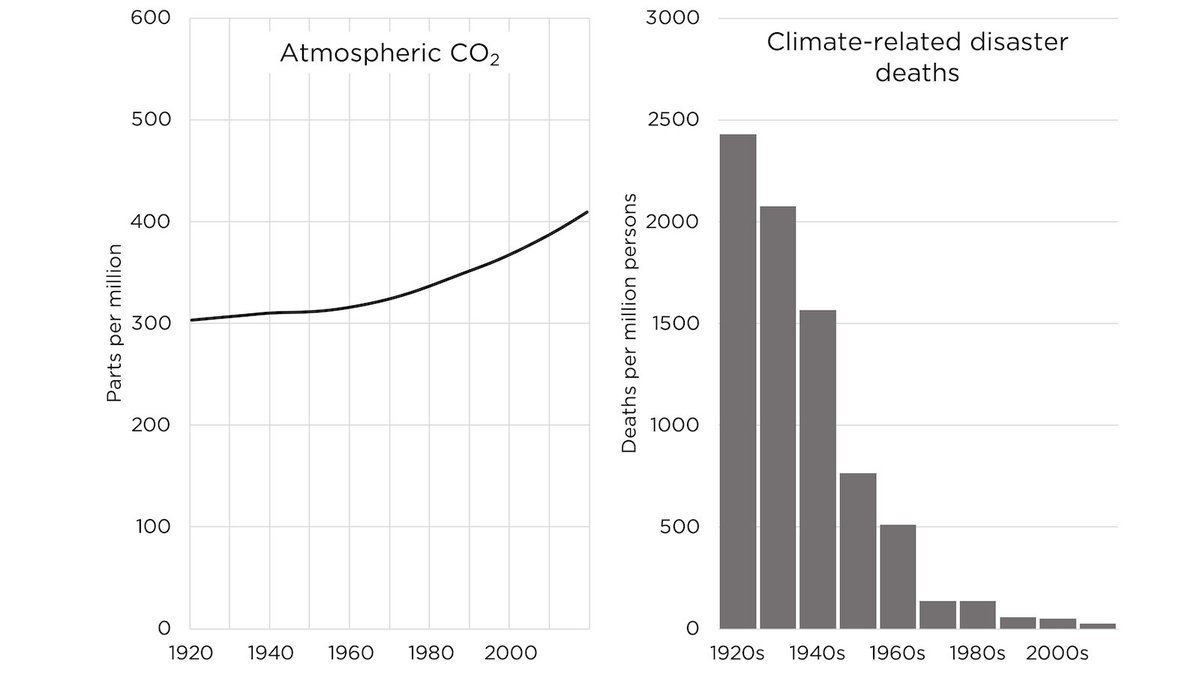
Fossil fuels' CO2 emissions *have* contributed to the warming of the last 170 years, but that warming has been mild and manageable—1° C, mostly in the colder parts of the world. And life on Earth thrived (and was far greener) when CO2 levels were at least 5X higher than today's.

As we get safer from climate thanks in large part to fossil fuels, we also become better at protecting property from disasters like tornadoes. That said, impactful tornadoes happen irregularly. 2021 seems to be one such outlier year. Not part of a trend.
https://twitter.com/RogerPielkeJr/status/1470475855856033798
Instead of acknowledging the non-trend in tornadoes and the decline in climate danger, the media and government are denying them. Our FEMA director says, "This is going to be our new normal and the effects that we’re seeing from climate change are the crisis of our generation.”
Why do the media and Administration portray a climate that fossil fuels have made safer than ever as a catastrophe? Because they hold the anti-scientific, anti-human dogma that human impact on Earth, including climate, is intrinsically immoral and inevitably self-destructive.
We can see a bias against human impact in Biden’s post-tornado claim that “everything is more intense when the climate is warming.” Actually, warming often makes life better—e.g., preventing cold-related deaths, which far exceed heat-related deaths.
https://twitter.com/BjornLomborg/status/1423571938463657987
Our society's bias against human impact is revealed by the fact that in the 1970s, when the media were warning of human-caused global cooling, they assumed that it would also make all kinds of climate dangers worse—including tornadoes.
(Image: @TonyClimate.)
(Image: @TonyClimate.)

The truth about safety from climate is that it is overwhelmingly determined by our ability to master climate, not the exact state of the global climate system. This is why Americans, using low-cost, reliable energy, can thrive in every climate—from polar Alaska to swampy Florida.
The media and administration are putting forward the false narrative of a fossil fueled climate catastrophe to justify fossil fuel elimination policies such as “Build Back Better.” But in reality the world needs far more fossil fuel.
Billions of people desperately need low-cost, reliable energy, which for the foreseeable future largely needs to come from fossil fuels. 3 billion people use less electricity than a typical American refrigerator. 1/3 of the world uses wood and dung for heating and cooking.

Solar and wind can't come close to replacing fossil fuels. They only provide electricity (20% of energy use)--and they don't even do that well. Because solar and wind are unreliable, they don't replace reliable power plants--they add to the cost of reliable power plants.

Poverty is still rampant around the world. Poverty is due to lack of productivity. Productivity requires low-cost, reliable energy.
The world needs far more energy, which means more fossil fuel. This matters far more than whether the % of CO2 in the atmosphere is .03% or .05%.
The world needs far more energy, which means more fossil fuel. This matters far more than whether the % of CO2 in the atmosphere is .03% or .05%.
The media and Administration are engaging in deadly pseudoscience by portraying the tragic Kentucky tornado as a symptom of unprecedented climate disaster that requires eliminating fossil fuels. More fossil fuel is needed so that everyone can live in an abundant, safe world.


• • •
Missing some Tweet in this thread? You can try to
force a refresh