Thomas Chua Profile picture
Dec 21, 2021 14 tweets 5 min read Read on X
Marathon Asset produced several iconic investors such as Nick Sleep and Jeremy Hosking.

Their letters from 2002 to 2015 provided a treasure trove of insights into their investment frameworks and how they look at the capital cycle.

Here are my main takeaways:
1/ Periods of high profitability leads to reckless investments.

When profits are high:

-Boost CAPEX with little regard for ROIC
-Competitors will follow suit to avoid losing market share
-CEO's incentives aren't aligned with shareholders

It's a race to the bottom.
2/ The capital cycle will swing down when investments are taken too far.

Forecasts that were reasonable will now look overly optimistic.

Profits collapse, management teams are changed, CAPEX is cut, and consolidation begins.

This will pave way for a recovery of profits.
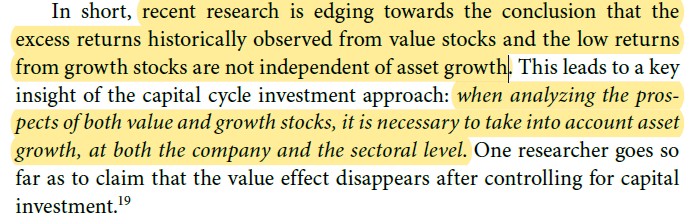
3/ Asset growth matters

Consider both asset growth at the company and industry level.

Avoid industries where assets are growing rapidly.
4/ We tend to extrapolate

When overdone, investments that appear logical at first can become disastrous.

We have a tendency to forecast linearly when many things are cyclical.

Examples: trade cycles, credit cycles, etc
5/ Overconfidence

In making forecasts, investors and corporate managers are prone to be overconfident.

The overinvestment behavior is reinforced when many players in the industry do the same.
6/ Focus on supply when making forecasts

Supply is far less uncertain than demand.

Since most analysts focus on demand, stock markets rarely price in supply shocks.
7/ Six tenets of capital cycle analysis
8/ Hunting for growth & value

When seeking growth, they look for businesses whose returns are more sustainable than what the market expects.

When seeking value, they look for companies whose improvement potential is generally underestimated.
9/ Primary driver of value is a favorable supply side.

In fact, a strong demand may destroy value as it triggers the industry to invest excessively.
10/ Look at where capital has withdrawn

When competition exits, it is when profitability and valuation start to rise.
11/ Companies with pricing power generate durable returns

It usually comes from:
-Oligopolistic market structure
- "Intrinsic" pricing power embedded in the product.

I.e. Branding of consumer products or mission-critical products.
If you like this, follow me here @steadycompound

I write about investment concepts, business breakdowns and growth philosophies.
If you have enjoyed this thread, you're gonna love my newsletter where I curate 3 ideas on investing and growth philosophies.

Every week.

steadycompounding.com

• • •

Missing some Tweet in this thread? You can try to force a refresh

 

Keep Current with Thomas Chua

Thomas Chua Profile picture

Stay in touch and get notified when new unrolls are available from this author!

Read all threads

This Thread may be Removed Anytime!

PDF

Twitter may remove this content at anytime! Save it as PDF for later use!

Try unrolling a thread yourself!

how to unroll video
  1. Follow @ThreadReaderApp to mention us!

  2. From a Twitter thread mention us with a keyword "unroll"
@threadreaderapp unroll

Practice here first or read more on our help page!

More from @SteadyCompound

Dec 14, 2025
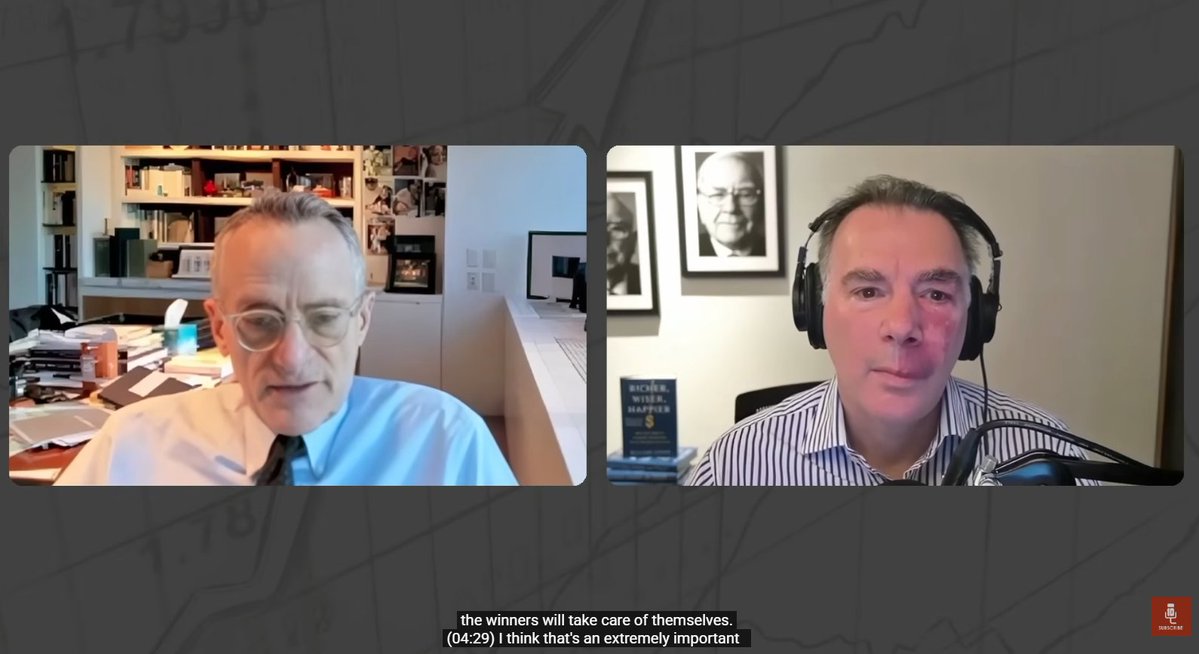
1/ Howard Marks just dropped 5 decades of investing wisdom in one conversation.

5 market calls in 50 years. $218 billion under management. Zero blowups.

Here's what separates him from everyone else: 🧵 Image
2/ The dinner that changed everything:

In 1990, a pension fund manager told Marks his portfolio stayed in the 27th-47th percentile for 14 straight years.

Sounds mediocre.

But over 14 years total? 4th percentile.

How? He never blew up while everyone else occasionally did.
3/ This became Oaktree's motto:

"If you can avoid the losers, the winners will take care of themselves."

Most investors shoot for the stars and occasionally shoot themselves in the foot.

Once you have a big loss, it takes years to recover. The math is brutal.
Read 25 tweets
Dec 10, 2025
Just finished Gavin Baker's latest interview with Patrick O'Shaughnessy.

It's one of the most insight-dense conversations on AI infrastructure economics I've encountered.

Key insights that matter for investors 🧵 Image
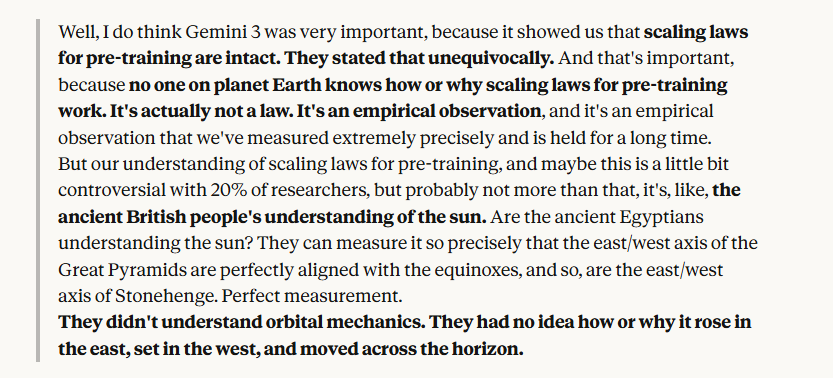
First, the big one: Gemini 3 confirmed pre-training scaling laws are still intact.

This matters because no one actually knows why scaling laws work. It's an empirical observation, not a theoretical guarantee.

Every confirmation that it still holds changes forward projections. Image
Here's what most people missed:

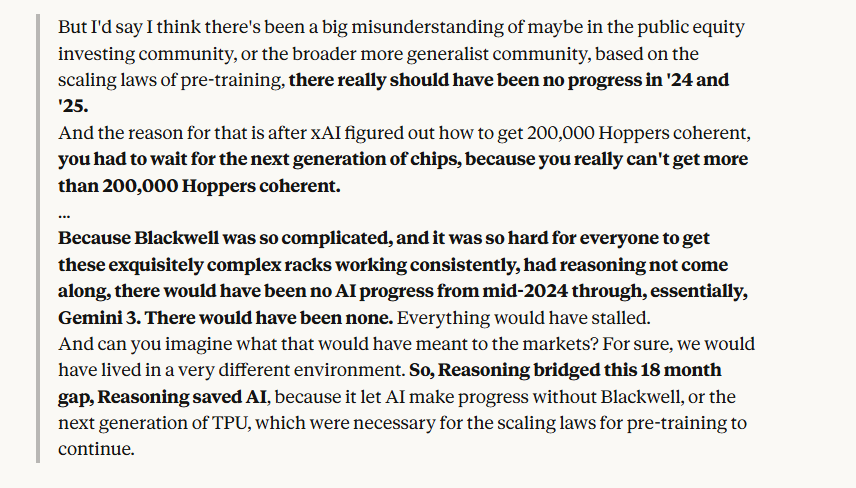
Between mid-2024 and now, there was no way to push pre-training forward. You can't get more than ~200,000 Hoppers coherent, and Blackwell was delayed.

Reasoning models bridged an 18-month gap where progress would have otherwise stalled. Image
Read 16 tweets
Dec 9, 2025
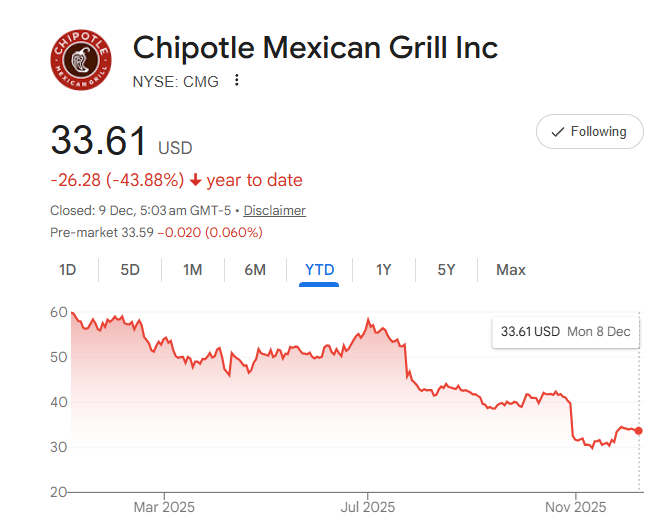
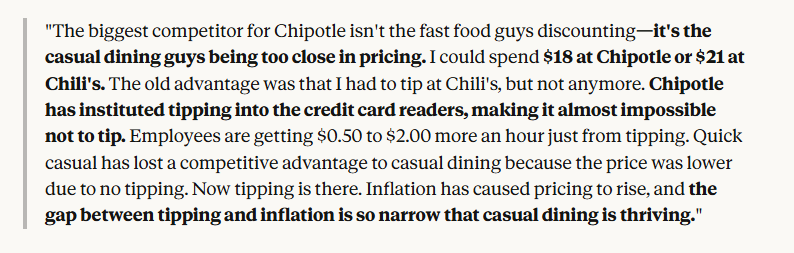
Everyone's blaming Chipotle's 44% decline on Slop Bowls.

The real threat? Casual dining.

A former Regional VP who ran 415 restaurants shared what management won't tell you: Image
Chipotle's average check: $18

Chili's: $21

The old advantage was no tipping. But Chipotle has embedded tipping into card readers, making it almost impossible not to tip.

That $3 gap with casual dining has nearly disappeared. Image
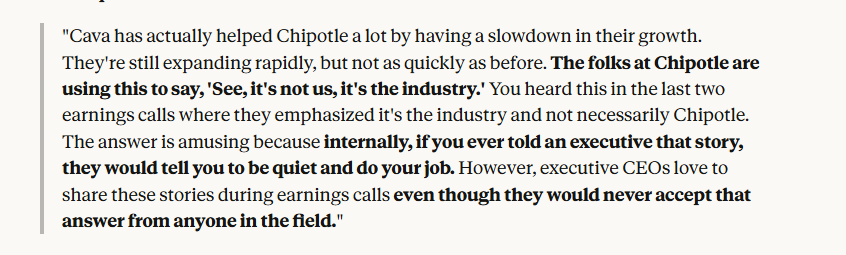
On Cava: Management points to Cava's slowdown as proof it's an industry problem.

"See, it's not us, it's the industry."

But internally? They'd never accept that excuse from their own people. Image
Read 13 tweets
Nov 26, 2025
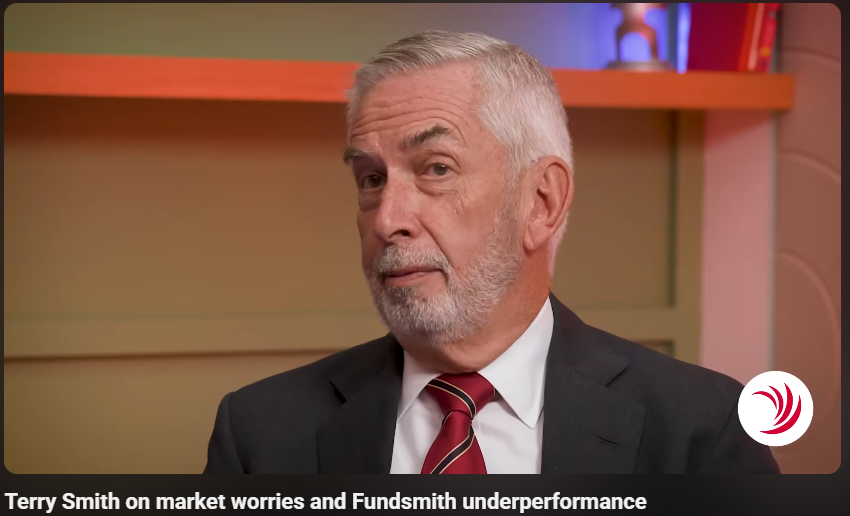
Fundsmith is on track for its 5th year of underperformance.

In a recent interview, Terry Smith explains the reasons why—and what he thinks is wrong with the market today.

Key insights: 🧵 Image
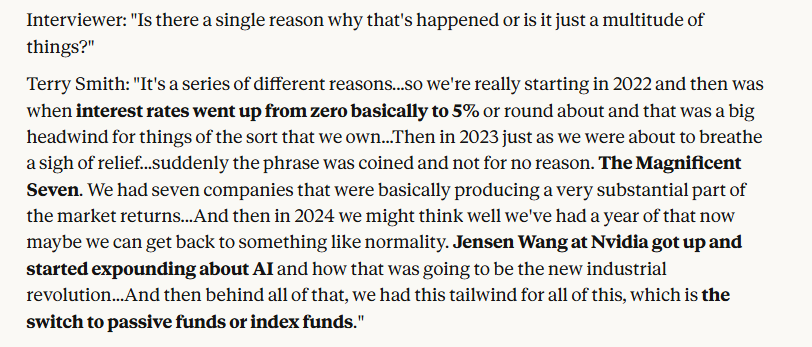
Smith breaks down the underperformance into distinct phases:

2022-23: Interest rates rose from 0% to 5%
2023: Magnificent Seven concentration
2024: AI boom/hype
Throughout: Passive fund flows

He claims each one is a headwind for quality investors. Image
On interest rates:

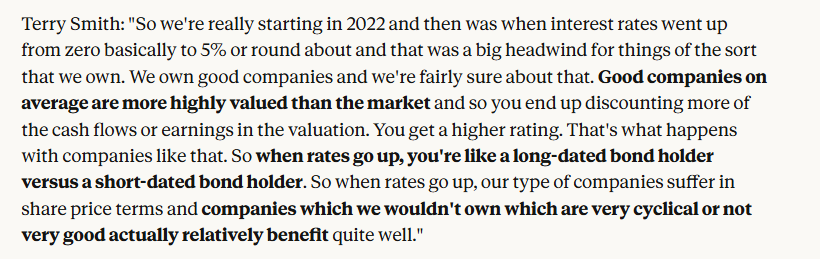
Quality companies trade at higher valuations because more cash flows are in the future. When rates rise, they behave like long-dated bonds—they get hit harder.

"When rates go up, our type of companies suffer in share price terms and companies which we wouldn't own which are very cyclical or not very good actually relatively benefit."Image
Read 15 tweets
Nov 23, 2025
Eric Seufert and Ben Thompson just released an interview that reframes AI monetization strategy.

Why affiliate links fail, why "agentic commerce" won't happen, the Netflix lesson OpenAI is ignoring, and Meta's first real bear case in years.

What stood out: 🧵
Context: Everyone assumes ChatGPT will monetize through affiliate links (Walmart, Etsy partnerships).

Seufert's argument: this is the wrong model. And the urgency is real—"OpenAI needs to launch its ads product today, they cannot wait."
Why affiliate advertising is wrong for ChatGPT:

1. It only monetizes queries with commercial intent

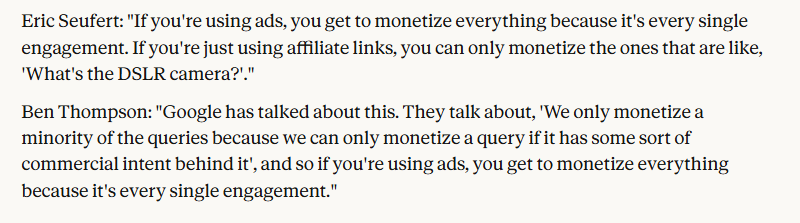
Seufert: "If you're using ads, you get to monetize everything because it's every single engagement. If you're just using affiliate links, you can only monetize the ones that are like, 'What's the DSLR camera?'."Image
Read 18 tweets
Nov 21, 2025
This is what happens when you answer the "tell me about your weakness" question too honestly.

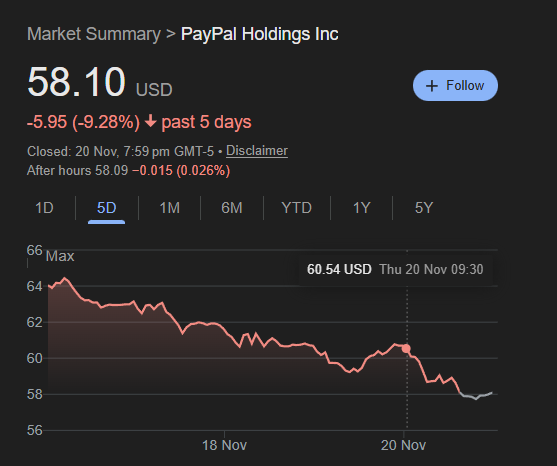
PayPal CEO Alex Chriss at Citi's FinTech Conference laid out the challenges so clearly it spooked the market.

Here's what he said: 🧵 Image
1/ Consumer spending deteriorated suddenly mid-September and it's persisting into Q4.

Chriss: "We started to see a slowdown on consumers, particularly around discretionary spending, retail and really in middle to low income brackets, which play a significant role in PayPal."

The weakness is concentrated: "If we look at some of our cohorts of higher income spenders, they're still spending. But we are seeing pressure for middle to lower income."

Q4 branded checkout expected to grow slower than Q3 as a result.
2/ The branded checkout rollout is taking much longer than expected.

Only 20% complete after significant time. Chriss admitted: "That's probably the piece I underestimated the most in terms of just how long it would take to get that experience out to customers."

The timeline? "We're just going to have to go through the hard work over the next few quarters and maybe even a couple of years to get through our backlog of merchants."

Years, not quarters. That's a meaningful delay.

Why so slow? Technical debt worse than realized.

Chriss: "We have 15-plus years of really bespoke integrations across our merchant base. This was something I personally didn't appreciate when I got here of just how many different integration patterns there have been."
Read 8 tweets

Did Thread Reader help you today?

Support us! We are indie developers!


This site is made by just two indie developers on a laptop doing marketing, support and development! Read more about the story.

Become a Premium Member ($3/month or $30/year) and get exclusive features!

Become Premium

Don't want to be a Premium member but still want to support us?

Make a small donation by buying us coffee ($5) or help with server cost ($10)

Donate via Paypal

Or Donate anonymously using crypto!

Ethereum

0xfe58350B80634f60Fa6Dc149a72b4DFbc17D341E copy

Bitcoin

3ATGMxNzCUFzxpMCHL5sWSt4DVtS8UqXpi copy

Thank you for your support!

Follow Us!

:(