Lots of reports of Omicron sequences carrying Delta-like mutations (eg P681R or L452R). Although a subset of these might end up being real, the vast majority will most likely turn out to be contamination or coinfection. No clear signals of anything real or nasty happening (yet).
To be sure a signal like this is real you really want multiple sequencing labs finding the same recombinant/homoplasy independently (or at least on different sequencing runs) - ideally you would look into the raw seq files as well and show no mixed bases.
As far as I understand it these are appearing now for two reasons: 1) Lots of Delta and Omicron circulating in the same areas 2) Some older sequencing primer sets being less effective at picking up parts of Omicron so low level contamination with Delta being selectively picked up
Finally its worth adding... much of what we understand about what makes Delta more transmissible/infectious, Omicron already possess - its currently unclear to me what Omicron could have to gain from Delta (with what we currently know at least)
Just to add to this thread as there's further similar reports... True recombinants don't tend to appear until a few weeks/months after there's been substancial co-circulation - we're only a couple of weeks into Omicron - I really doubt there are any prevelent recombinants yet...
Small update: the Cypriot 'Deltacron' sequences reported by several large media outlets look to be quite clearly contamination - they do not cluster on a phylogenetic tree and have a whole Artic primer sequencing amplicon of Omicron in an otherwise Delta backbone.
Here's a short thread with the evidence this is likely not real below (because I apparently can't thread properly):
It's been getting on for a year since I wrote this thread - heres a bit of an update of where we are with the evidence for mammal-to-mammal transmission of H5N1s.
What I'm not really able to cover yet is the North American cattle situation - not enough sequencing or epidemiological data has been shared to draw any strong conclusions - see this recent piece by @HelenBranswell This is frustrating to say the least...
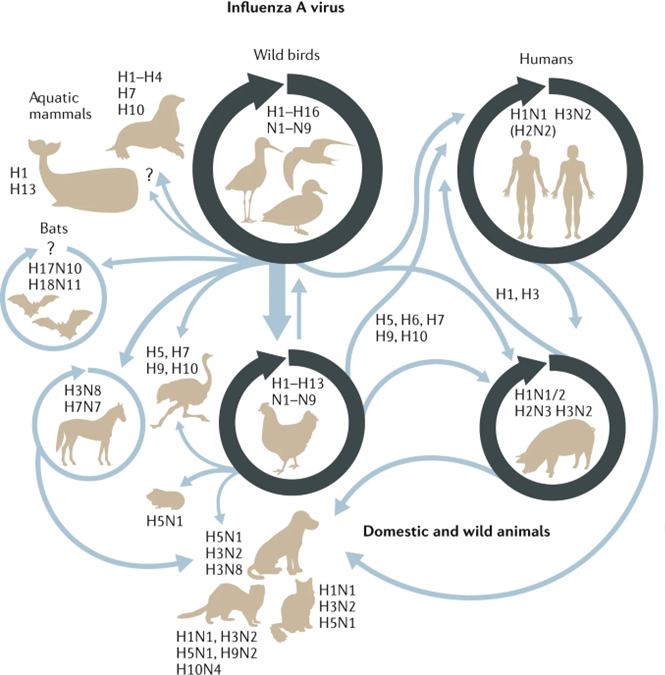
Thinking about pandemic preparedness, H5N1 has (rightfully I think?) recieved a lot of attention over the last couple of years.
However I think there is another group of flu viruses that most folks working on flu might say pose a higher pandemic risk - swine influenza viruses.
Swine influenza viruses have recieved a bit of attention recently - with 'cryptic' (ie no know contact with pigs) infections found in the UK and the Netherlands in the last few months gov.uk/government/new…
Swine influenza viruses with pandemic potential more or less come in two flavours - those with haemagglutinin (HA) and other genes from historic human seasonal influenza viruses - often from 'reverse zoonotic' (human to pig) events from the 1970-1990s
There have been some interesting developments with the panzootic (aka a pandemic of animals) H5N1 in mammals over the last few months.
Though I'd write a brief thread covering Polish cats, South American sealions and European fur farms.
Firstly, a quick situational update on the panzootic in birds. We're now 3 years into this outbreak and the virus is continuing to spread across the world, largely impacting waterfowl and seabirds (including many that are endangered)
Beyond birds though, we're seeing more and more infections in wild mammals that we've ever seen before. This is particularly widespread in scavengers and predators (for example foxes in Europe)
Excited to see our paper on coronavirus discovery in UK bats out. Its a cool story with some great multidisciplinary work between conservationists, molecular biologists, bioinformaticians, virologists, structural biologists, and more.
First off we did find some sarbecoviruses (distantly related to sars1 and 2) that had detecatable human ace2 binding, however this was pretty weak. We also know that it doesnt take that much go switch from weak to strong binding with sarbecos though.
We also found that these viruses apparently cant use the ACE2 from the species they were isolated from. This isnt unheard of with sarbecos (particular clade 2) but is a little surprising I think?
Inspired by some recent discussion we wrote a short report for virological about how one of SARS-CoV-2's accessory proteins (called ORF8) appears to have gone missing over the last year (with @LongDesertTrain and @siamosolocani)
Good question... if you ask 10 different virologists they may give you 20 different answers... in animal models it doesnt seem that important, and variants such as Alpha were missing most of it (but still did fine)...