

Today I noticed that a change of basis of a 3D multivector (i.e. complex quaternion) which obtains idempotent/nilpotent ‘light cone variables’ (elements squaring to themselves or zero) is equivalent to a choice of 2x2 complex matrix representation! (1/6) 
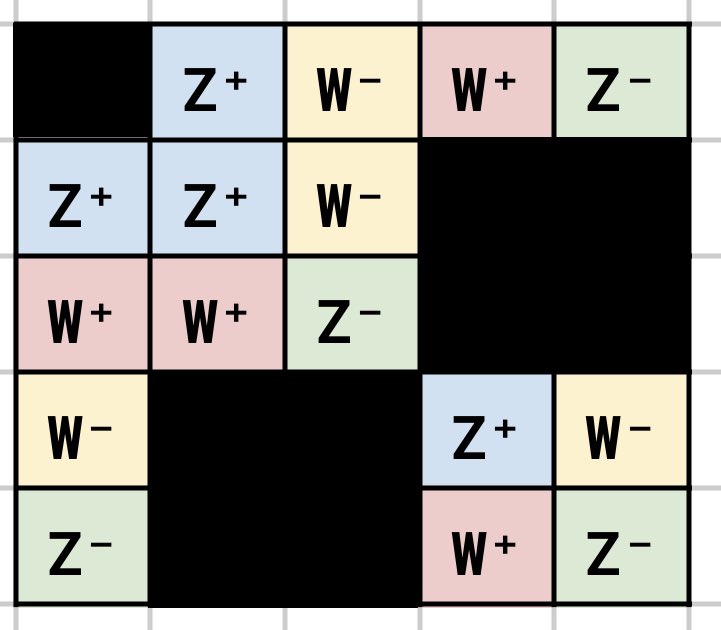
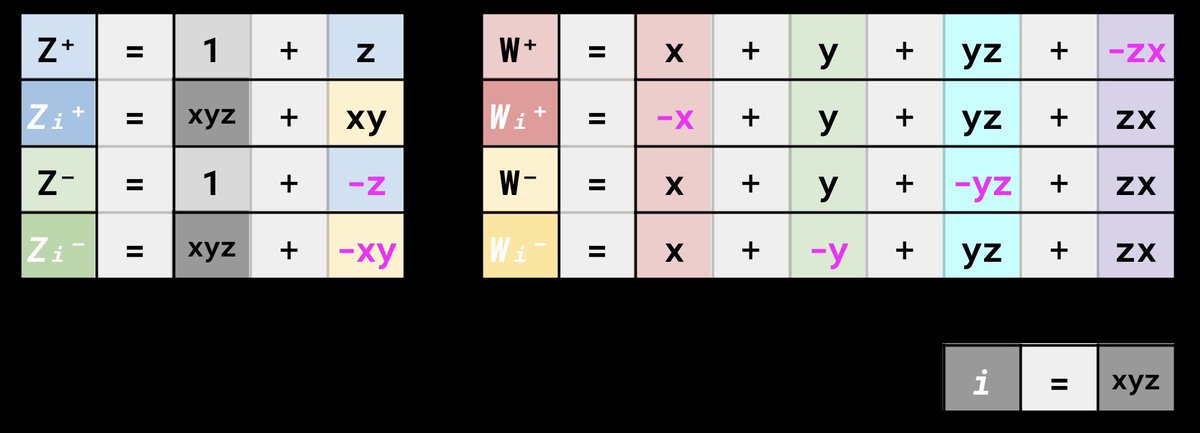
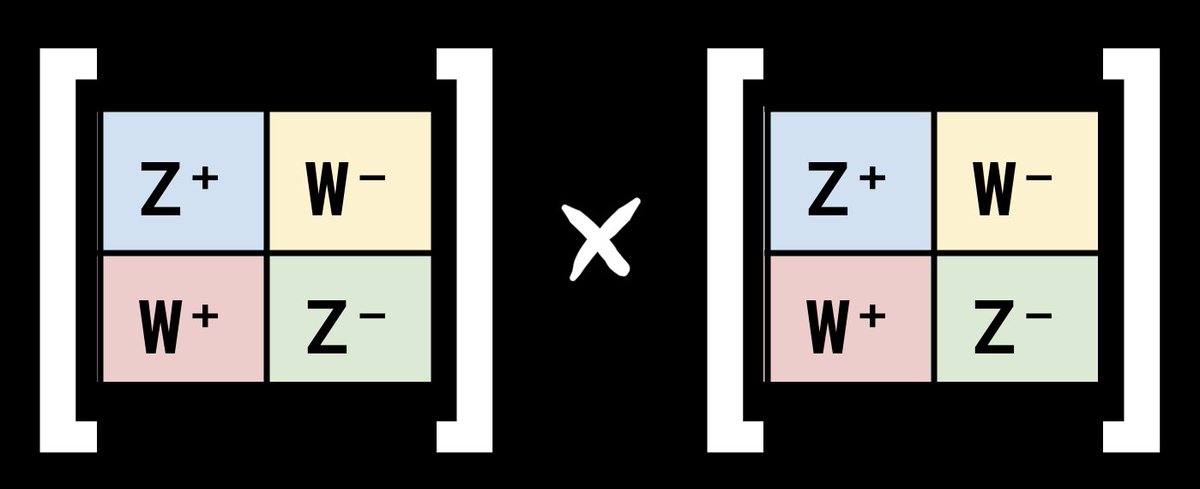
The 2x2 matrix is a place to measure spin up and spin down as your two orthogonal basis elements, and your choice of axis determines which direction D lands on the main diagonal as (1+D)/2 and (1-D)/2 whilst the orthogonal components get mixed into the off diagonal elements.
It then becomes intuitive how diagonalizing one choice of representation maximally mixes how much spin up/down you find in a representation with an orthogonal choice. Zeroing those off-diagonals means finding a reference frame where those contributions are equal and opposite!
So if choosing a 2x2 matrix representation forces us to choose a special axis whose eigenvalues are spin up and down, might some more general eigenvalues exist if we *don’t’ convert to a matrix? Can complex quaternions have first class eigenvalues and vectors?
I guess they exist and can be found analogous to pseudo-diagonalizing an asymmetric matrix. Multiplying a multivector by its reverse is exactly like multiplying a matrix by its Hermetian transpose; it squares scaling factors while canceling out any antisymmetric rotation.
The question then becomes how to interpret what our eigenvectors are and what they mean. Should the result be treated as a complex paravector, with complex eigenvalues in x, y, z, and time? Do these relate in any way to a possible real world measurement?
• • •
Missing some Tweet in this thread? You can try to
force a refresh



