Holden K's been writing a great series exploring why depictions of non-ironic utopias are so rare / unappealing.
I really love this suggestion in his latest post—that you can get a feel for a "moderate" utopia thru media centered on sports or performing arts.
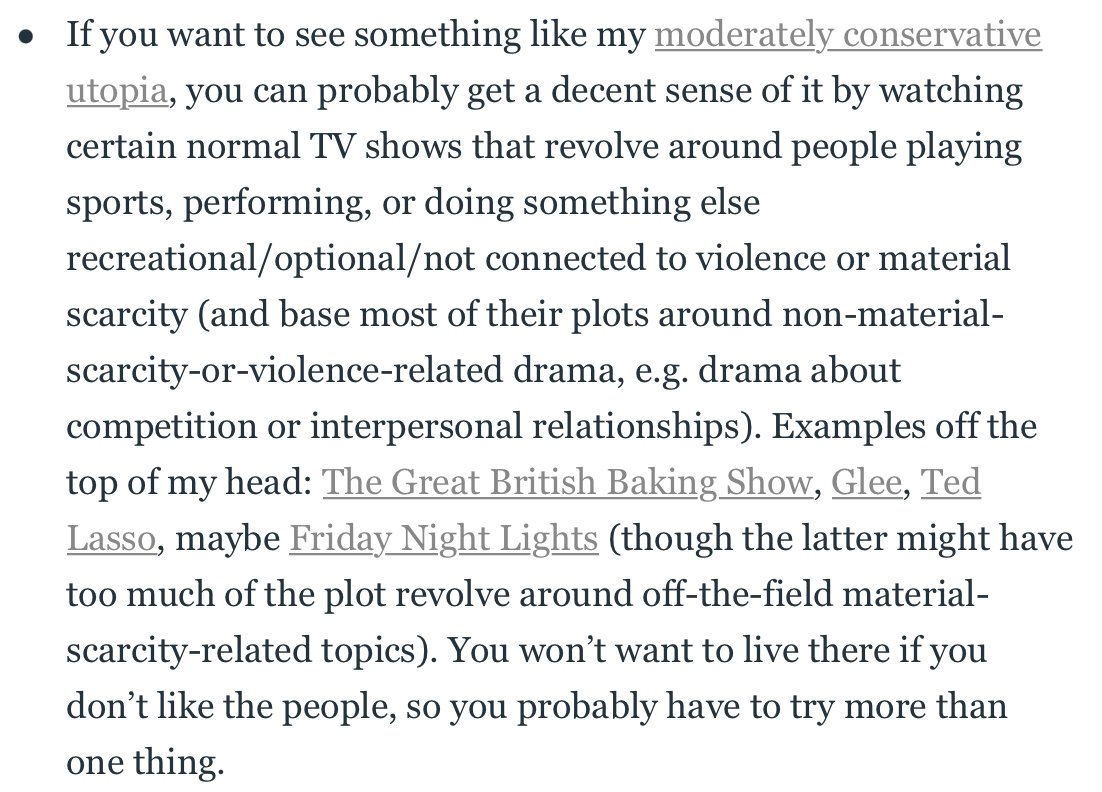
Earnest depictions of utopias often seem dreary because everything's too perfect—no telos!—but of course in these shows struggle for material scarcity is broadly replaced by struggle for creative expression, excellence, actualization, etc. Quite a beautiful vision, in some sense!
(Of course, in practice much of the conflict and struggle in these shows is "really" about material scarcity—the paucity of scholarships, the practical zero-sum-ness of being an athlete or musician in the world, etc. But I can subtract that away and still get an intuition…)
• • •
Missing some Tweet in this thread? You can try to
force a refresh

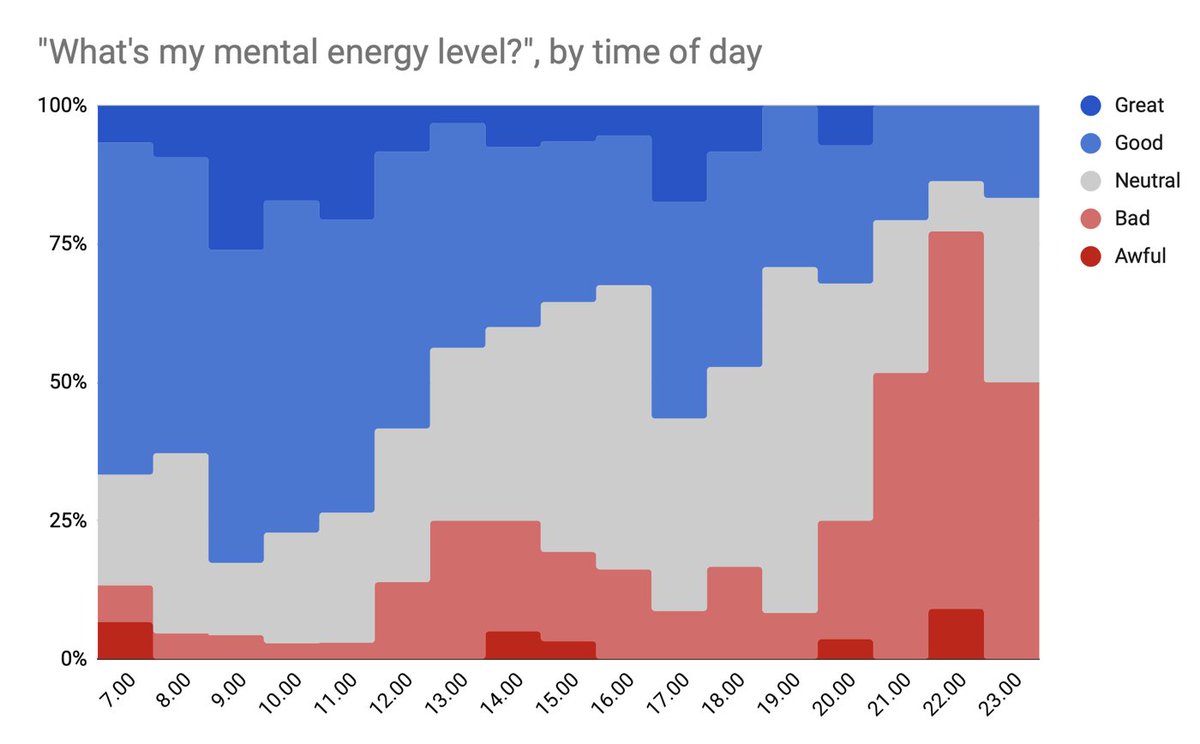
One unexpectedly great application for Apple Watch: stochastic self-sampling. e.g. here's my mental energy level throughout the day.
Can use notification actions to respond in one tap, so it's low-friction enough for 10+ prompts per day; and works when away from computer.
That's >500 data points over the past couple months. Hard to imagine collecting that if I had to remember to diary, or even if it required pulling out my phone.
Unfortunately, it only supports one prompt at a time. I'd also like to sample eg:
- "How curious am I feeling?"
- "How dutiful am I feeling?"
- "What am I thinking about?" (can use scribble / watch mic / top list)
In 1907, William James complains that psychologists have ignored the topic of "the energies of men"—that is, the practical stamina available for "running one's mental and moral operations".
Have good frameworks emerged for this in the past century?
There's "cognitive load", "ego depletion", "self-efficacy", etc… none of these really seem to hit the nail on the head here.
"Everyone is familiar with the phenomenon of feeling more or less alive on different days. Everyone knows on any given day that there are energies slumbering in him which the incitements of that day do not call forth, but which he might display if these were greater."
In "Where Is My Flying Car", Hall argues that what we really value in cities isn't necessarily physical density, but *temporal* density—ie low travel time. If all points were 5x further apart, but we move 5x faster, we'd prefer it: everyone could have more space. Is this right? /
One reason I like cities is definitely proximity to services and friends. Dozens of excellent restaurants and people within a thirty minute trip. But I also like running into people randomly, serendipitously. Living in a city is like shaking a fuller snow globe!
Not sure if temporal density is equivalent to physical density for the purposes of serendipity. If I only run into people at destinations, then there'd be no change if everything were spread out: the same people visit the same restaurants. But I run into people while walking!
Thinking about "game tape" for thinking, inspired by @tayroga, @mindy_online, past Twitch streams. I notice that thinking has limited legibility—tape captures only a fraction of what's going on. Which useful categories of feedback are possible? Which blocked by illegibility?
Some useful feedback I've gotten:
- are you being captured by the formal structure you created here, rather than by some real purpose?
- are you spending so much time reviewing those references because the main problem seems to hard, and you're avoiding it?
But I mostly haven't gotten useful feedback. Makes me wonder about the "span" of this format, at least interpersonally.
One barrier is that so much of effective thinking is instinctual: I often can't "justify" why I'm thinking about X; trying to do so too early will cause harm.
Sometimes, singing in tight vocal harmony, certain chords locked just right will produce a hair-raising effect: the air buzzes, the sound gets "fuller," goosebumps, psychosomatic tears. I think it comes from overtone overlaps? Sharing rabbit hole and questions so far:
Unfortunately, it's hard to convey this effect with a recording—it's much stronger if you're producing it. So I guess I'm mostly talking to other vocalists.
The first key bit seems to be that voices can sing in just intonation, i.e. whole number ratios: en.wikipedia.org/wiki/Just_into…
(I'm totally skipping explanation of overtones, temperament, and the harmonic series here… for a wonderful intro, see @vihartvihart's )
Discussing this more with Laura, one thing that surprises me is how few digital authoring envs you'd want to "live in" all day for both prose and visual explanations. Your team can live in Notion, but then no visual expls; or live in Figma, but probably not write there.
OneNote was the only full-featured tool we could think of which seemed well-suited to both text and visual explanations, though it has its own downsides.
We're all still "separating by mode of production", per Tufte…
Yes, one can still embed Figma artboards as blocks inside Notion documents, but that's still separating by mode of production. Means you're unlikely to spontaneously create text<>visual interactions as you'd naturally do on paper / whiteboard.