
📣 December 25 is a BIG day for astronomy!

With the launch of @NASAWebb, a new and exciting era of science awaits.

But how is Webb different from Hubble? How will these telescopes work together?

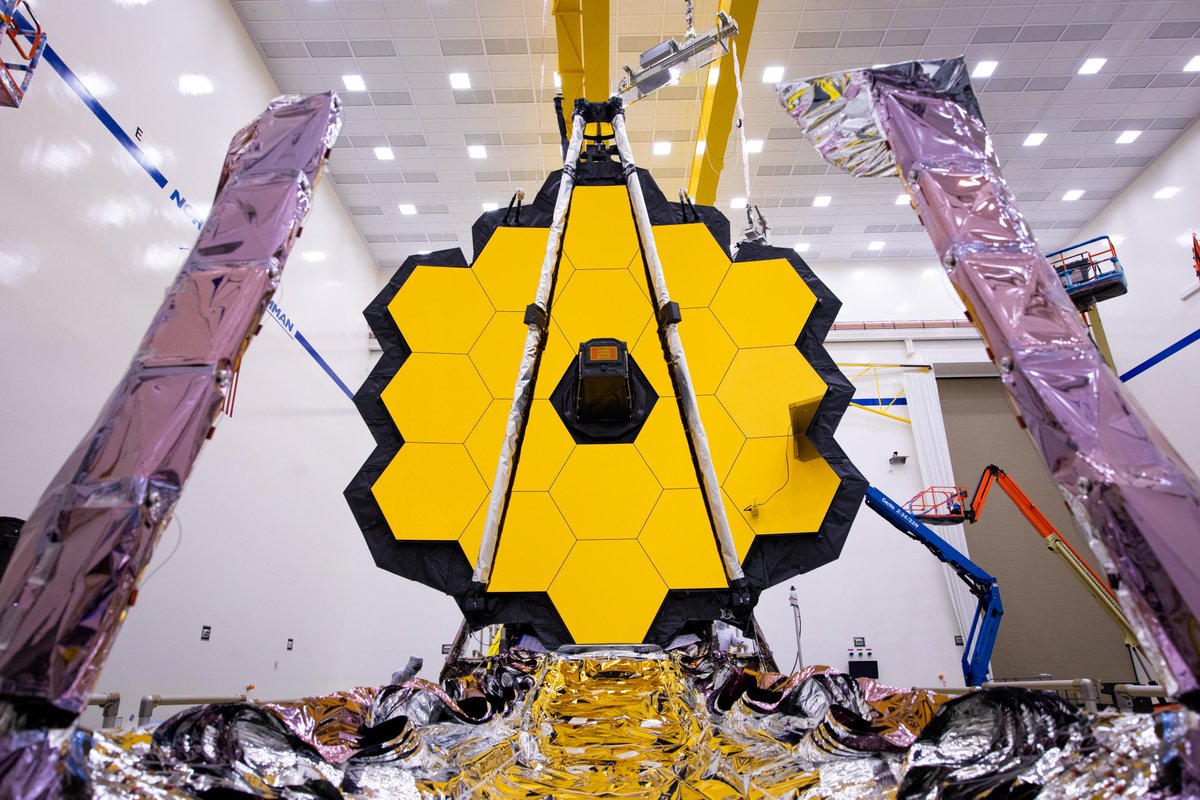
🧵 Read on... The golden mirrors of the James Webb Space Telescope shine
💡 Light

Hubble detects visible light (what our human eyes can see), along with some ultraviolet and near-infrared wavelengths.

Webb's extraordinary infrared vision will reveal longer and dimmer wavelengths of light, peering further into the universe and "back in time." The electromagnetic spectrum
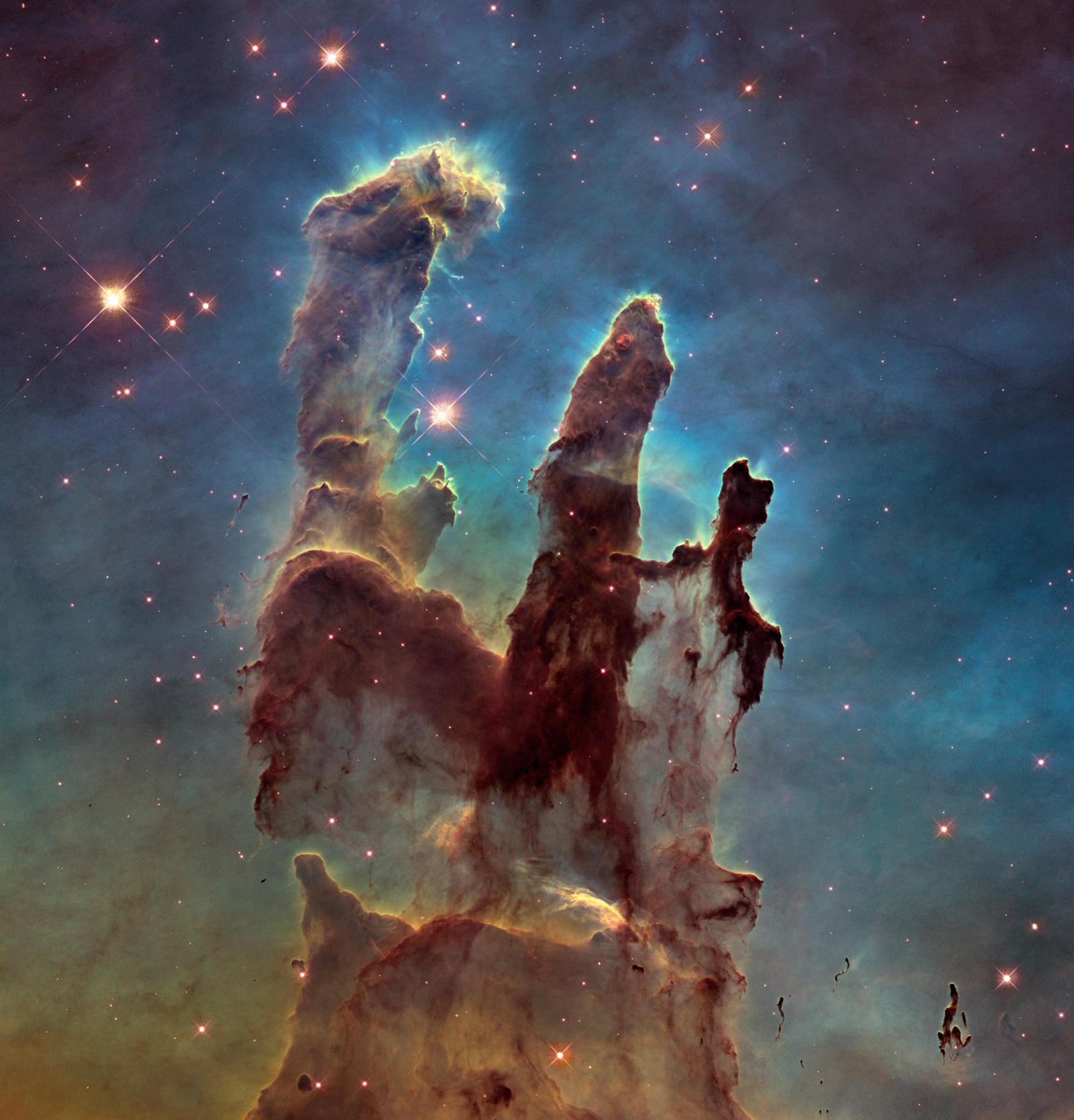
Infrared light also pierces through dust and gas, as seen in these two Hubble views of the Eagle Nebula.

The left image is in visible light, and the right is infrared.

Find out more about light: go.nasa.gov/3qurOz0
🪞 Mirrors

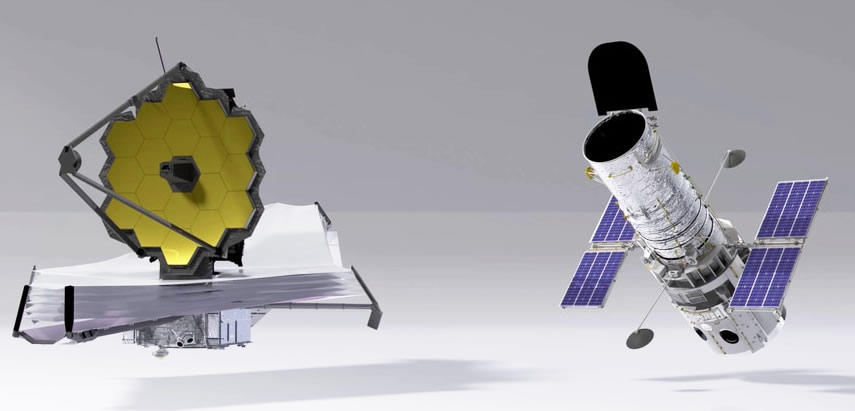
Both Webb and Hubble are reflecting telescopes. That means they collect their light from huge, curved mirrors rather than lenses.

However, Webb's primary mirror measures 21.3 feet, whereas Hubble's is 7.9 feet.
🌎 Orbits

Hubble orbits just above Earth's murky atmosphere at an altitude of about 340 miles, giving it a clear view of the universe.

Webb will orbit the Sun with Earth, roughly one million miles away from home around the second Lagrange or L2 point.
👨🏽‍🚀 Servicing

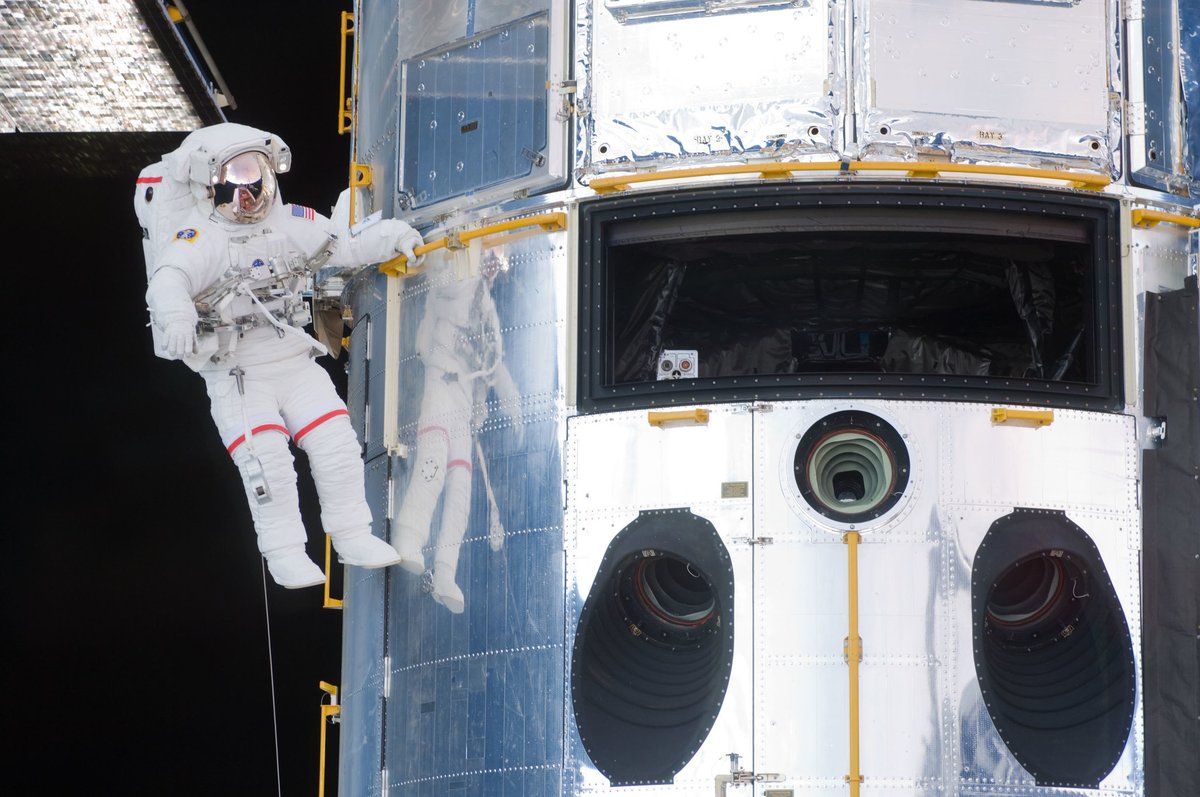
Hubble has lasted for 30+ years in large part due to its ability to be serviced by astronauts with the space shuttle. Astronauts visited Hubble five times to upgrade it!

Webb cannot be serviced, and has an expected lifespan of 5.5 to possibly over 10 years. An astronaut works on the Hubble Space Telescope
A common misunderstanding is that Webb is replacing Hubble.

But with their complementary abilities, the goal is for both Webb and Hubble to operate together for years to come!

Both of their powerful visions will help us gain a more complete understanding of our universe. A side-by-side animation of the James Webb Space Telescope a
Be sure to watch the launch of @NASAWebb as it begins its mission to #UnfoldTheUniverse!

Live coverage from @NASA begins Dec. 25 at 6 a.m. ET: go.nasa.gov/3JfLmiS
• • •

Missing some Tweet in this thread? You can try to force a refresh

 

Keep Current with Hubble

Hubble Profile picture

Stay in touch and get notified when new unrolls are available from this author!

Read all threads

This Thread may be Removed Anytime!

PDF

Twitter may remove this content at anytime! Save it as PDF for later use!

Try unrolling a thread yourself!

how to unroll video
  1. Follow @ThreadReaderApp to mention us!

  2. From a Twitter thread mention us with a keyword "unroll"
@threadreaderapp unroll

Practice here first or read more on our help page!

More from @NASAHubble

6 Aug
One of Hubble’s greatest legacies is its deep field images. But as much as we’ve learned from them, the deep field story is only beginning.

As we wrap up #DeepFieldWeek, find out what comes next in this thread ⬇️
When it launches later this year, @NASAWebb’s powerful infrared capabilities will provide deep and extraordinary views of our universe

Webb will detect “baby galaxies” and take us to within a stone’s throw of the Big Bang to observe the early universe: go.nasa.gov/3fDTzQM
Later this decade, @NASARoman will survey the universe and take staggering observations of wide swathes of space. Imagine dozens of Hubble deep fields in a single image!

That’s what Roman brings to the table: go.nasa.gov/3juaZ3u
Read 4 tweets
5 Aug
Time for a trip down memory lane…

🧵 Follow along this thread for a mini #DeepFieldWeek history lesson!

First up, we have the original Hubble Deep Field. Imaged in 1995, it took 10 days of exposure time to capture. In it, we could see about 3,000 galaxies! (Portion below)
In 2003 and 2004, Hubble captured a million-second-long exposure to create the Hubble Ultra Deep Field image, which contains about 10,000 galaxies! 🤯

A new camera on Hubble called the Advanced Camera For Surveys made it possible to get such a deep, intricate view.
Later, to create the Hubble eXtreme Deep Field, Hubble revisited the same patch of sky over a decade for a total of 50 days!

One of the coolest parts? The universe is 13.7 billion years old, and this image spans 13.2 billion years of galaxy development.
Read 6 tweets
13 May 20
Just as cars need maintenance, sometimes spacecraft need fixing, too. 🛠️When astronauts work on spacecraft in orbit, it's called space servicing.

Have questions about servicing? Leave a reply in the comments for a Q&A from 12-2 p.m. EDT on 5/14 with astronauts and experts!
💡Fun fact! Astronauts traveled to the Hubble Space Telescope for five servicing missions. Their work is the reason why Hubble has lasted 30 years in space, showing us images of the universe as a more colorful and stranger place than we ever imagined. Image
Christy Hansen trained the EVA (spacewalk) astronauts who serviced the Hubble Space Telescope and supported them during real-time mission operations on orbit as an EVA flight controller. Christy will be answering some of your questions today! Image
Read 5 tweets
24 Apr 20
The Hubble Space Telescope has given us a new image of a nursery for stars in a nearby galaxy to the Milky Way. ✨

Have questions about this new image? Leave them in the comments below! Join Hubble experts later today from 2-4 p.m. EDT for a Q&A.
Hi, I am Elena Sabbi. I am an astrophysicist at the Space Telescope Science Institute. Until last year I was a team lead for Wide Field Camera 3 on the Hubble Space Telescope. I study star formation and stellar evolution. I’ll be answering your questions today! Image
Hi, I’m Dr. Kenneth Carpenter. I’m the Hubble Space Telescope Operations Project Scientist and the WFIRST Ground System Project Scientist at NASA Goddard. My research specialty is on the outer atmospheres and winds of cool, evolved stars. Image
Read 5 tweets
16 Oct 19
Hubble captured a new view of an interstellar comet! That's a comet that came from outside our solar system, in the mysterious region of space between stars. ☄️

Have questions? Join scientists later today from 2-4 p.m. EDT to get them answered!

go.nasa.gov/2pw6blJ
Dr. Kenneth Carpenter is the Hubble Space Telescope Operations Project Scientist & the WFIRST Ground System Project Scientist @NASAGoddard in Greenbelt, Maryland. His research specialty is on the outer atmospheres & winds of cool, evolved stars. He's here to answer questions! Image
Max Mutchler is a scientist @stsci in Baltimore, where he has worked on Hubble for almost 30 years. He is an expert on Hubble’s cameras, & specializes in using them to observe Solar System objects. Max is now transitioning to work on @NASAWFIRST, a future space telescope. Image
Read 4 tweets
12 Sep 19
So, you heard yesterday that Hubble detected water vapor signatures in the atmosphere of a planet beyond our solar system that resides in the "habitable zone." What does all this mean? Follow along as Senior Project Scientist Dr. Jennifer Wiseman answers some questions. #Thread
How can we determine this planet's atmosphere from so far away and why is this discovery exciting?
Does this finding mean we've discovered life on other planets?
Read 8 tweets

Did Thread Reader help you today?

Support us! We are indie developers!


This site is made by just two indie developers on a laptop doing marketing, support and development! Read more about the story.

Become a Premium Member ($3/month or $30/year) and get exclusive features!

Become Premium

Too expensive? Make a small donation by buying us coffee ($5) or help with server cost ($10)

Donate via Paypal

Or Donate anonymously using crypto!

Ethereum

0xfe58350B80634f60Fa6Dc149a72b4DFbc17D341E copy

Bitcoin

3ATGMxNzCUFzxpMCHL5sWSt4DVtS8UqXpi copy

Thank you for your support!

Follow Us on Twitter!

:(


