Again, my *only* interaction with this person...well...ever was to challenge a particular claim from her defense of the 1619 Project on twitter.
Her entire response, then and now, is bizarre ad hominem while simultaneously claiming to be a "victim."
It's a truly bizarre spectacle, because Araujo's comments are invariably dependent on obscenities and even outright sexism and racism.
Suppose she engaged students in her classroom with demeaning and sexist language such as calling them "puppy" or "boy."
She would face a Title IX investigation, and the complaint would be entirely valid.
Here is how Araujo initiated our one and only exchange to date after I criticized the 1619 Project's overreliance on Ed Baptist's debunked arguments.
When others legitimately criticized the juvenile nature of Araujo's "your momma" insults and other derogatory remarks, she resorted to...outright sexism by attacking their gender.
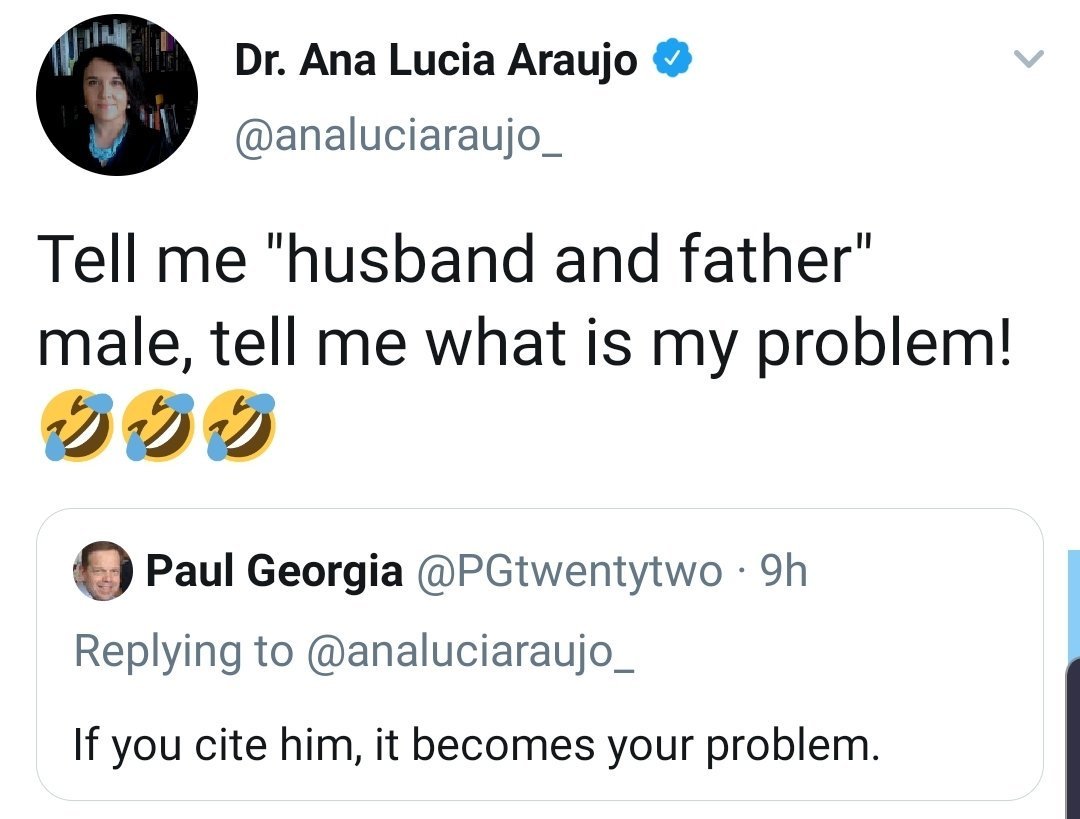
Not just once either. It's as if gratuitous sexism is Araujo's default position.
It'd be one thing if Araujo was just a random troll, in which case she could be ignored. Instead she's a professor at @HowardU and on the editorial board of @AmHistReview.
One wonders: does she extend similar sexism and belligerent obscenity to her students? To AHR submissions?
@HowardU@AmHistReview For example, does she also tell students who question Ed Baptist's error-riddled book in her classroom to "go f*ck themselves"?
Would an article submission to the AHR that challenged Baptist be desk-rejected by Araujo, & its author(s) told to "go f*ck themselves"?
Far-left historians today often exaggerate the importance of slavery to capitalism by tracing cotton's derivative products globally.
That said, there is one 19th century figure who directly benefitted from slave-produced cotton: Karl Marx.
For most of his adult life, Marx relied on handouts from his friend Friedrich Engels for his main source of income. From the 1840s-1869 Marx send Engels a non-stop stream of requests for money, which Engels usually obliged. After 1869, Engels sold his business partnership and began giving Marx a regular yearly allowance from the proceeds that more or less lasted until his death in 1883.
Engels's business, in turn, was a large textile mill in Manchester operated by his father's firm Ermen and Engels. And what did that mill make? Yarns and fabrics out of slave-produced cotton, which it sourced from the American south.
We know this because, in 1862, Engels wrote a letter to Marx about the American Civil War in which he reported that cotton from the south had dried up because of the blockade. Other business records indicate that Ermen and Engels got their cotton from shipments through Liverpool, which in the 1840s-1861 meant southern plantation cotton imports from the United States. Indeed, southern cotton would have been the raw material that sustained the majority of Engels' working career since he retired only 4 years after the end of the Civil War and the abolition of slavery in the United States. His firm likely also got cotton from other sources such as Egypt during the Civil War, but for most of his multi-decade career there, the cotton would have been slave-produced.
That means Engels very much made his family fortune as a derivative beneficiary of American slavery. And he used that slave-derived fortune to directly subsidize Karl Marx ;-)
Marx also knew where his patron's money was ultimately coming from, because Engels would write him detailed letters about the cotton markets in America - letters that were informed by his own business stake as a cotton textile mill manager.
We also know that Engels himself had no problem with his slave-produced inputs. In 1852 he wrote Marx, reporting that he had just pitched his father on relocating to Liverpool...
...where he would serve as the cotton procurement agent for the factory.
I pick on Slobodian in the thread below as an egregious and recurring offender. But this sort of quote-editing by leftist scholars is *extremely* common in academia.
Here's another by Nancy MacLean & Sandy Darity where they transform an attack on Apartheid into a defense of it.
MacLean et all published the manipulated quote above (along with several other similar manipulations) in an article for the Australian journal "History of Economics Review" in 2023.
In 2023 trio of us wrote a response comment calling attention to MacLean et al's blatant misrepresentations & sent it to the journal as a request for correction.
We encountered the same pattern of a politically partisan editor running interference to protect MacLean.
If a historian on the right abused evidence in this way, they'd face career ruination.
When Boston University's Quinn Slobodian does it, he gets a Guggenheim fellowship, book awards, and a Hewlett Foundation grant.
Academia's rot runs far deeper than a simple crisis of rigor.
Slobodian does this sort of thing frequently in his published works - almost always to make the person he is misquoting appear to be sympathetic to racism.
Here's another where he excerpts out the very next sentence in the passage...because it completely contradicts his own claim.
🧵We all saw Gabriel Zucman's NYT op-ed justifying the California wealth tax proposal, along with ostentatious claims that billionaires pay lower tax rates than average Americans. Let's dig into the methodology...
Zucman & his coauthor Emmanuel Saez have been making this claim in various forms for years and presenting it as "fact," even though they have struggled to gain scholarly acceptance of their approach. Instead, they do "peer review" by sending their stuff to the NYT editorial page
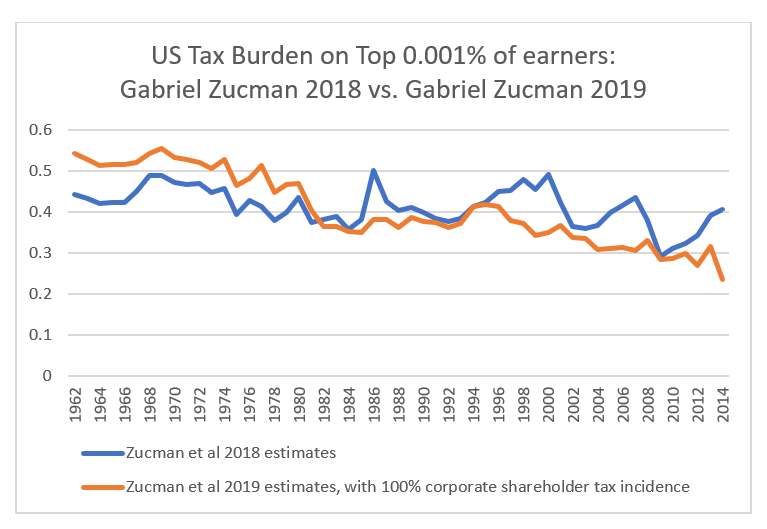
I first caught this pair in 2019 when the rolled out "new" stats claiming that the ultra-wealthy only paid an overall tax rate (federal/state/local) of a little over 20%.
In reality, the wealthiest Americans pay about 41% - a fact admitted in Zucman's own stats from 2018.
And here is a longer academic journal article I wrote about this episode, including digging into what Zucman altered to put his thumb on the statistical scale. independent.org/wp-content/upl…
🧵The Trump admin's defense of Section 122 tariffs has a huge legal obstacle that almost nobody has noticed thus far.
It comes from an obscure provision of the General Agreement on Tariffs and Trade. I'll explain below.
Let's start with Section 122 of the Trade Act of 1974. This is the provision that Trump used to reinstate a 10% across the board tariff after SCOTUS struck down his IEEPA tariffs in February.
The US Court of International Trade ruled against Trump on Thursday. He has appealed.
At issue with Section 122 is the meaning of "Balance of Payments deficits," which must exist before the president can impose tariffs through this law.
Historically, a BoP deficit meant a drawdown on the country's official monetary reserves under the Bretton Woods exchange system