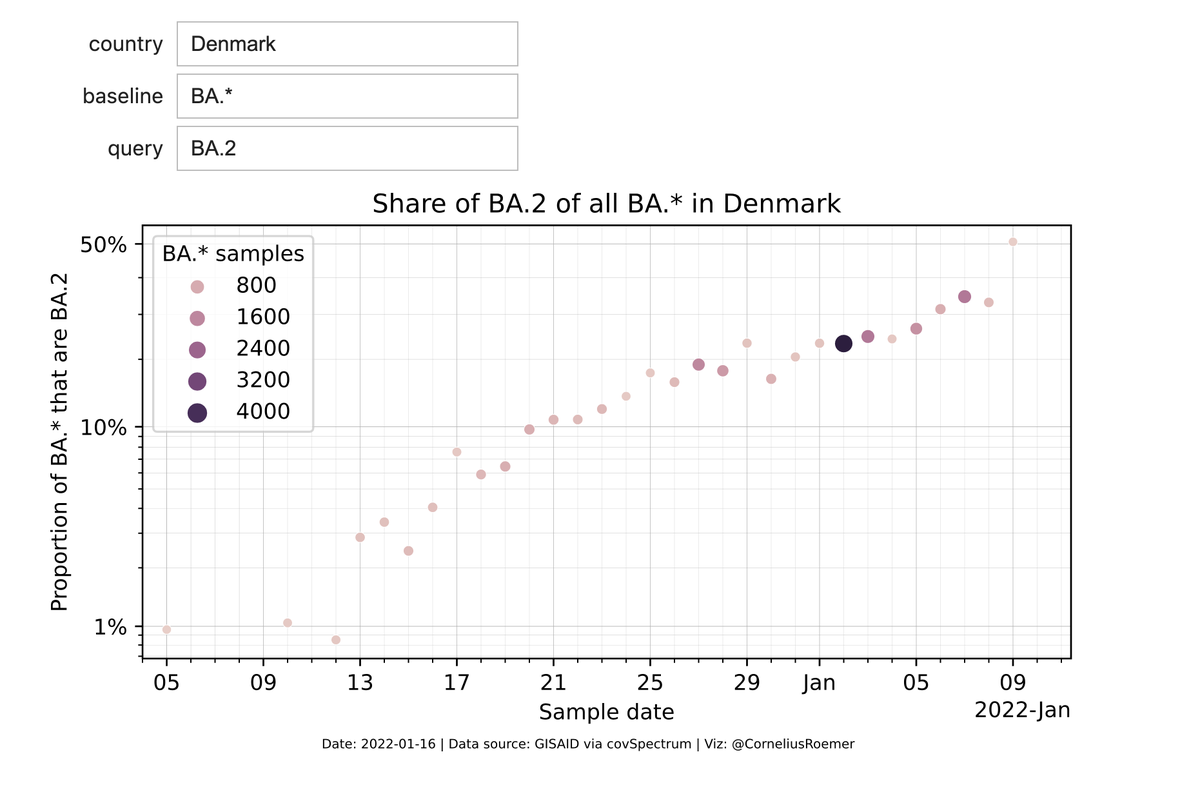
I made a new plot type to visualize how sub-lineages are growing with respect to their parent in a country.
Using @ProjectJupyter, Voila, and Binder I managed to make it interactive, so that everyone can type in their lineages/countries.
Try it out here: mybinder.org/v2/gh/corneliu…
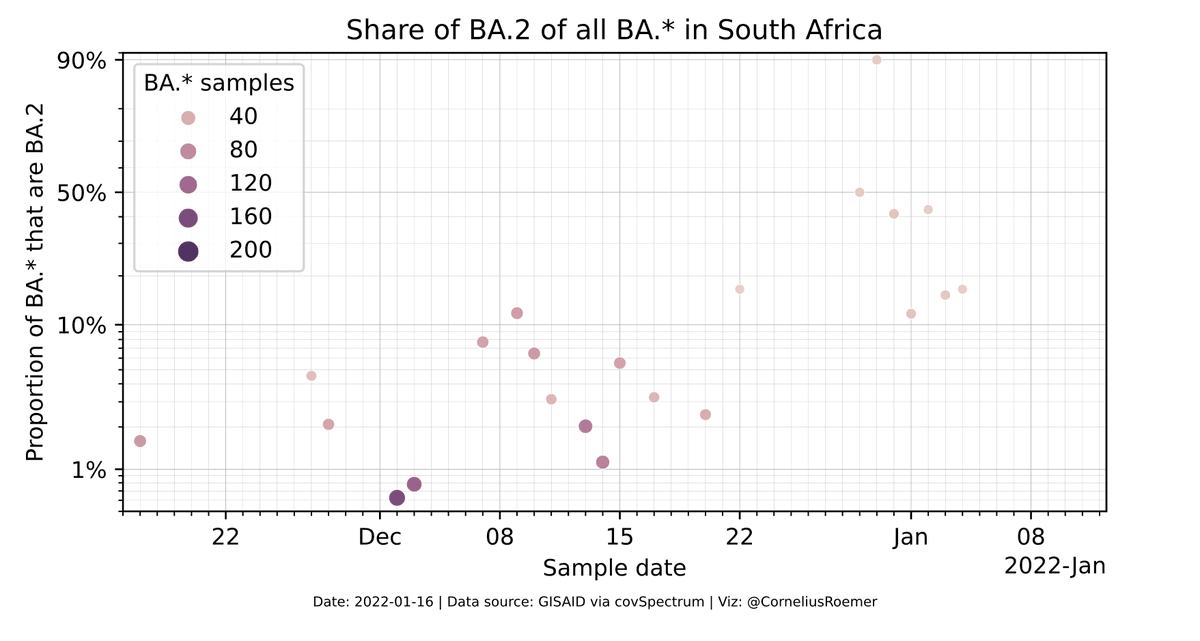
BA.2 is also rising as a share of all Omicrons in South Africa
End of November BA.2 represented around 2% of Omicrons.
Beginning of January, it was about 10 times more, maybe 20%.
In India, BA.2 has become the dominant Omicron variant towards end of December. Growing from ~5% in mid December to >50% by beginning of January.
In most other countries, BA.1 remains dominant, though BA.2 seems to slowly grow in share everywhere.
Apart from some predictions based on BA.2 sequence by @jbloom_lab not much is known about BA.2.
First clinical data will possibly come from Denmark.
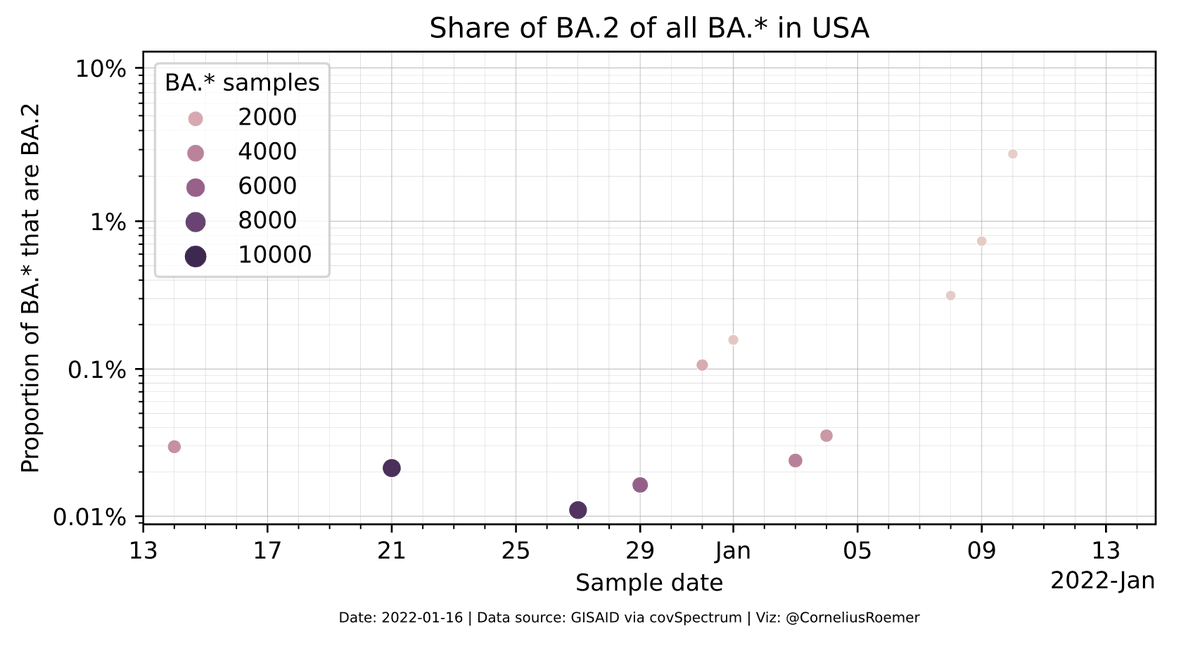
Here's the BA.2/Omicron share in the US
Where there are no dots visible, the share is 0% (which is minus infinity on a logit scale and hence not shown).
BA.2 _is_ detectable by PCR, these news reports are totally wrong.
Depending on the PCR test used it may not look like BA.1 (the other Omicron). But it will still give a positive result.
Frustrating to see falsehood about non-detectability still around.
The same plot type can be used to compare Delta variants, for example AY.4.2* vs all of Delta.
Here in the UK
The code is available here: github.com/corneliusroeme…
It's ridiculously easy to set up and deploy.
I had to fight a bit getting the plots to refresh and not error with partial input but now it works splendidly.
Easy to extend, e.g. query for mutations, multi-country etc.
• • •
Missing some Tweet in this thread? You can try to
force a refresh

Here are counts of BA.2.86 and overall sequence submissions to GISAID
Note that the English sample included in week 2023-08-07 likely got expedited, so it may be best to exclude from this analysis. 1/
In my very rough reading, there's not enough data yet to pin down growth advantage. It could be small or non-existent, or it could be sizeable, e.g. doubling every week.
Bear in mind that due to constant antigenic drift, there are always lineages with decent growth advantage. 2/
To really have an impact, BA.2.86 would have to become dominant, outgrowing even the fittest lineages around, e.g. HK.3 (EG.5.1 with S:L455F) or FL.1.5.1 (456L, 478R) which themselves are doubling in share about every two weeks. 3/
EG.5 (and EG.5.1) has recently got attention due to being highlighted by @UKHSA and @WHO.
EG.5, which is an alias for XBB.1.9.2.5, is a sublineage of XBB characterized in particular by Spike RBD mutation F456L. 1/
EG.5 is one of the fastest growing XBB sublineages, particularly common in China where it appears to be dominant.
As EG.5 has only one RBD difference compared to the upcoming vaccine strain XBB.1.5 vaccine protection is expected to be good. 2/
While the name EG.5 may sound very different from XBB, it is important to know that this is just due to naming - EG.5 is the short form of XBB.1.9.2.5. 3/
It appears that China has stopped uploading SARS-CoV-2 sequences to GISAID and now shares via its own version of Genbank: Genbase github.com/yatisht/usher/…
I don't yet fully understand the terms under which China shares the sequences - I assume (and hope_ they are just as open as Genbank.
In that case this is a great development towards having as much SARS-CoV-2 data being free of usage restrictions as possible.
GISAID should still be able to integrate the data in their platform (unless the license prohibits it, if it's Genbank-like then GISAID can pull the data as they've done with Genbank-only published sequences).
I'm seeing quite a bit of discussion about the potential impact of a big wave in mainland China on variant evolution.
I do not think a big wave in mainland China would have major consequences outside of China. 1/
While China is a big country, it has less than 20% of the global population. The rate at which new variants evolve would only increase slightly as a result of fractionally more infections worldwide. 2/
We have by now seen multiple second generation BA.2 variants evolve independently: BA.4/5 in Southern Africa, BA.2.75 in South Asia, BA.2.3.20 in the Philippines, BS.1 in South East Asia. 3/
For straightforward problems, @github Copilot really rocks.
Yes, as a Python dev, I could code this up myself in less than a minute
But why spend mental energy on this if it can be auto-generated?
As a beginner, this could have easily taken me a few minutes. Now it's just seconds
And the only unnatural about this example is that I deleted the output generated by copilot before recording.
Everything else is exactly as it was when I did it.
Nothing contrived, very natural usage pattern.
It's hard to think of a better way of solving this problem.
Copilot chose a very pythonic solution.
There's a good chance handwritten solutions by many developers would be less idiomatic and more confusing.
BQ.1* and XBB have different geographic foci
BQ.1* is mostly in Africa, Europe and North America
XBB in South (East) Asia
3 countries with similar levels worth watching for comparison and potential co-circulation are:
- Japan
- Australia
- South Korea cov-spectrum.org/explore/World/… 1/
BQ.1.1 and XBB have quite a lot of spike differences and seem to have similar growth advantages - this makes them candidates for co-circulation.
We may only be able to know once we see how the variants do in countries that had a wave with the other one. 2/
Here are the mutations that only occur in one of the two variants:
XBB only: S:V83A, S:Y144-, S:H146Q, S:Q183E, S:V213E, S:G339H, S:R346T, S:L368I, S:V445P, S:G446S, S:F486S, S:F490
BQ.1.1 only:
S:H69-, S:V70-, S:V213G, S:G339D, S:K444T, S:L452R, S:F486V 3/



