Peter Apps Profile picture
Jan 19 20 tweets 4 min read
Here is a tale of the building safety crisis which encapsulates so many of the failures which have led us to this point.

Gather round. We begin our story in late 2013...

insidehousing.co.uk/news/failed-fi…
At around this time Kingspan K15 (a combustible plastic insulation) was the market leading brand for high rise buildings. But people in the industry were starting to ask questions about its fire safety. Was the one test which supported its use really adequate?
As a result, an organisation called the National House Building Council (NHBC) told Kingspan it needed to see more testing proving its suitability. The NHBC is a private firm which signs off new builds as compliant with regulations and also provides warranties for them
Kingspan commissioned some more tests at the BRE (formerly a government-owned laboratory, now a private company). But these tests did not go well.

A first effort in January failed. A second effort in March failed to. But this time it was a bit closer.
The test fails if flames made it above the top of the eight metre rig inside an hour. In the March test, this clearly happened 43 minutes in. But instead of stopping the test immediately (as it was supposed to) the BRE allowed it to run on. But it was still considered a failure
Kingspan challenged this. “Surely we risk making fools of ourselves?” wrote one staff member. Another responded saying they wanted to “sow some seeds to influence that result”. They cc-ed lawyers into an email to the BRE insisting it should be "interpretted as a positive result"
The BRE declined to do so, but did take the unusual step of issuing a test report anyway (they are not typically issued for failed tests). The technician who did this agreed that “very great care would need to be taken” to ensure it was not misconstrued as a pass
But he also accepted this care was not taken. In fact he said “the test report doesn’t necessarily, unless you thoroughly read it, make it clear that the system has failed”. The only way to tell this was to notice the reference to flaming above the rig at 43 minutes.
Outside of this testing regime, the market was changing. Concerned that many buildings were being approved with cladding systems that had not been tested a group of building inspectors led by the NHBC came together to find a way forward.
They ultimately settled on a system of 'desktop studies', where test data could be used to justify systems which had not been specifically tested.

This brings us on to the building in question, Turnberry Quay in east London.
That block was completed in 2017 by developer Bellway. Two years ago, an EWS1 survey found Kingspan K15 insulation behind zinc cladding which the assessor said required remediation. The building had been signed off and warrantied by the NHBC.
Two years on, residents have spent £3,500 each on legal fees, surveys and fire alarms. They have been unable to sell their homes and move. They could still face life-changing bills for remediation.
In the course of investigating this, they have obtained the desktop study, produced in 2016 by fire engineering consultancy Warringtonfire which justified the use of K15 on their building.
Among other data, this report cited the March 2014 test as evidence of the product's compliance with regulations. The test which had failed. Not to mention that, we now know other tests which passed were carried out on versions of K15 which were not on the market.
Kingspan say it's perfectly normal to use data from failed fire tests as part of the evidence in a desktop study. They say it would have been obvious to Warringtonfire's engineers that the test failed and say that much post-Grenfell testing has proved K15 can be used safely
But this is little comfort to the residents. They are yet to hear if they qualify for the Building Safety Fund. Neither NHBC (which warranties the building) or Bellway have yet confirmed they will pay for the remediation.
This story is the building safety crisis in a microcosm: a failed testing regime, non-existent oversight of the use of combustible materials and now a system which seems incapable of holding anyone to account except those who live in the block. All of it must change.
For more on the bits in this thread you can read about Kingspan's testing here:

insidehousing.co.uk/insight/insigh…
More about the BRE's role here:

insidehousing.co.uk/home/home/gren…
And more about the NHBC here:

insidehousing.co.uk/insight/grenfe…

• • •

Missing some Tweet in this thread? You can try to force a refresh

 

Keep Current with Peter Apps

Peter Apps Profile picture

Stay in touch and get notified when new unrolls are available from this author!

Read all threads

This Thread may be Removed Anytime!

PDF

Twitter may remove this content at anytime! Save it as PDF for later use!

Try unrolling a thread yourself!

how to unroll video
  1. Follow @ThreadReaderApp to mention us!

  2. From a Twitter thread mention us with a keyword "unroll"
@threadreaderapp unroll

Practice here first or read more on our help page!

More from @PeteApps

Jan 10
Right so: some thoughts on what Gove has announced and is set to announce later (details courtesy of @JSimpsonjourno).

Some good. Some bad. Some potentially ugly (thread)

insidehousing.co.uk/insight/goves-…
What is Gove proposing? For those who haven't seen the news over the weekend, he is saying the current £5.1bn of cladding funding will be extended by £4bn, to cover remediation costs in buildings between 11m and 18.5m.
But it will not come from new govt funding. Instead Gove wants to get the construction industry into a room, threaten them with tough legislation and make them pay up apparently voluntarily. There are some problems with this and a major cavaet we will get to in the 'ugly' section
Read 31 tweets
Dec 16, 2021
Big scoop from Jack:

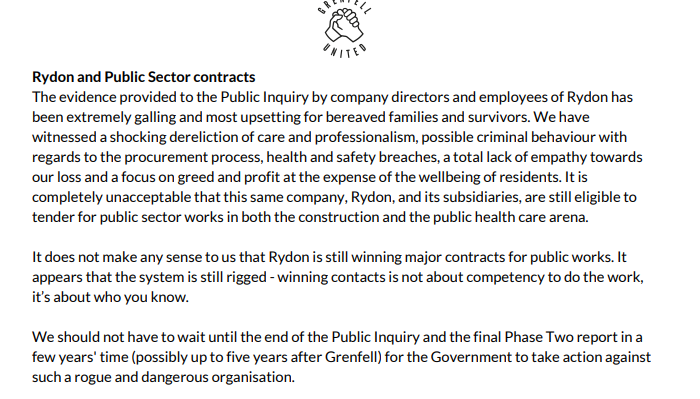
The government is understood to be considering preventing Rydon Homes accessing the Help to Buy programme, due to Rydon's involvement in the Grenfell Tower refurbishment. A couple of thoughts below:
If enacted this would be the first major govt level sanction for any organisation involved in the Grenfell Tower fire. They have talked tough in the past, but have never matched it with action.
However, you would have to ask: why now? Bereaved and survivors group Grenfell United have been pushing for this exact move since 2019. Below is a letter they sent to Robert Jenrick in August 2020:
Read 6 tweets
Dec 16, 2021
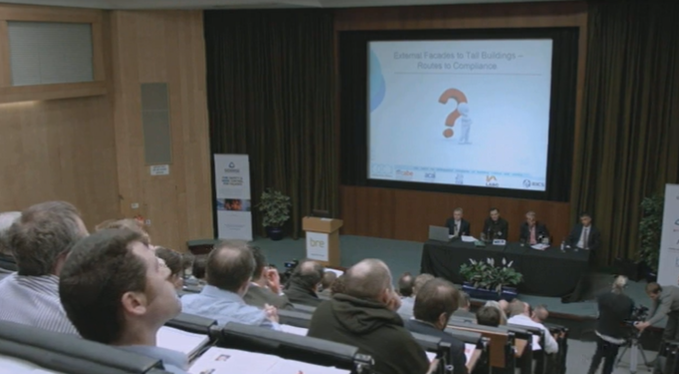
A pretty extraordinary morning just gone where we saw video footage from a January 2016 conference where a cladding fabricator warned of the wide-use of ACM (the cladding used on Grenfell) and the chair described it as a potential "ticking time bomb"
Audience member was Nick Jenkins, then of Euroclad. He warned that the material was in wide use in the UK and as a result "You could have an exact repeat of the Dubai fire in any number of buildings that we supply product to in London"
Steve Evans of the NHBC (largest building control body in the UK) was on the panel and agreed with Jenkins that an "anomaly" in official guidance this type of cladding "would meet the regulations". He told the inquiry today this was not his view and it was "badly worded"
Read 7 tweets
Dec 15, 2021
Report from today at the Grenfell Inquiry:

NHBC continued to permit the use of Kingspan insulation on high rises despite its own fire engineer concluding the combustible material was "an accident waiting to happen"

insidehousing.co.uk/news/nhbc-cont…
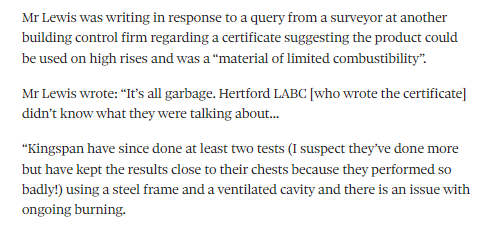
NHBC fire engineer John Lewis wrote this about Kingspan's K15 insulation in November 2014. But the firm (Britain's largest building control inspector) continued to sign off high rise projects containing the insulation
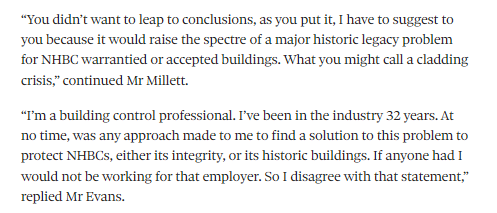
At March 2015, NHBC estimated it had 300 high rise buildings on its books using K15. Asked whether he was concerned that changing course would reveal a "cladding crisis" in all the facades signed off by NHBC, Mr Evans said no:
Read 5 tweets
Dec 14, 2021
Report from today at the Grenfell Tower Inquiry:

A senior manager at the NHBC has denied the firm was "captured by Kingspan" and "used as their poodles" over its acceptance of combustible insulation on high rises

insidehousing.co.uk/news/nhbc-deni…
The NHBC - the largest private building inspector in the country and a major warranty provider for new homes - was warned Kingspan's K15 insulation was not compliant on almost all high rises in summer 2013. But it carried on signing it off.
Today's witness Steve Evans blamed a misleading third-party certificate implying it was acceptable, and said NHBC was willing to wait for the firm to provide additional testing to demonstrate it was safe
Read 5 tweets
Dec 14, 2021
Report from the Grenfell Inquiry by
@Grainne_Cuffe:

The firm which issued a certificate saying Kingspan’s combustible insulation could be used on high rises was “gamed”, “played”, and “sweetened up” by the manufacturer, a senior staff member has said

insidehousing.co.uk/news/firm-that…
The inquiry saw an email showing that when Kingspan approached LABC asking for a large range of certificates another senior staff member wrote “We’ll save this failing company yet! Seriously, that’s really good news.” They had already been warned about its combustibility
When another building control operation (the NHBC) was considering rejecting the use of Kingspan's K15 on high rises due to fire safety concerns, internal emails show LABC staff describing it as "business opportunity" for LABC
Read 5 tweets

Did Thread Reader help you today?

Support us! We are indie developers!


This site is made by just two indie developers on a laptop doing marketing, support and development! Read more about the story.

Become a Premium Member ($3/month or $30/year) and get exclusive features!

Become Premium

Too expensive? Make a small donation by buying us coffee ($5) or help with server cost ($10)

Donate via Paypal

Or Donate anonymously using crypto!

Ethereum

0xfe58350B80634f60Fa6Dc149a72b4DFbc17D341E copy

Bitcoin

3ATGMxNzCUFzxpMCHL5sWSt4DVtS8UqXpi copy

Thank you for your support!

Follow Us on Twitter!

:(