1. This is a good thread but saying there's no anti-Semitism & Holocaust denialism misses the point since it's very clear from the minutes that the swear words & nudity are pretextual for larger discomfort about a story about the Holocaust.
2. I would encourage reading the actual transcripts because it's very explicit board members think grade 8 students should read about "It shows people hanging, it shows them killing kids" -- i.e. it's about the Holocaust.
3. The other area of objection is Maus shows how fraught Art Spiegelman's relationship is with father -- which is part of what makes the book great. It's about how suffering doesn't ennoble but causes trauma that ripples through generations.

4. Also the board members constantly talk about the "nudity" in Maus as if its salacious and sexual (this Spiegleman fellow worked for Playboy) when, as @janecoaston noted the nudity is of death camp prisoners being stripped naked, which actually happened
5. So the position of the school board is they are ok with kids learning about Holocaust so long as there are no hangings, no kids being killed, no intergenerational trauma & no scenes of naked prisoners. Which is the same as saying they don't want kids to learn about Holocaust
6. I would encourage people to read the school board minutes because beyond the decision to remove Maus it reveals a fundamental desire to avoid confronting the reality of the Holocaust. That's not Holocaust denial but it is a deeply anti-intellectual & harmful
7. The aversion to teaching the darker details about the Holocaust is very similar to the freakout over 1619 & history of slavery in general. It's about much more than swear words or nudity. More here: jeetheer.substack.com/p/maus-in-tenn…
• • •
Missing some Tweet in this thread? You can try to
force a refresh

1. When the Nation published my tribute to Terry Teachout this week they used this photo of The Vile Body, a salon Teachout formed in late 1980s, which revived all sorts of memories of the cult of Waugh & the failed attempt to create an American cultural aristocracy.
2. When we think of cultural Reaganism, what usually comes to mind is the populist pop stuff: Family Ties, Rambo, Red Dawn etc. But there was a niche high end counterpart in the Waugh Revival. Tellingly, when PBS aired Masterpiece Theatre they got William F. Buckley to introduce
3. The Wauvian moment in 1980s had many roots: popularity of the BBC adaptation of Masterpiece Theatre, longstanding anglophilia in elite circles bolstered now Thatcher/Reagan relationship, desire for alternative canon to fight cultural liberalism.
1. "Reactionary centrism" is a bulls-eye description of a powerful political faction that is claims to be trying to save the Biden presidency but is actually working to capsize it: Manchin, Sinema, Friedman, David Brooks, many flying the "popularist" banner.
2. This Brooks tweet is a nice encapsulation of the project of reactionary centrism, which is to get Biden to throw overboard the progressive agenda & govern as a center right president.
3. There's a lot to be said about reactionary centrism, one of which is that these are sore winners. They've gotten everything they wanted: Biden as president, Machin as veto on agenda, national unity & norms rhetoric. If things are a mess, maybe look in the mirror?
1. A lot of twitter jokesters had a field day a New Yorker critic named The French Dispatch as the best film of 2021 -- it seemed a mite self-congratulatory for The New Yorker to celebrate a film celebrating The New Yorker.
2. There have been movies about The New Yorker & its writers before -- Mrs. Parker and the Vicious Circle, Joe Gould's Secret -- but none have been as polarizing as The French Dispatch, in part because its not just about the magazine but the myth of the magazine.
3. The myth of New Yorker was actually discouraged by the two editors who dominated the magazine for its first 60+ years, Harold Ross & William, both in their way men of the shadows who wanted editing to be invisible. They resented myth-making of Thurber, Brendan Gill, etc.
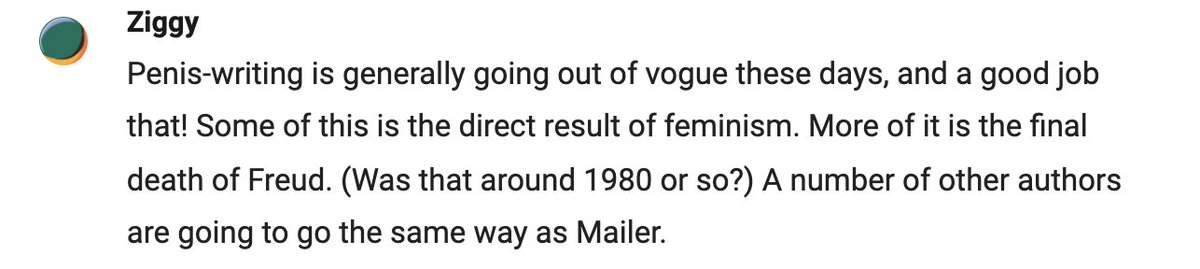
1. Mailer pseudo-kerfuffle follows a pattern: there's a type of male writer who tends to be a star when alive & then goes into reputational decline soon after death: macho, two-fisted, sometimes substance abusing: Hemingway, Hunter Thompson, Mailer, Harlan Ellison, Hitchens.
2. A commentator on my substack calls this literary school "penis-writing" and suggests it's fallen out of fashion. Hemingway has enjoyed a partial revival based on strength of his short stories, but it's hard to imagine Thompson, Mailer, Ellison or Hitchens doing same.
3. Hitchens is a particularly interesting case. The 10th anniversary of his death (Dec. 15, 2011) was last month and there is a flurry of attempts to reevaluate, shore up or restore, notably a @graydoncarter piece & @BenBurgis' new book.
1. Peter Sellers has an awkward cameo in Get Back. He showed up at the studio while the Beatles were uncertain of their fate after George Harrison briefly left the band. His appearance is a reminder though of how the band is part of the history of comedy as well as music
2. We all know about the British Invasion as a musical story: the Beatles, the Stones, the Who. But, less visible in North America, this efflorescence overlapped with the great flourishing of English comedy: The Goon Show, Sellers, eventually Python.
3. There were multiple links between the comedy explosion & music explosion. Both owing a debt to musical hall & nonsense literature, records as a major venue for comedy in that era, George Martin as a producer for Goon Show & other comedians before becoming Beatles impresario.