Today we report in @biorxiv programmable RNA sensors that express any protein gated on specific RNAs in a cell. Much like gene sequencing necessitated gene editing tools, we answer “What is the Cas9 of single cells?” 🧵👇🏼w @jgooten & @insitubiology 1/17 biorxiv.org/content/10.110…
Genome sequencing needs gene editing to probe insights gained from the data. With the advent of single-cell RNA seq (h/t @humancellatlas), there is now a similar need for cell type targeting at the RNA level. We tackle this with RADARS, a programmable way to target cells 2/17
Cell type targeting typically requires cell-specific promoters, which are tough to develop.
RADARS can express any protein (e.g. GFP, luciferase, caspases, Cre) simply by designing a guide against an RNA target – now targeting cells is as simple as editing the genome! 3/17
RADARS can express any protein (e.g. GFP, luciferase, caspases, Cre) simply by designing a guide against an RNA target – now targeting cells is as simple as editing the genome! 3/17

So how does RADARS work? We were inspired by our previous work on RNA editing tools like REPAIR for A to I editing of transcripts, which is useful for correcting disease mutations or pre-termination stop codons (UAG->UIG). 4/17
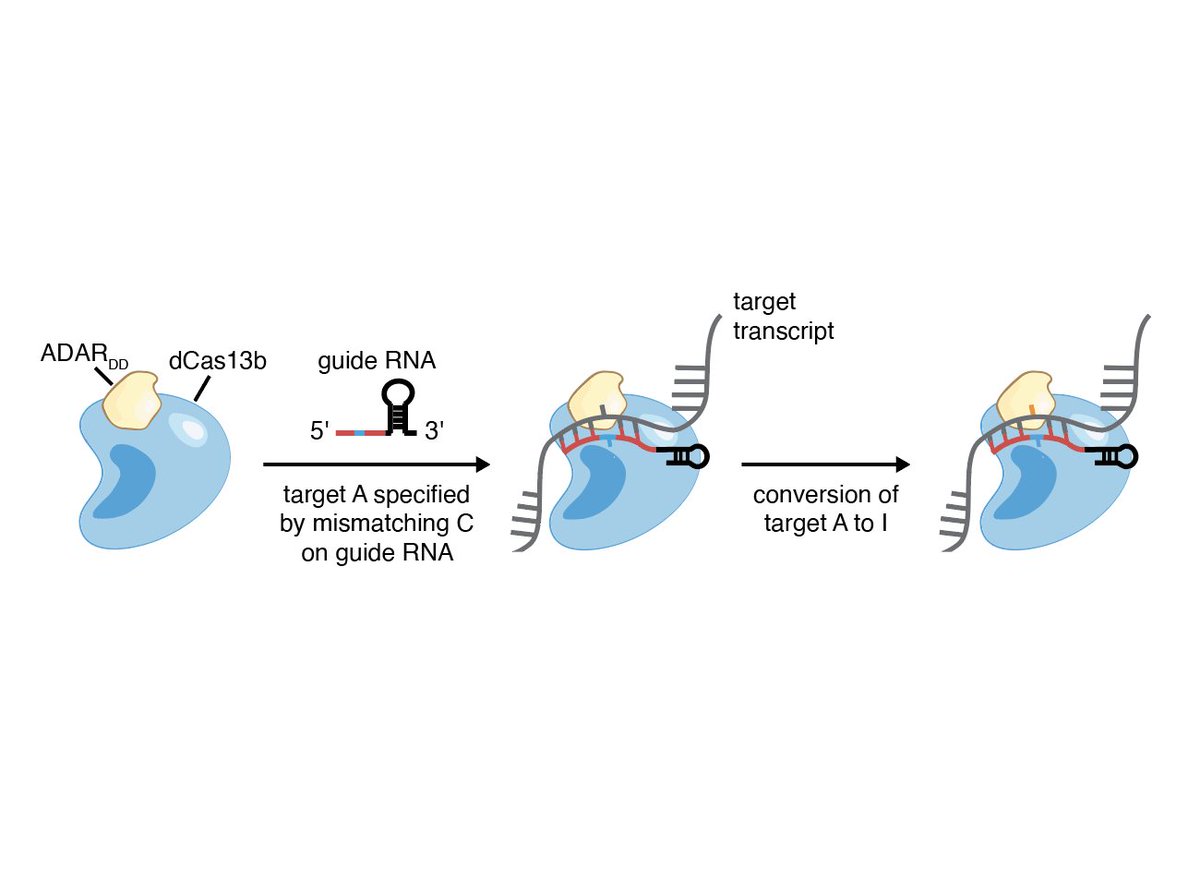
RADARS flips this paradigm around: instead of the guide editing the transcript via ADAR, the transcript edits a stop codon within the guide that has a gene cargo “downstream”. Editing of the stop codon then unleashes expression of the gene cargo – as simple as that! 5/17

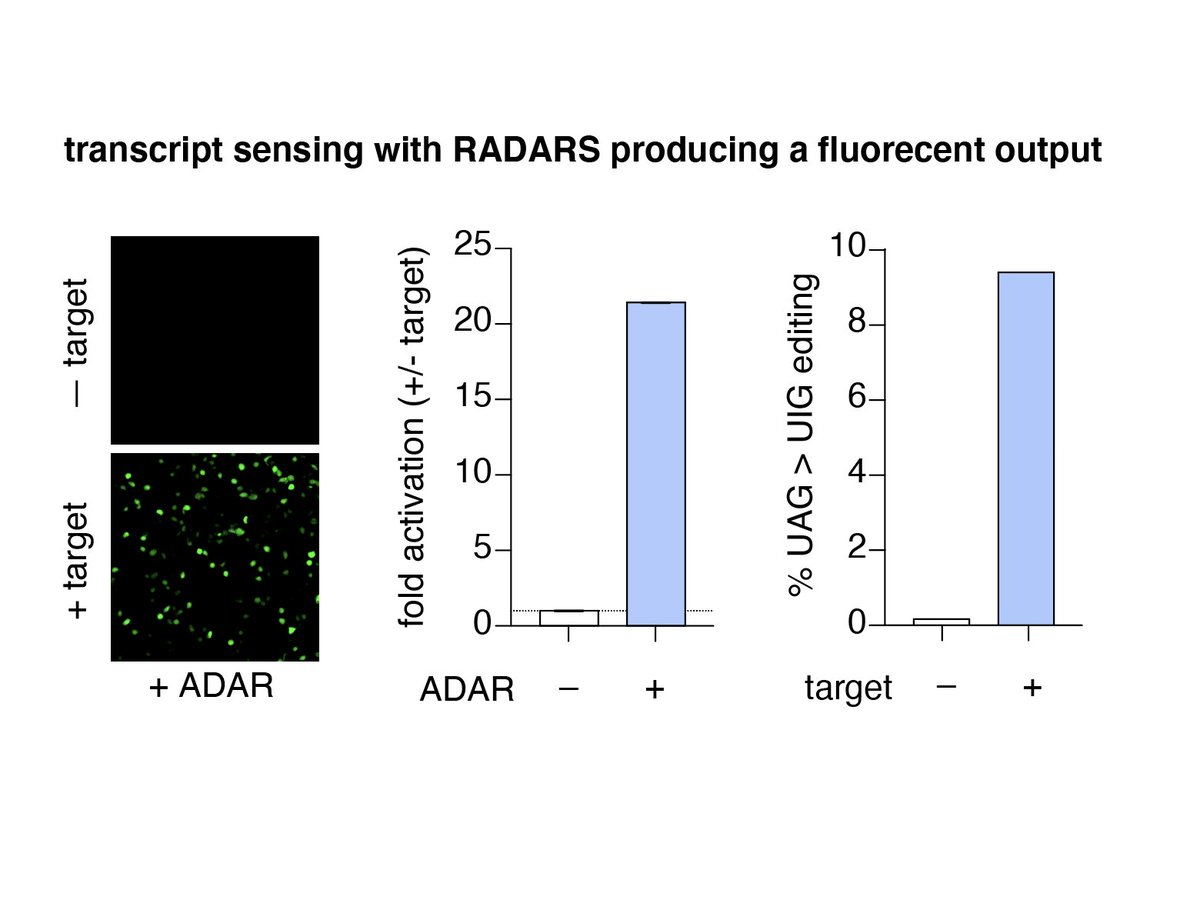
We first put RADARS to the test on sensing an EGFP transcript, finding success with both fluorescent and luciferase outputs and up to ~51 fold sensor activation. 6/17

What if you want to track individual cells? Fluorescent output versions of RADARS work great too, with high signal to noise and low background. They make for very pretty images as well! 7/17
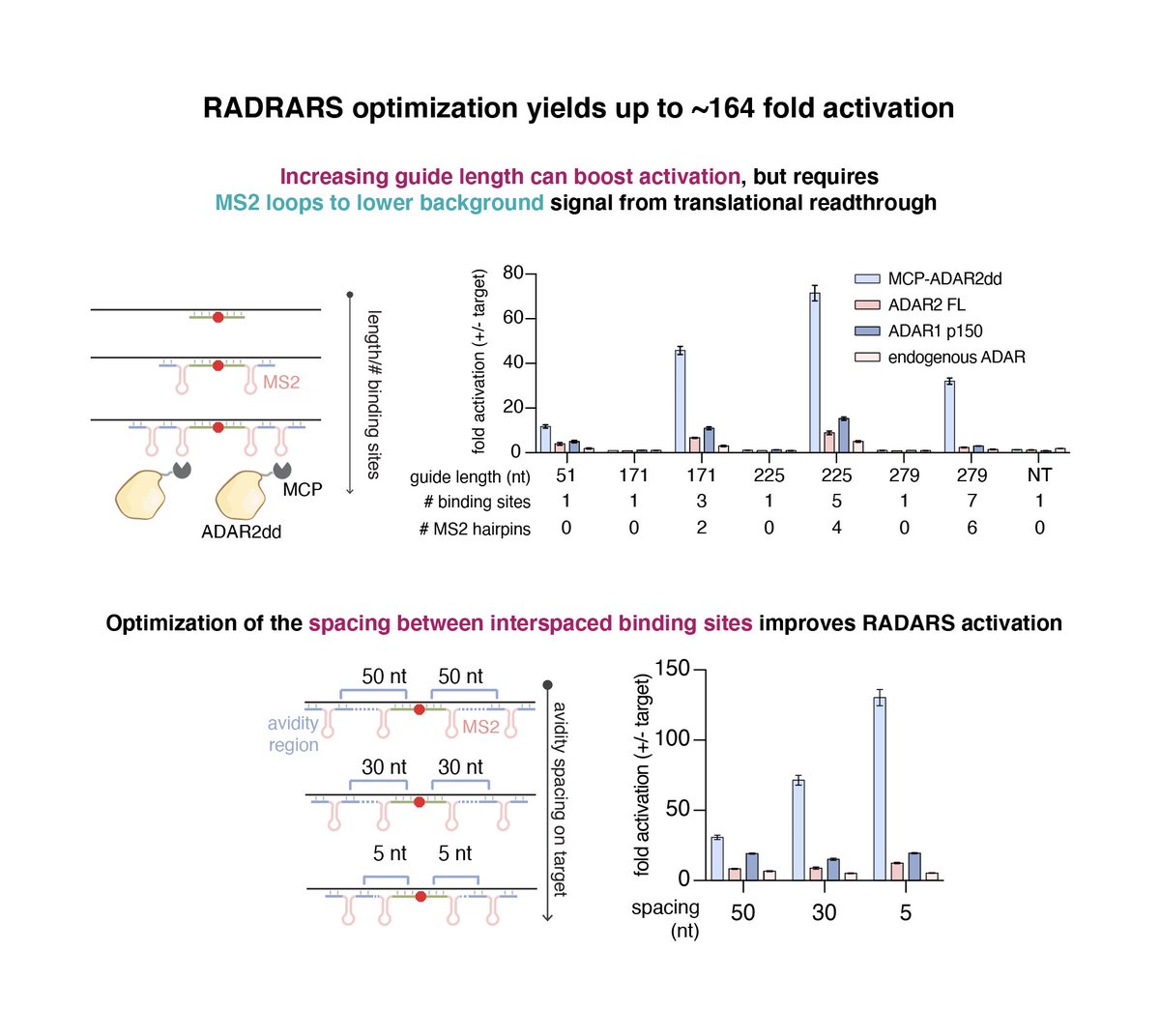
Engineering of the ADAR proteins and guides, including guide length titrations and secondary structure motifs like MS2 hairpins to block translational readthrough, brought our sensor activation up to 164-fold. 8/17
Moreover, RADARS is quantitative. We tested transcript levels over a 25-fold dynamic range and found strong linear correlation. We were quite surprised how quantitative these sensors can be! 9/17

On endogenous RNAs, RADARS delivers! We demonstrate RADARS for applications involving RNA knockdown (siRNA) and upregulation (heat shock model), finding that the sensors can track RNA levels in both directions consistent with gold standard qPCR. 10/17

RADARS is more than just a cell tracker though! Did you ever want to kill an undesirable cell type (like in a tumor) or downregulate a specific cell state? Well now you can. Using a caspase as the output protein, RADARS enables inducible cell killing based on specific RNAs. 11/17

What if your cell is marked by more than a single RNA? RADARS can sense two inputs, including AND and OR gate logic. Since many cell types can be distinguished by single or dual transcripts (analysis based on GTEx), this is a helpful feature. More complex logic coming soon! 12/17

What if you don’t want to overexpress a pesky ADAR protein? Well, we also show that RADARS can work with endogenous ADAR proteins normally expressed in human cells (albeit with lower activation), which could be useful for future clinical applications. 13/17
Lastly, we test RADARS on synthetic mRNAs. While DNA constructs have cell-specific promoters, there are no tools for restricting expression of synthetic mRNAs to specific cells. RADARS works with synthetic mRNAs and endogenous ADAR in vivo to detect liver specific RNAs. 14/17

We hope that RADARS will be useful to the research community for applications across basic science, therapeutics, and diagnostics. 15/17

As a quick aside, @jooten and I are expanding the lab so come join us if interested in developing RADARS further for cell control! 16/17
This work was the result of a fantastic collaboration with @jgooten, Fei Chen @insitubiology and incredible team effort led by Kaiyi Jiang @idmjky, Jeremy Koob, @dawnchenx, @RohanKrajeski, and Yifan Zhang with @lukas_villiger and @91_naynay. Congrats to this talented group! 17/17
Of course, would like to thank @mcgovernmit, @broadinstitute, our funders, including NIH, K. Lisa Yang and Hock E. Tan Center for Molecular Therapeutics, G. Harold & Leila Y. Mathers Charitable Foundation, Impetus Grants, Cystic Fibrosis Foundation, and all our other supporters!
• • •
Missing some Tweet in this thread? You can try to
force a refresh