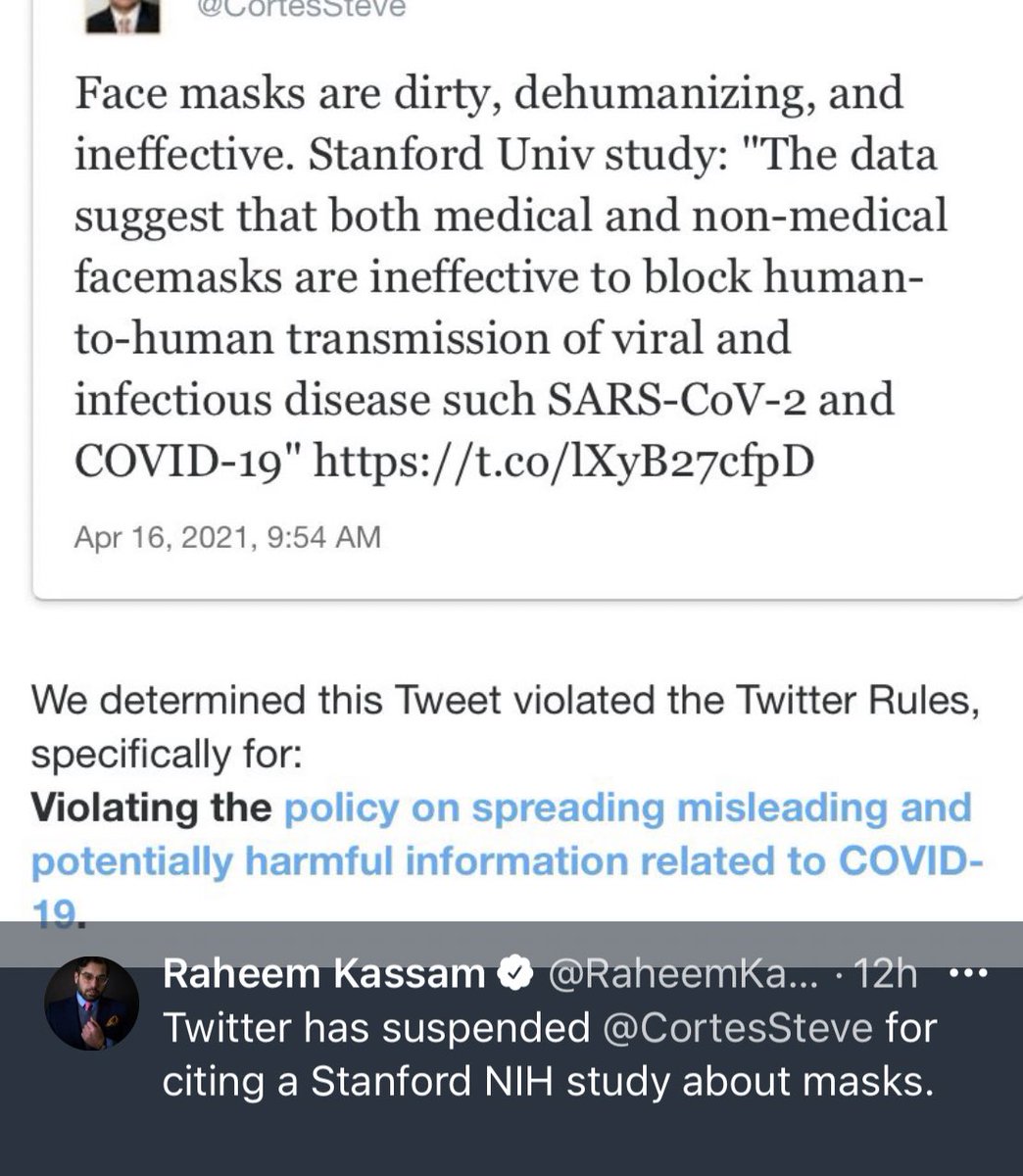
My thanks to @lionandunicornnews for altering me to this. This conversation with @ezraklein is a great example of how @johannhari101 gets his dodgy claims past his interlocutors. This was for the @nytimes. Not some gormless wellness podcast. nytimes.com/2022/02/11/pod…
First, he replies with a compliment to the interviewee. He does this all the time, no matter the quality of their points. (He even did it with Bill Maher.) Like saying your name over and over again, this is a technique of persuasion.
But it moves him on to making a point that supports the Stolen Focus thesis, but is deeply dubious. And @ezraklein knows it’s wrong, because he’s recently heard it debunked. So quite rightly, he challenges him on it.
Oh dear. Will Johann concede? Or reveal the source data from c.1922 that proves his point? (Spoiler: I don’t think it exists.) No. He just bulldozes @ezraklein with something that seems to me to be entirely false.
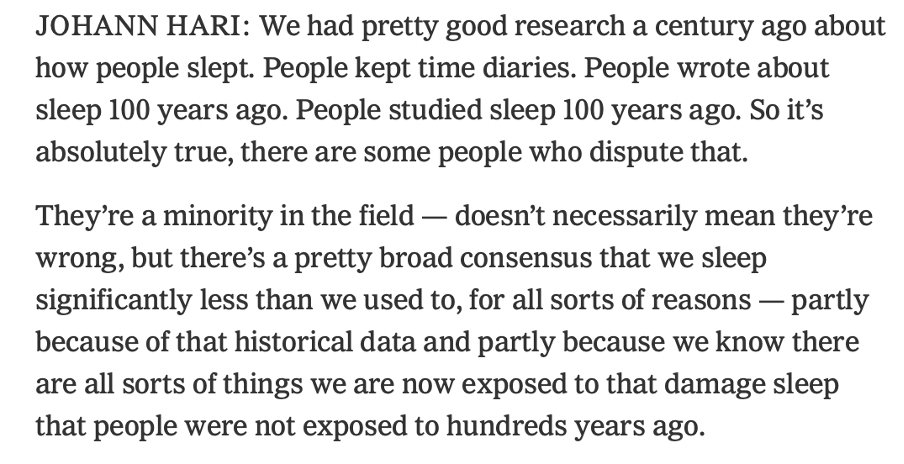
Johann says there is a consensus that our hours of sleep are falling, and that a minority disputes this. Let me give you some actual evidence. This is a study about UK sleep patterns since the 70s. onlinelibrary.wiley.com/doi/full/10.11…
Here’s another: A study of studies, collating material collected over decades. Pretty authoritative. ncbi.nlm.nih.gov/pmc/articles/P…
But @ezraklein doesn’t have all this at his fingertips, and probably trusted Johann and his editors at @bloosmburybooks to have done their job. Is the book any more trustworthy? Well, here, in Stolen Focus, is a melange of stats about sleep. Where on earth do they come from?
Well, that top one (and the 42 per cent figure) comes from a Gallup poll. Not a scientific study. A Gallup poll. And what about the National Sleep Foundation? They sound authoritative, don’t they? Uh-oh. Anyone who read Johann's anti-anti-depressant book won't like this.
So Stolen Focus ignores reliable studies that would dismiss its thesis, and seizes upon really ropey material that supports it. And the book is doing really well – which, I think, is the only strong evidence for its argument that nobody is paying attention.
The melancholy of Bagpuss, and its presentation of the past as something that is always being lost and recovered, has haunted me for decades. Those broken things were repaired, but nobody ever came to collect them, did they?
I can’t help feeling that Oliver Postgate’s father Raymond has a presence here. He was a Great War conscientious objector disowned by his father. Maybe this is the why Emily’s Edwardian world seems so sad and bereft.
And of course Raymond was a communist too - I’m sure he would have been amused by Bagpuss’s depiction of the intellectuals and the workers.
Fascinated to read in @Londoners_Diary that someone has put my criticisms of Stolen Focus to @johannhari101 and that he replied by saying that the "attention crisis" is real because "we sleep less than we did in the past". standard.co.uk/news/londoners…
Sorry to sound like a stuck record, but this is another issue on which Stolen Focus cherry-picks and exaggerates. Sleep deprivation is bad for you, that's obvious. But is there really a historic decline in the number of hours we spend asleep?
In this melange of stats (some plucked from Gallup polls), Johann acknowledges that there is "a scientific debate about the extent our sleep loss" - but he doesn't tell you about evidence that points in the opposite direction - that we're actually sleeping more than we once did.
Well, I was booked to go on @BBCRadio4 PM to challenge @johannhari101 about assertions made in his new book. He has pulled out for "personal reasons", so I'll just leave a thread about my concerns about his use of sources. I hope someone else will raise these questions with him.
Stolen Focus book is full of stats, full of references to scientific research. Can its author be trusted to handle this research – not to cherry-pick to help his case? I'll let you judge.
Let’s look at two examples. This is from a chapter about multitasking, but it also reaches towards Hari’s main point – that the seductions of digital culture are reducing our powers of concentration.
It was easy to find the url for the study because anti-vax and conspiracy theory Twitter has gone wild for it.
It’s by someone called Baruch Vainshelboim. He seems to be a sports physiologist with some link to Stanford. But the publication in which his work appears is not peer-reviewed, and it has weird spelling mistakes and footnotes with no page refs.
The Carry Ons will be rightly prominent in the obits today, but I want to think of Barbara Windsor like this today, as key member of Joan Littlewood’s revolution in theatre. In 2014 I met with her at Stratford East to discuss her part in Oh What a Lovely War!
We talked about taking the play to New York, how she gave free tickets to the Quakers holding a vigil in Times Square for the victims of the war in Vietnam. Here she is with Littlewood arriving at the airport.
We also talked about Michael Gove, who had written about the play in the Daily Mail as a “prime source of left wing myths” that reflected “the unhappy compulsion ... to denigrate virtues such as patriotism, honour and courage.”
Something happened today I’ll remember forever. A discussion on dictatorship for @BBCFreeThinking. This is Francesca Santoro L’hoir. Born 1933. As a little girl she acted with Chaplin in The Great Dictator. Could you read the last speech for us, I asked? She did. Devastatingly.
Here she is on the set with Chaplin, and in her scene in the movie as Aggie.