Ruth Deyermond Profile picture
Mar 4, 2022 17 tweets 3 min read Read on X
I wonder if what looks ever more like a huge military, economic, and strategic disaster for Russia is a product of a category error by Putin, who failed to appreciate what type of Russian military action he was starting. (A thread – apologies for the length.)
In the post-Soviet period, significant Russian state involvement in conflicts, Wagner operations aside, has been of three basic types. All of them have been ones where Russia had a clear military or legal advantage.
Type 1 (the earliest) was Russian “peacekeeping” in the post-Soviet separatist conflicts outside its borders. Russian interventions in the 1990s in states like Moldova and Georgia sided with separatists in order to obtain leverage over the government concerned.
This normally meant a “peacekeeping” presence in strategically useful regions (Transnistria, Abkhazia), preventing host states joining Western institutions. The presence was permanent because the conflict was never resolved (and vice versa). Pre-Feb 22, Donbas was another e.g.
These were relatively low cost operations benefiting from local support in the separatist regions and relying on (a) the huge capability gap between the Russian armed forces (even at its 1990s weakest) and the host state, and (b) the West not caring enough to do anything about it
Type 2, related to type 1, is the short war in support of a theoretically separatist region but where rather than keeping the opposing sides apart as peacekeepers, the Russia substitutes for the separatist forces and aim to secure the region officially or unofficially for Russia.
This was true in 2008 in Georgia, where a “responsibility to protect” the Russian citizens it had created provided a (not convincing) justification for its military action which allowed it to de facto acquire 2 regions of Georgia. Broadly the same logic applied in Crimea in 2014.
As with type 1, Russia’s ability to achieve its objectives fairly easily depends on the capability gap between Russia and the states involved (in the case of Ukraine in 2014, partly a product of the fact that the annexation happened during a period of wider domestic turmoil).
And though Western condemnation and penalties were stronger in these cases, they were still fairly limited - certainly compared with the benefits.
Type 3 is participation in an internal conflict on the side of the state concerned, rather than the separatists/insurgents. Syria falls into this category as, obviously, do the two wars in Chechnya.
Russia’s involvement in the conflicts (whatever the illegality of actions on the ground) was legal because in one case it was at the request of the state involved and in the other it was itself the state involved.
Putin’s language on the 2022 invasion of Ukraine suggests he thinks this an intervention of the second type – a South Ossetia or Crimea operation on a larger scale. The signs that the Russian government and military weren’t expecting a long conflict also suggest this.
But the invasion (or rather, the full scale invasion, since the invasion began in 2014) is none of these types of conflict – it’s war of a kind that Russia hasn’t previously tried to wage at any point in the post-Soviet period.
It’s a straight-up, illegal war of aggression involving horrendous war crimes against the civilian population, intended to effect regime change and to assert Russian hegemony (by re-orienting a puppet Ukraine back towards the “Russian world”).
And it’s not against a small, weak state with a small, weak army, and it’s not being fought in a largely pro-Russian region. And because it’s not an internal Russian issue, the war crimes being committed haven’t attracted the same semi-tolerance from external actors.
And just as importantly, partly because of these things, partly because of the cumulative effect of Georgia and Crimea and the wider collapse in Russia-West relations, the West is no longer indifferent or half-hearted in its response.
In assuming (and I have no idea why he did this, if he did) that he was involving Russia in a type of conflict that had worked for it before, Putin has dragged Russia into a war with devastating costs and which it cannot, in the long term, win. It’s a staggering mistake.

• • •

Missing some Tweet in this thread? You can try to force a refresh

 

Keep Current with Ruth Deyermond

Ruth Deyermond Profile picture

Stay in touch and get notified when new unrolls are available from this author!

Read all threads

This Thread may be Removed Anytime!

PDF

Twitter may remove this content at anytime! Save it as PDF for later use!

Try unrolling a thread yourself!

how to unroll video
  1. Follow @ThreadReaderApp to mention us!

  2. From a Twitter thread mention us with a keyword "unroll"
@threadreaderapp unroll

Practice here first or read more on our help page!

More from @ruth_deyermond

Jan 1
It's New Year, so time to look back and forward. These are 10 things I think we need to recognise in 2026. It’s a response to what I think are profoundly damaging mistaken assumptions I’ve heard and read from practitioners, journalists, and analysts in 2025. Warning: very long🧵
1. Russia isn’t winning in Ukraine.
Russia has expended extraordinary levels of resources, lost hundreds of thousands of men, and restructured its economy all in the attempt to win a war it started for no obvious reason against a smaller, less well-resourced state.
Read 55 tweets
Dec 16, 2025
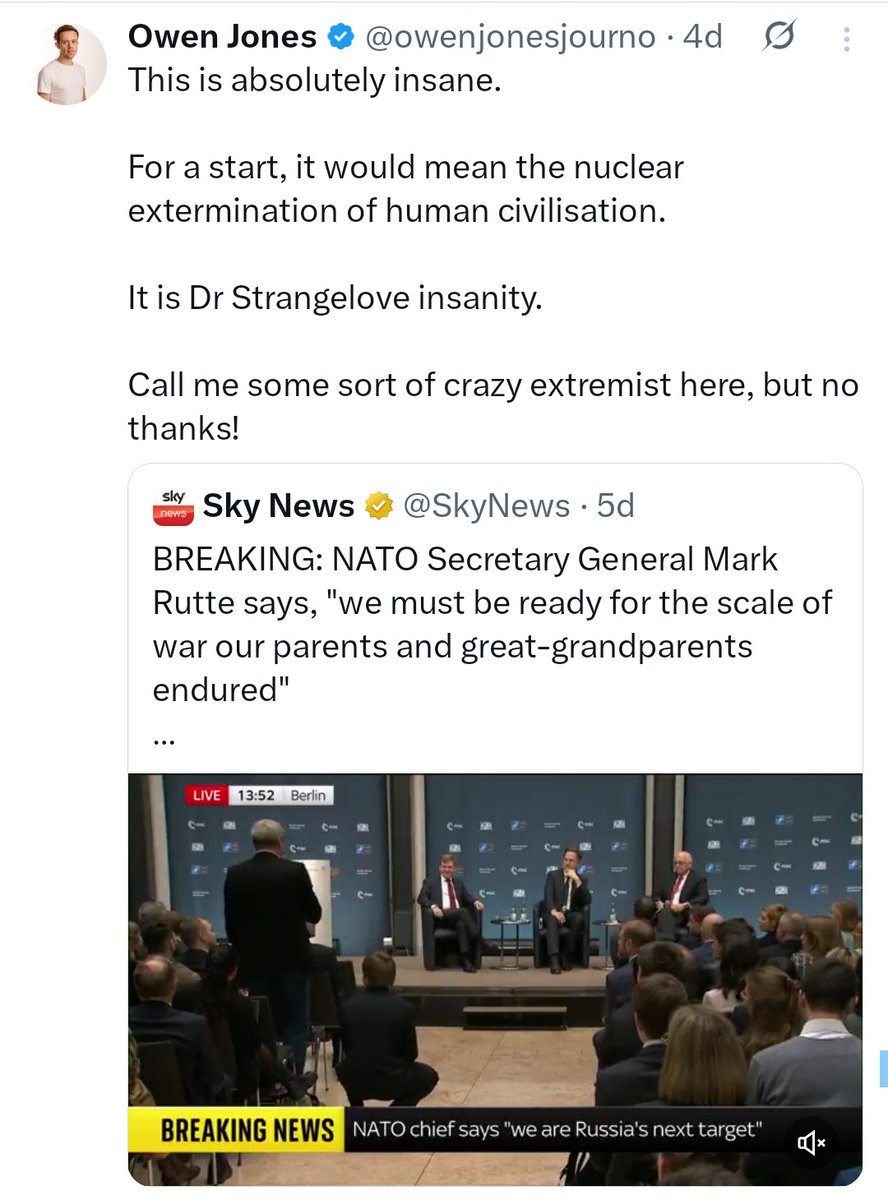
On both right and left, there's a lot of anger about the assessment of threat from Russia and the need to prepare to meet it. There's a lot I could say here (as my students know), but most of it boils down to two things. 🧵 Image
Image
1. For over a decade, but particularly since 2022, the ideology of Putin's presidency has rested on the claim that the West is an existential threat to Russia - that the main goal of the West is to destroy the Russian nation and state, Russian values and culture.
The need to destroy the Western "existential threat" to Russia is one of the key ideological pillars justifying Putin's domestic repression, the distortion of the economy, and the deaths of thousands of Russian soldiers. Putin's power now depends on the idea of war with the West.
Read 7 tweets
Dec 5, 2025
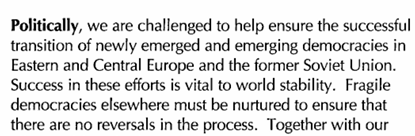
Thread on the huge shift in US policy towards Russia visible in the new National Security Strategy - the biggest change since the collapse of the USSR. 🧵
This first striking thing about the new US National Security Strategy is how little Russia is mentioned in it: only 10 times. Every NSS since 1993 has mentioned Russia more than this one. The 1993 one only has fewer because it mostly still talks about the former Soviet Union. Image
The absence of Russia from the 2025 National Security Strategy looks really odd both because Russia is obviously one of the states having the most significant impact on global stability at the moment, and because the administration is so clearly interested in Russia.
Read 17 tweets
Nov 29, 2025
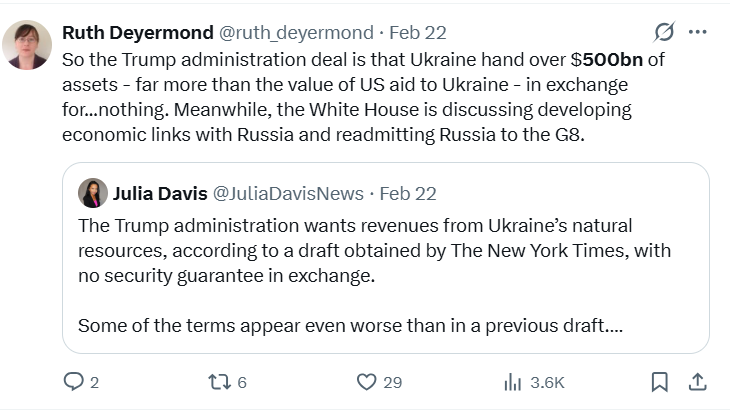
How is this a shock to anyone who's been paying any attention to what Trump has been saying and his admin have been doing all year? I posted this in Feb, for example. Officials who simply chose not to believe it because it's all too difficult might want to rethink their career. Image
This one was in April. If your job required you to look at US Russia policy at all in the last year - or in Trump's 1st term, when he talked about economic relations with Russia and readmitting them to the G8 - none of this should be remotely surprising.
I'm not really surprised that some officials are surprised the Trump admin is prioritising economic relations with Russia. It's clear that some in Europe's policymaking communities simply can't get their heads round the fact that the post-1945 US-Europe relationship is over.
Read 4 tweets
Nov 21, 2025
A quick run through of the Trump administration's proposal for a Ukraine security guarantee, which is a security guarantee in the same way that the Liberal Democratic Party of Russia is a party committed to liberalism and democracy. 🧵
The proposed security guarantee is allegedly modelled on NATO Article 5, but that doesn't contain any of these qualifications for action, let alone all of them. Image
This proposed security guarantee requires that an armed attack by Russia would have to be significant *and* deliberate *and* sustained to merit a response. In theory, Russia could drop a nuke on Kyiv and that wouldn't meet the criteria because the attack wouldn't be sustained.
Read 14 tweets
Nov 3, 2025
Trump has been praising Putin for over a decade, yet somehow this is news. It shouldn't be complicated to understand: Trump admires Putin and Trump wants to do business with Russia. It's been this way for years and it is not going to change. 🧵
During the 2016 election, Trump said that Putin was a better president than Obama. Also during the campaign, Trump claimed that Putin would never invade Ukraine; when it was pointed out that he already had, Trump blamed Obama for the annexation of Crimea, not Putin. http://edition.cnn.com/2016/07/31/politics/donald-trump-russia-ukraine-crimea-putin/
Once elected, he appointed as Secretary of State a man who had been given the Order of Friendship by Putin. His first National Security Advisor had been paid $45,000 to give a speech at RT's anniversary party just over a year before he was appointed. Image
Image
Read 10 tweets

Did Thread Reader help you today?

Support us! We are indie developers!


This site is made by just two indie developers on a laptop doing marketing, support and development! Read more about the story.

Become a Premium Member ($3/month or $30/year) and get exclusive features!

Become Premium

Don't want to be a Premium member but still want to support us?

Make a small donation by buying us coffee ($5) or help with server cost ($10)

Donate via Paypal

Or Donate anonymously using crypto!

Ethereum

0xfe58350B80634f60Fa6Dc149a72b4DFbc17D341E copy

Bitcoin

3ATGMxNzCUFzxpMCHL5sWSt4DVtS8UqXpi copy

Thank you for your support!

Follow Us!

:(