One of the difficulties in determining where Tesla falls in the autonomous vehicle space is that Tesla provides essentially no data to the public, especially its FSD Beta program.
Using the limited data we do have, let's compare.
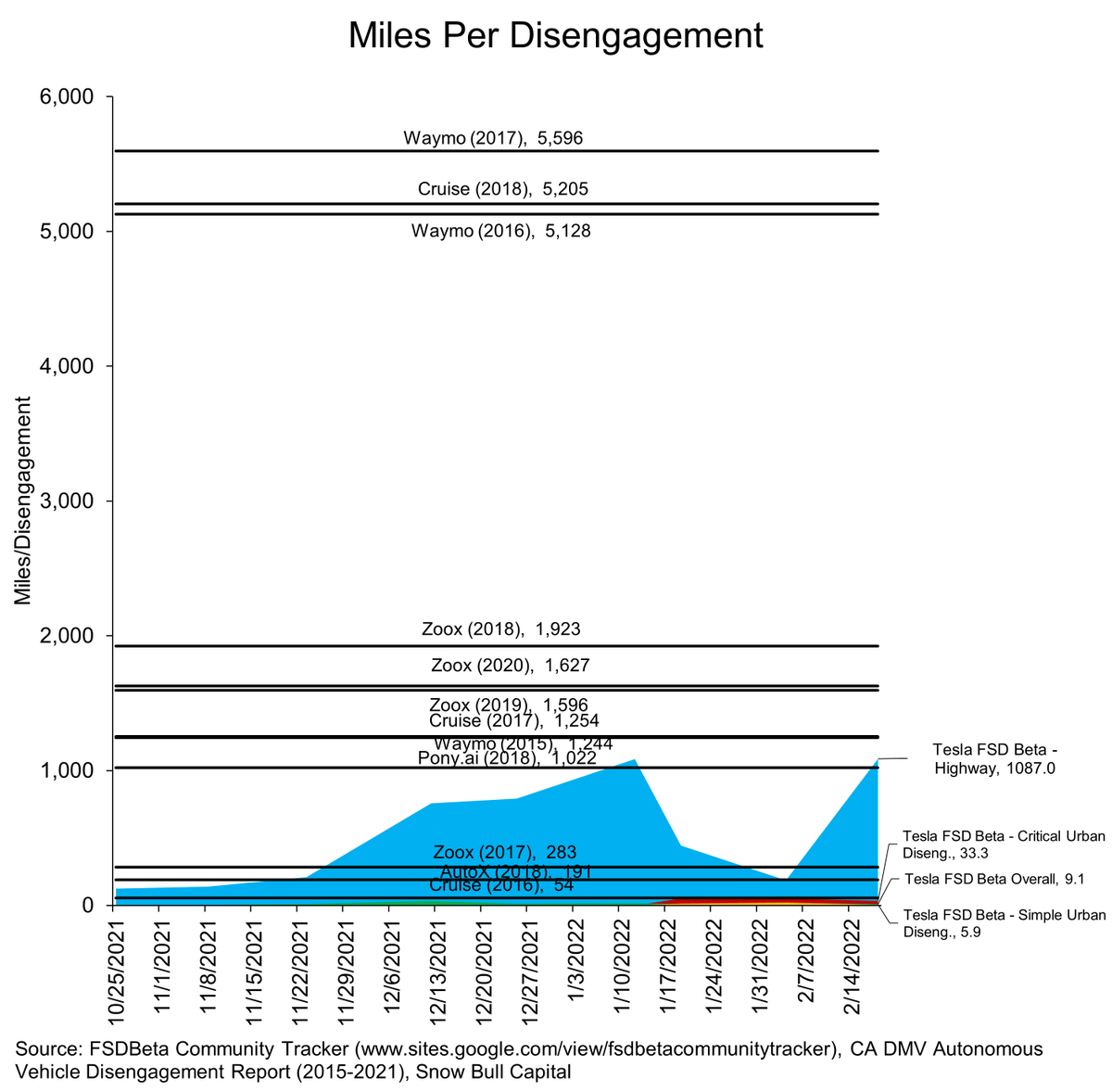
2/ I've put into perspective where Tesla sits relative to the others attempting Level 4-5 in the past:
Here:
But now there is a dataset the Tesla crowd is beginning to (contribute to and) cite.
3/ If you haven't seen it already, there is a data collective where select Tesla FSD Beta testers can manually input milage and disengagements from their drives to track the rate of improvement from version to version.
4/ Now, the average disengagement rates as submitted by the 75 Tesla owners in this are nowhere close to my experience with FSD Beta.
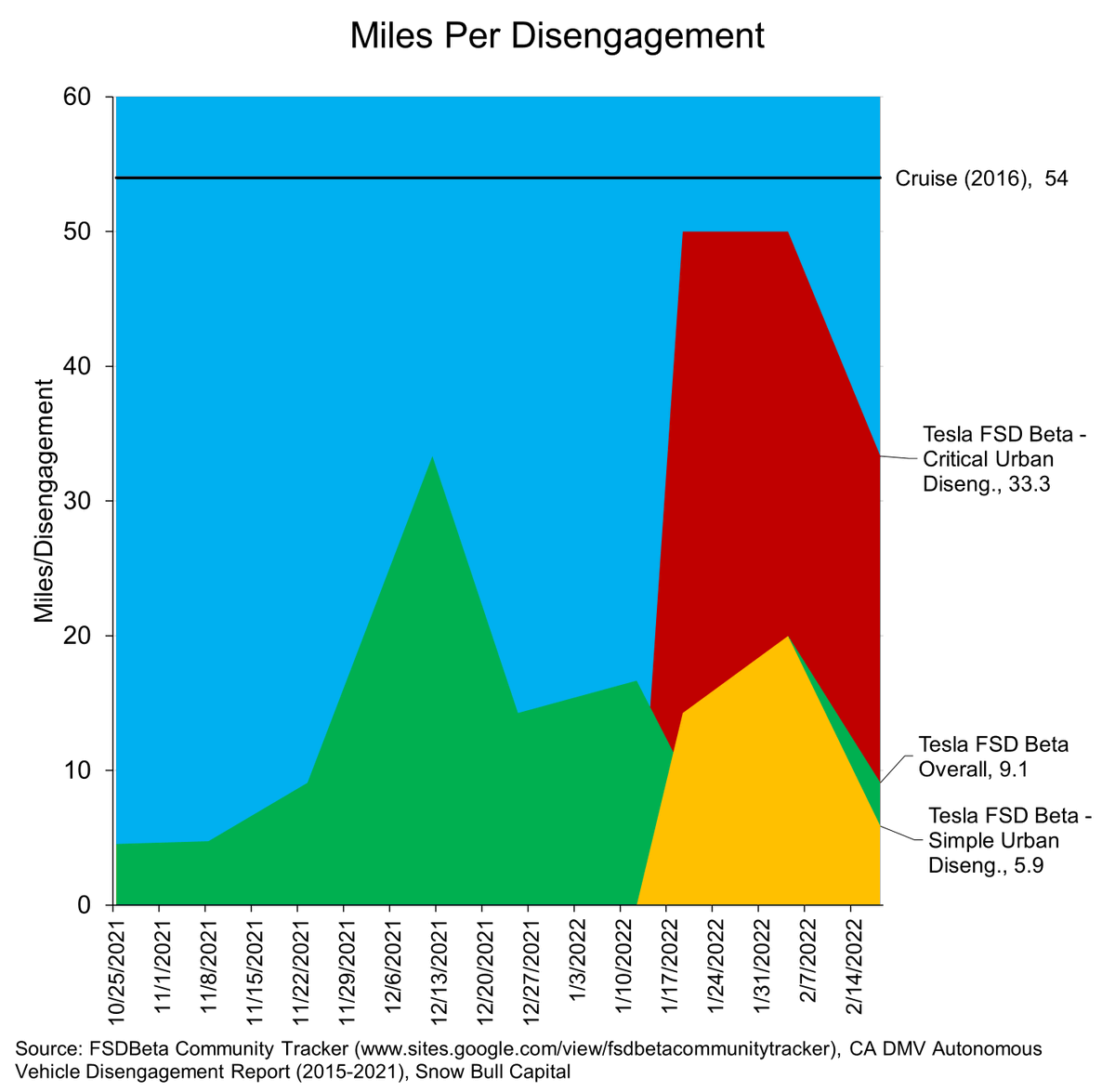
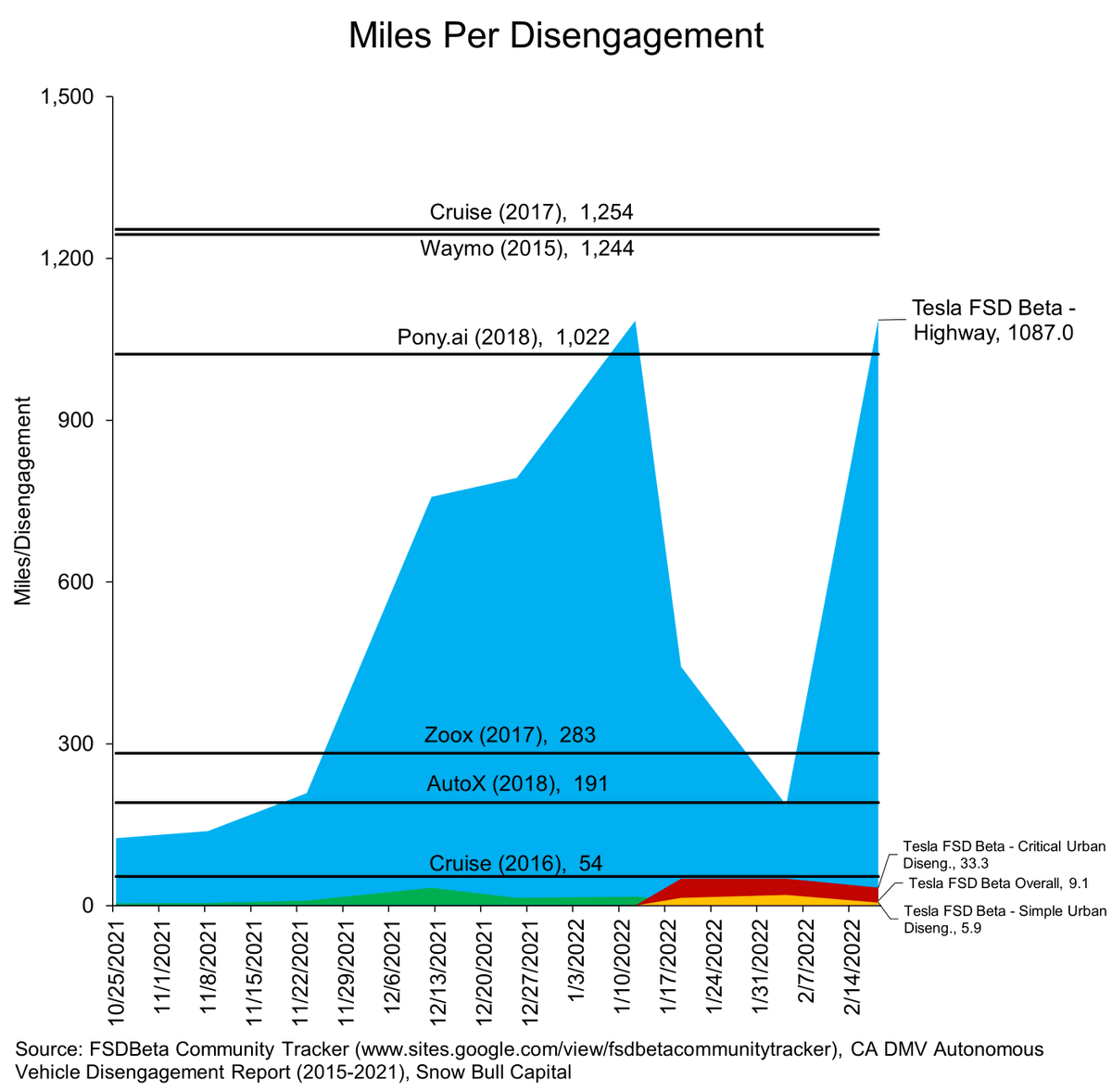
Like, 9.1 miles driven autonomously before a disengagement on urban driving? Or 1,087 miles on the highway before a disengagement? Yeah right.
5/ Regardless, let's use the inflated Tesla numbers and see how they stack up to the disengagement rates of other companies, all of whom submit data to the @CA_DMV annually.
Keep in mind, most of the other companies' data are for their alpha prototypes; Tesla is already on beta.
6/ First, let's chart the "FSDBeta Community Tracker" and convert out of "disengagements per mile"—a metric only used by Tesla (like "FSD")—and flip it around to a metric the big boys use: miles per disengagement.
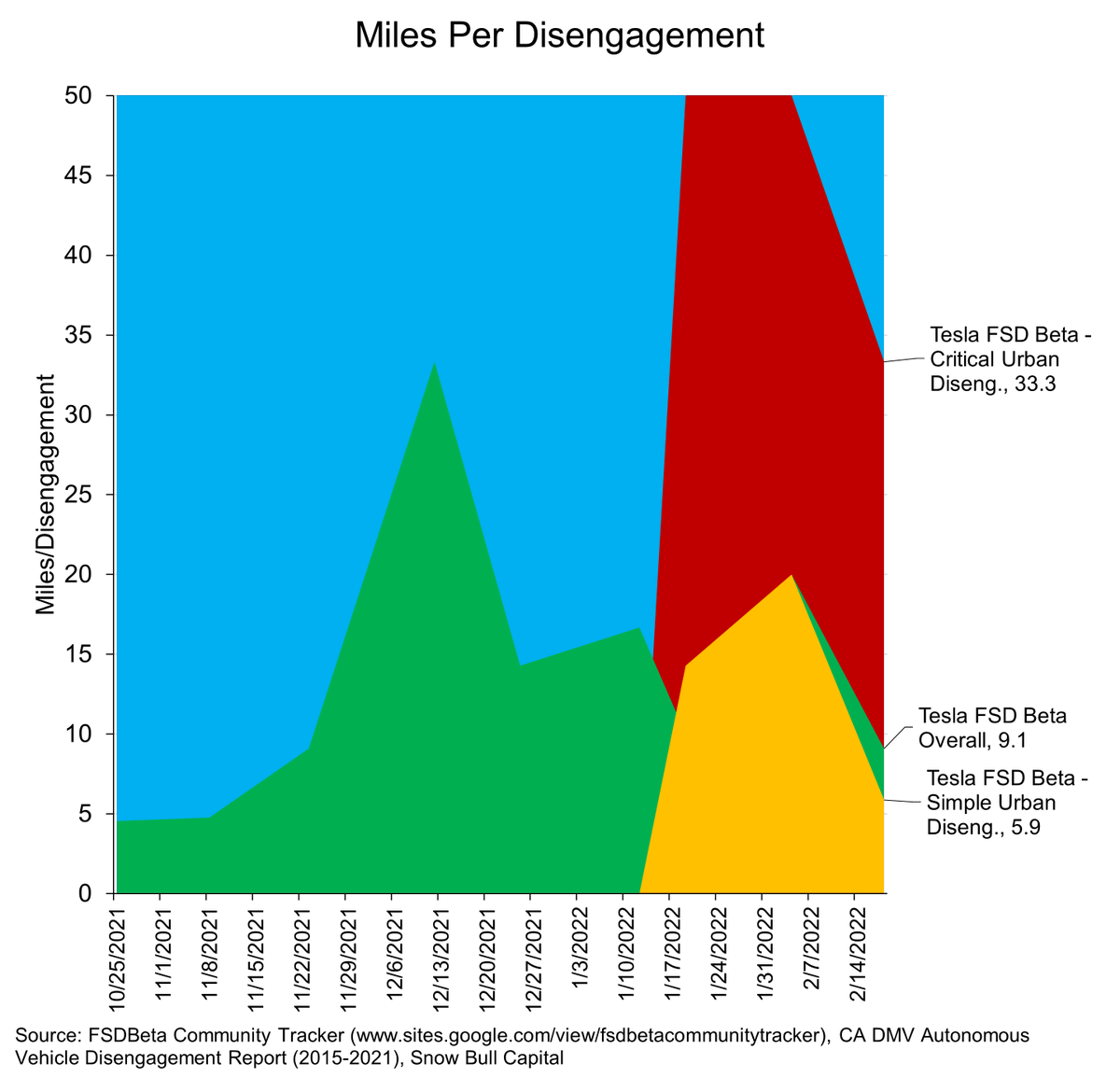
7/ Let's expand the y-axis. The first milestone under which $TSLA FSD Beta is sitting is @Cruise's CA disengagement rate from 2016. That means in the 2016 reporting period, on avg, Cruise's AVs traveled 54mi autonomously before a test driver or the AV system had to take control.
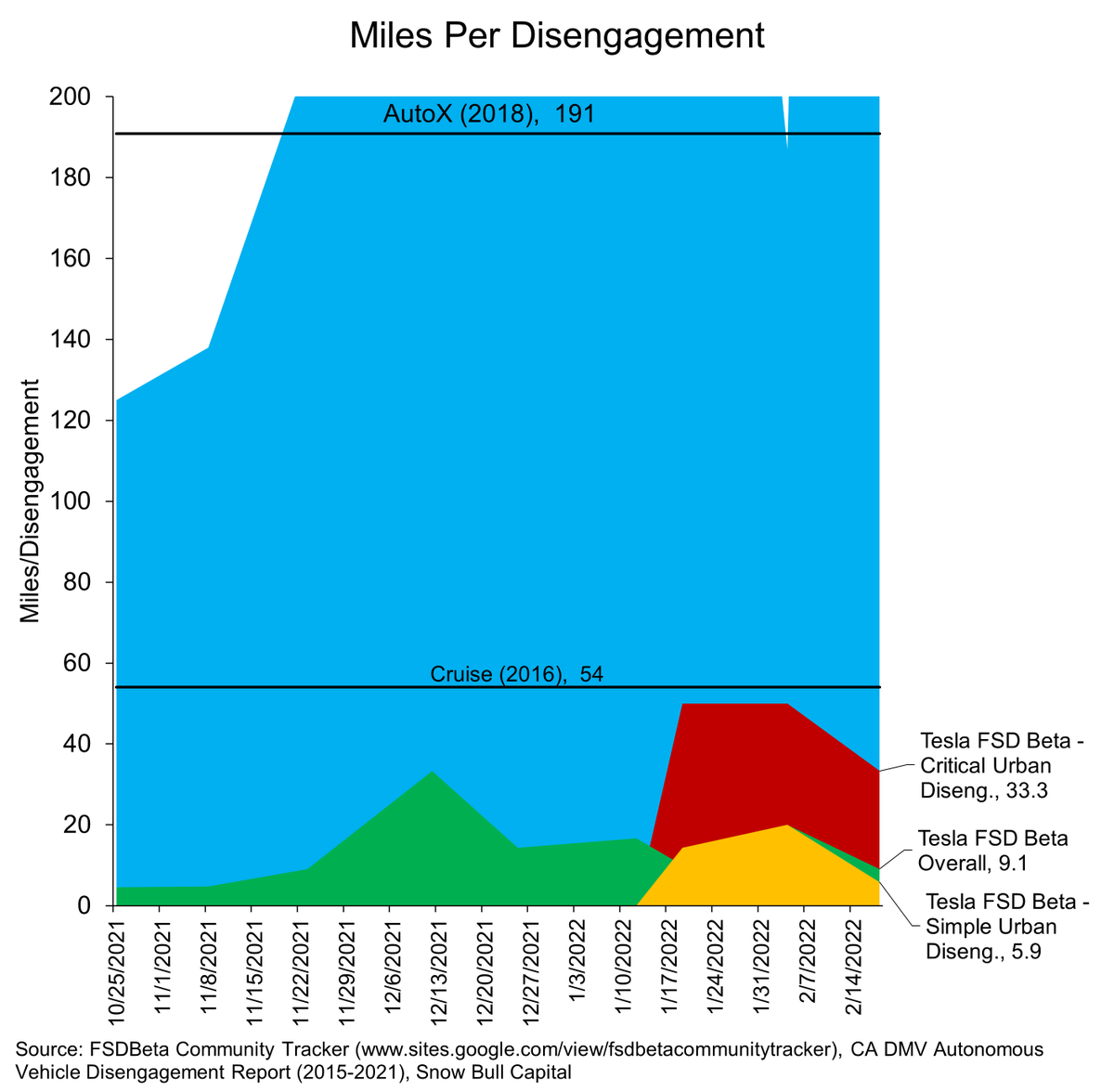
8/ Zooming out a bit more, we see @autoxtech's 2018 rate of 191 mi/disengagement, which was very impressive for the 1.5-year-old Chinese startup, at the time.
For perspective, Tesla had been selling "FSD-capable" vehicles for longer than AutoX had even existed.
9/ As we zoom out further, Tesla's preposterous 1,087 miles driven autonomously before the driver needs to disengage stat is in full view, but for the sake of argument, we will keep it (in blue) as we...
10/ ...zoom out further.
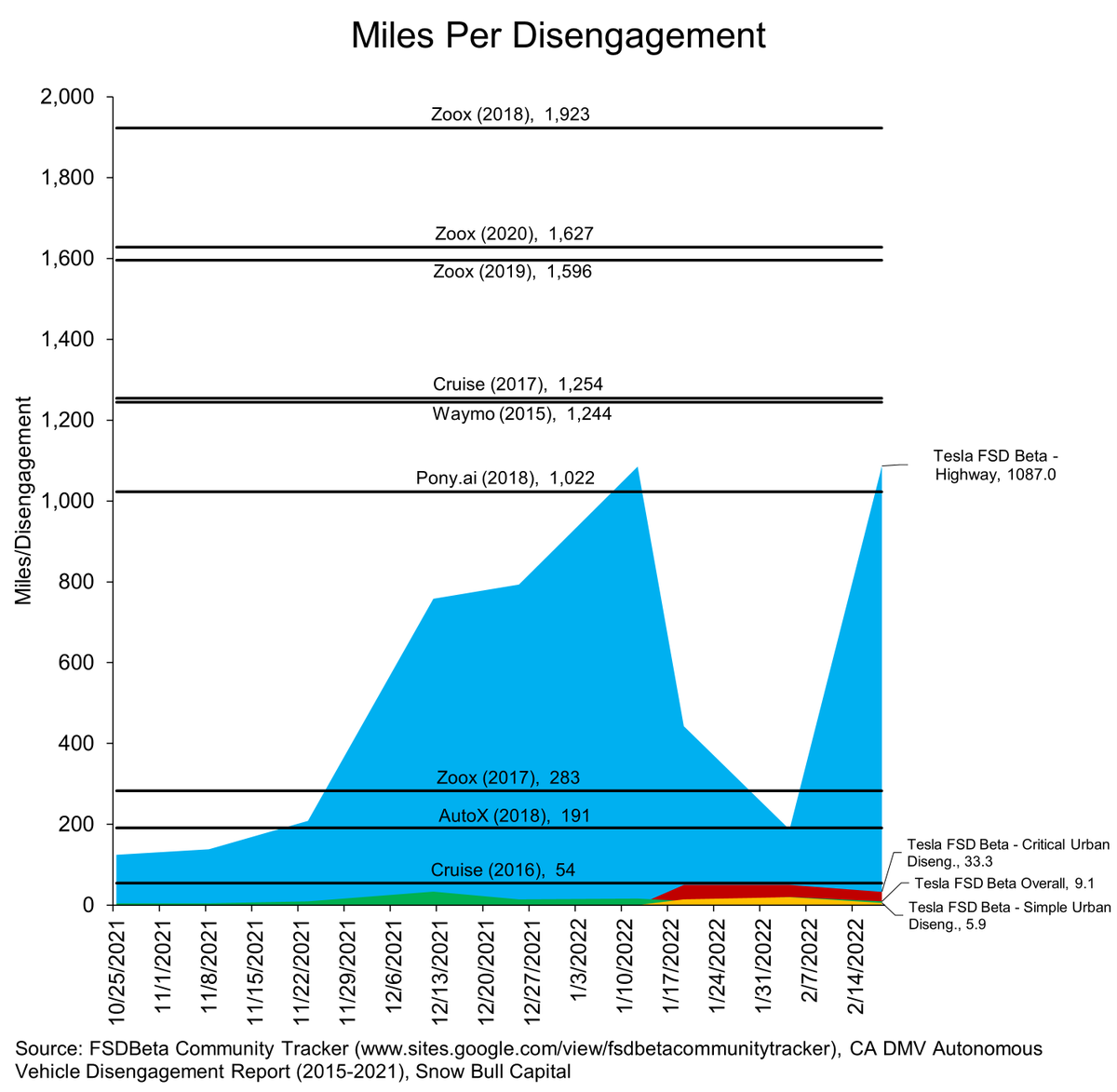
11/ Now we see the gap between the 2,000 to 5,000 mi/DE, which @Waymo first hurdled in 2016.
12/ Let's more-than-double the y-axis scale to 15,000. @PonyAI_tech nearly notched the 15,000 mi-mark last year. Check out the neck-and-neck Waymo/Cruise race a few years ago.
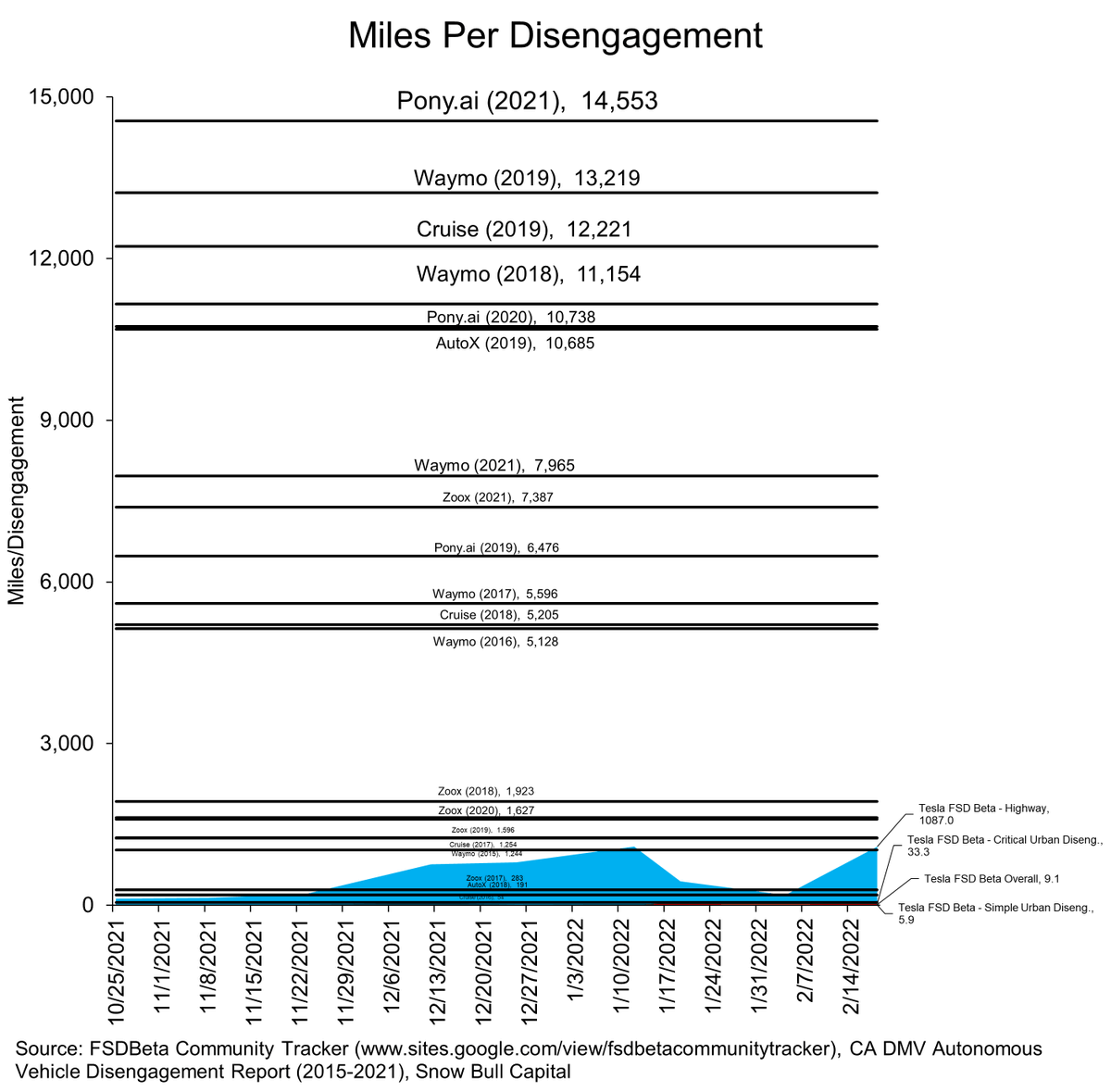
13/ We need to double the scale again to see the 2020 leaders' disengagement rates in CA.
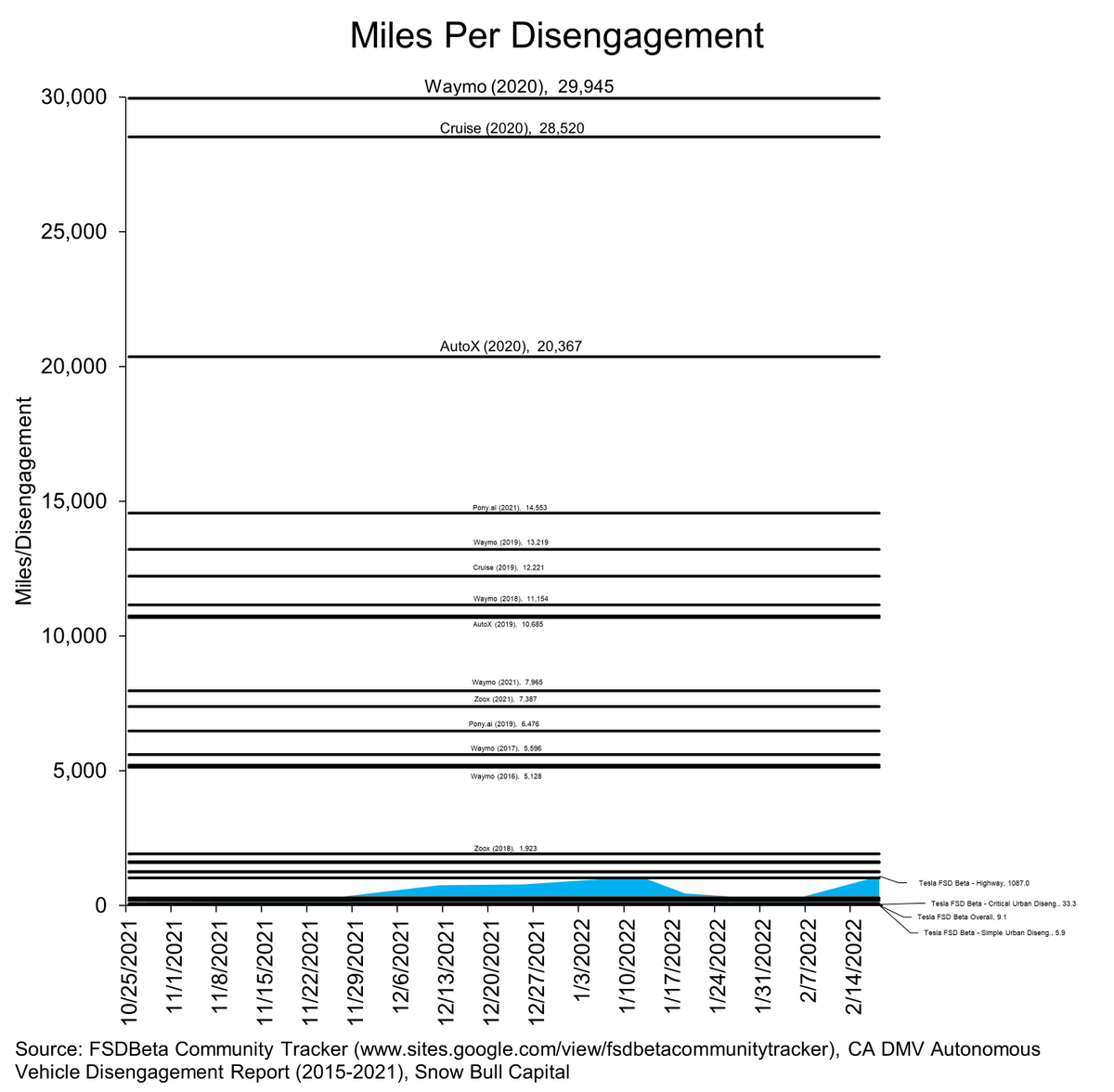
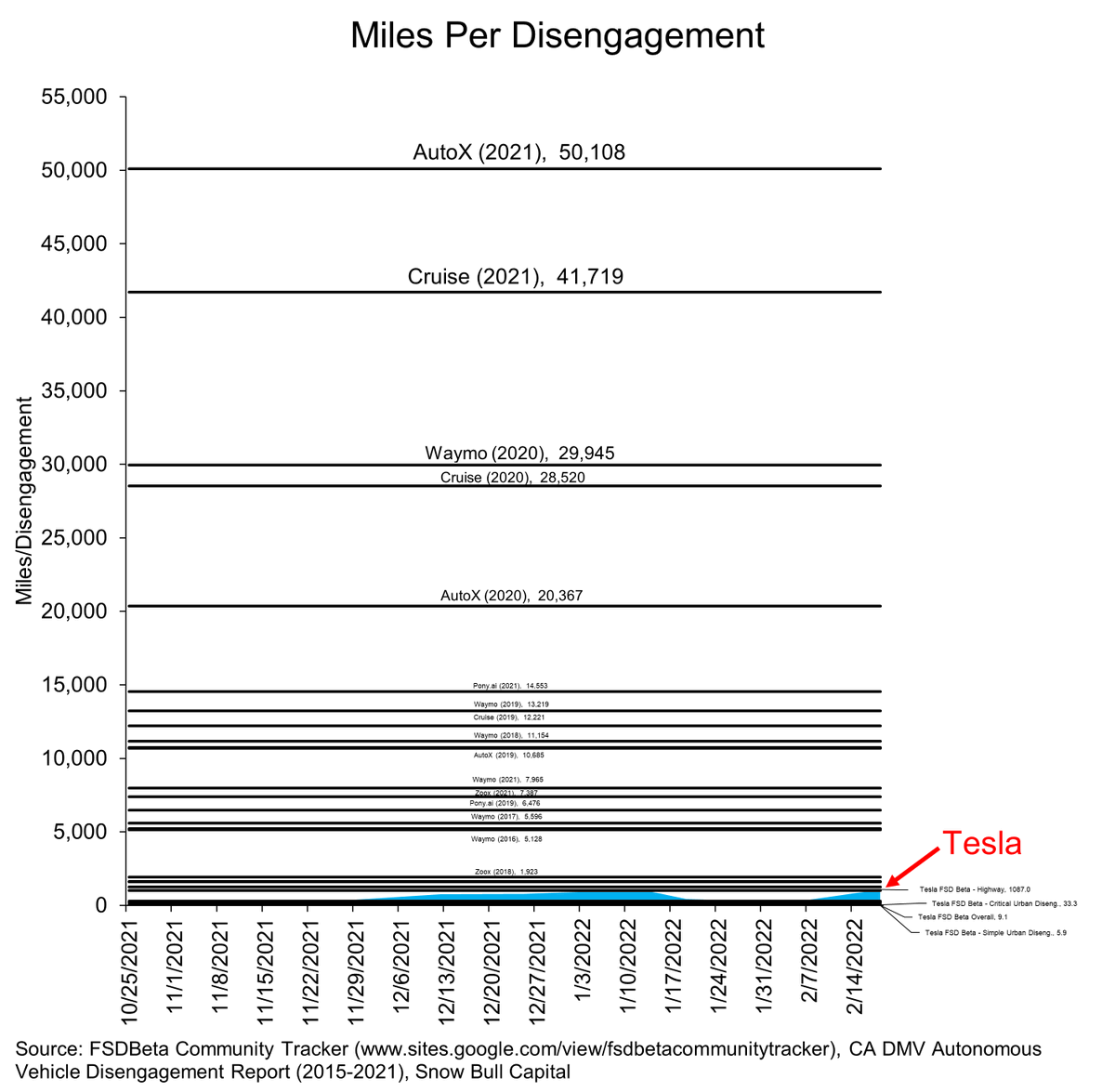
14/ Now nearly double the y-axis AGAIN to see @Cruise and the current leader, @autoxtech's disengagement rates last year.
You need a magnifying glass (or helpful red arrow) to see where @Tesla currently is in comparison.
• • •
Missing some Tweet in this thread? You can try to
force a refresh

Another DeepSeek moment. This is the world’s first actual smart phone. It’s an engineering prototype of ZTE’s Nubia M153 running ByteDance’s Doubao AI agent fused into Android at the OS level. It has complete control over the phone. It can see the UI, choose/download apps, tap/type, call, and run multi-step task chains.
Here I just say (in English) “find someone to wait in line for me” (something you can do in China), and it picks which app to open, configures the job, and hands me one confirm screen. I wouldn’t otherwise know how to do this, and here the phone just did it in a matter of seconds.
This isn’t a chat overlay, it’s a true multimodal agent. It has the brand-new Snapdragon 8 Elite Gen 5 with 16GB RAM, so it can push a lot of the agentic workload on-device. Here I take a picture of a NIO battery swap station and ask, “What is this thing?” It’s running ByteDance’s Doubao model (>175M users in China): a massive, sparse MoE model with full text+vision support. It recognizes the infrastructure from the photo, grounds it to NIO’s network, and explains what it does.
Here you see the cloud + on-device split very cleanly. Doubao handles the semantics: from a single hotel entrance photo it figures out which hotel this is, that I want to book tonight, and that it will need to check the hotel’s pet policy.
Then ZTE’s 7B Nebula-GUI model (a vision model trained to understand screens) running locally on the Snapdragon 8 Elite drives the UI like a human: it picks Ctrip app, opens it, fills in dates, finds cheapest rate, reads the hotel policy on pets, and informs me I can bring a dog.
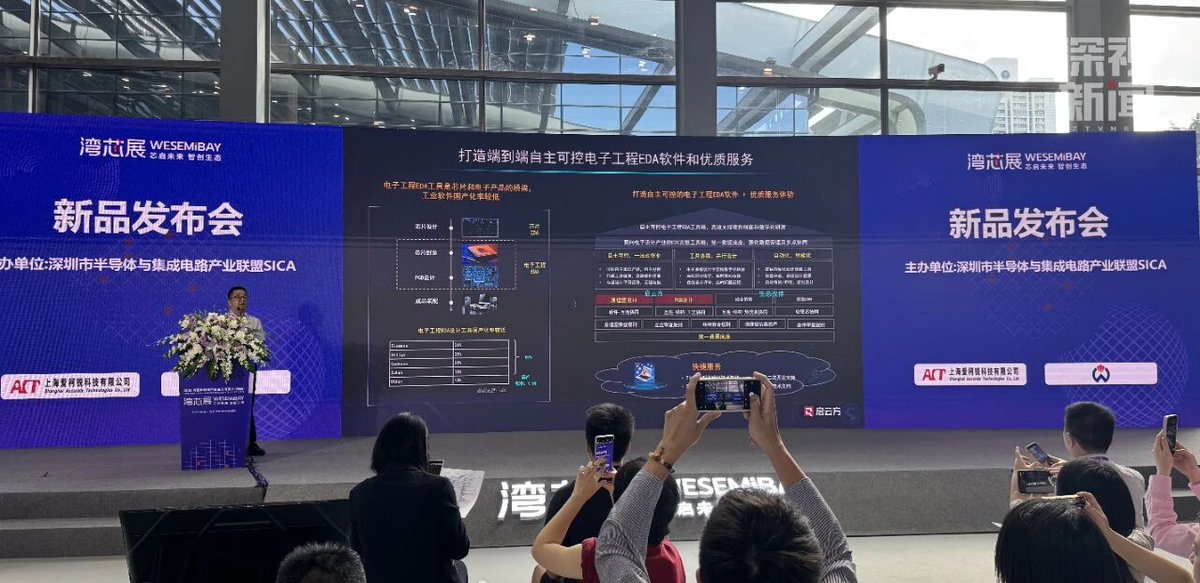
I’m at the Bay Area Semiconductor Expo in Shenzhen. A company called Qiyunfang, a subsidiary of 新凯来 (SiCarrier), just unveiled two fully domestic EDA software platforms: one for schematic and one for PCB design. Yet another Made in China 2025 success.
For context, EDA (electronic design automation) is the software backbone of chip and circuit design. Trump 2.0 tried to cut China off from it in March, forcing Cadence, Synopsys, and Siemens to halt China sales. But just weeks later, Washington quietly reversed course and lifted the ban. Then last week, Trump said the U.S. will impose export controls on “any and all critical software,” so assume EDA again. Turns out a secret team in Shenzhen had already created a solution: every core component, every bit of IP, all built domestically.
The theory in Washington was simple: if China can’t use U.S. EDA tools, it can’t design competitive chips or even advanced boards. It was meant to be another choke point on China’s entire hardware ecosystem.
Ok I can now tweet about it, the most advanced car in history is about to be unveiled. Live thread below.
This car is a really big deal for Wang. It packs so many innovations, many of his personal long-term dreams. Yangwang U7 (prototypes) has been his personal daily driver for the last year, so he is really excited. He sounds sick, probably nervous! He has had a busy month!
Here are some of the crazy examples of the tech this car is debuting
BYD just unveiled its DiSus-Z Intelligent Suspension System, debuting on the Yangwang U7. Here are five crazy examples.
1. Negative roll test maintains stability through corners
2. Active defense test
DiSus-Z is a fully electric, next-gen suspension system that replaces traditional hydraulic dampers with four highly integrated suspension motors. It can preempt side collisions by milliseconds, rapidly lifting the chassis on the impacted side to protect passengers
3. Rough terrain test
DiSus-Z can maintain remarkable stability over rough terrain, minimizing body shake and making bumpy roads feel smooth. By eliminating hydraulic fluid and directly actuating each wheel, DiSus-Z drastically reduces energy transmission losses.
I’m headed to Huawei’s Mate 70 launch event in Shenzhen (yes, Shenzhen Metro has business class). This phone/chip/OS/event is a really big deal for Chinese tech, and has big implications for US-China relations. Here’s some background.
In May 2019, the US Dept. of Commerce added Huawei and its affiliates to the Entity List, which restricted US companies (and allies) from exporting tech to Huawei. They expected this to cripple Huawei, because it wouldn't be able to acquire any semiconductors made with US tech.
The US govt assumed that by restricting Huawei’s access to cutting-edge semiconductor manufacturing equipment, particularly Extreme Ultraviolet (EUV) lithography machines from ASML, the company would be unable to produce cutting-edge chips at process nodes smaller than 10 nm. EUV lithography is crucial for efficiently manufacturing chips at 7 nm and below, utilizing light with a wavelength of 13.5 nm, which enables finer feature resolution with fewer patterning steps.
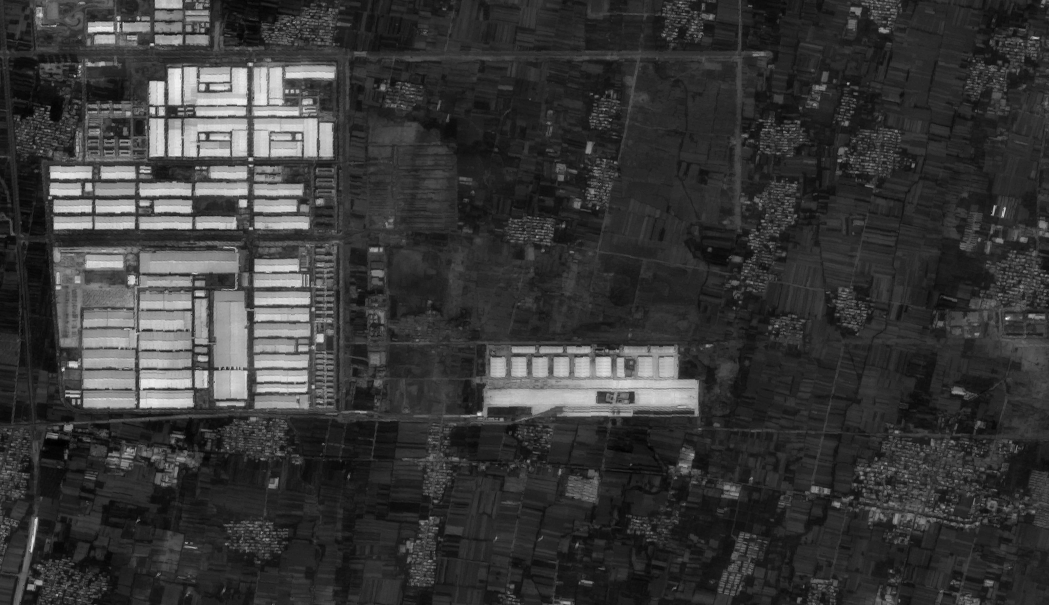
Here's the most recent satellite image, taken a few days ago. That new structure in the middle (汽车专用作业区) will connect the factory to the Zhengzhou International Land Port, which will be 50km², roughly the size of Manhattan.
The bottom right corner of the image is land being cleared for the Port's rail yard, so you can see how BYD's factory literally attaches to this massive port that will send cars to Europe, from the middle of China. BYD's factory is already way ahead of the port itself.