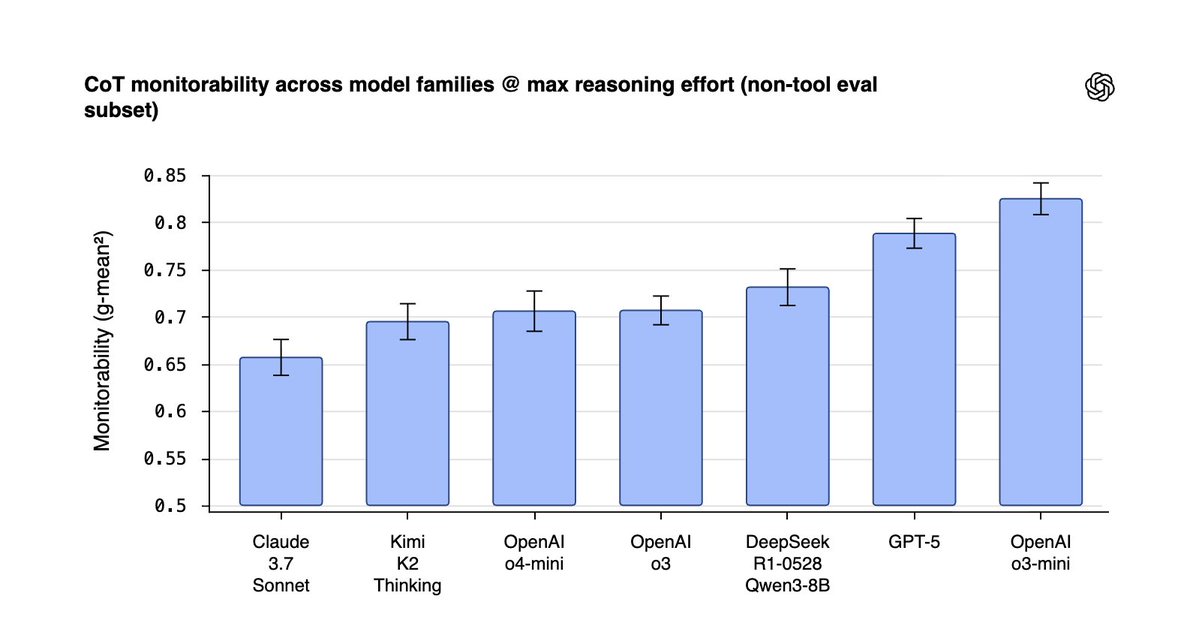
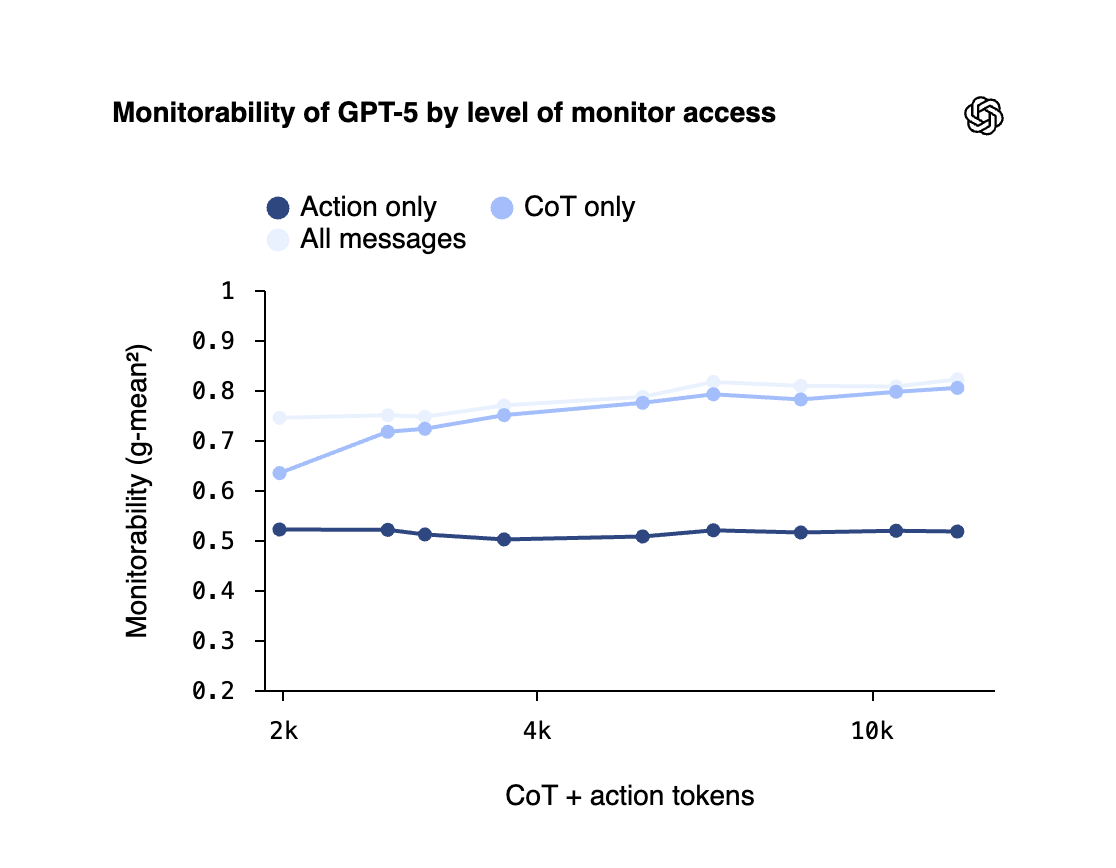
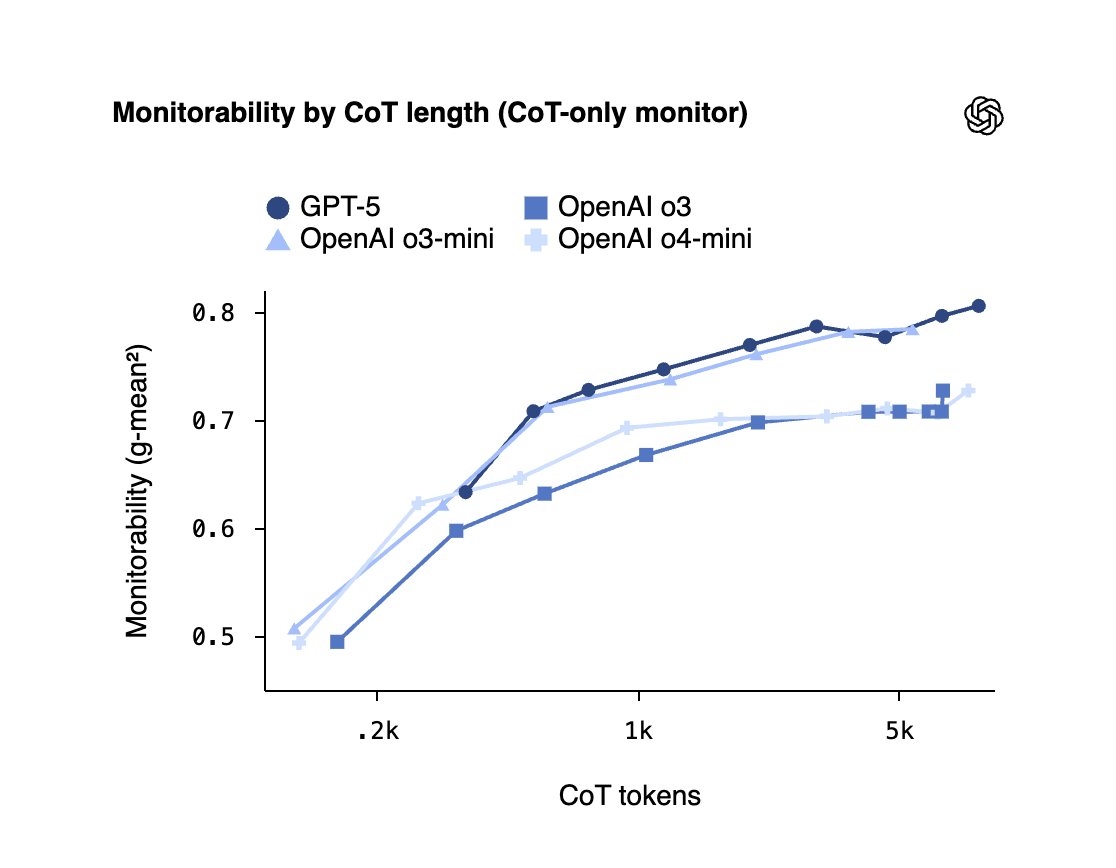
To preserve chain-of-thought (CoT) monitorability, we must be able to measure it.
We built a framework + evaluation suite to measure CoT monitorability — 13 evaluations across 24 environments — so that we can actually tell when models verbalize targeted aspects of their internal reasoning. openai.com/index/evaluati…
Monitoring a model’s chain-of-thought is far more effective than watching only its actions or final answers.
The more a model “thinks” (longer CoTs), the easier it is to spot issues.
RL at today’s frontier doesn’t seem to wreck monitorability and can help early reasoning steps. But there’s a tradeoff: smaller models run with higher reasoning effort can be easier to monitor at similar capability — at the cost of extra inference compute (a “monitorability tax”).
Accelerating scientific progress is one of the most impactful ways AI can benefit society. Models can already help researchers reason through hard problems — but doing this well means testing models on tougher evaluations and in real scientific workflows grounded in experiments.
We’re releasing a new eval to measure expert-level scientific reasoning: FrontierScience.
This benchmark measures PhD-level scientific reasoning across physics, chemistry, and biology.
It contains hard, expert-written questions (both olympiad-style problems and longer research-style tasks) designed to reveal where models succeed and where they fall short. openai.com/index/frontier…
GPT-5.2 is our strongest model on the FrontierScience eval, showing clear gains on hard scientific tasks.
But the benchmark also reveals a gap between strong performance on structured problems and the open-ended, iterative reasoning that real research requires.
GPT-5.2 Instant, Thinking, and Pro are rolling out today, starting with Plus, Pro, Business, and Enterprise plans. Free and Go users will get access tomorrow.
Introducing shopping research, a new experience in ChatGPT that does the research to help you find the right products.
It’s everything you like about deep research but with an interactive interface to help you make smarter purchasing decisions.
Shopping research asks smart clarifying questions, researches deeply across the internet, reviews quality sources, and builds on ChatGPT’s understanding of you from past conversations and memory to deliver a personalized buyer’s guide in minutes.
Most neural networks today are dense and highly entangled, making it difficult to understand what each part is doing.
In our new research, we train “sparse” models—with fewer, simpler connections between neurons—to see whether their computations become easier to understand.
Unlike with normal models, we often find that we can pull out simple, understandable parts of our sparse models that perform specific tasks, such as ending strings correctly in code or tracking variable types.
We also show promising early signs that our method could potentially scale to understand more complex behaviors.