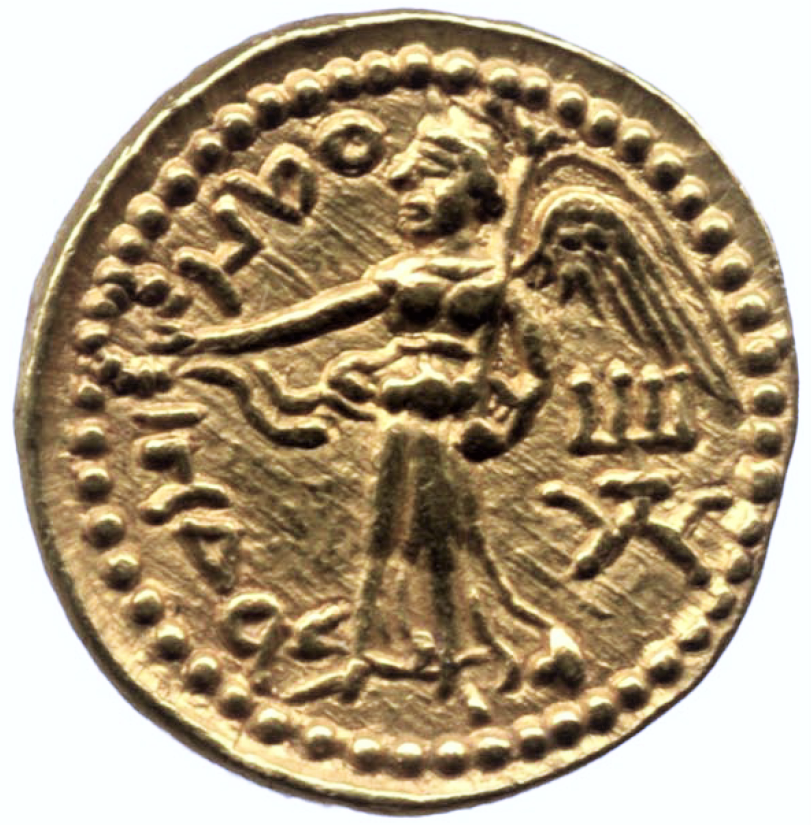
A kuShANa coin showing the Eastern Iranic deity of victory vainaiti. In Zoroastrian branch of the tradition, the deity is the male vanant associated with the star Vega (𝛼 Lyrae). This evidently goes back to the proto-I-Ir period in the least as the vedic abhijit has an identical
connotation & etymology; e.g. the taittirIya shruti states: अ॒भि॒जय॑त् प॒रस्ता॑द् अ॒भिजि॑त् | The change in gender in the Eastern Iranosphere seems to be a departure from the ancestral state. The iconography is clearly influenced by the cognate Greek deity Nike. Hence, 1 wonders
if the gender shift was also influenced by the Greek deity who appeared in the region during the yavana conquests & is often shown as being held by Zeus in the Indo-Greek coins. However, it may not be so simple as the H tradition as a female abhijiti going along with abhijit.
For e.g. the taittirIya shruti has: अ॒भिजि॑त्यै॒ स्वाहा᳚ । From the YV tradition abhijiti is generally understood as the star ε Lyrae beside Vega. Thus, it is not impossible that the E Ir tradition already had a female variant of vanant paralleling the Vedic abhijiti.
The worship of vanant or vanaiti in the E Ir world is indicated by a toponym -- the place close to what is today Bukhara in Ozbekistan was likely the seat of his/her cult. Unfortunately, little remains after its destruction by the marUnmatta-s.
• • •
Missing some Tweet in this thread? You can try to
force a refresh

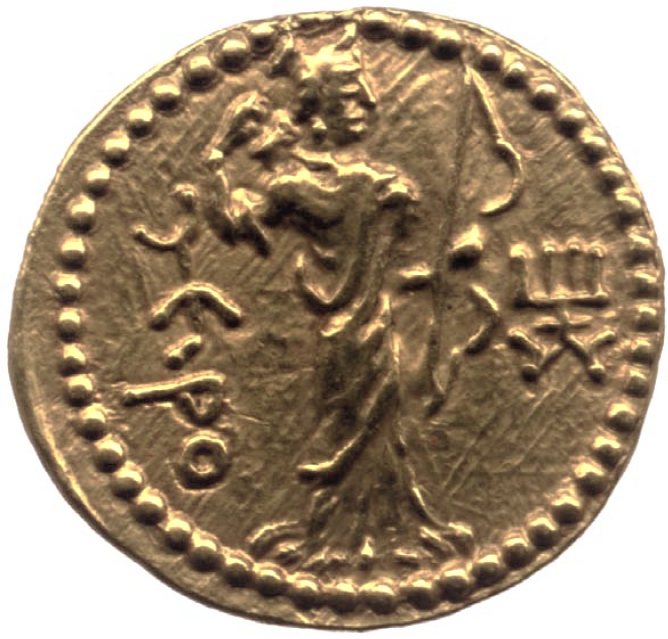
A kuShANa coin showing mithra with a mace: the mace was called a gadha in the Iranic tradition but explicitly equated with the vajra in the case of mithra in the famous manthra with a counter-religious overlay (see below) from long incantation to him in the Zoroastrian branch of
fravaêkhem vîrô-nyåñcim zarôish ayanghô frahixtem
that rushes felling heroes; cast out of red metal,
amavatô zaranyehe amavastemem zayanãm
of strong, golden metal; the strongest of all missiles,
verethravastemem zayanãm, mainyavaså vazeñti
the foremost of the verethra-smashing weapons missiles; travels through the heaven,
mainyavaså pateñti kameredhe paiti daêvanãm.
it falls through heavenly space upon *the skulls of the daevas.*
Indo-European epic tradition has a narrative feature that is given a specific name in the Greek branch -aristeia -- the exaltation of a specific hero in battle. The aristeias are marked by that hero standing out in great acts of valor, often accompanied by an uncontrollable fury,
with the rest almost becoming mere spectators. It has been widely noted in yavana Illiad where heroes like Diomedes, Patroclus, Hector & Achilleus have their aristeias which sometimes end in their death. In essence it is the highpoint of the career of the warrior, The aristeia is
also a feature of H epics. In the mahAbhArata we have several aristeias paralleling those of Patroclus, Hector & Achilleus ending in the deaths of the heroes -- abhimanyu, ghaTotkacha, bhagadatta among others. But apposite for the day we may note that the rAmAyaNa also features
A rare coin of huviShka-1 showing the Zoroastrian Iranic rudra-class deity tishtrya. For most part for the Eastern Iranic rudra-class deity was the cognate of the old vAyu: vayush uparo kaiiryo: vAyu who acts in the upper realm. In the Zoroastrian counter-religion rudra under the
name saurva or aeshma daeva was demonized but the deity class was retained intact (note parallel with ashvin class) & his characteristics transferred to his star - alpha Canis Majoris which was deified as tishtrya. In the eastern Iranic world following H conventions vayush was
identified with rudra &depicted with the same iconography. A parallel rudra-class deity, likely of the kushanic Iranians muzdhvAn (~vaidika mIDhvAn= rudra) faded away &vayush became dominant. Again following H conventions the old goddess anAhitA, syncretized with Sumerian/Semitic
IMO 1 of the last of the surviving yavana "purANa-s", composed just before the destruction of Classical world by the preta, that of Nonnus the Egyptian on his chosen god Dionysus preserves several old strands. Its focus is the "holy war" waged by Dionysus on the Hindus to make
them Bacchanalian wine-addicts. However, the account seems confused, melding African peoples, like Ethiopians, and West Asians with H. The Egyptian's topos of India begins in West Asia itself. His conquest of India is alluded to in several Greek sources but this late version is
perhaps an expression of what could be called a "wishful" figment existing in the yavana world longing for revenge for the defeats of the yavana-s in India&loss of the Alexandrian conquests. This material apart the Dionysiac epic preserves a good body of mythology that is useful
A 🧵returning to some themes relating to Altaic Khaganates. For a general background one can read this summary we wrote recently: manasataramgini.wordpress.com/2022/01/30/hun…
One development that has happened since is the publication of another paper on multiple genomes from the Avar Khagnate.
I began my first serious foray into Altaic history by reading René Grousset's "Empire of the steppes" and Chingiz Khan. It is fashionable these days, even though they have written no sweeping history like his, for modern Altaic scholar to crap on Grousset as otiose. Whatever our
current improvements in understanding, I still feel it is important to read& appreciate the pUrvAchArya-s. The thrill of reading Grousset cover to cover as a kid is 1 of those indelible feelings -- it was followed by many an afternoon of wandering as though on horseback thinking
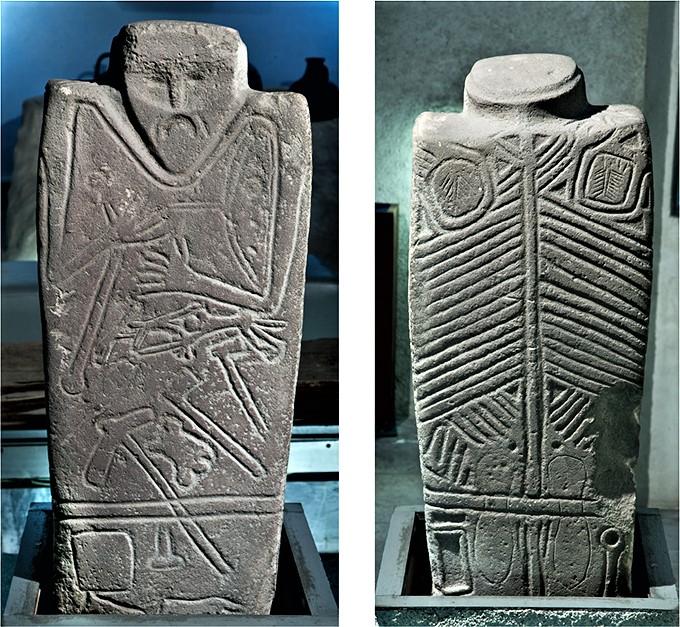
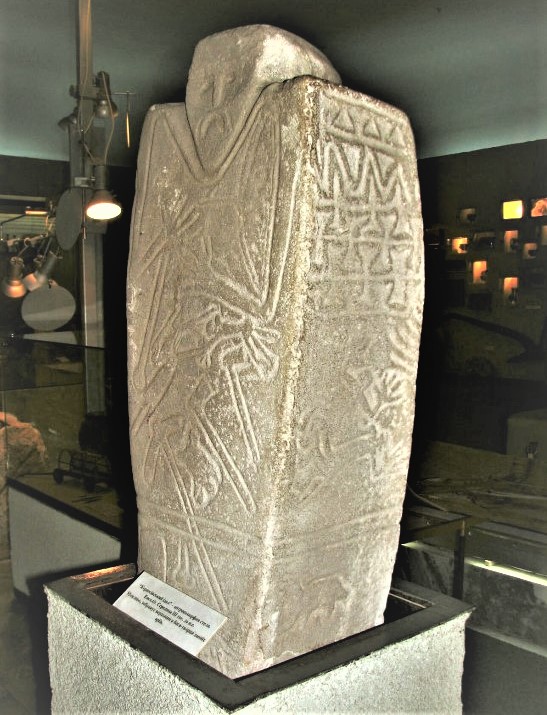
A thread on the Kernosovskiy & related icons. This image found in what's today Ukraine is from the Yamnaya horizon. If indeed it dates closer to then it is of considerable significance as it is a rare image from the early IE period. I've so far seen reasonably clear images of 3
sides. Above are front & back & here is the 3rd side with clear imagery on it. It depicts an ithyphallic male figure in a general iconographic convention seen in the later "balbal" stones of shaka, mongolic & turkic peoples & the more mysterious Hakkari stones. However, there is
1 indicator of an early age -- the similarity of the axe on the image to the Abashevo axe that is closer culturally & temporally to Yamnaya. A similar axe is seen in the Federovsky idol from the Poltava region of Ukraine likely again from the Yamnaya age