This image of Herakles was brought from placed in a temple of Apollo ~151 CE. I has a remarkable bilingual inscription in Greek & Parthian dialect of the Iranian language. There Heracles is identified with the Iranic god verethraghna & Apollon with tishtrya. It shows that between
Greek & Iranic branches of the IE religion the homologies could be more or less correctly sorted out with Herakles being placed in his ancestral indra-class & Apollo in the rudra-class. This identification is also seen in the statues produced by the Greco-Iranic king Antiochus
However, in the iconographic tradition of the Greco-Indian kings the senior representative of the indra class Zeus was identified with indra. For the Iranics that posed an issue as they tended to id him with ahura mazdha.
In the indosphere, Herakles was identified with the club-bearing primal teacher of shaiva tradition -- the v1 whose corpse was animated by rudra himself at kAyAvarohaNa. His name was identified with Herakles ~ lakulIsha; see: manasataramgini.wordpress.com/2009/06/06/the…
• • •
Missing some Tweet in this thread? You can try to
force a refresh

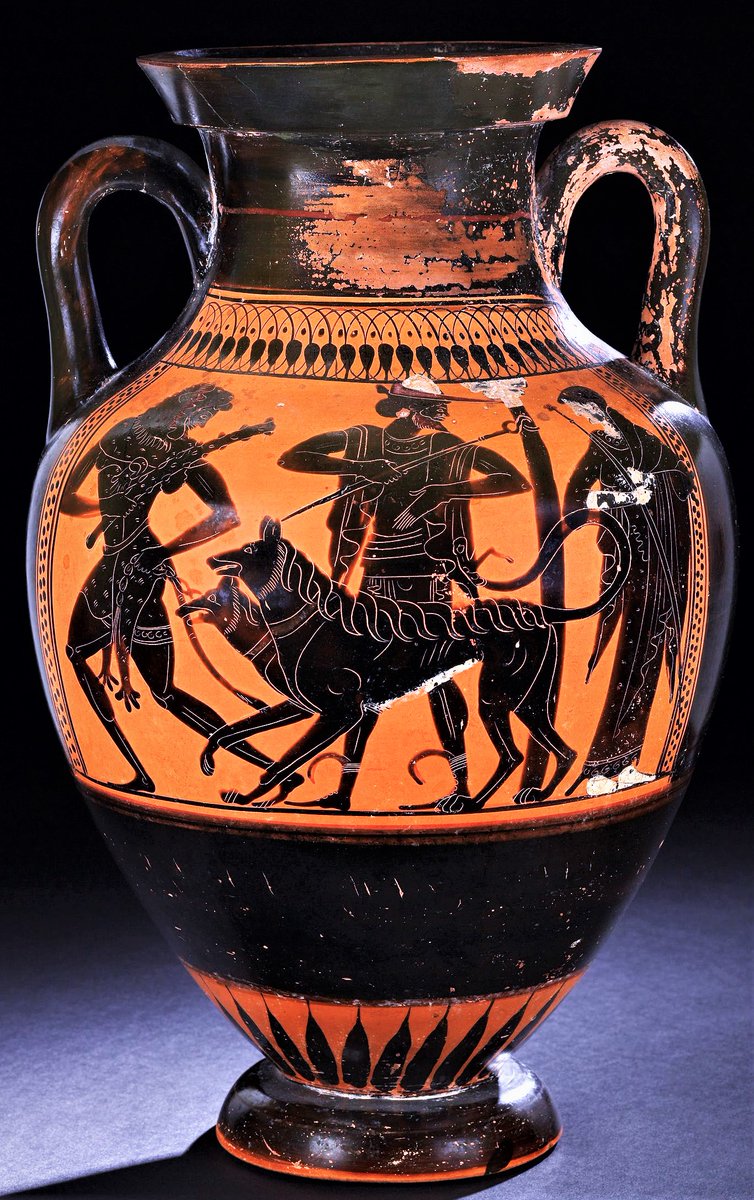
A brief discussion of some old IE motifs: Here is Herakles (left) seizing the dog of the netherworld Kerberos (note 2 headed here). Behind the dog is the god Hermes with his caduceus. To the right is the awful Persephone, the goddess of the realm of the dead. While Hermes is a
cognate of H puShan but his name might also be a cognate of saramA the mother of the hell-dogs in the H tradition. Comparable to the Attic amphora, the 2 dogs are depicted here in Iranic iconography from the kuShANa age gandhAra. Here the urvan of a dead Iranian is seen meeting
the goddess daenA with the two dogs as he crosses over the bridge cinvato peretu to the realm of the dead. daenA has the features of a benign manifestation of Persephone as Kore, reminding one of her favoring Herakles by giving him Kerberos as shown on the above amphora. The H
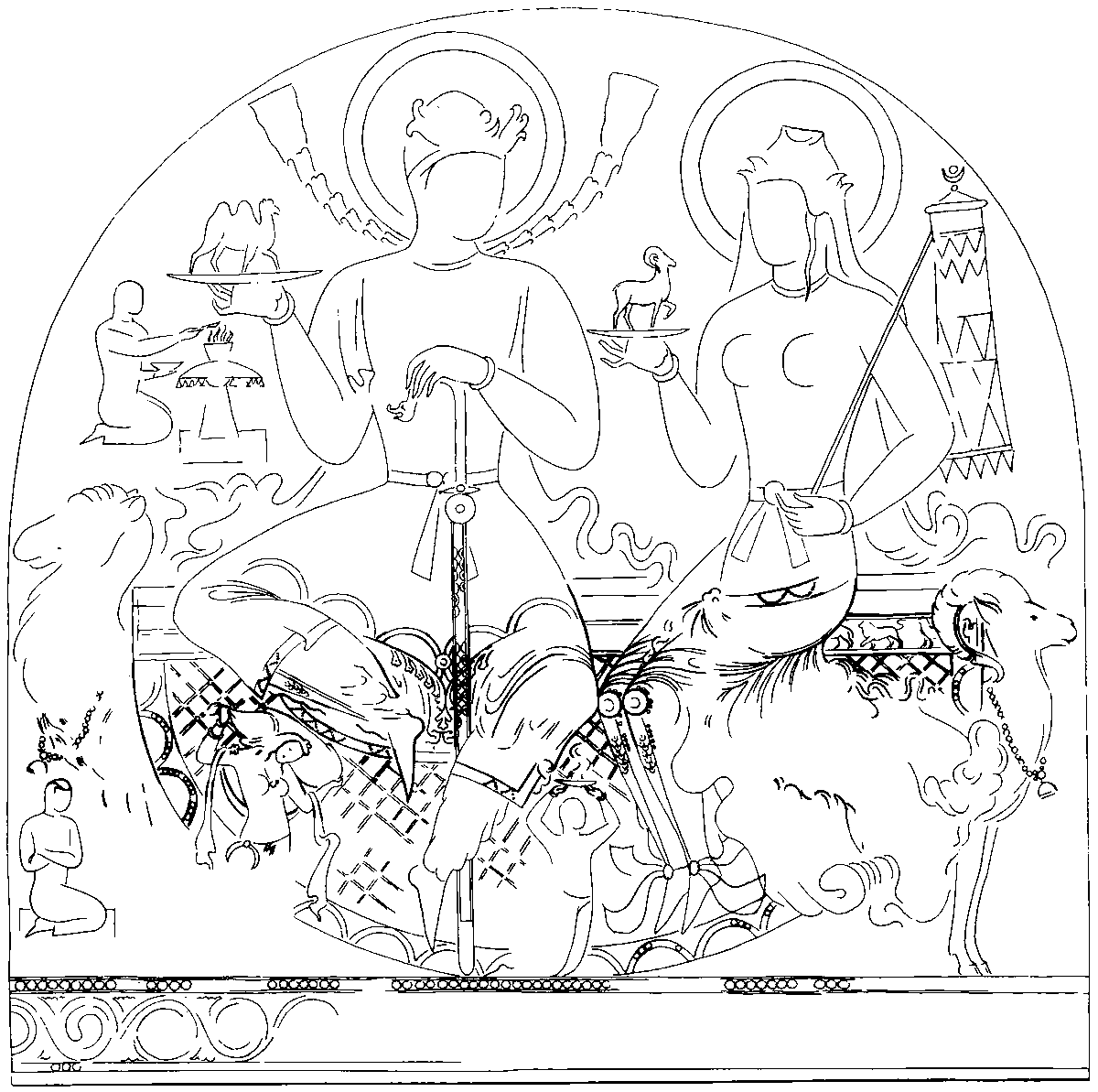
A mysterious couple of Iranic camel &sheep deities depicted in the ruins of Panjikent: The original is badly damaged &AFAIK only this drawing exists. While their identity is mysterious it points to an important bifurcation between Iranics &H. Whereas horse-names, e.g. kR^iShAshva
melanippos etc, widespread in multiple IE branches, camel names are Iranic. Whereas some RV vipra-s mention gifts of camels Arya-s are not named after camels, unlike horses. In contrast, the ram associated with this Iranic deity is shared with the H world. sarasvatI is associated
the ram starting from the shruti down to iconographic representations in Eastern India. However, her avestan cognate preserved in Zoroastrian tradition, Ardvi shUrA anAhitA, is not specifically offered ram. She gets many sacrifices with caprines being just one of those. However,
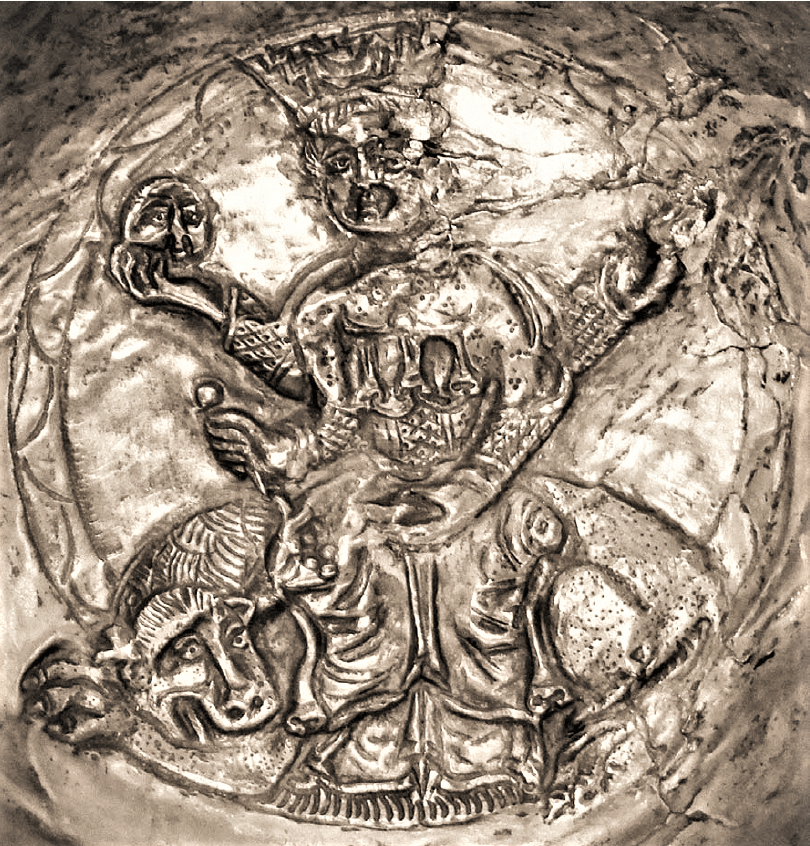
Inner Eurasia ~ 565-580 CE: The most remarkable is that little-known culture in the Kama river region. Far up north several silver bowls have been found that contain images of the goddess durgA-nAnA with at least one having an Eastern Iranian inscription. Who were they?
One of the durgA-nAnA images on a bowl from Bartym in the Kama region. Was a high north Iranic outpost?
The second of 4 durgA-nAnA bowls from the Kama region shows the deity holding a severed head. This indicates that multiple conventions from the H world transmitted to the Iranosphere. The E.Iranic script was based on the Semitic Aramaic script & was known as Khwarizmi.
A kuShANa coin showing mithra with a mace: the mace was called a gadha in the Iranic tradition but explicitly equated with the vajra in the case of mithra in the famous manthra with a counter-religious overlay (see below) from long incantation to him in the Zoroastrian branch of
the Iranic tradition:
hishtaite aom vâshahe mithrahe vouru-gaoyaoitôish
On a side of the vehicle of mithra, the lord of wide cow-fields,
vazrem srîrem hunivixtem satafshtânem satôdârem
stands an auspicious well-striking vajra with a hundred knots, a hundred edges,
fravaêkhem vîrô-nyåñcim zarôish ayanghô frahixtem
that rushes felling heroes; cast out of red metal,
amavatô zaranyehe amavastemem zayanãm
of strong, golden metal; the strongest of all missiles,
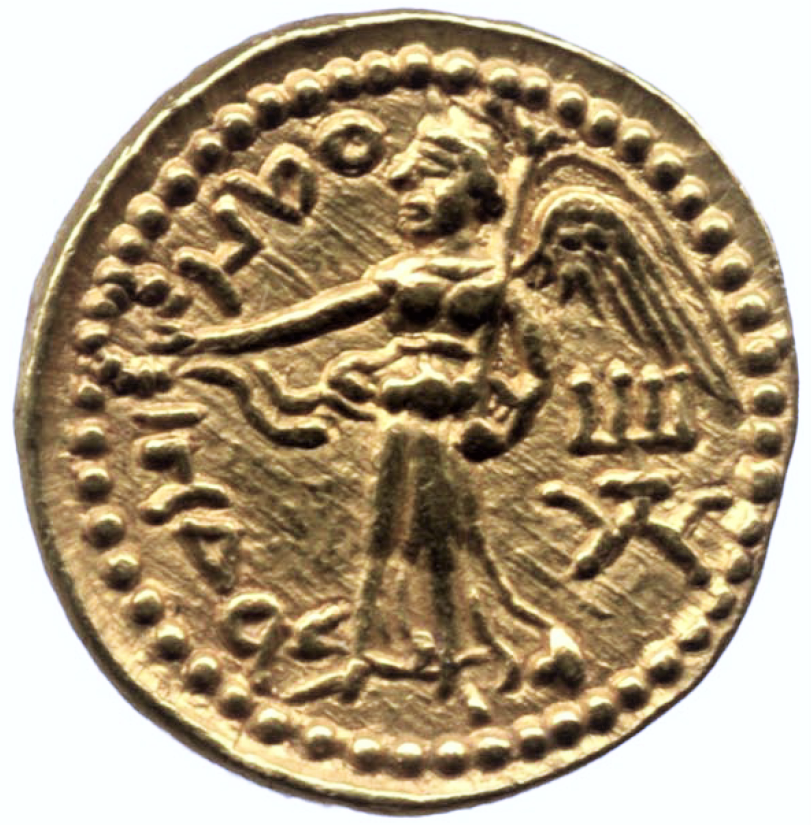
A kuShANa coin showing the Eastern Iranic deity of victory vainaiti. In Zoroastrian branch of the tradition, the deity is the male vanant associated with the star Vega (𝛼 Lyrae). This evidently goes back to the proto-I-Ir period in the least as the vedic abhijit has an identical
connotation & etymology; e.g. the taittirIya shruti states: अ॒भि॒जय॑त् प॒रस्ता॑द् अ॒भिजि॑त् | The change in gender in the Eastern Iranosphere seems to be a departure from the ancestral state. The iconography is clearly influenced by the cognate Greek deity Nike. Hence, 1 wonders
if the gender shift was also influenced by the Greek deity who appeared in the region during the yavana conquests & is often shown as being held by Zeus in the Indo-Greek coins. However, it may not be so simple as the H tradition as a female abhijiti going along with abhijit.
Indo-European epic tradition has a narrative feature that is given a specific name in the Greek branch -aristeia -- the exaltation of a specific hero in battle. The aristeias are marked by that hero standing out in great acts of valor, often accompanied by an uncontrollable fury,
with the rest almost becoming mere spectators. It has been widely noted in yavana Illiad where heroes like Diomedes, Patroclus, Hector & Achilleus have their aristeias which sometimes end in their death. In essence it is the highpoint of the career of the warrior, The aristeia is
also a feature of H epics. In the mahAbhArata we have several aristeias paralleling those of Patroclus, Hector & Achilleus ending in the deaths of the heroes -- abhimanyu, ghaTotkacha, bhagadatta among others. But apposite for the day we may note that the rAmAyaNa also features