There have been 8 shocks to the global food prices - yes eight (8). Most of them are ongoing!
🧵
1/n As for team transitory,…
No 1 - War: Ukraine, which was known as the ‘breadbasket of the FSU’, has 1/4 of world’s ‘black soil’ fertile land. In 2021 Ukraine accounted for 20%, 7%, 18% of global exports of barley, wheat & corn, respectively. It is under attack & VVP wants this war to be a food crisis.
2/
He will get his will. The UN Food and Agricultural Organisation estimates that 20-30% of sunflower, grains and corn will not be planted or harvested. It forecasts food prices to rise by another 8-22% because of the loss of Ukrainian production (FT, 9 April).
3/n
No 2 - Sanctions: Russia & Belarus are massive exporters of Potash and Nitrogen fertilisers. Russia accounts for 79% of EU Nitrogen fertiliser imports, largely owing to its cheap natural gas supplies & thus the cheapest feedstock.
4/n
Western sanctions have made it more expensive and harder for importers to buy Russian and Belarusian exports.
Land-locked Belarus has lost access to all neighboring ports except Russian ones due to sanctions, causing severe disruptions to the fertiliser supply chain.
5/n
Belarus has also banned the transit of fertilisers across its territory from Lithuania (as well as oil and other chemical products), in response to Lithuania stopping the transit of Belarussian potash fertiliser, adding further supply-chain pressures (Reuters, 2 February).
6/n
The Russian government has also imposed export restrictions on grains in order to ensure internal food security. It has, for example, banned the export of wheat, rye, barley and maize from 14 March through 30 June, and exports of white and raw sugar until 31 August.
7/n
No 3 - High Energy Cost: 1/3 of food costs are energy related: 80% of the cost of nitrogen fertilisers comes from gas, to which is added fuel cost of farm equipment or buildings. Energy cost are up big ($170/boe EU gas).
If you like avocado toast you love…?
8/n
No 4 - Higher transportation & packaging cost (7- 10% of food producers’ costs): Fuel accounts for 20-35% of costs for aviation companies and around 50% for shipping companies. The rerouting of trading with Europe will cause a sticky increase in transportation costs & delays.
9/
The west buying less Russian commodities and some countries, such as China and India, buying more of them is likely to push both freight rates and ton-miles up. Think Breton Woods III by Zoltan.
10/
CS analyst Lars Kjellberg estimates that 20% of fibre-based packaging and 35% of glass packaging is energy related, both direct & indirect ones: oil-derived chemicals used for fibre-based packaging, soda ash for glass and fossil-based feedstock for plastic.
11/
No 5 - Green Shift: We have seen increased demand for land to plant trees as a carbon offset, which puts further upward pressure on food prices as agricultural land becomes more expensive. A further source of pressure on food prices is the US Renewable Fuel Standard..
12/
The Biden Administration announced a temp waiver of the summertime ban on E15 gasoline (15% ethanol), which may lower oil prices at the expense of higher corn prices. E15 is only 10 cents cheaper, but less energy-intensive, so more volumes are likely to be sold.
13/
No 6 - Less Productivity: The price response should encourage more production, but not if input costs go up too much. Famers tend to sell part of their production forward, but face high input prices.
14/
There is evidence that farmers are finding it too expensive to buy fertiliser, so will use less. This reduces productivity. For instance, US government data estimates that high industrial fertiliser prices will reduce corn & wheat plantings by US farmers this spring.
15/
This is certainly true for rice farmers in Asia where end-consumer prices of rice did not appreciate to reflect higher feedstock prices of, say urea, as governments try to protect consumers (price controls). So farmers cannot afford the needed fertiliser - full stop.
16/
No 7 - A series of poor harvests
17/
No 8 - China Covid Policy: Lockdowns could disrupt the planting season. Up to 1/3 of famers in the northeastern province of Jilin, as well as in Liaoning & Heilongjiang provinces, have insufficient agricultural inputs after their villages were sealed off.
18/
These three provinces account for 20% of China’s food production (FT, 10 April). The lockdown also creates a potential for shortages of migrant workers.
1) oil on water (includes floating storage) and oil in transit well surpassed Covid levels.
Part of it reflects inefficiency of the sanctioned Russian & Iranian oil trade as well as the recent US sanctions on Rosneft & Lukoil.
Part of it is an outright bearish oil market = too many barrels chasing too few buyers -> needs lower prices.
2/n: Oil in transit
2) Weak Chinese petroleum product consumption:
China is in recession due to its property bust and despite the CCPs desire to steer clear of it by forcing every other industry to build what isn’t required domestically (overcapacity issue) and then dump goods onto global trade.
Because of the latter most observers still don’t get the painful economic status China is in. But China is in it.
Also, the CCP prefers coal fuelled transportation as well as LNG truck driving for the purpose of geopolitics.
Both requires less, not more, diesel and gasoline in 2026 vs 2025. Jet and Naphtha are different story but won’t drive oil buying by refineries => Oil demand by 2nd largest economy globally is bearish. Accept.
However, the CCP may take the absurd to the next level in 2026 and force refineries to build even more floating-roof oil tank storage (as part of meeting an artificial Soviet 2.0 plan within its Investment-led Growth Model) in which case refineries may buy more oil next year, but not for the purpose of producing more petroleum products but solely for storages. If they do so, however, their crude oil buying will be EXTREMELY price sensitive.
Time and State companies oil quotas will tell.
PS: If u care to understand China’s property bust structurally, here is a link to my 7 part Stack series. It remains as valid then as now.
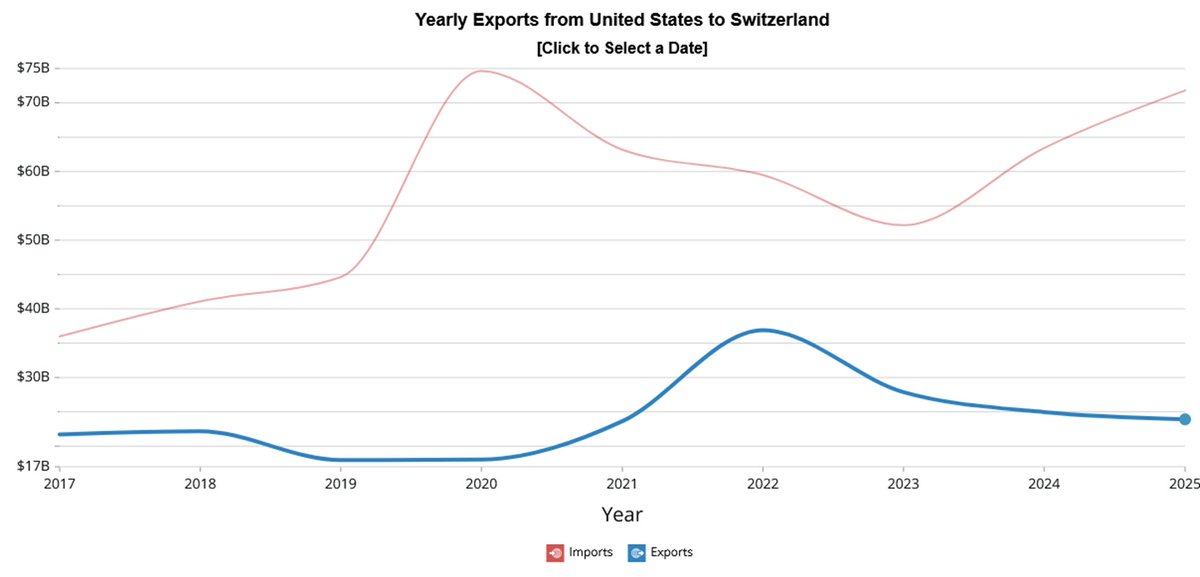
Let me add a few more facts & figures and some high level observations about the United States goods trade deficits with Switzerland of some $20bn annually.
The Swiss government and certain companies have little reason to lament—these tariffs were foreseeable.
Yes, the real issue is their scale: 39% compared to Europe’s 15%, which clearly puts some Swiss exports at a competitive disadvantage. It is what it is.
And while I still believe this situation is fixable, we must be prepared for the worst-case scenario to persist—or even worsen, with potential new tariffs on pharmaceuticals (currently exempted).
So, who is at fault? As some of us learned in officer school during military service: the Bundesrat misjudged the fundamentals of strategic assessment—Lagebeurteilung (judgement of enemy situation). That needs to be addressed. Trump wants balanced trade. Address it. Period.
History is not kind to those who choose dreams over reality—or to the weak who paint themselves as victims.
Therefore, whether Trump’s trade deficit logic makes any sense whatsoever (which it clearly doesn't in the Swiss case) is beside the point.
He’s the president. He has communicated his views clearly and consistently for decades. Adapt. Take the man seriously.
Trustworthy or not, as lamented by President Keller Sutter is none of our business.
2/n @SecScottBessent @BobgonzaleBob
Let’s now take a closer look at Switzerland’s goods trade surplus with the United States.
At Burggraben, we rely on the OEC tool (a paywalled MIT spin-off) for robust global trade data as part of our investment analysis process of all sorts—so we can assess this with confidence. I hope our readers will appreciate the data quality shared herewith for free.
While the annual trade surplus has fluctuated in recent years, the underlying—or let’s call it intrinsic—gap consistently hovers around $20 billion, as the data below will show.
More concretely, Iran likely enriched some 250kg of HEU stockpiles since 2021. Worse, it also said to adds significant new capacities.
That material so far could quickly be turned into the fuel for the equivalent of 10 bombs, should Iran’s leadership take the political decision to pursue weapons, according to Bloomberg.
Here is my theory how the major incident - a so called blackout - occurred at 12:30 CET today in the power system of Spain & Portugal:
1/n
At the time of the incident, Spain and Portugal operated the grid at very high renewables share of about 66% - i.e solar (55%) and wind (11%; eolica)
2/n
While this isn’t unusual for Spain, it does mean that the grid operates with little inertia (resistance to change) during such time. The grid is therefore vulnerable to external effects…!
On this platform, certain perma bulls keep pushing a bullish crude narrative based on relative U.S. inventories—day after day, for three years now.
Their logic: Total U.S. crude inventories (including the SPR) are at 838 million barrels (orange line), 200 million barrels below the 10-year average → bullish!
Yet, inventories keep falling, and prices remain stuck in a range. Clearly, they are wrong.
1/9 @UrbanKaoboy @Iris62655179 @BrentRuditLeo
The problem with their logic?
a) The U.S. is no longer the marginal importer of crude oil—Asia is (or was).
b) U.S. inventories are artificially high on a 10-year average due to the shale boom, which took off in 2014. Shale growth and Covid distort the data, keeping inventories (ex SPR) elevated. So any 5- or 10-year comparison is meaningless—period.
2/n US Crude Oil Inventory ex SPR
Including SPRs, the picture looks more normalised - but not tight. But does the US really need 700mb of strategic reserves in 2025? I don't think so.
Yesterday, I shared a few thoughts that I’d like to expand on, especially given how volatile the current tariff landscape under this admin has become.
Navigating it isn’t just difficult—it’s nearly impossible to avoid missteps. Hopefully some traders will expand on my thoughts...
1/n
What do we know?
As at 23 March 2025, Comex copper price in New York is trading at 14% premium to LME in London. Buying a tonne of copper in NY costs $11,213 versus 9,842 in London, $1,371 per tonne more than in London.
2/n
Why is that? Because of tariff FEARS, not tariffs.
Traders are hedging future risk of potential tariffs on all forms of the raw material, such as cathodes, concentrates, ores, and even scrap. But there aren't such tariffs in place for copper yet (unlike alumnium).