Why Japan and the movements in the Yen are important to macro 101
A number of people have asked this same question which I answered in my private Twitter feed last week. Below is the the thread
The reasons why Japan is important to the world economy are many. They have a 5TN GDP and are a major trader with the world. But the big deal is that Japan has massive accumulated savings of 20TN or more and have a very high personal savings rate. Because there is limited
Local investments as the government owns most of the JGB's and a lot of stocks. Japanese investors are a major player on the world stage and their flows move asset markets and their currencies. The weakening of the yen which I predicted is literally a flow out of poor
Performing Japanese assets propped up by government buying to US asset markets. The Japanese policymakers are trying to stimulate their economy via easing financial conditions where domestics would consume. Inflation is secondary because local demand is weak. The easing also
weakens the currency which in does have a positive impact or increasing competitiveness of Japanese goods. But also generates demand for foreign assets resulting in a spiral. That is what we see at the moment and the BOJ and MOF want some stability and also resent speculation
Either by the legendary Mrs Watanabe or foreign speculators and will intervene to screw the speculators but that won't last. However at some point domestics will sense the end of the the yen selloff and profit take on foreign denominated assets, weakening those assets and
Repatriating money back to Japan. That flow would obviously have an impact on global asset prices. So this large savings pool and what it is doing is critically important to the global markets as is other large pools like China PBOC, Norway sovereign fund, Middle eastern sovs
And British, US, and European savers. Japan is where the action is as the BOJ and MOF are heading in a different direction than their peers.
• • •
Missing some Tweet in this thread? You can try to
force a refresh

Money creation and credit creation in the private sector 101 part 2.
Role of Repo.
In the prior thread I outline credit creation which can happen without banks and money creation which requires banks.
I also hinted at bank reserves role as being one of grease to the
system and NOT necessary for bank money creation but necessary for interbank deposit shifts. I also didn't discuss base money creation from the Fed and won't be dealing with that in this thread either.
Here I will discuss the specific role of Repo in today's financial system
The big takeaway is it is one of many important and necessary means of credit creation AND it has no role in money creation unless a bank is a party to the transaction.
That will take some weedy mechanics to prove. But before we do that let's talk about the entire economy
Money creation and credit creation in the private sector 101
There has been a lot of focus on the repo market lately. I get it. It's an important part of the capital markets in the credit creation process. But its growth and contraction is part of the credit creation process
The repo market where transactions are between hedge funds and money market investors, and those who desire leverage for whatever purpose is an important market in the credit creation process BUT is not part of the money creation process UNLESS a commercial bank or the Fed is
A party to the transaction. Because this is largely misunderstood by even some plumbing experts it's worth it for me to write out my understanding (maybe im wrong which would be awesome so I can learn). So here I go.
I've been studying various versions of balance sheet expansions over my career. I'd classify them as
Japanese first failed effort
UK's version
U.S. Version 1
U.S. version 2
ECB version
Japanese all in version 2
They are all fairly different in approach. The big takeaway 🧵
The developing Fed version that most are excited about is most akin to the Japanese first failed effort.
Here's a rough summary of each
In 2001-2006 Japan the BOJ initiated QE. In their version they offered significant lending to the Japanese banking system for good collateral
The balance sheet doubled in size at a pace of 35 Tn yen per year. However of that 35tn only 5 was direct asset purchase and most of that was Japanese Tbills. This is very similar to the BTFP program from SVB time and the current SRF. It was also sorta similar to ECB LTRO
Why do repo rates change and what do they have to do with reserves. This is a super technical issue and there are better folks to follow on this topic than me but I'll give it a go.
Firstly what are the two sides of a repo transaction and why do they want to interact.
One side is a guy with a bank deposit he wants to earn interest on. The other is a guy who wants to borrow money overnight and has assets he owns that he is willing to provide as collateral to the loan. We can go down a level on each side but for now let's keep it simple.
Most repo transactions are done with UST as the collateral and most UST collatarel used is TBills but. UST's are also highly common collateral but do to the marked to market risk they offer less borrowing capacity per unit of notional (higher haircut)
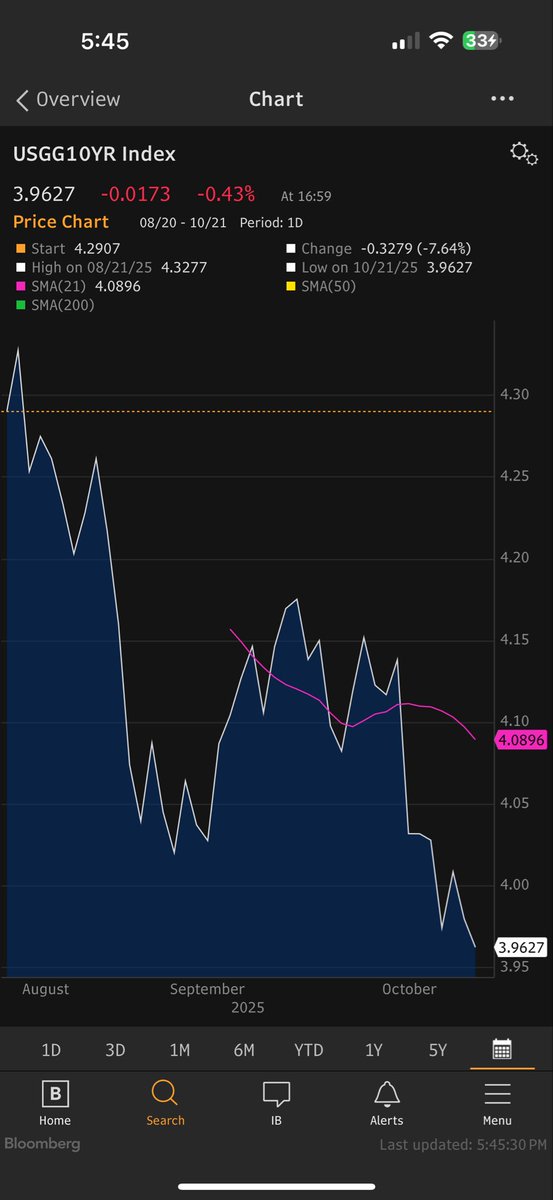
Some thoughts on 10 year notes since Powell guided for a restart of the cutting cycle at Jackson Hole. Trying to answer what the bond market is saying
Nominal yields have fallen 33bp
Note yields are driven lower by
1)Falling real GDP expectations
2)Falling Inflation expectations 3) Falling "risk" of owning assets 4) Improving supply/demand balance vs expectations.
In attributing nominal yield changes to these 4 things unfortunately market prices don't
Easily demonstrate these things. For instance 3&4 are only able to be measured via a model which estimates risk premiums or the expected return over holding cash
Even Breakeven inflation and real TIPS yields have risk premium buried in there market yields. However we can try
SPX has a trailing earnings yield of 4% with expected 1 year earnings growth of 11.7%. What's the bull case? For me the bull case is a combination of simply collecting the earnings accrual
and having the multiple expand slightly. In that case a 16% return would occur which is roughly 1 std higher and happens 1 out of 6 timer.
The big driver of equity returns is the accrual of earnings. Over the last 5 years earnings accrual has dominated historic returns
As long as companies continue to grow earnings they will go up over the long term.
Multiples rise and fall and as can be seen in the chart can dominate performance of equities in the short term. Furthermore multiples are impacted by interest rates