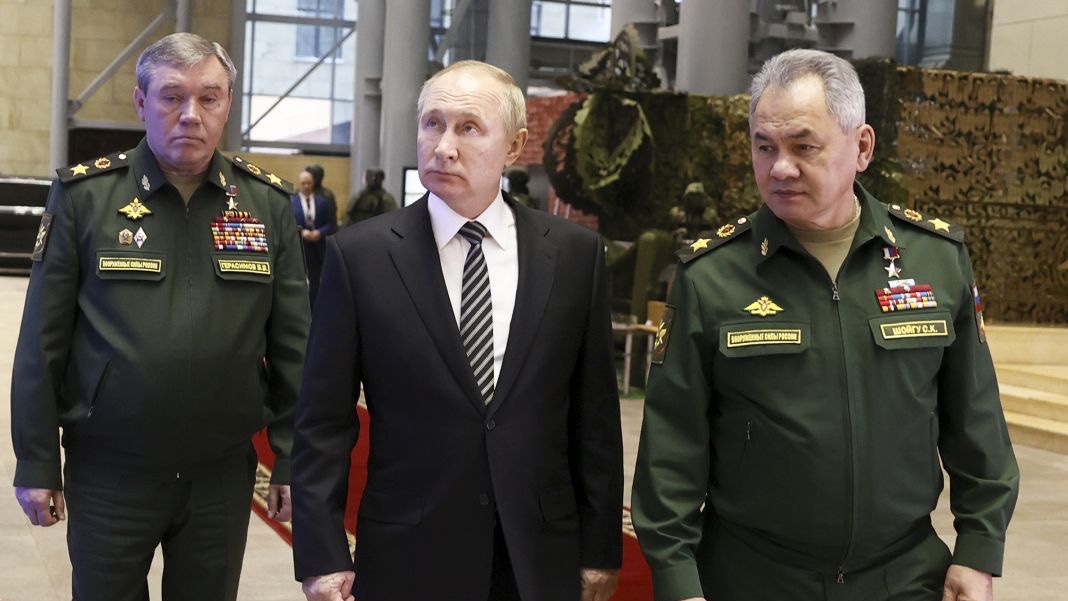
It is 64 days since the Russian invasion of Ukraine began. Today, an examination of the implications of Gerasimov ‘taking charge’ of the Russian invasion of Ukraine. 1/20
2/20 There are unconfirmed reports that General Gerasimov has moved to Ukraine and may be taking overall command of the Russian campaign. This is still in the realm of speculation. Therefore lets use this thread as a bit of a thought experiment.
3/20 General Gerasimov is the Chief of the General Staff of the Russian Armed Forces. He was appointed to this position by President Putin in November 2012.
4/20 Why is the chief Russian military commander taking over what is essentially a theatre command? If confirmed, this would be a significant intervention, probably directed by Putin, and may see a change in how Russian operations are planned and executed.
5/20 It is very unusual for the most senior military leader of a nation to ‘step down’ and assume an operational command. It is an indicator that Putin is running out of options for his Ukraine special operation. There are also some interesting strategic and operational impacts.
6/20 Strategic impacts. Who replaces him? Gerasimov has led the Russian military in their reforms for the past decade. He also commands the day to day running of the entire military, including strategic forces. It is not a position that should be left unfilled for long.
7/20 If Gerasimov goes to Ukraine, and no-one replaces him, who will oversee overall Russian military operations and development in short term, as well as any mobilisation?
8/20 Does it mean Russian military strategy will improve, or get even worse? Despite the mythic status of Gerasimov before the war, the performance of the Russian military he oversees – strategic to tactical – has been quite sub-par. realcleardefense.com/articles/2022/…
9/20 And not only has it been ineffective on the battlefield, but the atrocities also it has committed – city destruction, deliberate targeting of civilians, torture and murder – are indicative of a corrupt professional ethos. Gerasimov is ultimately responsible for this.
10/20 Finally, what does this mean about Putin’s mindset? Has he lost faith in Gerasimov?
11/20 In WW2, General MacArthur appointed UA Army General Robert Eichelberger to command US forces at Buna. Before departing, Eichelberger was told "Bob, I want you to take Buna, or not come back alive." Has Gerasimov been given a similar directive by Putin?
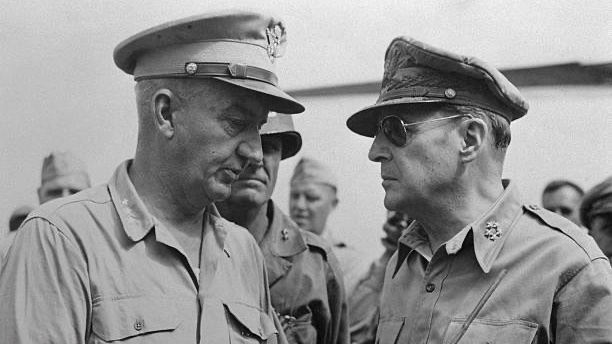
12/20 Or has both Putin and Defence Minister Shoigu set up Gerasimov as the fall guy for any Russian failure in the war?
13/20 Operational impacts. It appears, if Gerasimov’s appointment is confirmed, to place General Dvornikov’s appointment in a new light. Perhaps Gerasimov might be the overall joint commander, with Dvornikov assuming the function of land component commander.
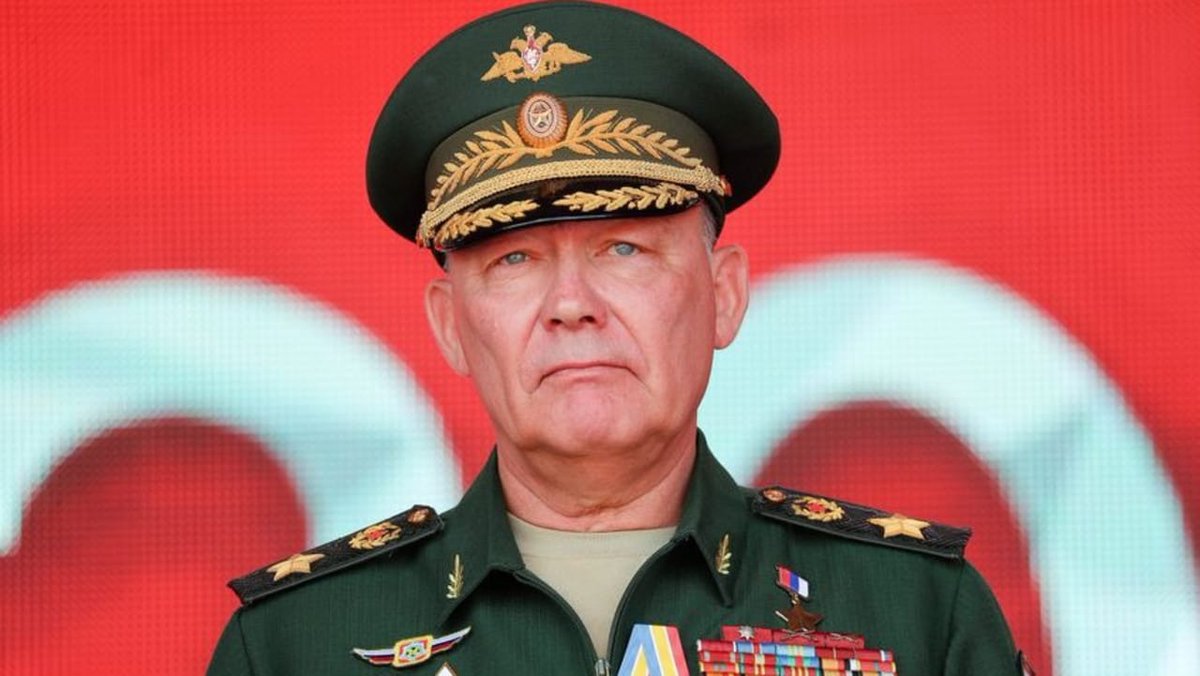
14/20 Perhaps General Dvornikov has not proved the competent joint commander the Russian hoped for, or has not met strategic timelines for success.
15/20 Gerasimov is renowned as a military theorist. Despite the fact that his ideas are yet to be proven on the battlefield in Ukraine, perhaps Gerasimov might bring an improved level of joint planning and execution to Russian operations. Its a big maybe.
16/20 To do this, Gerasimov would need a joint planning staff. He will need more than a couple of command vehicles, an aide-de-camp and a secure satellite phone if he is to exert real command authority over Russian operations in Ukraine.
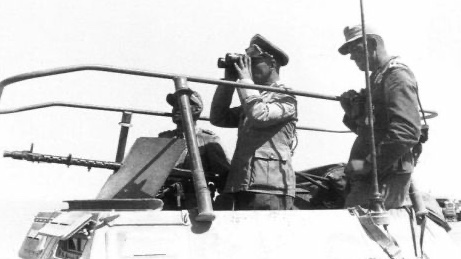
17/20 Good generals can generally be found in only a couple of places on the battlefield: at the location of most danger and the location of most opportunity. They do this so they can best marshal resources to support the commander on the ground, and to provide leadership.
18/20 Gerasimov would be going to the Russian Army’s place of most danger & opportunity. Most dangerous because a loss in the east would probably see a long pause in operations for the Russians to regenerate forces & rethink strategy. And would have a political impact for Putin.
19/20 And it is the place of most opportunity because it is probably the only location where Russia has any chance of an operational breakthrough that could allow them to tell their citizens (and their international friends) that the Russian military was successful in Ukraine.
20/20 Gerasimov, until recently, was seen as one of the better Russian theorists of the modern era. However, his reforms have not resulted in battlefield success. It is unlikely his presence on the battlefield, in charge of a tactically mediocre Russian force, will change things.
• • •
Missing some Tweet in this thread? You can try to
force a refresh

Ukraine has just struck a Russian defence plant with its new long-range FP-5 missiles and damaged a key bridge to Crimea. Things keep getting worse for Putin and Gerasimov. My Part 2 assessment of Russia's losing war, and how Putin might reverse things. 1/5 🧵
2/ Russia is losing its war on Ukraine. But a losing trajectory is not a settled outcome. Part 2 of Losing on Every Dimension examines the five "reversal conditions" that could still rescue Putin, and what the West must do to lock in his defeat.
3/ The most revealing point about these five reversal conditions. With one exception, none lies within Russia's own control: a US settlement, the oil price, China's treasury, North Korean manpower, and Western fatigue. Russia's escape from defeat depends on the decisions of others.
For the first time since the invasion, Russia is losing more troops than it can recruit. Net territorial movement over the past three months has favoured Ukraine. Part 1 of my new assessment, I explore how Russia is "Losing on Every Dimension" - military, cognitive, moral, industrial and economic. 1/7 🧵
2/ MILITARY. In 2025 Russia paid roughly 200 casualties per square mile taken. In the first five months of 2026, with a net gain of 17 square miles, it paid over 9,600 per square mile. The meat grinder is grinding through Russian men faster than Russia can produce them. Tactical operations are now unified with mid-range and long-range strikes.
3/ COGNITIVE. Russia's narratives are decoupling from a battlefield made visible by open-source reporting. When Putin has to ask Ukrainian permission to hold parades, and cannot hold an international forum without a Ukrainian attack, his narrative about inevitable war crashes.
Our darker angels have returned. For a decade, influential scholars argued that major war was on an irreversible decline. Pinker's 'Better Angels' thesis became almost orthodoxy in parts of the security studies world. But, as @lawdavf has written, war has a future. 1/4 🧵
2/ Fast forward to 2024. PRIO records 61 state-based conflicts — the highest since World War II. 129,000 battle deaths. The fourth most violent year since the Cold War. The 2024 data from SIPRI and PRIO is unambiguous: a historic peak in state-based conflicts, the fourth most violent year since the Cold War, and a Russo-Ukrainian war that has now consumed an estimated 500,000 lives.
3/ The analytical failure wasn't just academic. Governments that accepted the 'war is fading' narrative underinvested in defence, deterrence and industrial capacity. Ukraine paid some of the price. But most Western nations are still underinvested in force structure, defence industry, war stocks and most importantly, national will to resist authoritarian aggression.
China fields a military where 70-80% of soldiers are only children. Every battlefield death risks extinguishing a family line. This demographic reality shapes Xi's strategic calculus in ways Western analysis should pay more attention to. My new piece explores this. 1/5 🧵mickryan.substack.com/p/one-child-on…
2/ China's one-child policy ended in 2015. Its military consequences are only beginning. By 2015, ~70% of PLA soldiers and 80% of combat troops came from one-child households. There is almost no historical precedent for a major military force comprised almost entirely of only children.
3/ The research is sobering. Only children are measurably less trusting, less resilient, less risk-tolerant, and less competitive than those with siblings. These are not ideal traits for combat. They are increasingly the defining traits of the PLA's human capital.
Some initial thoughts on the new Australian National Defence Strategy released today in Canberra. Overall, the focus and trajectory of Australia's defence strategy remains consistent with the 2024 version. There are some notable things worth highlighting. 1/15 🧵🇦🇺
2/ The new NDS shifts more towards a true 'defence' strategy rather than just a 'military' strategy that was described in the 2024 version. There is stronger language around national civil preparedness, fuel security, and economic security. This is good. But these are also topics that should be in a National Security Strategy - if Australia had one!
3/ Spending. There is an uptick in spending. This is a positive. There is a claim that we might get 3% of GDP on defence at some point in the future. The reality is that because we are well short of this now, trying to fund both AUKUS and the ADF at the same time with current spending is challenging (nice word for not possible), and conventional military capabilities are degrading - and not modernising fast enough.
“The advantages of threatening an American ground intervention are real. The advantages of actually committing boots on the ground are also real but more limited. The disadvantages could be numerous.” My weekly update on Iran, Ukraine and the Pacific. 1/6 🧵
2/ Ukraine has achieved something significant in the south. Ukrainian attacks there have disrupted Russian offensive planning, consumed Russian reserve forces, and demonstrated that Ukrainian combined arms operations can impose genuine operational costs. But there is also a trade-off in these southern operations. Gains in the south have come at some cost to northern Donetsk, and Russian forces retain the initiative on what is Russia’s main effort on the ground: the envelopment of Ukraine’s fortress belt and the remainder of Donetsk.
3/ In Iran, the oldest lesson in strategy keeps surfacing: military success in the air and at sea does not automatically translate into political outcomes on the ground. Iran has not been beaten. The question being probably being considered in the Pentagon, Congress and the White House is whether ground forces would ensure that the military campaign achieves a decisive political outcome - or whether it would lead to a larger and more difficult American military commitment to the Middle East with uncertain results.