A mysterious deity Zqyqa of pre-Abrahamistic Arabians from the Hatra temple complex. He is believed to be the master of the netherworld with a dog. Note trishUla with likely lunar deity -an iconographic parallel across Eurasia. The Hatra vandalized by the Khilafat few years back
He appears to have manifested in a benign form above & a fierce form here. The IE influences are clear: the dog; here 3-headed as yavana Kerberos. His axe is again an IE influence. The time deity on the trishUla has both the solar ray & lunar crescent. To the other side is the
West Semitic goddess Ashtart (= East Semitic Ishtar) on throne with 2 lions; On her crown sits an eagle, while below here are the 2 fishes indicating the astronomical symbol of the colure in Pisces. It is not clear if the weapon in her hand is a club. Below the Kerberos is a 2nd
dog -- the two probably represent the constellations of Canis Major and Minor. The scorpion & the bow opposite to them are likely the constellations of Scorpio & Sagittarius.
The eagle on the crown of Ashtart is likely a represent of the ancient Semitic solar deity Shamash. Some parallels are seen in this dyad of goddesses from Palmyra which combine Iranic, Greek & Semitic elements. The eagle is likely equivalent to that seen with Ashtart. The dog is
clearly reminiscent of the Iranic daenA. The first goddess is trampling a man. The second goddess is iconographically similar to the Greek Tyche/Roman Fortuna.

• • •

Missing some Tweet in this thread? You can try to force a refresh

 

Keep Current with manasataramgini

manasataramgini Profile picture

Stay in touch and get notified when new unrolls are available from this author!

Read all threads

This Thread may be Removed Anytime!

PDF

Twitter may remove this content at anytime! Save it as PDF for later use!

Try unrolling a thread yourself!

how to unroll video
  1. Follow @ThreadReaderApp to mention us!

  2. From a Twitter thread mention us with a keyword "unroll"
@threadreaderapp unroll

Practice here first or read more on our help page!

More from @blog_supplement

Apr 29
SM has raised a bit of conflict in me thus: On 1 hand I think H should be educated about the texts as they are rather their 2nd had imaginations regarding them. On the other hand I agree with the below -- average H education is simply too poor for them to meaningfully apprehend
"difficult" texts that need nuance & historical context. While this may sound elitist, this is exactly what SM has taught me. There is a certain body of anti-intellectual H who are simply not capable of seeing "difficult" texts as they are leave along points where the text is a
bit indirect but has an implication that can be deeply troubling to their sensitivities. In large part, I see this as a result of the broad tendency to accept Abrahmistically inspired fashions that are coercively imposed on the rest of the world by the power of the Occident. The
Read 10 tweets
Apr 29
A 🧵branch from previous RT. While skanda & ShaShThI are the most common deities on the coins of yaudheya& kuninda republics from the Panjab confederation they also issued several shiva coins, 1 was this chatur-dAm (tetradrachm) with a tricephalic umA-maheshvara. mahesha tramples
a dAnava -- a prototype of the apasmara demon -- the agent of mental disease in the south Indian dakShiNAmUrti iconography. To his left stands umA embracing rudra. somewhat clearer in this exemplar: These were issued by kuninda, yaudheya or both jointly. The opposite side showed
the famous deer of these gaNa-rAjya-s. The second type was the one posted here:

In both these rudra holds a trident-headed halberd. Faintly seen in the first exemplar of the above. The same weapon is also held by skanda in some of the earliest depictions
Read 9 tweets
Apr 16
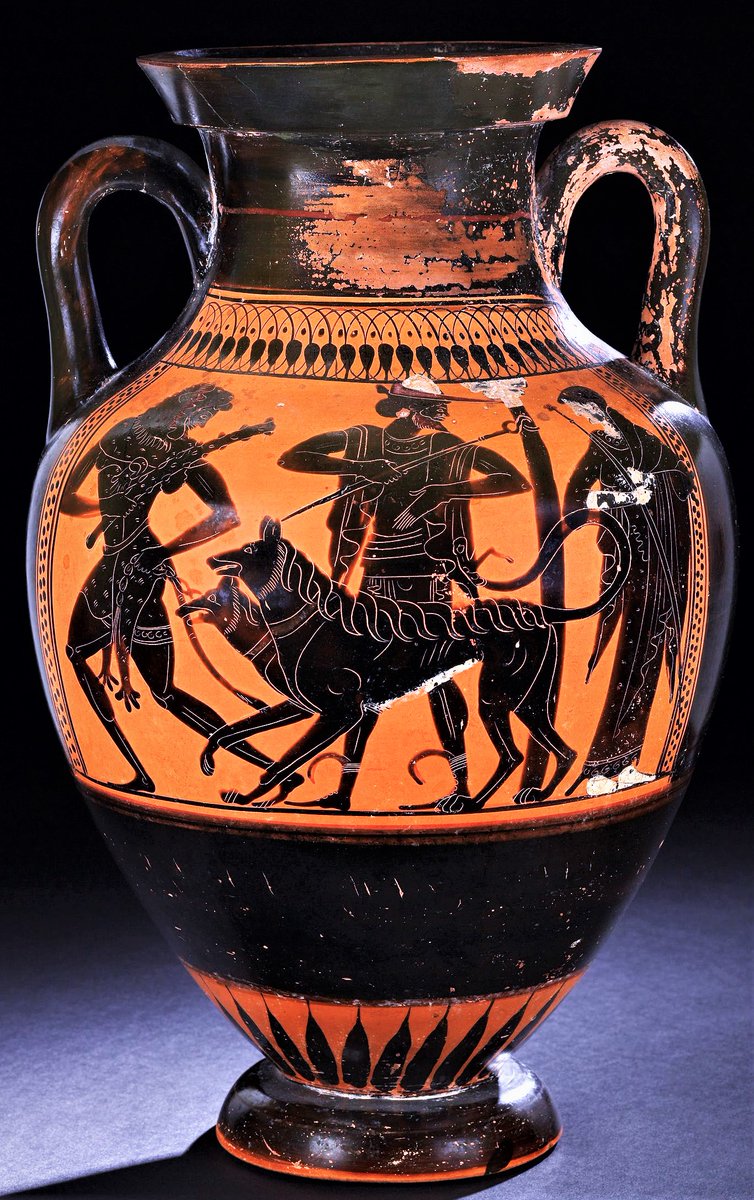
A brief discussion of some old IE motifs: Here is Herakles (left) seizing the dog of the netherworld Kerberos (note 2 headed here). Behind the dog is the god Hermes with his caduceus. To the right is the awful Persephone, the goddess of the realm of the dead. While Hermes is a
cognate of H puShan but his name might also be a cognate of saramA the mother of the hell-dogs in the H tradition. Comparable to the Attic amphora, the 2 dogs are depicted here in Iranic iconography from the kuShANa age gandhAra. Here the urvan of a dead Iranian is seen meeting
the goddess daenA with the two dogs as he crosses over the bridge cinvato peretu to the realm of the dead. daenA has the features of a benign manifestation of Persephone as Kore, reminding one of her favoring Herakles by giving him Kerberos as shown on the above amphora. The H
Read 28 tweets
Apr 16
This image of Herakles was brought from placed in a temple of Apollo ~151 CE. I has a remarkable bilingual inscription in Greek & Parthian dialect of the Iranian language. There Heracles is identified with the Iranic god verethraghna & Apollon with tishtrya. It shows that between
Greek & Iranic branches of the IE religion the homologies could be more or less correctly sorted out with Herakles being placed in his ancestral indra-class & Apollo in the rudra-class. This identification is also seen in the statues produced by the Greco-Iranic king Antiochus
See:
However, in the iconographic tradition of the Greco-Indian kings the senior representative of the indra class Zeus was identified with indra. For the Iranics that posed an issue as they tended to id him with ahura mazdha.
Read 4 tweets
Apr 15
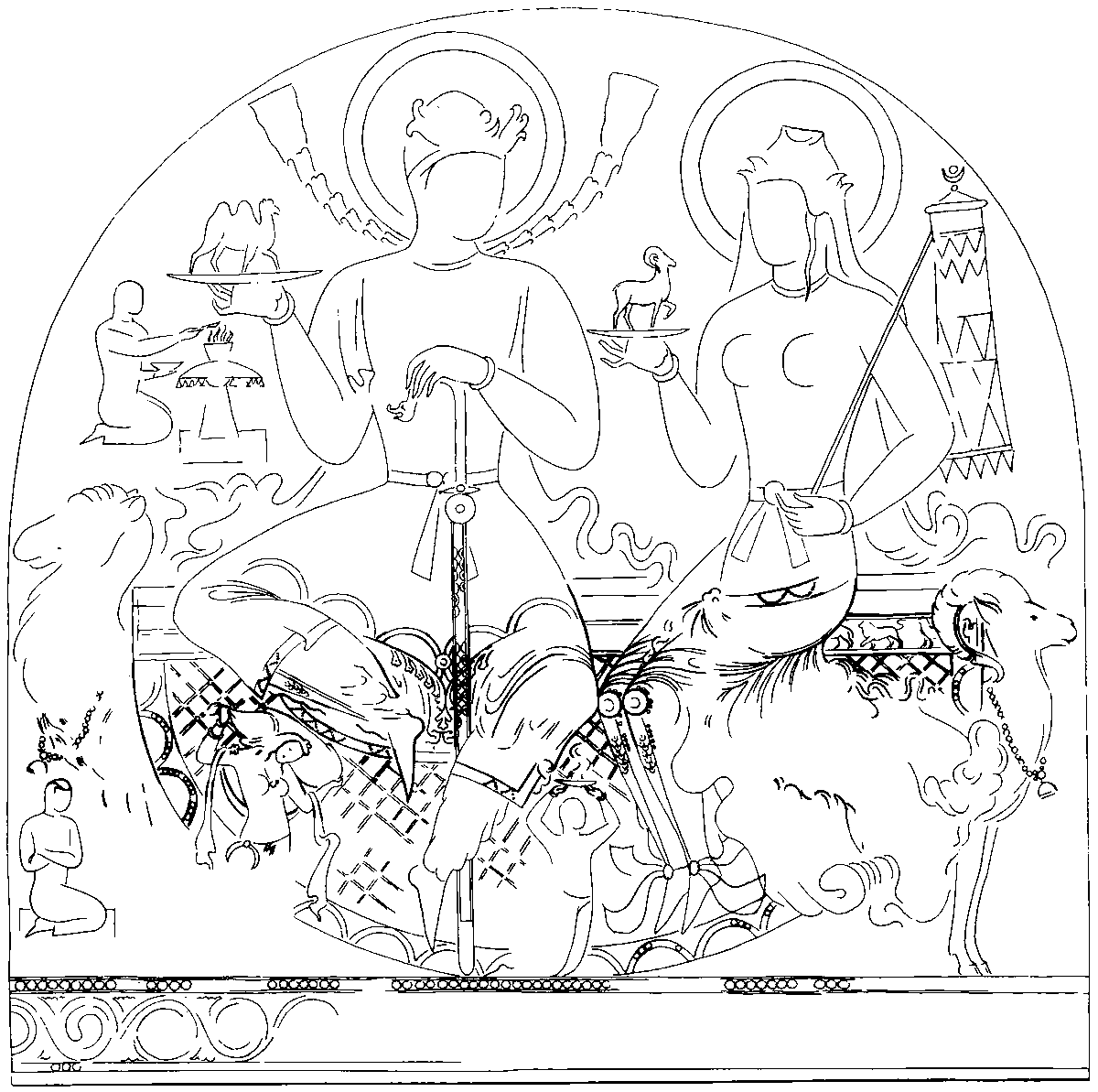
A mysterious couple of Iranic camel &sheep deities depicted in the ruins of Panjikent: The original is badly damaged &AFAIK only this drawing exists. While their identity is mysterious it points to an important bifurcation between Iranics &H. Whereas horse-names, e.g. kR^iShAshva
melanippos etc, widespread in multiple IE branches, camel names are Iranic. Whereas some RV vipra-s mention gifts of camels Arya-s are not named after camels, unlike horses. In contrast, the ram associated with this Iranic deity is shared with the H world. sarasvatI is associated
the ram starting from the shruti down to iconographic representations in Eastern India. However, her avestan cognate preserved in Zoroastrian tradition, Ardvi shUrA anAhitA, is not specifically offered ram. She gets many sacrifices with caprines being just one of those. However,
Read 5 tweets
Apr 13
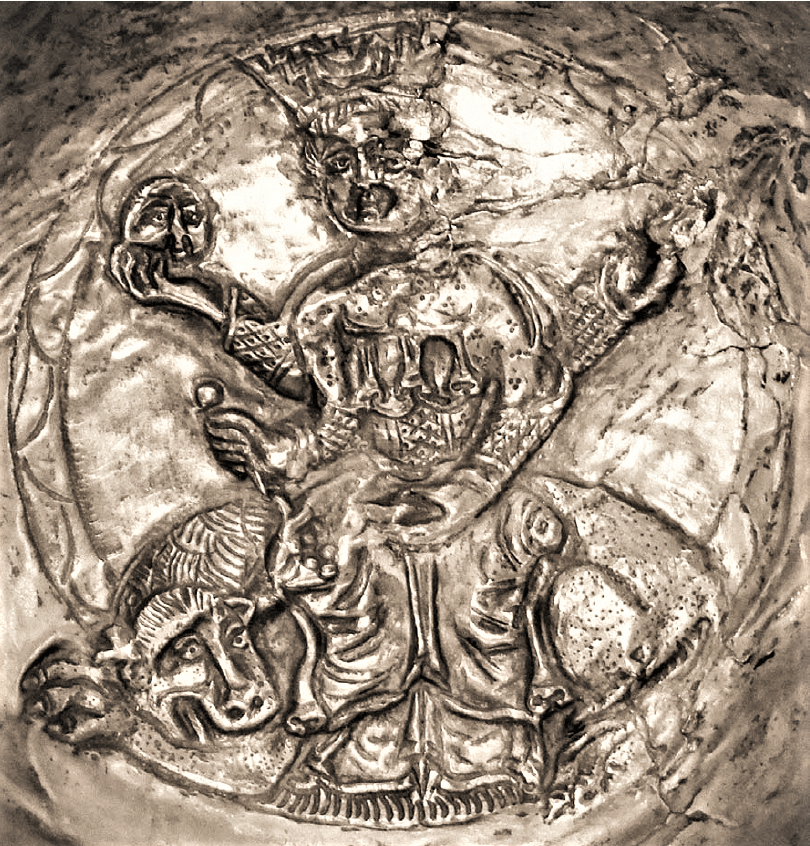
Inner Eurasia ~ 565-580 CE: The most remarkable is that little-known culture in the Kama river region. Far up north several silver bowls have been found that contain images of the goddess durgA-nAnA with at least one having an Eastern Iranian inscription. Who were they?
One of the durgA-nAnA images on a bowl from Bartym in the Kama region. Was a high north Iranic outpost?
The second of 4 durgA-nAnA bowls from the Kama region shows the deity holding a severed head. This indicates that multiple conventions from the H world transmitted to the Iranosphere. The E.Iranic script was based on the Semitic Aramaic script & was known as Khwarizmi.
Read 6 tweets

Did Thread Reader help you today?

Support us! We are indie developers!


This site is made by just two indie developers on a laptop doing marketing, support and development! Read more about the story.

Become a Premium Member ($3/month or $30/year) and get exclusive features!

Become Premium

Don't want to be a Premium member but still want to support us?

Make a small donation by buying us coffee ($5) or help with server cost ($10)

Donate via Paypal

Or Donate anonymously using crypto!

Ethereum

0xfe58350B80634f60Fa6Dc149a72b4DFbc17D341E copy

Bitcoin

3ATGMxNzCUFzxpMCHL5sWSt4DVtS8UqXpi copy

Thank you for your support!

Follow Us on Twitter!

:(