A photograph taken on April 3 showed the scene where Russian forces executed eight men at 144 Yablunska Street, #Bucha
Vadim Ghirda/Associated Press
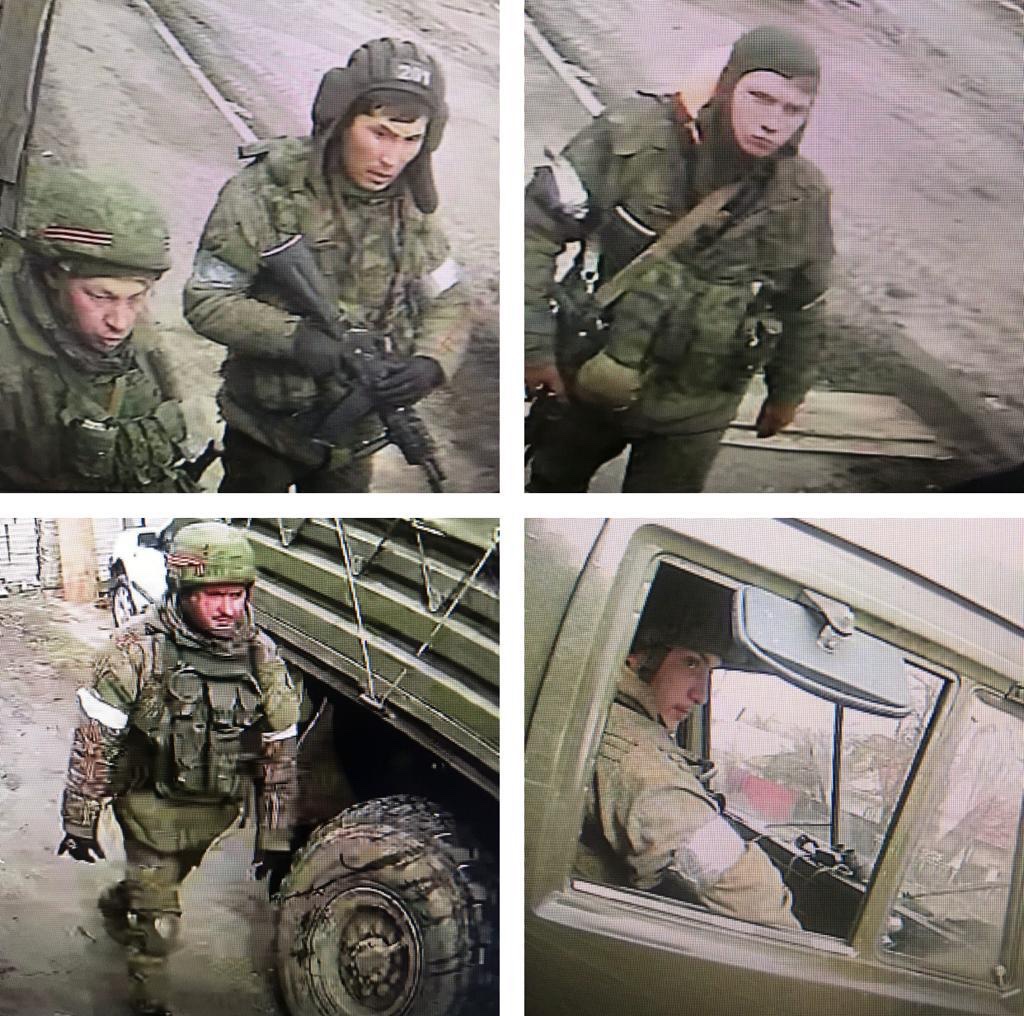
Still images from a surveillance camera opposite 144 Yablunska Street showed Russian paratroopers occupying Bucha around the same time the group of men were executed.
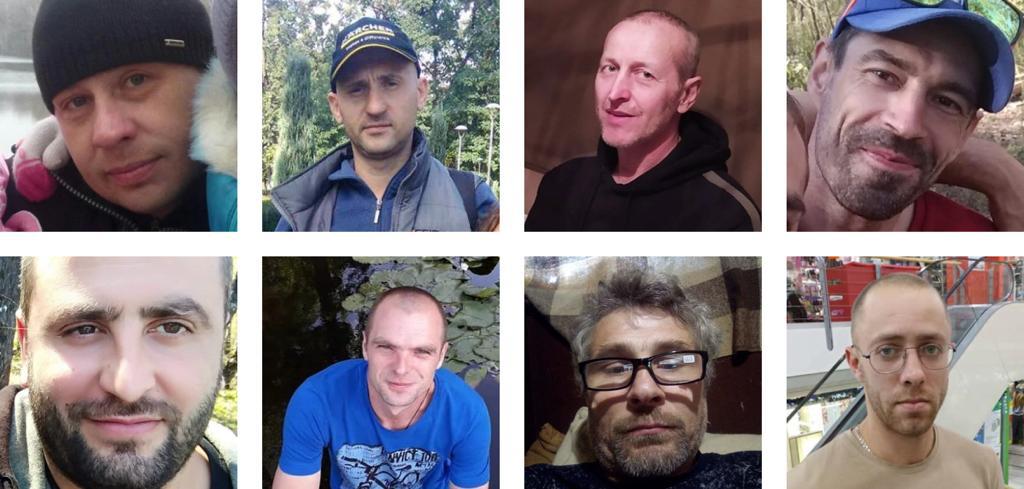
📷 taken from social media, show the eight men who were executed. Top row, from left: Anatoliy Prykhidko, Andriy Matviychuk, Andriy Verbovyi and Denys Rudenko. Bottom row, from left: Andriy Dvornikov, Svyatoslav Turovskyi, Valera Kotenko and Vitaliy Karpenko
• • •
Missing some Tweet in this thread? You can try to
force a refresh

What are Russia’s real interests in Africa? Let’s break it down.
Russia often talks about "anti-colonial solidarity" with Africa. In reality, its policy follows a classic colonial model - using manipulation, destabilization, coercion, and systematic extraction of resources.
In this model, Africa is not a partner but a territory for exploitation:
• first, dependency and fear are created;
• then local elites are hooked on "security services";
• and finally, control is converted into concessions, quotas, and export flows.
Independent journalists show that Russian influence structures in African countries aim to create political turbulence and the managed degradation of institutions. Russia supports forces that turn states into closed, controlled, and unsafe spaces for citizens - places where access to strategic assets can be "rewritten" in exchange for fear and weapons.
This fits a material logic: Africa holds about 30% of the world’s mineral reserves, including cobalt (over 70% of global production in the DR Congo), as well as significant deposits of gold, manganese, bauxite, lithium, and rare earth metals. Control over these resources provides both profit and geopolitical leverage. And that is exactly what Russia wants.
The systematic nature of this approach is well illustrated by the ecosystem of influence structures described by journalists - the so-called "Company": a network of political technologists, media managers, information operations specialists, and intermediaries working simultaneously in Africa, Latin America, and the Middle East. Its function is not only to promote pro-Russian narratives, but also to cultivate loyal elites, discredit Western partners, organize information attacks, and create conditions for political turbulence.
Information destabilization here is the prelude to economic penetration: first, the balance of influence is shifted, and then deals for extraction, logistics, or military presence are facilitated.
Notably, in the Central African Republic, where Russian mercenaries operate with impunity, timber, gold, and diamonds make up the bulk of exports - precisely the sectors easiest to "capture" through concessions, site security, and logistics control.
Official data compiled by the World Bank is telling: in 2022, the CAR’s extractive sector contributed only 0.6% of GDP, while accounting for 46.5% of exports. In monetary terms, that’s roughly CFAF 25.5 billion in gold exports and CFAF 8.9 billion in diamond exports, but government revenue from extraction amounted to only CFAF 2.0 billion. This is typical of a colonial-style economy: resources exist, but rents "leak" through the shadows, corruption, and external beneficiaries.
Russian schemes operate like "dirty value chains": extraction in high-risk areas ➡️ shell companies and intermediaries ➡️ "cleansing" of origin through third jurisdictions ➡️ monetization on the global market.
The U.S. Treasury, when grounding sanctions, explicitly noted that the Prigozhin-linked company Midas retained preferential access to the Ndassima gold mine in the CAR, whose reserves experts valued at over $1 billion. The Blood Gold Report estimates that since 2022, the Kremlin has earned over $2.5 billion from African gold (including operations in Mali, Sudan, and the CAR), using smuggling and corporate schemes to turn "blood gold" into cash.
This is the 21st-century colonial formula: control of security and information ➡️ control of the resource ➡️ control of the money.
Marine resources are a separate story.
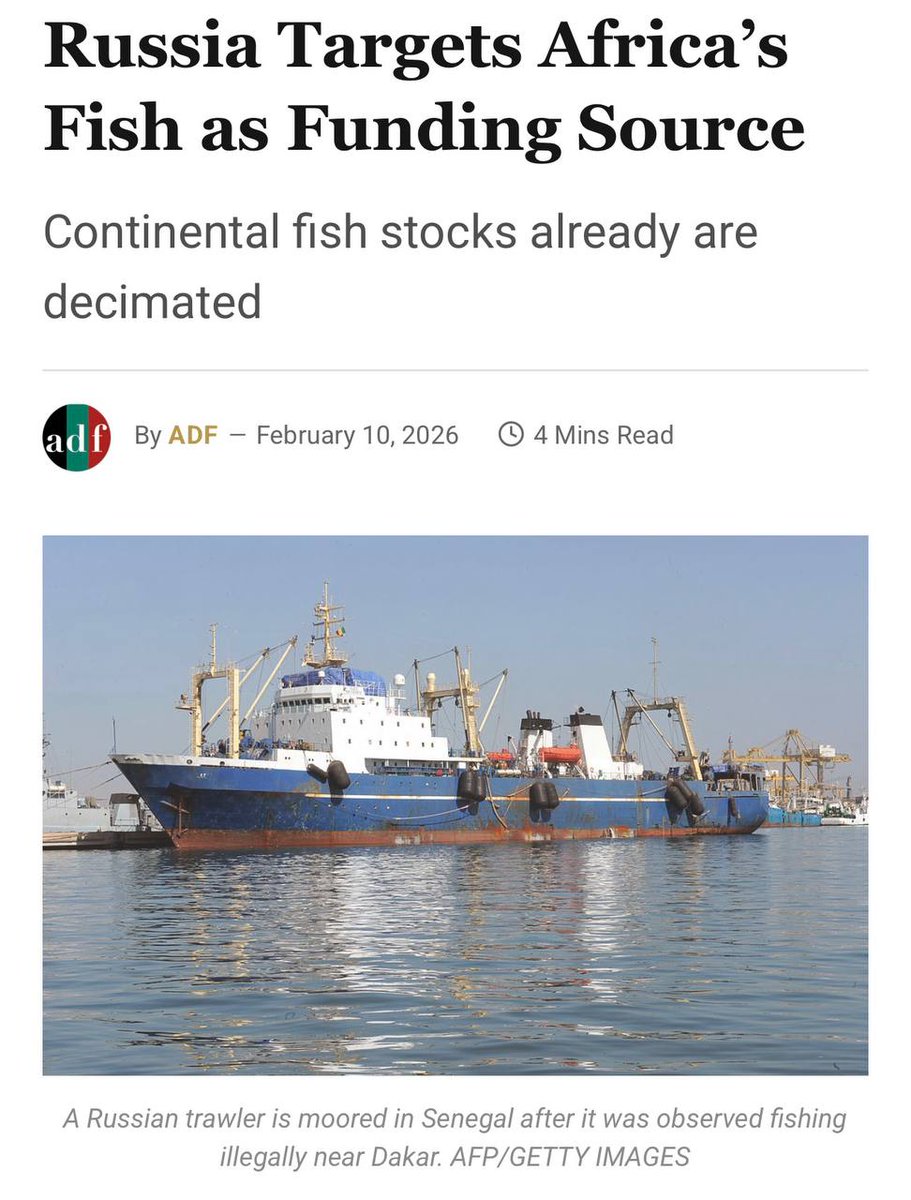
African countries lose around $11.2 billion annually due to illegal, unreported, and unregulated fishing; approximately $9.4 billion of those losses occur in West Africa alone.
According to the IUU Fishing Risk Index, Russia consistently ranks among the states with the highest risk indicators for illegal fishing, second only to China. Dozens of Russian trawlers operate within the exclusive economic zones of countries stretching from Morocco to Namibia.
In December 2025, Moscow concluded a fisheries agreement with Morocco - a country that itself loses around $500 million annually due to the illegal exploitation of marine resources.
Under previous arrangements, up to 10 Russian trawlers were permitted to catch as much as 140,000 tons of small pelagic fish (such as sardines and mackerel) per year in exchange for roughly $7 million in annual payments - a negligible sum compared to the real scale of extraction.
Similar agreements are in place with Sierra Leone (up to 40,000 tons annually); Russian vessels also operate off the coasts of Angola, Guinea-Bissau, Mauritania, Namibia, Nigeria, and Senegal.
Allegations include AIS signal shutdowns, at-sea transshipment to conceal the origin of catches, and quota violations. More than half of fish stocks from the Strait of Gibraltar to the mouth of the Congo River are already biologically unsustainable. This amounts to a form of colonial-style exploitation that directly undermines the food security of entire societies.
1/4 Putin does not believe in 🇷🇺 victory over Ukraine anymore. But he's not going to give up.
His plan - arms race, another mobilization, war until the last Russian soldier stands.
To Putin any option to return Crimea and Donbas is worse than millions of Russian soldiers dying.
2/4 I see two options of our quick Victory and peace afterwards:
1. Putin's death or his removal from power through a coup d'état within his environment.
Chance of mass uprising in Russia is very small - repressive machine works well, number of people ready to rebel is little.
3/4 2. Rapid offensive of 🇺🇦 Army that will encircle Donetsk agglomeration, sever so-called "corridor to Crimea", taking thousands of Russian soldiers as PoWs.
That would be a decisive loss for the Russian army and 🇷🇺 leadership.
Option 1 is preferable, opt.2 - more likely, IMO.
Dmytro Finashyn, Danylo Melnyk, Andrii Sobkovskyi, wounded 🇺🇦 Army veterans, arrived to the US for the Ukrainian Prayer Breakfast and some other important events.
They were greeted by 🇺🇦 diaspora. During their visit Heroes will share their stories and experiences.
2/8 There is no doubt that this is a carefully planned attack on the colony by 🇷🇺. There are no operational military targets for 🇺🇦 in Olenivka. Moreover, Army has all tools to identify precisely the facilities to be destroyed: ammunition depots, operational states, fuel bases.
3/8 Scale and speed of the information campaign by 🇷🇺 propagandists indicate that this was a precisely planned, organised action. We know that some of captured defenders were transferred to barracks where the hit took place a few days before. Classic, cynical false flag operation
German Chancellor @Bundeskanzler wrote an excellent column that Germany is completely revising its internal and external policies after Russia's full-scale invasion into Ukraine.
Some quotes from that column are in the thread below.
"🇷🇺 missiles have not only caused massive destruction in Kharkiv, Mariupol, Kherson, but shattered European and international peaceful order of the past few decades."
"Letting Putin get away with it would mean that violence can break the law practically without any consequences.
"New reality includes €100 billion special fund for Bundeswehr - the biggest turnaround in security policy in Federal Republic of 🇩🇪's history."
We are supporting 🇺🇦 – will do so for as long as necessary – in economic, humanitarian, financial terms and by delivering weapons"