Angry thread about M270 MLRS and M142 HIMARS 🧵
and a bit about BM-27 Uragan and BM-30 Smerch too.
Angry, because every M270 and M142 thread I have seen on twitter so far is FULL OF MIND BOGGLING ERRORS... because all of them (!) use as source of their "knowledge" the
1/n
and a bit about BM-27 Uragan and BM-30 Smerch too.
Angry, because every M270 and M142 thread I have seen on twitter so far is FULL OF MIND BOGGLING ERRORS... because all of them (!) use as source of their "knowledge" the
1/n

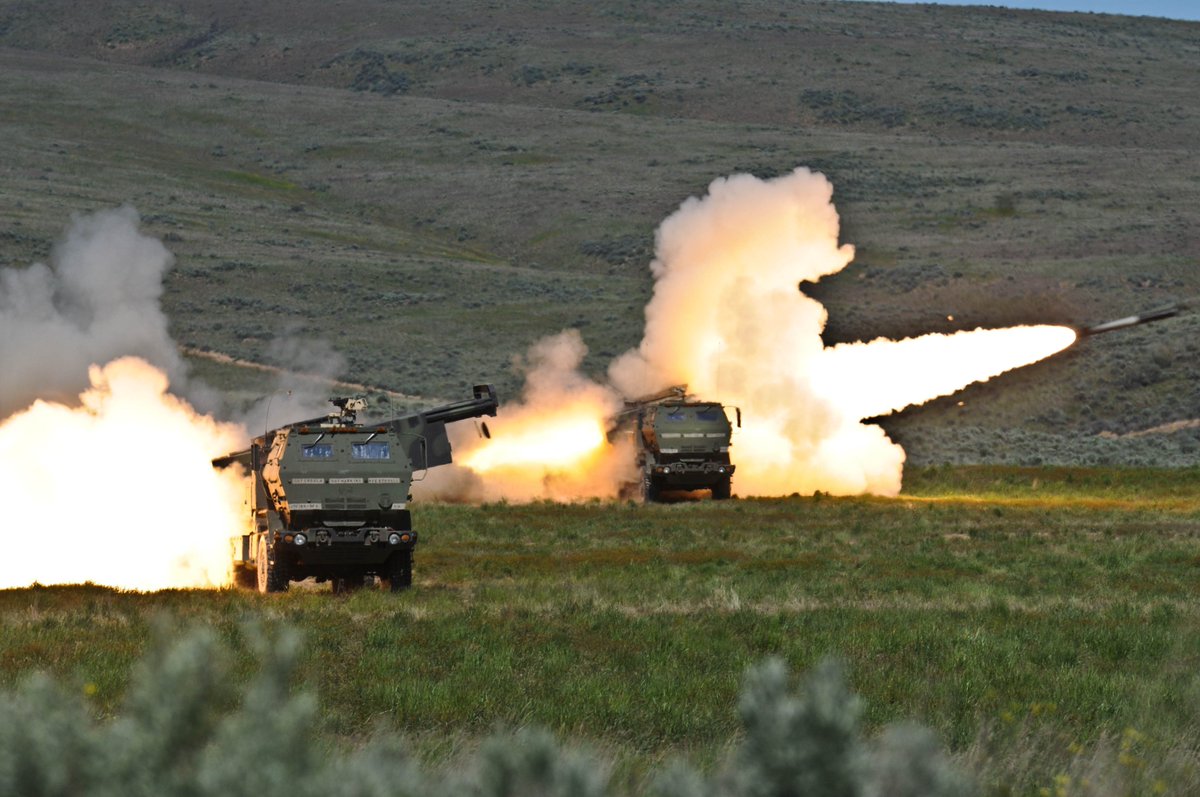
error-filled M270 wikipedia article... 🤦♂️🤦♂️
Let's dive in. First: M270 and M142 are technologically decades ahead of their Soviet-era counterparts: BM-27 Uragan and BM-30 Smerch. See the red arrows I painted? Yes, those are optical sights...
2/n
Let's dive in. First: M270 and M142 are technologically decades ahead of their Soviet-era counterparts: BM-27 Uragan and BM-30 Smerch. See the red arrows I painted? Yes, those are optical sights...
2/n


Uragan and Smerch have to be sighted optically... and in the case of the Uragan soldiers have to adjust elevation and deflection by turning wheels.
Even Uragan's two outriggers have to be lowered and emplaced by muscle power.
3/n
Even Uragan's two outriggers have to be lowered and emplaced by muscle power.
3/n
Optical sights means that it takes the 10-12 minutes to measure and prepare a launch sites and sight a launchers.
Firing dumb rockets with optical sight also means that the Uragan and Smerch's accuracy is atrocious... i.e. when a Smerch fires its 12 rockets,
4/n
Firing dumb rockets with optical sight also means that the Uragan and Smerch's accuracy is atrocious... i.e. when a Smerch fires its 12 rockets,
4/n


then the circular error probable (CEP) is 170 meter. This means only 50% of rockets fall within a 170 meter radius of the actual target... the other 50% will come down even further away than 170 meter from the target.
Meanwhile US GLMRS missiles have a CEP of 5 meters.
5/n
Meanwhile US GLMRS missiles have a CEP of 5 meters.
5/n
This is the reason russian forces fire mostly rockets with cluster munitions. They know they can't hit a target, so they saturate the area around a target with cluster munitions, hoping that at least something will hit...
Photo: remnants of Uragan cluster munition rockets.
6/n
Photo: remnants of Uragan cluster munition rockets.
6/n

And reloading the Uragan and Smerch is a time-consuming drag... It takes 20 minutes to reload a Uragan and it takes 5x russians 40 minutes to load 12x rusty rockets into a Smerch.
7/n
7/n
Ukraine also uses Uragan and Smerch, but russia has bombed Ukraine's rocket factories and as no allied nation produces Uragan or Smerch rockets, Ukraine desperately needs M270 and/or M142 launchers with their more accurate missiles.
8/n
8/n
Besides the accuracy of their missiles, what else makes the M270 and M142 so much better?
For starters: the speed of reloading. Both use rocket pods pre-loaded at the factory with either six GMLRS missiles of the same type or one ATACMS missile. Trucks bring the pods to
9/n
For starters: the speed of reloading. Both use rocket pods pre-loaded at the factory with either six GMLRS missiles of the same type or one ATACMS missile. Trucks bring the pods to
9/n

predesignated ammo supply points, where M270/M142 exchange their used pods for new ones in 5 minutes thanks to their built in cranes.
Meanwhile the truck is already on its way to get more pods.
And if you're in a hurry - the M270 can reload its pods simultaneously.ously.
10/n
Meanwhile the truck is already on its way to get more pods.
And if you're in a hurry - the M270 can reload its pods simultaneously.ously.
10/n
And how do the M270 and M142 aim their missiles?
Well, with a top-secret tool called "keyboard". This must sound like magic to russian soldiers with their sights and collimators.
All M270s in US/NATO service and all M142 fire GPS-guided missiles, which are aimed via the
11/n
Well, with a top-secret tool called "keyboard". This must sound like magic to russian soldiers with their sights and collimators.
All M270s in US/NATO service and all M142 fire GPS-guided missiles, which are aimed via the
11/n

M270A1's Improved Fire Control System (IFCS - left photo) or the M142's Universal Fire Control System (UFCS - right photo).
Since 4QFY21 the M270A1's IFCS is being replaced by the Common Fire Control System (CFCS), which will allow upgraded M270A2 to fire the
12/n
Since 4QFY21 the M270A1's IFCS is being replaced by the Common Fire Control System (CFCS), which will allow upgraded M270A2 to fire the
12/n


future Precision Strike Missile (PrSM). Which brings us to the types of missiles that exist (or existed or will exist) for the two systems:
• M26
• M28
• M30/M31
• M39/M48/M57
• PrSM
13/n
• M26
• M28
• M30/M31
• M39/M48/M57
• PrSM
13/n

The M26 series were unguided, cluster munitions rockets. The US Army acquired 506,718 and used around 17,000.
The M26 and the extended range M26A2 were carrying M77 submunitions, which had a fail rate of more than 5%. The M26A1 was an extended range version of the M26
14/n
The M26 and the extended range M26A2 were carrying M77 submunitions, which had a fail rate of more than 5%. The M26A1 was an extended range version of the M26
14/n
carrying the more advanced M85 submunitions with a dud rate of about 4% (pictured).
However in 2008 the Bush administration instituted a policy to retain and use only cluster munitions with a dud rate of less than 1% or less after 2018.
15/n
However in 2008 the Bush administration instituted a policy to retain and use only cluster munitions with a dud rate of less than 1% or less after 2018.
15/n

Already in 2007 the US Army had begun a program to dismantle its M26 rockets by 2019 and by 2012 98,904 M26s had been dismantled.
In 2017 the Trump administration canceled the Bush administration's cluster munitions policy and as of 2022 it is unknown if - and if yes,
16/n
In 2017 the Trump administration canceled the Bush administration's cluster munitions policy and as of 2022 it is unknown if - and if yes,
16/n
how many - M26 rockets are are still in US possession. However the US Army (and all NATO allies) have no M26 rockets in their active stockpiles for at least the last 10 years.
The M28 series are a reduced range practice rounds of no interest to us.
17/n
The M28 series are a reduced range practice rounds of no interest to us.
17/n
The M30 series consists of two GPS-guided missiles (GMLRS) with different warheads:
• M30 - with M101 cluster munitions (2% duds)
• M30A1 - Alternative Warhead, with 160,000+ Tungsten balls - it is like a giant shotgun
From 2004 to 2009 the Army bought 2,475 M30,
18/n
• M30 - with M101 cluster munitions (2% duds)
• M30A1 - Alternative Warhead, with 160,000+ Tungsten balls - it is like a giant shotgun
From 2004 to 2009 the Army bought 2,475 M30,
18/n

but because of the 2% fail rate of the M101 cluster munitions the army stopped buying the M30 in 2009 and focused on developing the M30A1.
All M30s cluster warheads were scheduled to be replaced by M30A1 Alternative Warheads by 2019.
19/n
All M30s cluster warheads were scheduled to be replaced by M30A1 Alternative Warheads by 2019.
19/n
As of 2022 it is unclear if, and if yes how many, M30 missiles are still in the US arsenal.
The M31 and M31A1 are variants of the M30 GMLRS missile with unitary high-explosive warheads.
Lockheed Martin produces about 11,000 M30A1 and M31A1 GMLRS missiles per year, and the
20/n
The M31 and M31A1 are variants of the M30 GMLRS missile with unitary high-explosive warheads.
Lockheed Martin produces about 11,000 M30A1 and M31A1 GMLRS missiles per year, and the
20/n
US military has as of 2022 at least 60,000 GMLRS in its arsenal.
In 2022 the M30A2 (aka XM403) and M31A2 (aka XM404) will replace the two A1 variants in production.
As the US does not plan to give Ukraine the longer range ATACMS missiles I will dicuss them only in brief:
21/n
In 2022 the M30A2 (aka XM403) and M31A2 (aka XM404) will replace the two A1 variants in production.
As the US does not plan to give Ukraine the longer range ATACMS missiles I will dicuss them only in brief:
21/n
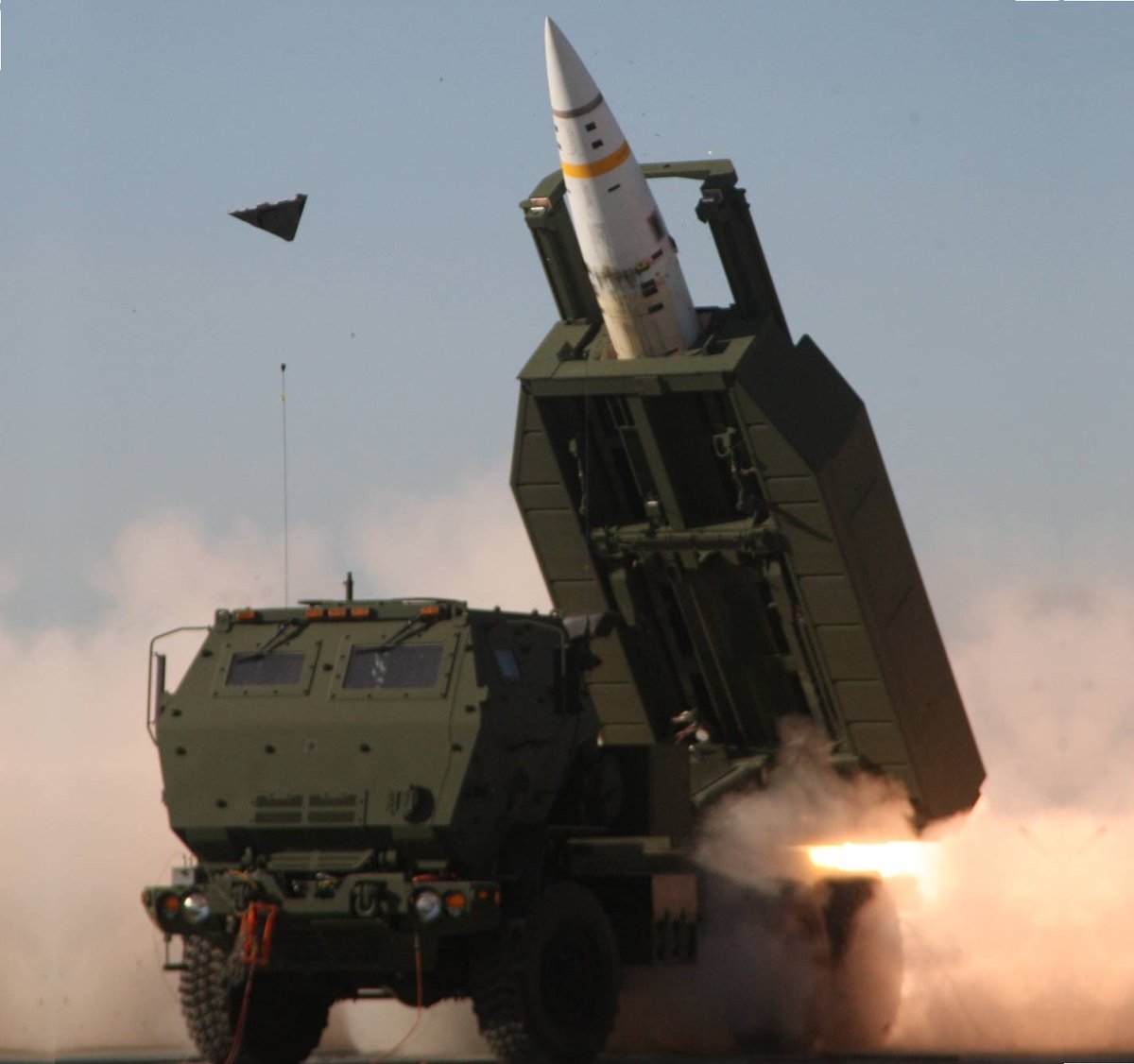
• M39 - with M74 cluster munitions (the "steel rain" of Desert Storm) - only non GPS-guided ATACMS
• M39A1 - longer range, GPS-guided M39 variant with reduced M74 payload
The Army planned to have both either dismantled or rebuilt as M57 by 2020.
22/n
• M39A1 - longer range, GPS-guided M39 variant with reduced M74 payload
The Army planned to have both either dismantled or rebuilt as M57 by 2020.
22/n
• M48 - with unitary warhead, 176 produced in 2001-04, of which 58 were used during OEF/OIF
• M57 - with unitary warhead, improved CEP, and new fuze, 513 produced 2004-13, 47 used
It is likely only the M57 (new and rebuilt M39/M39A1) remain in the US military's arsenal.
23/n
• M57 - with unitary warhead, improved CEP, and new fuze, 513 produced 2004-13, 47 used
It is likely only the M57 (new and rebuilt M39/M39A1) remain in the US military's arsenal.
23/n
As of 2022 Lockheed is in the process of modernizing the ATACMS missiles to extend their service life until the Precision Strike Missile (PrSM) enters service in 2027.
All of this tells us that Ukraine will receive M30A1, M31, and M31A1 missiles.
24/n
All of this tells us that Ukraine will receive M30A1, M31, and M31A1 missiles.
24/n
People tweeting that Ukraine will get M26 rockets, M30 missiles, XM403/404 missiles, GMLRS ER missiles, etc. don't know what they are talking about.
And yes, the arrival of M270 or M142 will be a turning point, as my next thread will show.
russian troops are doomed.
25/n
And yes, the arrival of M270 or M142 will be a turning point, as my next thread will show.
russian troops are doomed.
25/n

Part II of this thread - including maps about how the situation at the front will change with the arrival of M270A1 or M142 systems - begins with this tweet:
https://twitter.com/noclador/status/1531067601006301184
• • •
Missing some Tweet in this thread? You can try to
force a refresh