THREAD: Would the real Priestly source please stand up!
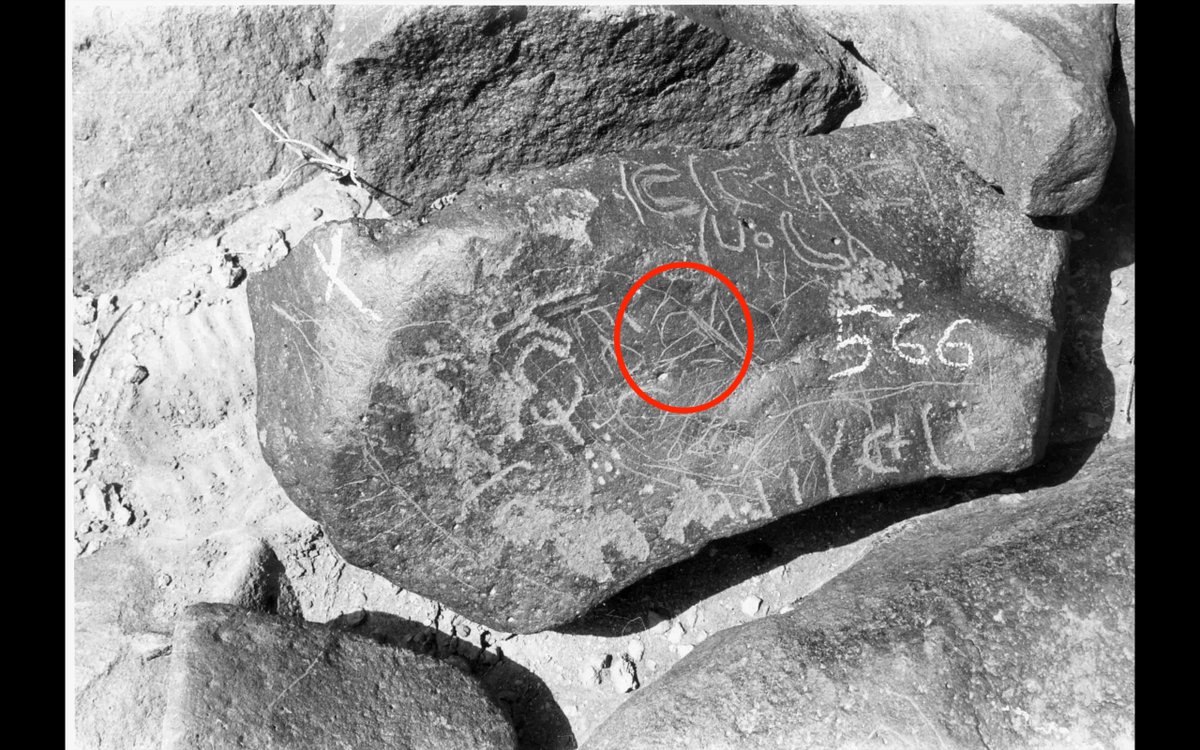
Since today is a special day the in the UK, some thoughts about the *dates* recorded in Scripture might be in order (as might apologies for the rather weak visual pun).
Since today is a special day the in the UK, some thoughts about the *dates* recorded in Scripture might be in order (as might apologies for the rather weak visual pun).

Question: What kind of events does Scripture assign exact dates to, and what kind of events does it leave largely undated?
Let’s consider a few events in Israel’s history and find out.
Let’s consider a few events in Israel’s history and find out.
The establishment of a kingship in Israel was a pretty big deal, right?
So when exactly did Saul rise to power?
What was the day of his coronation? Or the month if you prefer?
So when exactly did Saul rise to power?
What was the day of his coronation? Or the month if you prefer?
How about David’s coronation? (I don’t need an exact year BC—‘on the Xth day of the Yth month’ will do fine.)
Or Solomon’s?
Or Rehoboam’s?
Or Abijah’s? ...
Or Solomon’s?
Or Rehoboam’s?
Or Abijah’s? ...
Do we know the day or month when *any* king of Judah acceded to the throne? Or any king of Israel?
Or when any of these kings fought any of their major battles?
To the best of my knowledge, we don’t.
Or when any of these kings fought any of their major battles?
To the best of my knowledge, we don’t.
The books of Judges, Samuel, Kings, and Chronicles record thousands of different events, many of which changed Israel’s history for ever,
and yet we can’t assign exact days and/or months to more than a handful of them.
and yet we can’t assign exact days and/or months to more than a handful of them.
We *can*, however, assign exact days and months to a certain type of event in Israel’s history. Consider a few examples.
We know exactly when the exodus took place—that is to say, we can assign it to a particular day and month (Exod. 12.18, 16.1, etc.).
We know exactly when the exodus took place—that is to say, we can assign it to a particular day and month (Exod. 12.18, 16.1, etc.).
We know exactly when the Tabernacle was erected (Exod. 40.17),
when Israel entered Canaan (Josh. 4.19),
when the Temple was dedicated (2 Chr. 7),
when Jerusalem fell (2 Kgs. 25), and so on.
Why these events and not the others?
What connects them?
when Israel entered Canaan (Josh. 4.19),
when the Temple was dedicated (2 Chr. 7),
when Jerusalem fell (2 Kgs. 25), and so on.
Why these events and not the others?
What connects them?
The answer, I suggest, is the sanctuary—or, more specifically, the priesthood.
------ PRIESTS AS KEEPERS OF TIME ------
In the ancient world, it was typically the role of a society’s *priests* to administer its calendar,
and understandably so.
In the ancient world, it was typically the role of a society’s *priests* to administer its calendar,
and understandably so.
Priests had important rituals to perform at key dates in the year, which they needed to know about and prepare for.
Furthermore, many priests functioned as part-time astronomers: they observed the stars, practiced divination, announced new months (on the basis of new moons), and may even have announced ‘leap months’ (to keep the religious calendar in sync with the agricultural cycle).
The same can be said of Israel’s priesthood (to a greater or lesser extent).

The Tabernacle’s inauguration was deliberately scheduled to take place on the 1st day of the religious year (Exod. 40.2),...
...and the performance of particular sacrifices at particular times (e.g., Sabbaths and new moons: Num. 28) would have provided a natural way for the priesthood to track time, as would the rotation of priestly courses (cp. 1 Chr. 24);
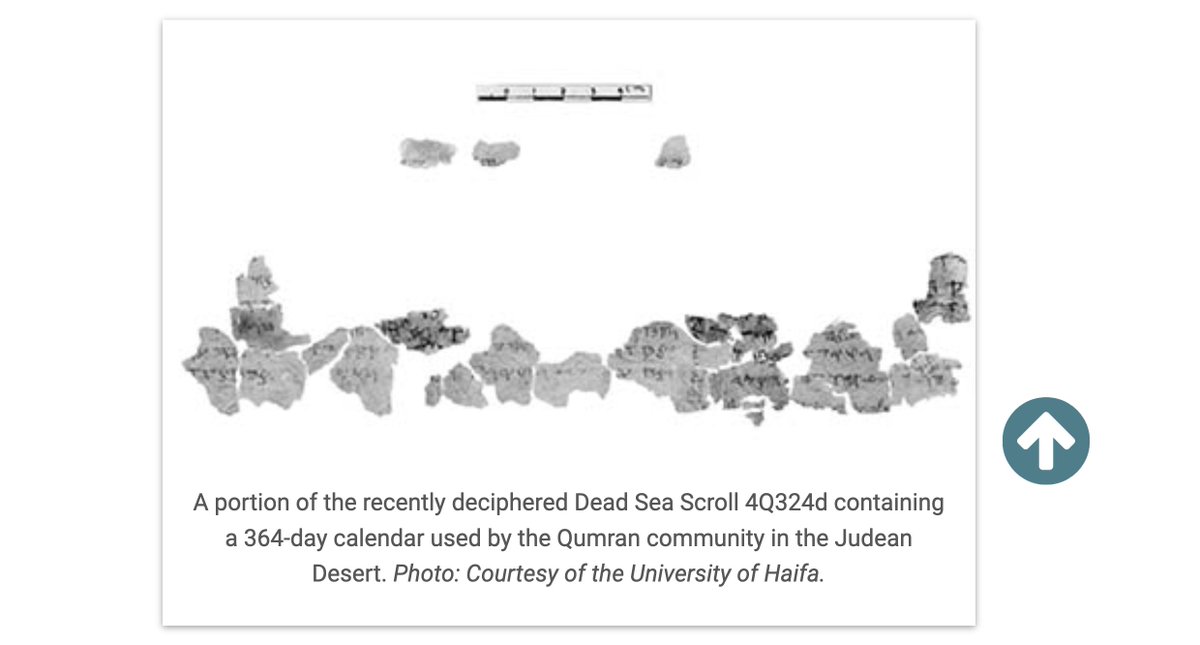
indeed, the purpose of the earliest detailed calendars found in Israel (at Qumran) is precisely to schedule priestly courses.
Suppose, then, the Levites were Israel’s time-keepers—the administrators of Israel’s calendar.
That the Biblical narrative records the particular dates mentioned above then makes good sense.
That the Biblical narrative records the particular dates mentioned above then makes good sense.
The priests would have taken a particular interest in the movements of the ark (e.g., when they carried it ark across the river Jordan at Joshua’s command),
as they would in the Temple—its dedication, re-dedication, fall, reconstruction, and so on.
as they would in the Temple—its dedication, re-dedication, fall, reconstruction, and so on.
These facts come into sharper relief when we consider the Levites’ role as keepers/preservers not only of the calendar, but of Scripture.
------ PRIESTS AS KEEPERS OF SCRIPTURE ------
Scripture was to be read and recited all over Israel.
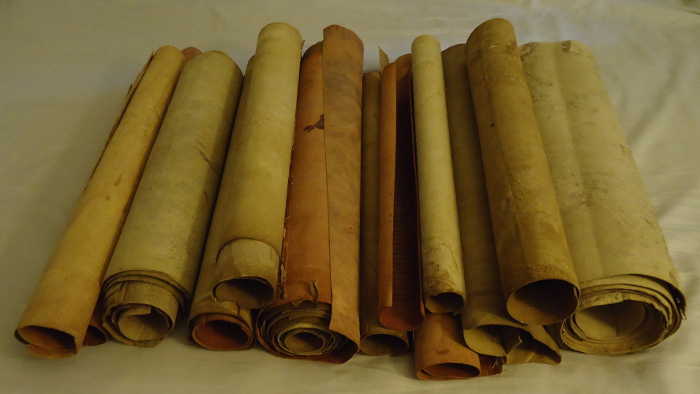
The *book* of the law, however, appears to have been preserved primarily in the sanctuary.
Scripture was to be read and recited all over Israel.
The *book* of the law, however, appears to have been preserved primarily in the sanctuary.
As Dirk Jongkind (@DJngKnd) points out in his Introduction to the Greek New Testament (linked below), the tablets of the law were housed in the ark (1 Kgs. 8.5) (a vessel made specifically in order to house God’s word: Deut. 10.1–5),...
...and the book of the law was later entrusted to the Levites, whose job was to carry the ark (Deut. 31.24–26)—a fact which may explain why kings were told to make a copy of the law ‘from before the Levitical priests’ (מלפני הכהנים הלוִיִם) (Deut. 17.18).
amazon.co.uk/Introduction-T…
amazon.co.uk/Introduction-T…
Just as master-copies of deeds and prophecies were ‘laid up’ (to allow later generations to consult them: cp. Isa. 8.16, 29.11, Jer. 32.10–11, Dan. 8.26, 12.4), so a master-copy of the law would have been laid up in in the vicinity of the sanctuary.
Hence:
🔹 in Samuel’s day, the place where regulations are safeguarded is the sanctuary;
🔹 in Josiah’s day, the book of the law is (re)discovered in the Temple (2 Kgs. 22);
🔹 in Samuel’s day, the place where regulations are safeguarded is the sanctuary;
🔹 in Josiah’s day, the book of the law is (re)discovered in the Temple (2 Kgs. 22);
🔹 and, in the post-exilic era, the law is re-established in Jerusalem when a priest (Ezra) comes to reinstate it there (Ezra 7–8).
Some (Scriptural) documents may even have been ‘date-stamped’ when they entered the sanctuary archives.
Some (Scriptural) documents may even have been ‘date-stamped’ when they entered the sanctuary archives.
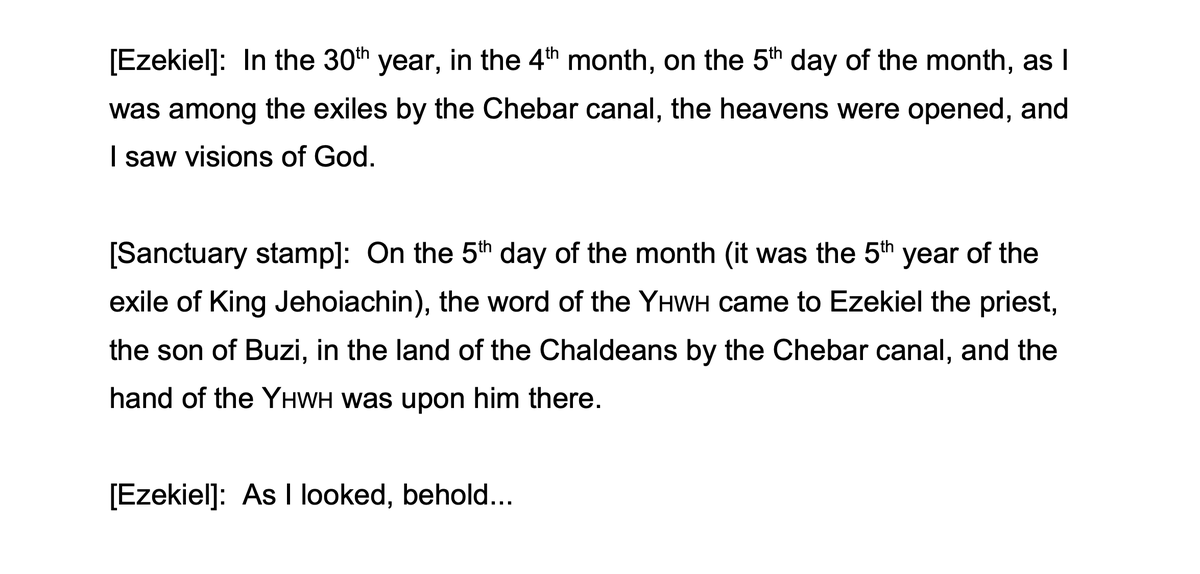
Consider, for instance, the introduction to Ezekiel’s memoirs, where a sanctuary date-stamp seems to have been added (in the third person) between Ezekiel’s date formula and his first vision:
Other records would also (presumably) have been kept in and around the sanctuary.
Only descendants of Levi could function as priests, so it would have made sense for genealogical records to have been stored in the sanctuary (cp. Ezra 2.61–62).
And genealogical records are known to have been kept in the Second Temple.
And genealogical records are known to have been kept in the Second Temple.
In light of these considerations, we can plausibly account for the various ‘day-stamps’ included in the Biblical record of Israel’s history.
In the two dozen tweets below (which may go on to be some of the least read and controversial on all of Twitter), I’ll list each day-stamp in the Biblical record of Israel’s history...
...together with a description of how it could have been preserved in the collective memory of the priesthood and/or the records of the sanctuary.
🔹 Exod. 16.1, Num. 10.11 note the days on which Israel arrived at particular locations in the wilderness.
Explanation: Moses (a Levite) is known to have made a detailed record of Israel’s travels in the wilderness (cp. Num. 33), which could have included dates and hence informed the sanctuary of them.
🔹 Num. 1.1 notes the day on which Israel’s census was taken.
Explanation: As the keepers of Israel’s genealogical records, the sanctuary would have been a logical place for records of Israel’s census to have been day-stamped and laid up. (Censuses need to be dated.)
Explanation: As the keepers of Israel’s genealogical records, the sanctuary would have been a logical place for records of Israel’s census to have been day-stamped and laid up. (Censuses need to be dated.)
🔹 Num. 33.38 and Deut. 1.3 note the days on which Aaron and Moses died.
Moses and Aaron were Levites, and their deaths would have been events of great significance, which the sanctuary may have sought to ‘observe/memorialise’ in some way in future years.
Moses and Aaron were Levites, and their deaths would have been events of great significance, which the sanctuary may have sought to ‘observe/memorialise’ in some way in future years.
🔹 Josh. 4.19 notes when Israel entered into Canaan.
Israel were led into Canaan by the priests themselves (at Joshua’s command), and the date of their entrance would have been a memorable one since it preceded the Passover by only a few days (Josh. 5.10).
Israel were led into Canaan by the priests themselves (at Joshua’s command), and the date of their entrance would have been a memorable one since it preceded the Passover by only a few days (Josh. 5.10).
🔹 2 Chr. 7 and 29.17 note when the Temple was dedicated and later re-dedicated.
The Temple’s dedication (in Solomon’s day) and re-dedication (in Hezekiah’s day) would have been epochal events for the priesthood, and would surely have been reflected in the sanctuary’s records.
The Temple’s dedication (in Solomon’s day) and re-dedication (in Hezekiah’s day) would have been epochal events for the priesthood, and would surely have been reflected in the sanctuary’s records.
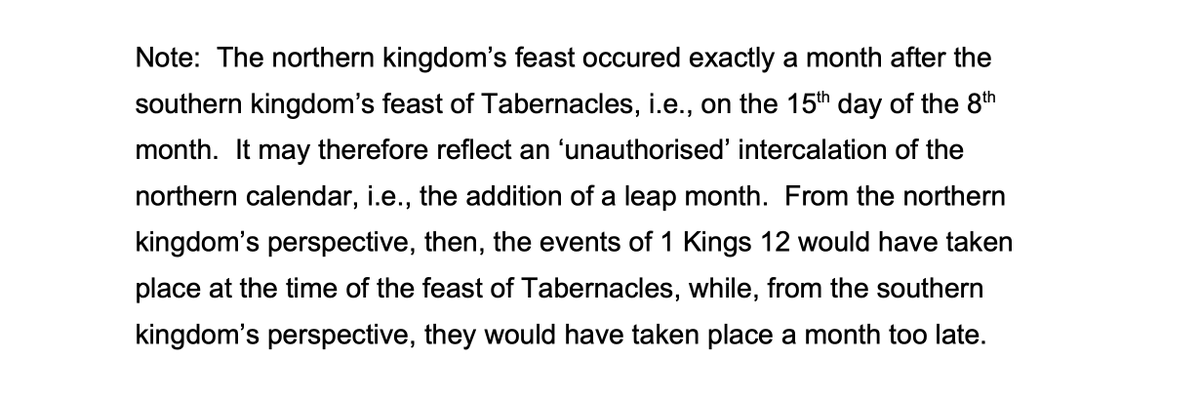
🔹 1 Kgs. 12.32 note when a rival system of worship was established in the northern kingdom (1 Kgs. 12.32).
The northern kingdom observed a paganised version of the feast of Tabernacles a month after the southern kingdom, which would have been of particular concern to the priesthood (and may have prompted certain priests to abandon their northern residences).
🔹 2 Kings 25 notes the days on which Jerusalem’s defences were breached prior to the Temple’s fall.
Needless to say, the timetable of the Temple’s fall would have been of particular significance to the priesthood and is still reflected in Israel’s calendar (cp. Tisha B’Av);
furthermore, the text of 2 Kings 25 is likely to stem from the records of Jeremiah the priest (Jer. 52).
furthermore, the text of 2 Kings 25 is likely to stem from the records of Jeremiah the priest (Jer. 52).
🔹 Ezra 3.6 and 6.15 note the days on which the sacrificial system was reinstituted and the Temple was rebuilt.
Ezra was a priest (and scribe), and these events would have been of particular significance to him.
Ezra was a priest (and scribe), and these events would have been of particular significance to him.
🔹 Ezra 7.9 (etc.) and Neh. 8.2 (etc.) note the days on which various important assemblies took place.
These assemblies were of great significance to Ezra’s ministry, and, where the book of Nehemiah dates them, Ezra is present.
These assemblies were of great significance to Ezra’s ministry, and, where the book of Nehemiah dates them, Ezra is present.
🔹 Unlike the prophecies of folk like Hosea, Amos, and Jonah, a large number of Ezekiel’s prophecies and narratives are dated with a day-stamp (Ezek. 1.1, 8.1, 20.1, 24.1, etc.).
Ezekiel was not only a prophet; he was also a priest, and many of his prophecies were delivered in and around the Temple and/or concerned its future.
Either he or the sanctuary’s administrators could have day-stamped them. (Two prophecies are double-dated: 1.1–3, 40.1.)
Either he or the sanctuary’s administrators could have day-stamped them. (Two prophecies are double-dated: 1.1–3, 40.1.)
🔹 Many of Haggai and Zechariah’s prophecies are likewise dated (e.g., Hag. 1.1, 2.1, Zech. 1.7, 7.1, etc.)
Haggai and Zechariah’s prophecies were delivered directly to Jeshua the high-priest after the re-institution of the daily sacrifices (Ezra 5.1ff.);
Haggai and Zechariah’s prophecies were delivered directly to Jeshua the high-priest after the re-institution of the daily sacrifices (Ezra 5.1ff.);
furthermore, they explicitly concerned the Temple’s reconstruction. They could plausibly have been day-stamped and later laid up in the sanctuary archives.
------ FINAL REFLECTIONS ------
References to exact days are uncommon in Scripture.
Events which *we* might think of as highly significant—the coronation of kings, victories in battle, etc.—are not assigned to particular days.
References to exact days are uncommon in Scripture.
Events which *we* might think of as highly significant—the coronation of kings, victories in battle, etc.—are not assigned to particular days.
Events of particular concern to the priesthood, however, are.
The sanctuary is like a clock which was constructed in the wilderness and carried into Israel (by the priesthood),
and, when the Biblical narrative enters its vicinity, day-stamps frequently crop up.
The sanctuary is like a clock which was constructed in the wilderness and carried into Israel (by the priesthood),
and, when the Biblical narrative enters its vicinity, day-stamps frequently crop up.
As such, the presence of day-stamps in Scriptural texts has the potential to tell us about their place of composition and/or preservation, and appears to reflect the way in which time was kept in the sanctuary, as measured by its sacrificial and liturgical timetable.
• • •
Missing some Tweet in this thread? You can try to
force a refresh