Using the four ancient ancestral groups as parental components to directly estimate and compare the ancestry proportions of the 333 centenarians and 690 controls, resulting in the following mean values for CENT (WHG = 0.022, Iran_N = 0.019, Turkey_N = 0.63, Yamnaya_EBA = 0.32) and ITA (WHG = 0.017, Iran_N = 0.022, Turkey_N = 0.63, and Yamnaya_EBA = 0.33
Ancient genomes give insight into 160,000 years of East Asian population dynamics and biological adaptation.
How ancestral lineages and agricultural innovations shaped East Asian populations, while migrations and admixture events linked to shifting subsistence strategies contributed to genomic and phenotypic diversity.
Adaptive signatures from ancient genomes further elucidate the underpinnings of high-altitude adaptation, pigmentation, and morphological traits, offering new insights into human evolutionary biology.
Human evolutionary process and potential migrations in East Asia. Symbols of different colors and shapes are used to represent individuals with distinct archeological backgrounds and genetic connections.
The colored outlines delineate various regions: yellow for the TSM, purple for the ARB and WLRB, light yellow for the YRB, dark blue for the YZRB, and light blue for the TP and TYC.
The individual labels were consistent with the shapes and colors used in Fig. 2. The arrows indicate directions of past population spread or diffusion, with arrow colors corresponding to specific regions.
Genetic ancestry proportions of research participants who reported that all four grandparents were born in Mexico.
(a) Genetic ancestry proportions of individuals in the initial clustering cohort; the x-axis reflects the mean ancestry of every five individuals with the most similar ancestry proportions (for anonymity purposes).
(b) Mean genetic ancestry proportions of the nine populations identified in the initial round of PPSBM clustering, with the mean proportions of sub-population identified in subsequent sub-clustering shown to the right.
(c) Genetic ancestry proportions of additional PPSBM clustering applied to the Central Mexican Highlands population, followed by the Central–Isthmus Corridor population. Genetic ancestry populations presented at very low proportions are merged into the “Trace” category. Inner circles of the wheels, when present, represent continental-level ancestry proportions.
"Fully Bayesian framework that models IBD sharing with a generative planted-partition stochastic block model (PPSBM). To benchmark accuracy, we simulated genomes under recent population divergence and compared PPSBM estimates with those from the widely used Leiden community-detection algorithm. The PPSBM correctly assigned 81.0% of individuals on average versus 67.0% for Leiden, outperforming Leiden in 92.0% of replicates."
"Bayesian inference of population structure using identity-by-descent-based stochastic block models"
Applying the PPSBM to the genomes of 63,196 individuals of Mexican descent demonstrated that this method scales effectively to large genomic cohorts and has the potential to reveal fine-scale structure.
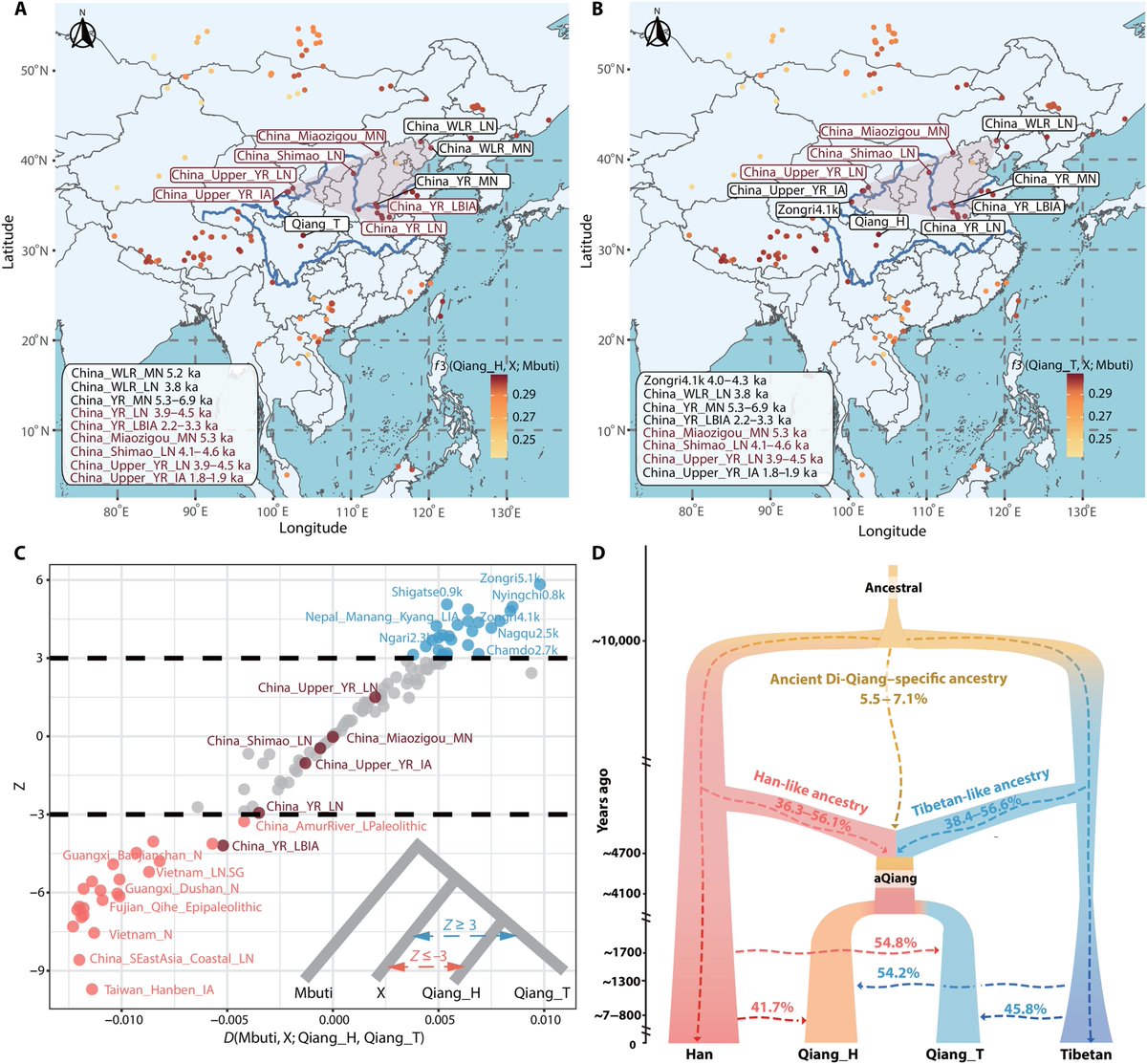
The origins of Tibeto-Burman populations on the eastern Tibetan Plateau (TP), especially within the Tibetan-Yi Corridor, remain unresolved.
By sequencing whole genomes of 293 individuals from 21 Tibeto-Burman-speaking groups and genotyped 799 individuals from 60 Sino-Tibetan-speaking groups to reconstruct regional population history.
Genetic landscape of Sino-Tibetan-speaking populations in Eastern Eurasia. a) Geographic distribution of newly genotyped Sino-Tibetan groups alongside modern and ancient reference populations, providing a spatial context for the genetic background of the population. b) The temporal framework of ancient East Asian reference populations was plotted along a timeline of YBP. c) PCA of modern and ancient East Asians, in which ancient individuals were projected onto the patterns based on the two principal components estimated from modern population genetic variations. Modern individuals are grouped by language family in the PCA, with colored polygons indicating genetic or linguistically cultural affinities.
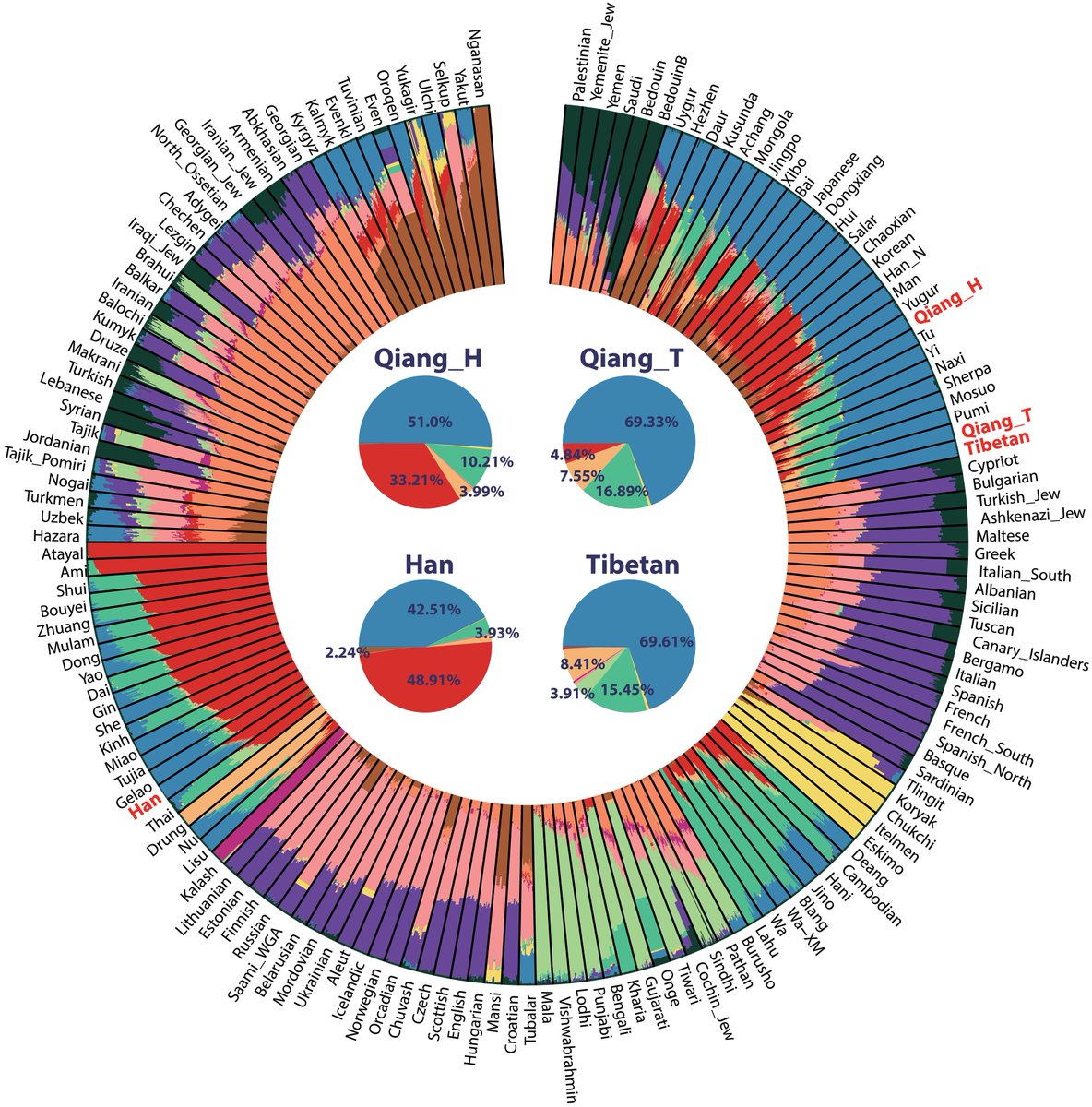
Population structure of Tibeto-Burman groups in the Tibetan-Yi and Hexi corridors inferred from the HO_WGS dataset. a) Model-based ADMIXTURE analysis of ancient and modern Eastern Eurasian groups, using five predefined ancestral components with the least cross-validation errors. The populations included are consistent with those shown in Fig. 1c. b) Genetic structure and clustering patterns of Tibeto-Burman groups from East and Southeast Asia. The left panel shows the phylogenetic relationships reconstructed from 1-outgroup-f3 values, whereas the right panel displays the admixture profiles of the target Tibeto-Burman groups. Population labels, geographical regions, ethnicity, and sample size were presented between the tree and admixture results.