

In the coming days, Americans may here about Lithuania's blockade of the RU enclave of Kalinigrad.
Few Americans know about this Russian enclave WEST of several NATO nations. I introduced the importance of its strategic importance to @CNN in December.
A 🧵 1/10
Few Americans know about this Russian enclave WEST of several NATO nations. I introduced the importance of its strategic importance to @CNN in December.
A 🧵 1/10
https://twitter.com/sentdefender/status/1538875943527370753
K-grad (as it's called by @USArmyEURAF ) is a Baltic port sandwiched between Lithuania & Poland. It was once known as Königsberg.
Founded in 1255 by Teutonic Knights during the Crusades it was eventually named Königsberg for King Ottokar II of Bohemia. 2/
Founded in 1255 by Teutonic Knights during the Crusades it was eventually named Königsberg for King Ottokar II of Bohemia. 2/


Königsberg was Polish, then Prussian, then the largest easternmost city of Germany throughout World War II.
The city was bombed by RU from 1944 through the Battle of Königsberg.
It was captured by the Soviet Union on 9 April 1945, right before war's end.
Look familiar? 3/
The city was bombed by RU from 1944 through the Battle of Königsberg.
It was captured by the Soviet Union on 9 April 1945, right before war's end.
Look familiar? 3/


Later, as the Allies met at Potsdam & divided responsibility for Europe after the Nazi surrender, the city was occupied by the Soviets & renamed for Soviet revolutionary Mikhail Kalinin. It was made RU's westernmost Oblast.
The Soviets desperately wanted this Baltic port. 4/
The Soviets desperately wanted this Baltic port. 4/
During Soviet days, RU had a "land bridge" through an area called the Suwalki Gap.
And the RU Baltic Sea ports were open.
There was never a problem getting to K-Grad.
But when Poland, the 3 Baltic countries & others gained independence in the 90's, things changed. 5/
And the RU Baltic Sea ports were open.
There was never a problem getting to K-Grad.
But when Poland, the 3 Baltic countries & others gained independence in the 90's, things changed. 5/

RU conducted focused covert & overt activities in the area starting in the early 2000's
Informational, cyber and electronic attacks by RU significantly increased.
The cyber attacks against Estonia in 2007 were particularly "robust." 6/
ccdcoe.org/uploads/2018/1…
Informational, cyber and electronic attacks by RU significantly increased.
The cyber attacks against Estonia in 2007 were particularly "robust." 6/
ccdcoe.org/uploads/2018/1…
Then in 2014, when RU annexed Crimea & invaded the Donbas, RU upped their activities in the area.
Poland, the Baltic states of Estonia, Latvia and Lithuania, and NATO became increasingly concerned.
This article by Matt Cesare provides some insight. 7/
fpri.org/article/2020/1…
Poland, the Baltic states of Estonia, Latvia and Lithuania, and NATO became increasingly concerned.
This article by Matt Cesare provides some insight. 7/
fpri.org/article/2020/1…
Many (me included) believed RU would eventually attempt a "land grab" of the Suwalki Gap, using the excuse of physically connecting their ally Belarus with K-grad.
That would require them invading Polish & Lithuanian sovereign territory.
Which brings us back to LI's blockade.8/
That would require them invading Polish & Lithuanian sovereign territory.
Which brings us back to LI's blockade.8/
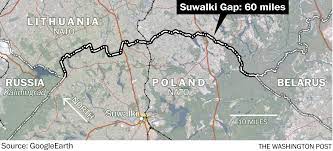
Saturday, RU called the blockade "unprecedented" & "unlawful."
LI's FM Landsbergis responded that LI was implementing approved EU sanctions & they were taken after “consultation w/ the EU Commission."
Thanks, Lithuania, for these actions! 9/
LI's FM Landsbergis responded that LI was implementing approved EU sanctions & they were taken after “consultation w/ the EU Commission."
Thanks, Lithuania, for these actions! 9/
A final thought...
In Jan 1991 as an Army major fighting in Desert Storm I wasn't watching events in Europe.
But in traveling to Vilnius, Riga & Tallinn in 2006 & again in 2011-12, I met those who had fought for their freedom.
They get it. Watch. 10/10
In Jan 1991 as an Army major fighting in Desert Storm I wasn't watching events in Europe.
But in traveling to Vilnius, Riga & Tallinn in 2006 & again in 2011-12, I met those who had fought for their freedom.
They get it. Watch. 10/10
*hear*
• • •
Missing some Tweet in this thread? You can try to
force a refresh





