1/ If you're in the Russian military, why do you need protection from these people but also aspire to behave like them? The answer lies in Russia's gangster culture. In this third 🧵 in a series, I'll look at some factors behind the epic scale of Russia's military corruption. 

2/ For the first thread in the series, on low- and medium-level military corruption, see below.
https://twitter.com/ChrisO_wiki/status/1531716422220632067?t=Y_LiloFrllvFq4wz5RtnzQ&s=19
3/ For part 2, on corruption among Russia's military elite, see:
https://twitter.com/ChrisO_wiki/status/1536422857777025024?t=iLVptVIfVrOrL1Mn4mD0ag&s=19
4/ Russia has often been described as a mafia state. It's perhaps more usefully to call it a mafia-ized state - one where wider society has adopted criminal tactics and language. Russian organised crime has a long history, dating back well before Soviet times.
5/ Soviet efforts to crack down on crime backfired - the gulags became training and recruitment centres for criminals, and stimulated gang formation. Corrupt Soviet officials and the KGB came to use criminal networks to supply needs the state couldn't meet, or as deniable assets.

6/ Criminal networks emerged from the shadows during the Gorbachev era, exploiting economic liberalisation. When the USSR collapsed in 1990 and its assets were privatised, officials turned to criminals to help them liquidate recently acquired state property.

7/ Society in many parts of the former USSR - not just Russia, it's been a big problem in Ukraine too - thus became 'mafiaized'. Criminal behaviour became the normal way that things were done. Oligarchs used criminal means to gain fortunes and Russian organised crime went global.
8/ One of the most important aspects of the criminalisation of Russia was the development of 'krysha' (literally a 'roof') as an organising principle of Russian society. In plain English, it's a protection racket.

9/ You acquire krysha - protection - from others to enable you to do your business, legitimate or otherwise. Without it, you may be vulnerable to enemies or those who simply want to steal from you. It often substitutes for Russia's corrupt and broken police and justice systems.
10/ Krysha can be acquired through payments in kind, through social or political obligations, or simply through bribery. It works at all levels from ordinary businesses to top politicians. It also works within organised crime groups, who seek krysha from corrupt officials.
11/ Krysha underlies much of the corruption in Russia's armed forces. They are themselves vulnerable to gangsterism. In multiple regions, organised crime gangs have terrorised, extorted, plundered and attacked entire military units, likely under the protection of krysha.

12/ In one case, in the city of Yurga in Kemerovo oblast, between 2017 and 2021, a gangster named Mudaris Tartykov - nicknamed Mandarin or Misha the Bear - extorted three military brigades based there. The base was nicknamed 'the damned place' by Russian soldiers.

13/ Tartykov's gang set up a checkpoint right outside the base's entrance, where they stopped and extorted contract soldiers for a share of their payday on the 10th of each month. Soldiers who refused were abducted, beaten, humiliated, recorded on camera and blackmailed.
14/ Tartykov boasted that he had 'connections' - i.e. krysha - with local law enforcement, military commanders and even with the FSB, Russia's domestic security agency. This was probably true: he was arrested in February 2021 but was soon released, allegedly after paying a bribe.
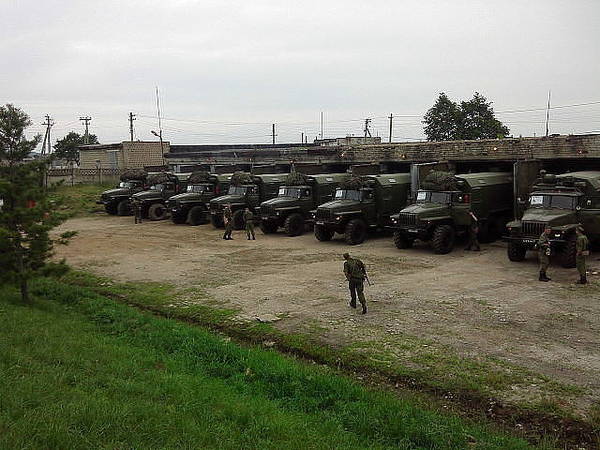
15/ Similar cases have been reported across Russia, in Ulan-Ude, Trans-Baikalia, Chelybinsk and Fokino. A common thread is that it often happens in distant territories where central government power is weak and local governments and police are overwhelmingly corrupt.
16/ Another notable case happened in Sergeevka, a village near the Chinese border dominated by a large military base. The machine gun and artillery division based there was terrorised for years by a gangster named Ruslan Kobets, who actually lived on the base.

17/ Kobets routinely extorted Sergeevka's 2,500 soldiers and looted the vehicles stored on the base. At least half of the soldiers paid for krysha, with the gang going into the base to collect their dues - likely protected by officers whom Kobets had bribed for his own krysha.
18/ "Sometimes a hundred thousand [rubles], and sometimes half a million, are withdrawn from the unit on payday," according to one gang member in Sergeevka. It wasn't just the gangsters but also other soldiers who were involved in the extortion rackets.

19/ In one incident highlighting his impunity, a drunken Kobets and his gang beat up Lt Col Fayzaliev, head of vehicle services at Sergeevka; Capt Grigoriev, head of artillery; and Capt Shagan, head of reconnaissance; plus several ensigns. But Kobets was not even arrested.
20/ The assaulted officers withdrew their statements to the police and were transferred to other units. Kobets was banned from entering the base but ignored the order. Action was only taken against him when journalists exposed the case, but extortion continued regardless.
21/ Policemen were stationed inside the base but the only real change, according to the soldiers in Sergeevka, was that instead of making their krysha payments inside the base, they now went to the village to make payments. "Health is more important than money", as one put it.

22/ In an environment where corruption is universal, few are willing to challenge it. The soldiers in Yurga paid up because everyone else was doing so. They had no recourse. Some of their officers were likely part of the racket, while their commanders didn't want to know.
23/ Military commanders also had no jurisdiction over civilian criminals and had no wish to cooperate with the civilian police, as it would expose their own wrongdoing. As anti-corruption campaigners put it, "it is believed that it is wrong to take dirty linen out of the hut".

24/ How was the Yurga case concluded? Officially, not a single case of extortion by military personnel was found. Mudaris Tartykov was re-arrested in December 2021 following a public outcry and is now awaiting trial on a charge with a potential 7 year jail sentence.
25/ Krysha works at all levels in the Russian military. Many corruption cases never come to light because culprits are protected. Even if their activities are identified, they may never be prosecuted because of krysha. And even if prosecuted, krysha may get them off lightly.
26/ In my first thread in this series, I mentioned the example of Colonel Sergei Serkin. Formerly the chief provisions officer for the North Caucasus Military District, he was bribed to buy 3,500 tons of fast-rotting cattle food for use as food for his troops.

27/ Although Serkin was arrested and tried, instead of getting the 5-year sentence demanded by prosecutors the court ruled that he "violated the law absolutely disinterestedly". He was given a modest fine and released from custody, even retaining his rank.
28/ It subsequently emerged that the judge, Vladimir Bukreev, had received a $190,000 bribe from Serkin. Moreover, according to Serkin's subsequent confession in court, the fix had been in from the start at the highest levels of the Russian military justice system.
29/ According to Serkin, the deputy military prosecutor of Moscow told him "who was in charge of my case and ... said that the solution to the issue was worth $500,000". Serkin paid an initial $160,000 bribe but it wasn't enough to stop the case going to trial.
30/ Krysha goes right to the top of the system. I also highlighted the story of former Russian Defence Minister Anatoly Serdyukov, fired in 2012 amidst a 3 billion ruble corruption scandal after being discovered in a bathrobe in his mistress's luxury Moscow apartment.

31/ He was charged with a relatively minor offence but was amnestied by Vladimir Putin in 2014. He clearly had obtained krysha from Putin. It was widely rumoured that he had been caught out for political rather than legal reasons, due to his reforms of Russia's military.
32/ Serdyukov created Russia's current system of battalion tactical groups (BTGs) as part of his professionalisation of the Russian armed forces. But he massively pissed off the generals, not least by ordering them to undergo mandatory physicals which most of them failed badly.

33/ What happened to his mistress, Yevgenia Vasilyeva? While under house arrest, she released her own poetry collection, held an exhibition of her cat portraits and launched a jewelry line. She filmed a music video and painted a portrait of Barack Obama, which she sent to him.

34/ She was eventually sentenced to five years in jail and reported to a penal colony in Vladimir on 21 August 2015. She was paroled on 25 August, five days into her five-year sentence. Vasilyeva and Serdyukov have since been reaccepted back into elite society.
35/ There's no bigger or better krysha than political power, and nobody has more than Vladimir Putin. The biggest roof in Russia is on top of his $1 billion palace. Krysha payments likely contribute to his estimated $200 billion fortune, reputedly extorted from oligarchs.

36/ Krysha likely explains the existence of this $18 million luxury mansion outside Moscow, which Alexei Navalny attributes to current Russian Defence Minister Sergei Shoigu (annual salary $120,000). There's little chance it was paid for legitimately.

37/ Ultimately, the armed forces operate on krysha rules: if you have strong enough krysha - and none is stronger than Putin's - then everything is permitted and nothing is forbidden. As long as the boss is protecting you, you'll be OK.

38/ I'll continue later in a further thread with more on Russian military corruption, looking at the motives and consequences resulting from it. /end (for now)
@OSINTEng @RALee85 @Blue_Sauron @Osinttechnical @TrentTelenko @MarkHertling @DomNicholls @Nrg8000 @UAWeapons @TrueFactsStated @WarintheFuture @KofmanMichael @michaeldweiss @aravosis @JoshManning23 @general_ben @tomiahonen @PToveri @MarkGaleotti @MishaGlenny @mdmitri91
Here's the fourth thread in this series:
https://twitter.com/ChrisO_wiki/status/1540428503308541952
• • •
Missing some Tweet in this thread? You can try to
force a refresh