Proclus' conception of Divine Forms and Unities and how the Divine penetrates through all layers of manifested reality. [THREAD] 
In late antiquity, an Idea is regarded as an incorporeal thing which is the cause of those things which are similar to it and is the model for the existence of sensible things.
Since there is a hierarchy of intellects from the divine intellects to the cosmic intellect, participated by the World-Soul, and to ordinary thinking intellects, Ideas, as real and objective entities, cannot be regarded simply as thoughts of individual human minds.
Instead, they are noemata of the divine Intellect, or Being. They subsist by their own noetic existence in the realm of Being. Although their effects are found in the sensible world of bodies, by themselves they are immaterial, simple, eternal, unchangeable and transcendent.
According to the Neoplatonic perspective, the so-called "universals" that Aristotle sets against Plato's Ideas either refer to the "immanent universal" or to the secondary abstraction made by the human mind after it has experienced those immanent forms already placed in ...
... sensibles by the Demiruge in the process of proodos. However, the pre-existent forms (eide) of all characteristics that actually exist in the sensible world are a priori contained (as the noetic "sparks" and "traces") in human minds.
And, if these noetic "sparks" are hidden, they must be recollected through spiritual exercises, askesis, and dialectic. Proclus says:
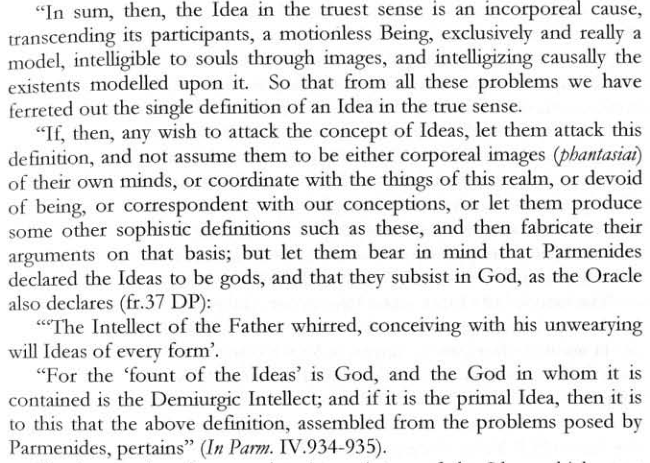
Proclus speaks of a complete intermixture of the Ideas which, as a single whole, constitutes a harmony in the unparticipated divine Intellect, according to the metaphysical principle that "everything is in everything but in a manner appropriate to each".
This principle, originally attributed to Anaxagoras' theory of mixture, by extension may be applied to all manifested reality, functioning as the main method for hermeneutical exegesis and analysis. It reflects the world of Egyptian gods, symbolically summarized by the Ennead.
All neteru [gods] are regarded as manifestations (bau), faces, or hypostases, of one another, thus constituting countless iconographical combinations, but ultimately deriving from the single Principle, the single God, who reveals himself in millions of forms.
However, in such an intelligible compound as Amun-Ra, Ra is not viewed as being lost in Amun, but remains himself jut as much as Amun does and both of them can again be manifested separately or appear in other metaphysical combinations.
Although the power of each eidos and each neter extends everywhere, in themselves they are nowhere. Not all things participate in them alike. L. Rosan explains the reason why the eternal world is only imperfectly reflected within time:
the departure of characteristics from Ideas is perfect, but the return of things to Ideas is imperfect. This is what "distinguishes one thing from another, namely, the degree to which it returns to its causes".
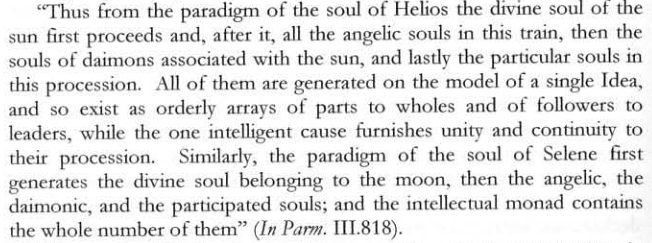
Proclus speaks of descending chains that appear as Forms proceed through successive downward steps, arguing that the series start from "Man Himself", then, comes to a "heavenly man", then a "fiery man", an "airy man", a "watery man", and last of all—an "earthly man".
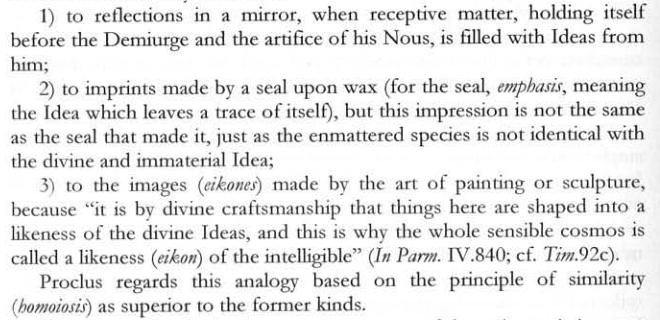
The action of Ideas upon things or rather their participation in intellectual Ideas may be likened to 1) reflections in a mirror, 2) imprints made by a seal upon wax, 3) images made by the art of painting or sculpture.
Since everything in the huge meta-structure of the universe in in some way (either as a cause, by existence, or as an image) mirrored in everything else, unity is present even to a material thing, but in a fashion proper to it, being not of the same rank as an intelligible unity.
The universal set of unity, interweaving every portion of manifested reality with every other portion, is constituted of henads. The unparticipated independent henads, standing closer to the One in the hierarchy of causation, are themselves called theoi.
While participated henads are sumbola and sunthemata—the supernatural theurgic symbols and tokens able to elevate the soul to the level of transcendent union (henosis).
If any description of manifested reality, understood as theophany, involves a description of henads, i.e., of the transcendent gods and their ineffable symbols extended through all levels of being, then rational philosophical and mythological description coincide.
For example, the theology of the Chaldean Oracles already identified the Chaldean entities iynges (iunges, maintained as the "thoughts of the Father") with Platonic Ideas.
The iynges, that is the living mythical beings playing the role of the Forms, are regarded as purveyors of unity. They produce a multitude of offspring and then swallow them up and integrate them into true noetic synthesis.
The intelligible iynges drive the soul upwards and, along with the "maintainers" (likened to elevating rays of the visible sun) and teletarchs (initiators and guides at all stages of the soul's striving towards noetic union), they personify divine grace at all levels of being.
The theurgic instrument used by the Chaldean Platonists and also called iynx (iunx, pl. iunges) consists of a cone which begins in unity and becomes plurality through a vertiginous multiplication of itself.
The hierarchy of unities is the hierarchy of the traditional gods, their names and attributes. Therefore the divine characters penetrate even to the last terms of the participant series: the henad communicates even to the body an echo of its own quality.
In this way the body (soma) becomes not only ensouled and intellective, but also divine (theion).
"All divine bodies are such through the mediation of a divinized soul, all divine souls through a divine intelligence, and all divine intelligences by participation in a divine henad: the henad is immediate deity, the intelligence most divine, the soul divine, the body deiform."
From: Philosophy as a Rite of Rebirth: From Ancient Egypt to Neoplatonism, by Algis Uždavinys.
• • •
Missing some Tweet in this thread? You can try to
force a refresh