1/ 'There's a self referred patient for you', ER doc tells me
'Self referred?'
'Yes, husband getting her discharged from multiple hospitals looking for a diagnosis'
Self referrals are nerve-racking, I thought, as I walked in, looking at the deeply jaundiced, disoriented woman
'Self referred?'
'Yes, husband getting her discharged from multiple hospitals looking for a diagnosis'
Self referrals are nerve-racking, I thought, as I walked in, looking at the deeply jaundiced, disoriented woman

2/ The husband, Raj is by side of her bed
He is worried sick
Elsewhere, they were advised liver transplant
Docs weren't sure what was causing liver failure,
killing his wife, Meera
All he knew was that it was acute liver failure(ALF)
ALF is a terrifying, flummoxing disease
He is worried sick
Elsewhere, they were advised liver transplant
Docs weren't sure what was causing liver failure,
killing his wife, Meera
All he knew was that it was acute liver failure(ALF)
ALF is a terrifying, flummoxing disease

3/ It strikes without warning
A healthy person with healthy liver can be suddenly fighting for life on the ventilator in ALF
It is diagnosed when acute liver insult results in jaundice, followed by blood thinning (coagulation failure, represented by INR test >1.5) along with
A healthy person with healthy liver can be suddenly fighting for life on the ventilator in ALF
It is diagnosed when acute liver insult results in jaundice, followed by blood thinning (coagulation failure, represented by INR test >1.5) along with


4/ brain failure, also known as hepatic encephalopathy (HE) within weeks
HE is mandatory & liver MUST be normal prior to liver injury in ALF
In already diseased liver (chronic liver disease or cirrhosis) acute liver injury leads to acute-on-chronic liver failure(ACLF) not ALF
HE is mandatory & liver MUST be normal prior to liver injury in ALF
In already diseased liver (chronic liver disease or cirrhosis) acute liver injury leads to acute-on-chronic liver failure(ACLF) not ALF

5/ The causes for ALF varies between countries
In India, it is acute hepatitis E
In UK, paracetamol poisoning (suicidal attempts)
Identifying and treating ALF requires that a specific set of questions be asked,
to look for reversible causes or plan life saving transplantation
In India, it is acute hepatitis E
In UK, paracetamol poisoning (suicidal attempts)
Identifying and treating ALF requires that a specific set of questions be asked,
to look for reversible causes or plan life saving transplantation


6/ In ALF, the liver failure results in rapid shut down of other organs
The brain is affected first
Whole brain swells up
Pressure inside skull goes high
Leading to prolapse (herniation) of brain matte
Squeezing of brain structures across skull
This leads to irreversible..
The brain is affected first
Whole brain swells up
Pressure inside skull goes high
Leading to prolapse (herniation) of brain matte
Squeezing of brain structures across skull
This leads to irreversible..
7/ brain death.
Along with it, other organs also rapidly shut down - leading to multiple organ failure
With multiple organ failure, death is certain
Meera developed jaundice, brain failure and blood thinning within 4 weeks
This was preceded by loss of appetite and fatigue
Along with it, other organs also rapidly shut down - leading to multiple organ failure
With multiple organ failure, death is certain
Meera developed jaundice, brain failure and blood thinning within 4 weeks
This was preceded by loss of appetite and fatigue

8/ At multiple hospitals she was taken,
all causes of ALF were looked into
But none turned out positive
So she was diagnosed as ALF of indeterminate origin and advised a life saving liver transplant
But this wasn't an easy task
The family of 4, including two little children
all causes of ALF were looked into
But none turned out positive
So she was diagnosed as ALF of indeterminate origin and advised a life saving liver transplant
But this wasn't an easy task
The family of 4, including two little children


9/ ..could not afford a transplant
Raj was just just making ends meet as a lab tech
The two kids were in lower grade school
They did not have a clue that their mother was fighting for her life
Adding to their woes,
A donor was not available and Raj was of another blood group
Raj was just just making ends meet as a lab tech
The two kids were in lower grade school
They did not have a clue that their mother was fighting for her life
Adding to their woes,
A donor was not available and Raj was of another blood group

10/ I looked at the young mother - 32 y and tells Raj,
'My friend, she is slipping into a liver failure coma
& there is very little we can do if we cant protect her lungs
She needs to be on a ventilator.'
He asks, 'Will she come off the ventilator?'
& I say, 'I don't know'
'My friend, she is slipping into a liver failure coma
& there is very little we can do if we cant protect her lungs
She needs to be on a ventilator.'
He asks, 'Will she come off the ventilator?'
& I say, 'I don't know'
11/ ALF requires quick management
A set of clinical and lab criteria decides who survives ONLY with an emergency transplant
- called King's College
- or Clichy criteria
- or ALFED Model Criteria (followed in India), developed by AIIMS docs at Delhi
A set of clinical and lab criteria decides who survives ONLY with an emergency transplant
- called King's College
- or Clichy criteria
- or ALFED Model Criteria (followed in India), developed by AIIMS docs at Delhi


12/ 'But it will buy us sometime, to find what is killing her liver'
Raj's mother is with him and he talks to her, briefly
He comes back to me and says, 'I agree'.
And I say, 'Please send mother and the kids home
We have a long drawn battle ahead of us.'
And he complies..
Raj's mother is with him and he talks to her, briefly
He comes back to me and says, 'I agree'.
And I say, 'Please send mother and the kids home
We have a long drawn battle ahead of us.'
And he complies..
13/ ..goes to the kids and tells them,
'I'll come home with mother within a few days. You have to go to school. Go with grandmother. Don't worry, Papa is here'.
I hear that
And it feels like a ton of responsibility
As I look at the ER docs readying to put Meera on the machine
'I'll come home with mother within a few days. You have to go to school. Go with grandmother. Don't worry, Papa is here'.
I hear that
And it feels like a ton of responsibility
As I look at the ER docs readying to put Meera on the machine
14/ Meera is now sedated & on ventilator,
Sleeping, without pain, suffering
The machines getting her organs the oxygen it requires
While she sleeps,
we sacrifice ours, to find the acute insult
that hides in plain sight
Was it something we could reverse?
Could we save..
Sleeping, without pain, suffering
The machines getting her organs the oxygen it requires
While she sleeps,
we sacrifice ours, to find the acute insult
that hides in plain sight
Was it something we could reverse?
Could we save..
15/ ..this young mother, for her kids to hug her once again?
A thorough review of records,
We find that the previous docs have left no stone unturned
Except one
A liver biopsy
Since Meera was in ALF, her blood was extremely thin
Which meant, a traditional biopsy would..
A thorough review of records,
We find that the previous docs have left no stone unturned
Except one
A liver biopsy
Since Meera was in ALF, her blood was extremely thin
Which meant, a traditional biopsy would..

16/ ..cause intense bleeding into her liver
and she would not survive it
But we had another option - a transvenous biopsy
Where the liver is accessed through a vein in neck
And small liver tissue pulled out through vein
We could do this even in patients on the ventilator
and she would not survive it
But we had another option - a transvenous biopsy
Where the liver is accessed through a vein in neck
And small liver tissue pulled out through vein
We could do this even in patients on the ventilator


17/ Raj gives us the green signal and we do it with ease
The small 1cm liver tissue is now rushed to the pathologist
It held all answers to what was killing the young mother of 2 kids
Tissue preparation and staining goes on at break neck speed
The pathologist knows..
The small 1cm liver tissue is now rushed to the pathologist
It held all answers to what was killing the young mother of 2 kids
Tissue preparation and staining goes on at break neck speed
The pathologist knows..

18/ that we were running out of time
Meanwhile, Meera starts showing clinical signs of increased brain swelling and pressure
There is high chances of her brain squeezing out of the skull, killing her
There is a method of measuring the brain pressure and its called 'Bolting'
Meanwhile, Meera starts showing clinical signs of increased brain swelling and pressure
There is high chances of her brain squeezing out of the skull, killing her
There is a method of measuring the brain pressure and its called 'Bolting'
19/ ..where in a pressure transducer probe is placed into the fluid filled cavity of the brain (called ventricles)
through a hole burrowed in the skull
Critical care docs contemplate bolting to see for pressures
But, we decide against it as clinical signs were suggestive of...
through a hole burrowed in the skull
Critical care docs contemplate bolting to see for pressures
But, we decide against it as clinical signs were suggestive of...


20/ raised pressure in the skull
High ammonia is what makes the brain cells swell up
& cause HE in ALF
So we decide to tackle the ammonia aggressively
Through a procedure called plasma exchange therapy
Meera goes on a high volume plasma exchange session
To remove the bad..
High ammonia is what makes the brain cells swell up
& cause HE in ALF
So we decide to tackle the ammonia aggressively
Through a procedure called plasma exchange therapy
Meera goes on a high volume plasma exchange session
To remove the bad..

21/ ammonia-rich plasma.
Plasma therapy high or standard volume removal
Buys time for dying patients, for the liver to regenerate
And this was the only way we could keep Meera alive, for now
She stabilized after two sessions
Meaning, no further clinical deterioration
Plasma therapy high or standard volume removal
Buys time for dying patients, for the liver to regenerate
And this was the only way we could keep Meera alive, for now
She stabilized after two sessions
Meaning, no further clinical deterioration


22/ While we struggled to keep Meera alive on the ventilator
The pathologist calls me in 48 hours, to come down to the lab
I rush there, hoping for an answer
A final diagnosis for which we could do something
The kids were waiting back home
She says, 'Look at it yourself'..
The pathologist calls me in 48 hours, to come down to the lab
I rush there, hoping for an answer
A final diagnosis for which we could do something
The kids were waiting back home
She says, 'Look at it yourself'..
23/ And I peep into the microscope & see things bizarre
Was it viral hepatitis?
Was it autoimmune hepatitis?
Some areas looked like severe fatty liver!
Others areas had severe bile duct damage!
And I turn to the pathologist and ask her,
'What am I looking at?'
Was it viral hepatitis?
Was it autoimmune hepatitis?
Some areas looked like severe fatty liver!
Others areas had severe bile duct damage!
And I turn to the pathologist and ask her,
'What am I looking at?'

24/ & she says - 'Its everything you can think of
There is damage due to viruses, autoimmune disease, toxins, drugs, bacterial infections, you name it.'
'Only 1 thing can mimic everything
& thats drug induced liver injury (DILI)
Time for you to find out which'
I'm exhausted.
There is damage due to viruses, autoimmune disease, toxins, drugs, bacterial infections, you name it.'
'Only 1 thing can mimic everything
& thats drug induced liver injury (DILI)
Time for you to find out which'
I'm exhausted.


25/ Bcoz we have been asking for every drug under the sun to Raj so many times
Common liver toxic prescription drugs, OTC meds, herbal drugs, Homeopathic tinctures
Raj denied everything
& I ask him about diet changes
Any changes to food, fad diets, mushroom use and then..
Common liver toxic prescription drugs, OTC meds, herbal drugs, Homeopathic tinctures
Raj denied everything
& I ask him about diet changes
Any changes to food, fad diets, mushroom use and then..

26/ Raj sits up and asks,
'Does food cause liver damage?'
To which I say, 'Yes, certain foods can - like mushrooms', aloe vera, green tea extracts.
webmd.com/hepatitis/toxi…
'What about protein supplements?', Raj asks me.
And I turn around and ask him, 'What do you mean?'
'Does food cause liver damage?'
To which I say, 'Yes, certain foods can - like mushrooms', aloe vera, green tea extracts.
webmd.com/hepatitis/toxi…
'What about protein supplements?', Raj asks me.
And I turn around and ask him, 'What do you mean?'
27/ Herbal and dietary supplements also called HDS
Are now an upcoming cause of liver injury and liver failure
In the United States alone,
More patients underwent transplantation for HDS liver injury, last decade
Herbalife products containing various potentially toxic herbs
Are now an upcoming cause of liver injury and liver failure
In the United States alone,
More patients underwent transplantation for HDS liver injury, last decade
Herbalife products containing various potentially toxic herbs

28/ ..have been described to cause severe liver injury and liver failure
The National Institute of Diabetes & Digestive and Kidney Diseases, USA, calls Herbalife
"A well established cause of clinically apparent liver injury"
ncbi.nlm.nih.gov/books/NBK54844…
They also list various..
The National Institute of Diabetes & Digestive and Kidney Diseases, USA, calls Herbalife
"A well established cause of clinically apparent liver injury"
ncbi.nlm.nih.gov/books/NBK54844…
They also list various..

29/ ..other HDS that has caused liver failure,
Some requiring transplant or leading to death
Such as Hydroxycut, Move Free, Oxylite Pro and SlimQuick
ncbi.nlm.nih.gov/books/NBK54844…
Meera was overweight & hypothyroid
One day, the couple came across a nutritional club that advertised
Some requiring transplant or leading to death
Such as Hydroxycut, Move Free, Oxylite Pro and SlimQuick
ncbi.nlm.nih.gov/books/NBK54844…
Meera was overweight & hypothyroid
One day, the couple came across a nutritional club that advertised
30/ ..healthy weight loss through meal replacements
Raj bought Meera 2 months (INR 10,000 or $130) worth protein supplements as meal replacement for weight loss
2 months into using these products,
some containing green tea extracts,
a common cause for liver failure, Meera..
Raj bought Meera 2 months (INR 10,000 or $130) worth protein supplements as meal replacement for weight loss
2 months into using these products,
some containing green tea extracts,
a common cause for liver failure, Meera..

31/ ..started to develop severe fatigue and loss of appetite
In a few weeks time, she was jaundice and a month later,
on the ventilator, fighting for her life
The biggest issue with HDS liver failure is that they are irreversible
Almost 100% patients die without a transplant
In a few weeks time, she was jaundice and a month later,
on the ventilator, fighting for her life
The biggest issue with HDS liver failure is that they are irreversible
Almost 100% patients die without a transplant

32/ And I knew this
Because published literature on HDS liver failure is depressing
The culprits are multiple since HDS has complex ingredients & there is no antidote
[Like we have for paracetamol poisoning, N acetyl cysteine is the antidote]
This meant, plasma exchange wont
Because published literature on HDS liver failure is depressing
The culprits are multiple since HDS has complex ingredients & there is no antidote
[Like we have for paracetamol poisoning, N acetyl cysteine is the antidote]
This meant, plasma exchange wont

33/ ..work for long in keeping Meera alive
So I call Raj and tell him, that he had to beg, borrow or steal
For Meera to get better and take her back home, to the kids
Since we did not have a transplant unit functioning at the time,
I referred her to the best center nearby..
So I call Raj and tell him, that he had to beg, borrow or steal
For Meera to get better and take her back home, to the kids
Since we did not have a transplant unit functioning at the time,
I referred her to the best center nearby..
34/ We shifted Meera quickly, onto an ambulance,
as Raj sat nearby with docs present to assure her safe passage to transplant center
Raj held my hand, but did not say anything
His eyes thanked me for the diagnosis
But his mind morose, heart exhausted
And I said,
as Raj sat nearby with docs present to assure her safe passage to transplant center
Raj held my hand, but did not say anything
His eyes thanked me for the diagnosis
But his mind morose, heart exhausted
And I said,
35/ 'You will take her home to the kids soon. All will be well'
He faked a smile as we closed the ambulance doors
A few days later, Raj messages me,
tells me that a nephew was ready for donation,
work up was ongoing and funds slowly came in.
Plasma therapy was continued..
He faked a smile as we closed the ambulance doors
A few days later, Raj messages me,
tells me that a nephew was ready for donation,
work up was ongoing and funds slowly came in.
Plasma therapy was continued..
36/ and I was glad, the fire still burned
8 days after I said goodbye to Raj,
I received a message late evening, from him
Just 3 words & he went offline
'She is gone'
It was late Feb-March 2018
Meera's brain herniated, leading to brain death, killing her on the ventilator..
8 days after I said goodbye to Raj,
I received a message late evening, from him
Just 3 words & he went offline
'She is gone'
It was late Feb-March 2018
Meera's brain herniated, leading to brain death, killing her on the ventilator..
37/ Donor was not fit, couldn't find others
Meera's heart beat as long as it could,
for the love of her kids,
but had became weary,
as she battled a persistent enemy.
'Every good thing must come to an end'
& Raj brought Meera's body back home to their children
As promised.
Meera's heart beat as long as it could,
for the love of her kids,
but had became weary,
as she battled a persistent enemy.
'Every good thing must come to an end'
& Raj brought Meera's body back home to their children
As promised.

38/ We published Meera's report in August 2018 titled:
Slimming to the Death: Herbalife-Associated Fatal Acute Liver Failure—Heavy Metals, Toxic Compounds, Bacterial Contaminants and Psychotropic Agents in Products Sold in India
Not just Meera's report, we assessed similar..
Slimming to the Death: Herbalife-Associated Fatal Acute Liver Failure—Heavy Metals, Toxic Compounds, Bacterial Contaminants and Psychotropic Agents in Products Sold in India
Not just Meera's report, we assessed similar..
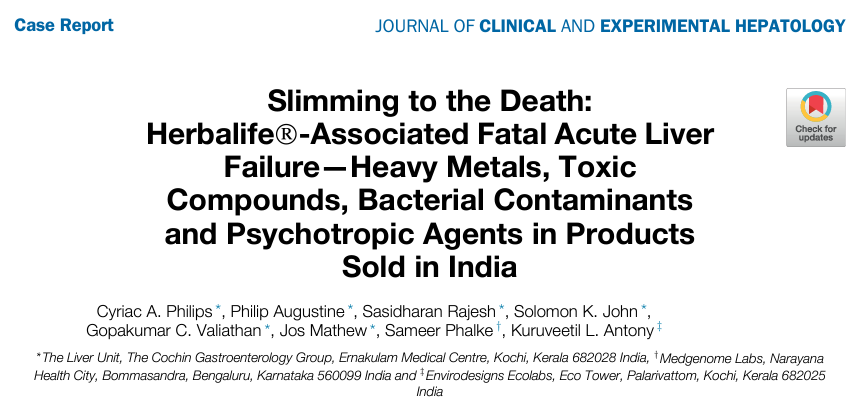
39/ ..products & found contamination within products sold online
And from then on, our lives changed.
Late Oct & Nov 2019,
Herbalife send legal letters threatening to sue us for defamation
and asked us to prove our credibility, and convince THEM that we were real doctors.
And from then on, our lives changed.
Late Oct & Nov 2019,
Herbalife send legal letters threatening to sue us for defamation
and asked us to prove our credibility, and convince THEM that we were real doctors.


40/ They made 'Scientists' on their payroll write
'critical letters' to the journal, trying to discredit our report
But the journal gave us a chance to refute their allegations
& both their letter and our responses were published
Evidence trumped fear mongering
'critical letters' to the journal, trying to discredit our report
But the journal gave us a chance to refute their allegations
& both their letter and our responses were published
Evidence trumped fear mongering


41/ But it didn't end there
Company sent their trump card, Prof Steven Newmaster to destroy our credibility via a 10-12 page criticism
Which we destroyed with a 24 page response
retractionwatch.com/wp-content/upl…
Newmaster was himself later accused of data fraud..
science.org/content/articl…
Company sent their trump card, Prof Steven Newmaster to destroy our credibility via a 10-12 page criticism
Which we destroyed with a 24 page response
retractionwatch.com/wp-content/upl…
Newmaster was himself later accused of data fraud..
science.org/content/articl…
42/ ..but then cleared of 'misconduct',
while the investigation found that he “displayed a pattern of poor judgement and failed to apply the standards reasonably expected in research activity in his discipline,” (Oh well)
And we thought that was it...
science.org/content/articl…
while the investigation found that he “displayed a pattern of poor judgement and failed to apply the standards reasonably expected in research activity in his discipline,” (Oh well)
And we thought that was it...
science.org/content/articl…
43/ But the company had more surprises for us
They sent threatening legal letters to the Journal, The Editorial Board, The Publisher Elsevier,
flexing more muscle in the process
And even after a second investigational peer review which concluded our report was credible,
They sent threatening legal letters to the Journal, The Editorial Board, The Publisher Elsevier,
flexing more muscle in the process
And even after a second investigational peer review which concluded our report was credible,
44/ Through more legal pressure, Herbalife succeeded in removing our report from all web sources and the Journal
Elisabeth Bik wrote about how science lost and money won in her blog scienceintegritydigest.com/2020/12/20/pap…
Retraction Watch featured our battle for science and Meera on theirs..
Elisabeth Bik wrote about how science lost and money won in her blog scienceintegritydigest.com/2020/12/20/pap…
Retraction Watch featured our battle for science and Meera on theirs..
45/ retractionwatch.com/2020/12/22/aft…
So we published it on Zenodo a free to upload data repository which Herbalife again removed after threatening Zenodo
So we uploaded it on ResearchGate for posterity..
So we published it on Zenodo a free to upload data repository which Herbalife again removed after threatening Zenodo
https://twitter.com/theliverdr/status/1346066577708314627?s=20&t=8hpO75lcahYKRxDzwgzOWQ
So we uploaded it on ResearchGate for posterity..

46/
And Herbalife threatened ResearchGate
and removed it from there too
After our report came out, multiple other large reports on HDS causing liver injury was reported from world over, many featuring Herbalife products
And Herbalife threatened ResearchGate
and removed it from there too
https://twitter.com/theliverdr/status/1361215780956770306?s=20&t=0KoP2i-FaLA-c-hddFsYjA
After our report came out, multiple other large reports on HDS causing liver injury was reported from world over, many featuring Herbalife products
https://twitter.com/theliverdr/status/1516002814413381634?s=20&t=vvj3Ch8CRrZ7hGDv4IITiw
47/ Our report was the first from Asia
I tweeted about new cases recently,
& Herbalife again threatened me with a 'Cease and Desist' notice
Tussle over HDS industry, public health & science will continue
until the day, science will win
I may not..
I tweeted about new cases recently,
& Herbalife again threatened me with a 'Cease and Desist' notice
https://twitter.com/theliverdr/status/1519519143418077185?s=20&t=Z26X4wR9qpZFd9Q7aUQZvA
Tussle over HDS industry, public health & science will continue
until the day, science will win
I may not..

48/ witness this during my lifetime,
but I hope, future scientists/clinicians
watch over their patients & family and protect them
from this avoidable public health risk.
I spoke to Raj 2y after that last message
He found a new job, moved to a new place
but I hope, future scientists/clinicians
watch over their patients & family and protect them
from this avoidable public health risk.
I spoke to Raj 2y after that last message
He found a new job, moved to a new place
49/ I called him because a New York Times reporter wanted to run this story and she wanted Raj's interview
This is a great chance, I had a selfish thought
My work would get highlighted
But at the expense of digging up the dark past of another man
The reporter was sweet, she..
This is a great chance, I had a selfish thought
My work would get highlighted
But at the expense of digging up the dark past of another man
The reporter was sweet, she..
50/ ..travelled all the way from Mumbai to speak to me,
took my pics & spoke to Raj via a translator
I called Raj thereafter
And asked him how it went
He said he had to relive that gloom, but he did it only for me, because I was family
I ask him about his kids
He says they..
took my pics & spoke to Raj via a translator
I called Raj thereafter
And asked him how it went
He said he had to relive that gloom, but he did it only for me, because I was family
I ask him about his kids
He says they..
51/ ..were busy with studies
& they miss their mother
Everyday
He says he thinks of Meera
only when he thinks about hospitals & ME
Over phone, his voice breaks
And I feel miserable
So I talk to the reporter & call it off
Because NYT has a three tier fact checking and Raj..
& they miss their mother
Everyday
He says he thinks of Meera
only when he thinks about hospitals & ME
Over phone, his voice breaks
And I feel miserable
So I talk to the reporter & call it off
Because NYT has a three tier fact checking and Raj..

52/ ..will have to relive his tragedy again & again
& it wasn't worth it.
I didn't want to burden him with the past.
During our last conversation, I thanked Raj,
But tell him the NYT story is off
& that he could call me anytime for any help
But I dont call him
Not anymore
& it wasn't worth it.
I didn't want to burden him with the past.
During our last conversation, I thanked Raj,
But tell him the NYT story is off
& that he could call me anytime for any help
But I dont call him
Not anymore

• • •
Missing some Tweet in this thread? You can try to
force a refresh