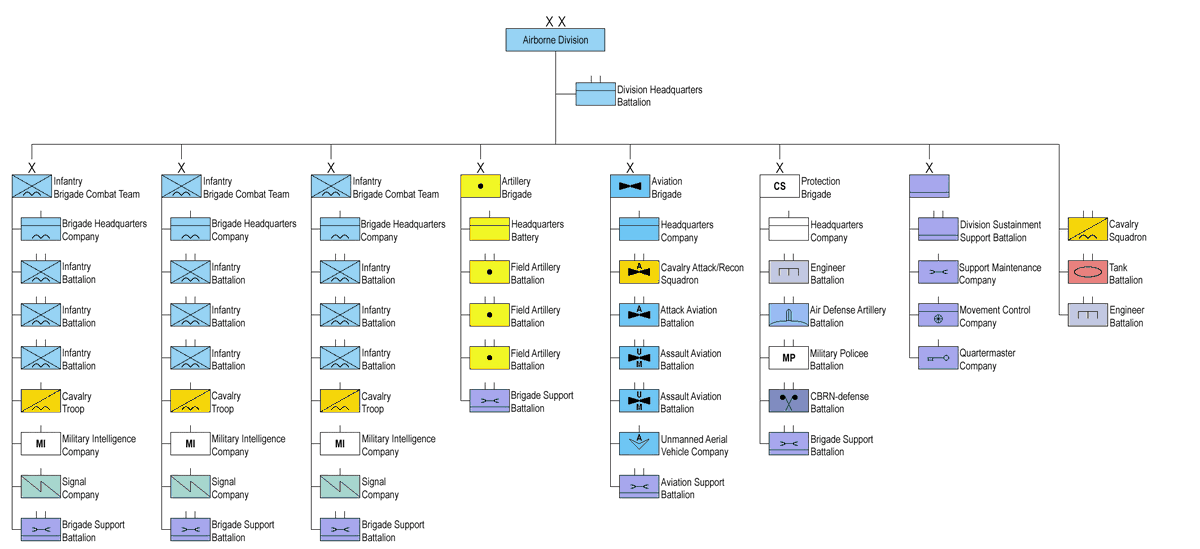
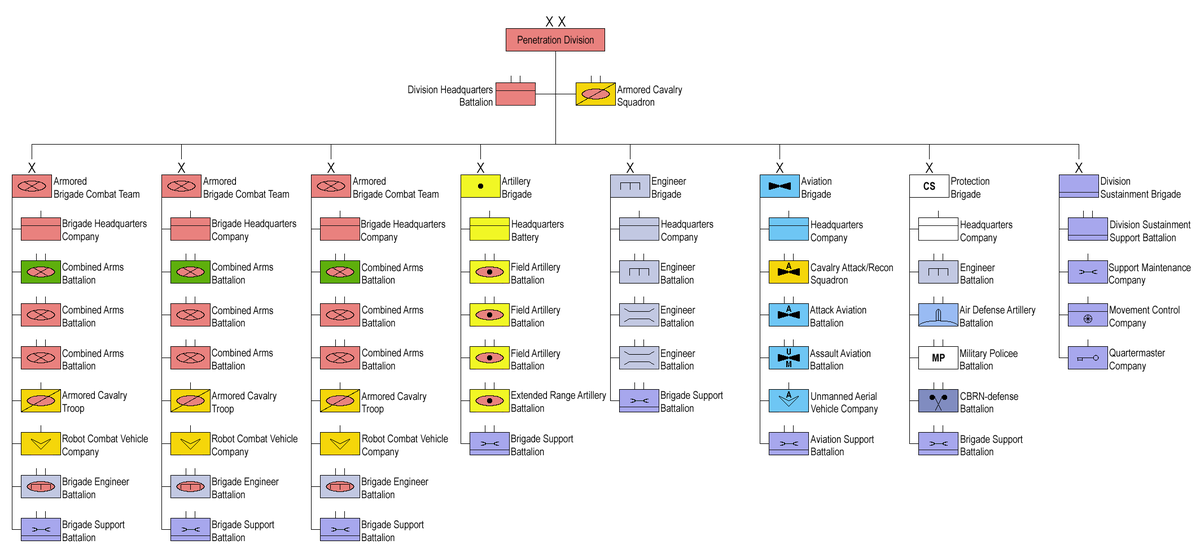
I created graphics of current @USArmy divisions and the future WAYPOINT 2028 division.
First up the current and future light division. The @10MTNDIV (10th Mountain) will likely be the first division to be reorganized like this.
1/n
Next the @82ndABNDiv and @101stAASLTDIV, which are currently organized like light divisions. Both divisions will slightly differ from standard light divisions under WAYPOINT 2028.
2/n
Current heavy division and future heavy division organization - my guess is that the @FightingFirst will receive a Stryker brigade from the @4thInfDiv, and the 4th Infantry will receive an armored brigade from the @1stCavalryDiv, which in turn will gobble up the @3dUSCAV.
3/n
This would give III Corps three heavy WAYPOINT 2028 divisions, with the @1stArmoredDiv becoming the army's Penetration Division, meant for crossing rivers in Eastern Europe.
• 2nd Infantry - in South Korea, no idea what will become of its two Stryker brigades in Washington
• 3rd Infantry - will likely be a heavy division with Pennsylvania's National Guard Stryker brigade
5/n
• 11th Airborne - tasked with defending Alaska, so it will receive a unique organization with airborne and infantry brigades
• 25th Infantry - based in Hawaii, it will be a light division with probably an attached National Guard infantry brigade
6/n
Speaking of @NationalGuard - it will be interesting to see how the Guard's current eight infantry divisions (28th, 29th, 34th, 35th, 36th, 38th, 40th, 42nd) with their 27 brigades (20 infantry, 5 armored, 2 Stryker) will be formed into coherent divisions.
7/n
The US Army is clearly moving away from counter-insurgency to peer-level conflict with this reorganization. Most clearly with the massive Penetration Division... which should be based in Poland, because it is designed to fight there.
8/n
I like this reorganization. Especially the Protection Brigades (revamped Maneuver Enhancement Brigades). I only have serious doubts about cutting separate Stryker brigades.
Stryker brigades with wheeled, armored Dragoon Strykers with 30mm chain guns are an excellent
9/n
capability that allows commanders to quickly project protected firepower across vast territories. I hope the @2dCavalryRegt of @USArmyEURAF remains untouched by WAYPOINT 2028. I also would prefer @3dUSCAV to remain independent and 1st Cavalry to become a second Penetration
10/n
Division.
Last but not least - the @USMC reorganization is clearly meant to fight and defeat China in the Western Pacific, while the US Army's reorganization is clearly meant to fight and defeat russia in the Eastern Poland.
11/.
• • •
Missing some Tweet in this thread? You can try to
force a refresh

The F-16 is a capable fighter, which is in service with 11 NATO air forces (Norway retired theirs this January). It's the fighter Ukraine will most likely receive from the US.
1/n
I explained why it will be the F-16 in a short 1 April thread.
I am all for giving Ukraine 80-90 F-16, as it is a far better fighter than the junk russia has.
However Ukrainian Su-27 or Mig-29 pilots can not master a F-16 in a few weeks.
First let's talk air bases: the moment Ukraine lands F-16 at its air bases, russia will hammer these bases with cruise and ballistic missiles.
So before a F-16 can fly to Ukraine, each air base needs a Patriot air defense battery to protect it from russian attacks.
What does this mean for russian logistics?
A thread 🧵:
Since 2014-15 russia built dozens of ammo dumps hidden in civilian buildings near railway stations in the parts of Ukraine it occupies.
1/n
russian logistics depots are always close to railways as russia's military has a serious lack of logistic units, especially transport units.
This is compounded by russia's military being corrupt and technologically backwards, even eschewing things like forklifts or cranes.
2/n
So russian supplies and ammo are loaded by hand onto trains, transported towards the front, unloaded there by hand, loaded onto trucks by hand, and then driven to the frontline units, where it is unloaded again by hand.
It's time consuming. No other army is so backwards.
First we saw that Ukrainian PzH 2000 crews don't use the automatic magazine.
Now we see that AHS Krab crews also don't use the automatic magazine, but lift each projectile by hand into the autoloader.
Why? I have a theory - and it tells us a lot about Ukraine's situation.
1/n
The PzH 2000 has a fully automated magazine with 60 projectiles, which are automatically placed into the autoloader. The autoloader loads and rams the projectiles into the barrel and the automatic primer magazine loads the primer.
All this allows for a high rate of fire.
2/n
The AHS Krab uses a modernized British AS-90 turret, so I will use an AS-90 video to explain the Krab's loading process.
The AS-90 has a fully automatic magazine with 48 projectiles. The selected projectiles are moved to the magazine's center and a crew member then uses a
Italy bought 68 PzH 2000, 54 of which are assigned to three regiments:
• 8th Field Artillery Regiment "Pasubio"
• 52nd Artillery Regiment "Torino"
• 132nd Field Artillery Regiment "Ariete" 1/6
The 8th and 132nd are the artillery regiments of Italy's two heavy brigades, which are both assigned to NATO. The 52nd is the army's divisional artillery regiment and also assigned to NATO.
And yes, the 8th and 52nd have the Ukrainian Tryzub in their coat of arms, as both 2/6
regiments fought in Ukraine in 1941; taking Horlivka and Donetsk from the Soviets (the Ukrainian Tryzub is actually the most common element in Italian Army heraldry).
A further 6 PzH 2000 are assigned to the army's Artillery School, while 6 are the reserve, and 2 are at the
Just saw someone I respect tweet that Iron Dome and Patriot are "long range air defense" systems, that "provide point defense"... and that Patriot is "extremely limited".
And I am like -WTF? WTF???
The US alone has 60+ Patriot batteries and more than 400 launchers. 1/5
Patriot is the most common Western air defense system. And it is not a point defense system. Yes, Patriot could be used as a point defense system if a battery would only employ PAC-3 and/or PAC-3 MSE missiles, but
(Photo: a M903 launcher with 8 PAC-3 and 6 PAC-3 MSE) 2/5
every battery employs a mix of PAC-2 and PAC-3 missiles - the latter for point defense, the former for long range air defense. The range of PAC-2 is 160+ km, while the Patriot's AN/MPQ-65A radar has a range of 220+ km.
(Photo: a M903 launcher with 2 PAC-2 and 6 PAC-3 MSE)
Chris posted a good thread about NASAMS, which the US might provide to Ukraine.
Check it out, then come back and I will add a bit more missile info if you like tech specs.
NASAMS comes in three versions numbered 1 to 3. As of 2022 only NASAMS 2 and NASAMS 3 are in service.
We do not know yet if they US bought used NASAMS 2 or brand new NASAMS 3 systems, which are currently being produced by Norway for Lithuania, Qatar, Hungary, and Australia.
2/n
NASAMS 2 & 3 use the AN/MPQ-64F1 Sentinel radar, with a range of 120 km.
Ukraine already received four AN/MPQ-64A1 Sentinel to cue Stinger teams onto approaching russian planes & helicopters.
(The new GhostEye MR radar was unveiled last October and is not yet in production) 3/n