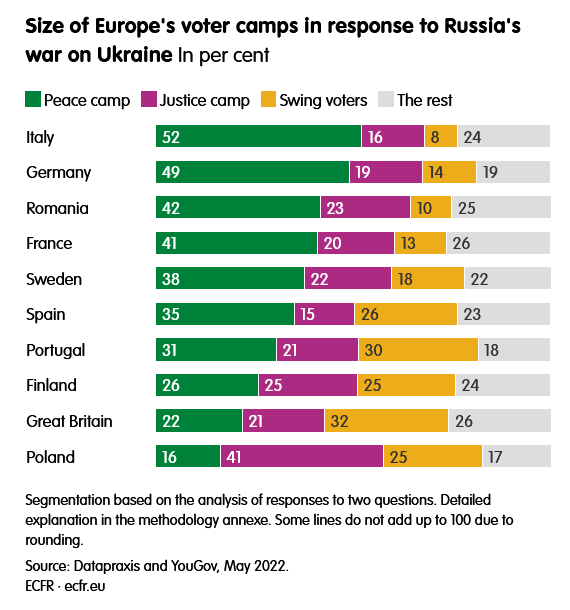
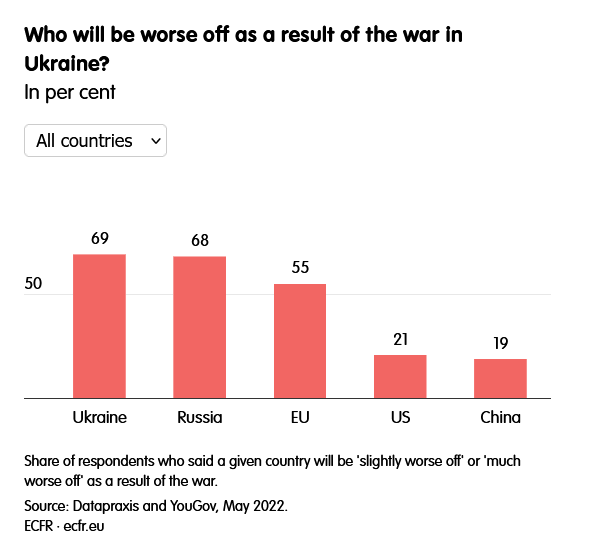
Pretty interesting polling with 8000 sampled across 10 EU nations, nailing down some of the gradations of European sentiment regarding the current conflict. Specifically regarding the goals of the conflict - "peace" or "justice" for Ukraine. /1 ecfr.eu/publication/pe…
First off, broadly speaking, most Europeans want a complete severance of ties with Russia, with UK and Poland leading the pack. On the other end, Romania and Italy favor cutting ties the least, though nearly half of respondents wanted a complete severance of economic ties. /2
Moreover, the "peace" camp shouldn't be seen as pro-Russian or even particularly pragmatic. A near majority of them also favor a complete severance of ties. In general Russia should dispense with the notion that there are many sympathetic ears within the European public. /3
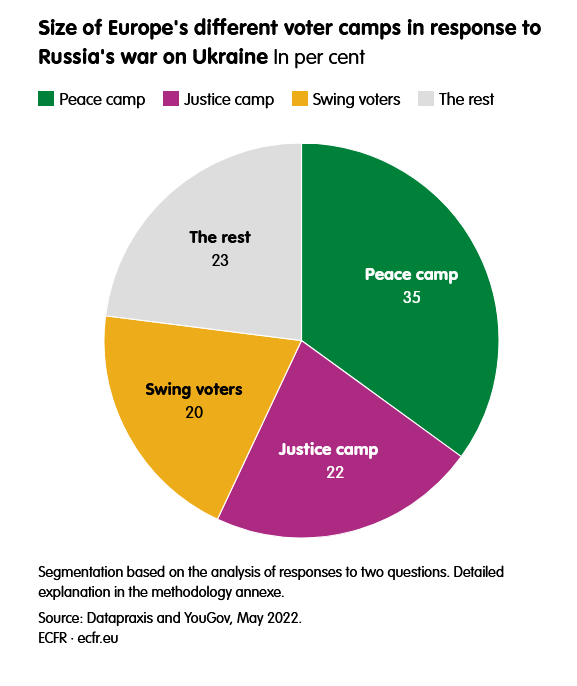
That said, the ones who want "peace" in Ukraine outnumber the justice-seekers, though by no means are they dominant, with nearly half the public undecided. In general this tendency is most pronounced in Italy, Germany, Romania, France. /4
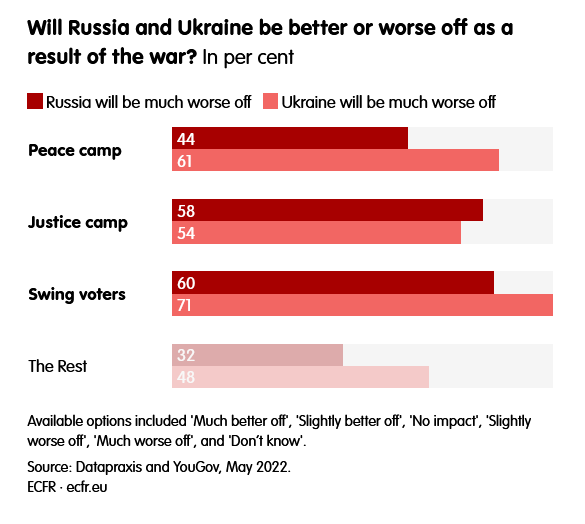
Curiously, justice-seekers don't actually think that their outcome will be much better for Ukraine. They just want to do damage to Russia. In general they take solace in the idea that the EU will be hurt less than Russia will be. /5
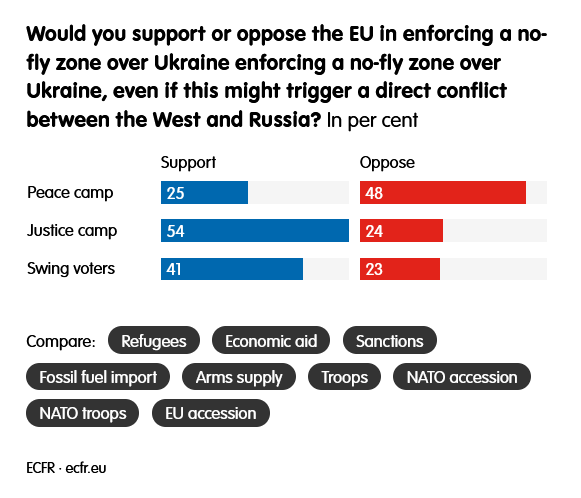
Now some of the most important bits of information, tucked away deep in this survey. Support for escalation in the form of a no-fly zone risking open conflict split along peace/justice lines, though judging from the "swing" camp, it is still uncomfortably close to a majority. /6
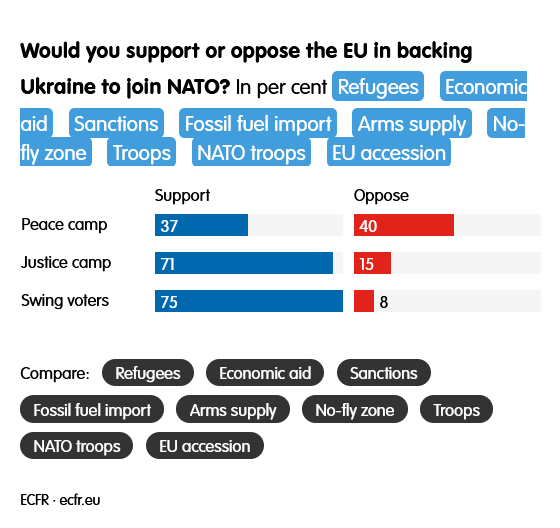
As for NATO accession, the Peace camp is equally split for and against. While justice seekers and swing voters are overwhelmingly in support. This set of data is in line with earlier data showing the limitations of Russian influence and Russia-sympathetic sentiment. /7
And in general it seems that the Europeans are willing to further escalate, which figures into the calcs of the Russian leadership in calibrating the escalation ladder. In contrast to the peace/justice framing, the polling suggests a deeper divorce between Russia and Europe. /8
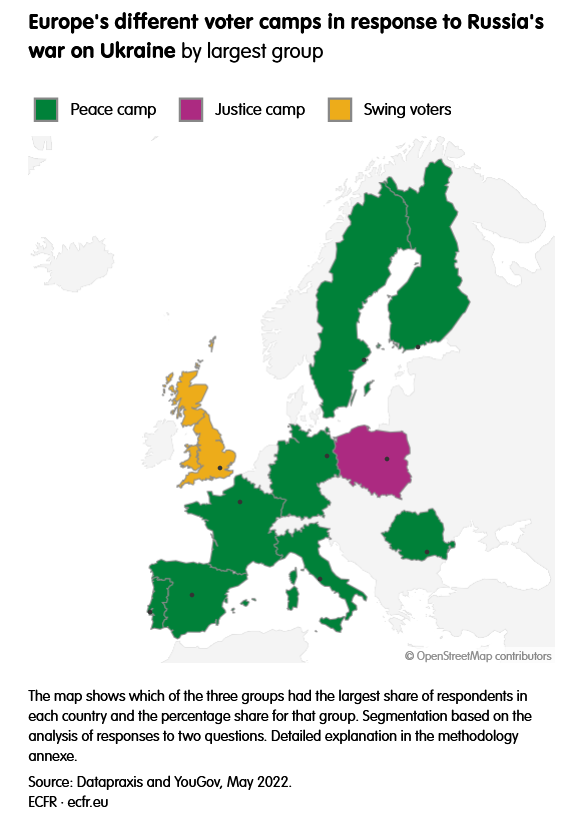
The EU public hasn't proven to me that their opinions regarding Russia are substantially different than that of their leadership, other than that they are even more willing to escalate. I am waiting to be proven wrong. /9 END
Reading about the Sino-Vietnamese border conflicts of 1979 through the 1980s, one can’t help but get a sense of déjà vu. In fact the prelude with the buildup in 1979 eerily echoes the current special military operation. /1
And once the fighting was underway, talk of the war was subdued, without even public displays in the PRC for supporting the troops. The operation had to be limited in scale and time so as to not attract outside attention, especially from Vietnam’s ally, the USSR. /2
Ostensibly, the reason for the intervention was to halt Vietnam’s intervention in Cambodia, but there were deeper motivations, such as the Sino-Soviet tensions (Mao split over destalinization), the historical problems with Vietnam’s relationship with its larger neighbor, and /3
1. Ukraine just completed its 5th wave of mobilization is on its 6th, with 400k+ mobilized. 2. Russia hasn't been mobilizing apart from a relatively small number of volunteers (a few 10s of thousands) 3. The colonel's assumptions seem to be rooted in racial bias.
Ukrainians are getting killed in massive numbers, but they can ship off new replacements with days of training. This, strictly speaking, isn't a manpower shortage. This is a training shortage. The Zelensky regime is demonstrating how easy it is to get cannon fodder for this.
All right, as promised, it’s time to talk about the collapse of the Akkadian Empire and the 4.2ka BP aridification event. /1
The 4.2ka BP aridification event, or the 4.2-kiloyear event, was a severe megadrought that affected much of the world, in particular Europe, the Middle East, and Africa at around 2200 BCE and lasting for more than 2 centuries. /2
Although this was not the first megadrought to hit the ancient Middle East, prior events did not occur at a time when there was large-scale social and political organization. The 4.2ka event occurred at the height of the world’s first empire, the Akkadian Empire. /3
A very good question, and one that I will use as a jumping off point. Just why is the Western media so aligned with the Zelensky team’s provocations and media narratives? It’s fundamentally an alignment of interests. /1
While some will say that the media is just whatever the “deep state” tells them to say, and there is much truth to the role govt plays in shaping media narratives, this view is too simplistic as it does not account for factions within the govt and the agency of journalists. /2
In their minds Western press has created a mythology around itself as the protector of free speech and the common people, based on the legacy of legendary investigative journalists like Ida B. Wells who exposed the epidemic of lynching in the Southern USA. /3
I keep seeing this stupid article pop up on my feed, with people celebrating supposedly how the Western media is being brought to heel and is being forced to admit the truth. This is wishful thinking. It is a psyop article. /1 independent.co.uk/news/world/eur…
Even with Russia's material advantages, a 20:1 advantage in artillery (40:1 in ammunition) on Russia's side would entail a complete, rapid collapse of Ukrainian lines. There would not be enough Ukrainian artillery to even conduct artillery skirmishes. /2
Moreover it has nonsensical statistics like outnumbered in artillery range - artillery restricted to a range of 25 kilometres, while the enemy can strike from 12 times that distance. They are literally counting Iskander for 300km range
There's a lot of commentary out there that attempts to glean some sort of endgame scenario out of a key phrase or two out of the mouth of Lavrov or Peskov or some other government official. Let me clue you in on how governing a bureaucracy works. /1
This was written by Han Fei, a Chinese strategist during the late Warring States period, and it is remarkable in the canon of ancient philosophy in that it is nothing but practical insight into the flow of power in a bureaucratic setting. Very readable even for non-philosophers/2
The idea of a leader as a cipher, someone who holds his cards close to his chest and carefully manages bureaucratic rivalries is something that has been said about Putin, actually. Richard Sakwa, one of those Western scholars who isn't garbage has described him as... /3