The A-10 Thunderbolt II is a one-trick pony that is of no use to Ukraine:
• can the A-10 fly Combat Air Patrols (CAP)? No.
• can the A-10 Suppress Enemy Air Defenses (SEAD)? No.
• can the A-10 do Close Air Support (CAS)? Yes.
The F-16 can do all three and do them better.
1/n
• can the A-10 fly Combat Air Patrols (CAP)? No.
• can the A-10 Suppress Enemy Air Defenses (SEAD)? No.
• can the A-10 do Close Air Support (CAS)? Yes.
The F-16 can do all three and do them better.
1/n

The F-16 can mount six AIM-120C-7 or six AIM-120D AMRAAM beyond-visual-range air-to-air missiles (BVRAAM). The A-10 can mount none, because it doesn't even have a radar.
Photo: a F-16C Block 40, which uses the AN/APG-68(V)5 radar, departs with six AIM-120C-7 for a CAP.
2/n
Photo: a F-16C Block 40, which uses the AN/APG-68(V)5 radar, departs with six AIM-120C-7 for a CAP.
2/n
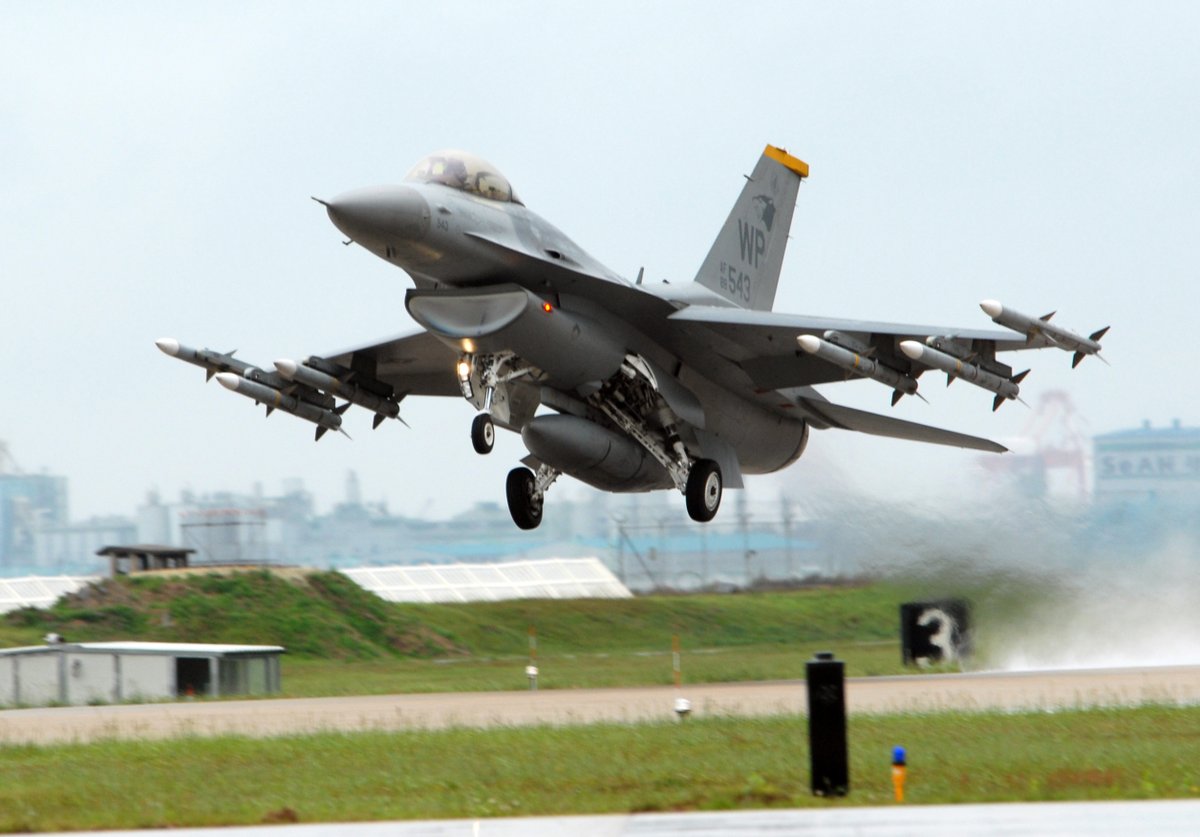
The F-16 can mount two AGM-88E AARGM air-to-surface anti-radiation missiles with a AN/ASQ-213 HTS pod to find and strike enemy air defenses. The A-10 can't.
Photo: two F-16CJ Block 52 with a full SEAD load on patrol.
3/n
Photo: two F-16CJ Block 52 with a full SEAD load on patrol.
3/n

When the A-10 was designed and introduced a plane doing CAS had to fly low to accurately straff enemy positions.
Low meant within range of enemy man-portable air-defense systems (MANPADS) and anti-aircraft cannons. Therefore the A-10 has an armored cockpit.
4/n
Low meant within range of enemy man-portable air-defense systems (MANPADS) and anti-aircraft cannons. Therefore the A-10 has an armored cockpit.
4/n

With the arrival of laser-guided, GPS-guided, infrared homing, etc. bombs and missiles a plane doesn't have to fly low to accurately hit an enemy position.
Nowadays a F-16 (or A-10, F-15E, F/A-18E/F) can fly above the range of MANPADS and anti-aircraft fire, because
5/n
Nowadays a F-16 (or A-10, F-15E, F/A-18E/F) can fly above the range of MANPADS and anti-aircraft fire, because
5/n

thanks to targeting pods they can drop a dozen bombs with pinpoint accuracy on enemy positions.
The US Air Force even mounted Sniper Advanced Targeting pods on B-1B Lancer bombers and used the bombers for CAS.
There is no need for a fighter to fly low anymore.
6/n
The US Air Force even mounted Sniper Advanced Targeting pods on B-1B Lancer bombers and used the bombers for CAS.
There is no need for a fighter to fly low anymore.
6/n

Even the A-10 fly now with a Sniper or Litening targeting pod.
On the modern battlefield there is no need for a plane like the A-10 anymore - a plane that can only be used after fighters have won air supremacy and have destroyed enemy air defenses.
7/n
On the modern battlefield there is no need for a plane like the A-10 anymore - a plane that can only be used after fighters have won air supremacy and have destroyed enemy air defenses.
7/n


Of all the US Air Force fighters the F-16 is the most versatile.
It is still in production and the newest variant, the F-16V Block 70/72, is capable to defeat all non-NATO fighters. And: the Block 70/72 upgrade can be retrofitted to older F-16 variants.
8/n
It is still in production and the newest variant, the F-16V Block 70/72, is capable to defeat all non-NATO fighters. And: the Block 70/72 upgrade can be retrofitted to older F-16 variants.
8/n

On the other hand the A-10 is only useful against an enemy without air force and with no air-defenses.
If A-10 planes are sent to Ukraine now, then their life expectancy is less than that of a russian ammo dump.
What Ukraine needs are F-16. And lots of them.
9/.
If A-10 planes are sent to Ukraine now, then their life expectancy is less than that of a russian ammo dump.
What Ukraine needs are F-16. And lots of them.
9/.

PS re. other US fighters:
• F-22, F-35 off limits to UA
• F-15C/D can only do combat air patrols
• F-15E/EX USAF needs them all
• F/A-18C/D excellent fighter, not as good for SEAD as the F-16, production line has closed, 2nd best option for UA
• F/A-18E/F USN needs them all
• F-22, F-35 off limits to UA
• F-15C/D can only do combat air patrols
• F-15E/EX USAF needs them all
• F/A-18C/D excellent fighter, not as good for SEAD as the F-16, production line has closed, 2nd best option for UA
• F/A-18E/F USN needs them all
• • •
Missing some Tweet in this thread? You can try to
force a refresh