So I think it’s a decent question to ask whether settling Mars really reduces existential risk or not. More on that below. But 1st I gotta ask whether Mars-skeptics have actually run economics models on it or not. I have, and AFAICT it will not be that hard to settle Mars. 🧵 1/n
https://twitter.com/finmoorhouse/status/1534888982990954501
2/ It’s on my to-do list to publish the Mars settlement economics model, but I have more urgent tasks so it will be a while. Also let me say I’m not really a Mars type. I’m more of a “Moon, asteroid & cislunar industry to save the Earth” type. But I see synergistic value in Mars.
3/ The problem with these Mars-skepticism arguments is they are all one-sided equations: “Mars has X and Y problems.” The missing side of the equation should have been an engineering & economic estimate of handling that problem. If it is too costly, then yeah, Mars is too hard.
4/ But just stating the challenge without the quantitative assessment is only half of the equation. Here are other examples of one-sided equations:
5/ Some people claim the Earth can only be 5,000 years old because the mountains erode to quickly and would be all gone by now if the Earth were older. But the other side of the equation is the rate of mountain building, which they left off.
6/ Example 2: Some people say we know for sure there is extraterrestrial life in the galaxy because it is sooooo big with soooo many planets. The other side of the equation is the rate that life forms on planets. Without that part, we can’t really say if life is common or not.
7/ Example 3: planetary scientist Tommy Gold made a famous mistake when he predicted the Moon dust would be so deep that we would sink in it. He thought that because the rate dust falls to the Earth should be the same on the Moon, so after billions of years it’ll be DEEP! But…
8/ pretty quickly — like within a week — he recognized his mistake because a colleague at Cornell pointed out the other side of the equation: that geological processes on the Moon turn dust into larger particles (impact melt forms larger glass particles), etc. So dust NOT deep.
9/ Sadly, because of that brief 1-sided equation, even 60 years later we are saddled with rumors that NASA thought the Moon dust would be deeper than it really is. Not true. NASA knew the real depth before we landed anything on it. The 1-sided equation fallacy did this to us.😭
10/ Nowadays we hear lots of “1-sided equation” arguments about Mars being soooo hard to live on that we clearly should not try it. “It has no breathable air. It has radiation. It has toxic dust. Clearly it will be too costly to make a city there where humans could thrive.”
11/ Ok, then let’s see the other side of the equation. Does anybody have something more than hand waiving for the other side of the equation? If so, we need numbers. How much hardware needs to be sent to Mars? How many workers to operate it? How much food? What can they export?
12/ Then add up the cost of those shipments to Mars minus the value of exports back to Earth. Can the trade balance go to zero? How much is needed to finance the difference until then? If you don’t have numbers, you don’t have anything.
13/ I think people are susceptible to 1-sided equations about Mars for several reasons. One reason is because people don’t have a good sense for what “hard” really is. Here are some things that are actually hard…
14/ “Hard” includes developing an extensive supply chain on Earth that fills the entire world with smart phones. That was hard. Surviving on Mars doesn’t require manufacturing smart phones. It just requires air, dirt, water, stuff like that. Easy by comparison.
15/ “Hard” includes developing an economy where most people work on stuff we don’t even need: like Sumatra Starbucks beans, fashion, tourism, TV, cars, Twitter, pretty much everything. How few people work in agriculture and other actual necessities! So imagine…
16/…if we cut out some entire sectors of the economy that aren’t needed, like the automotive industry, suburban construction, most furniture and fashion—are those workers enough to wash dirt and operate air circulation systems on Mars? Actually, they are far more than needed.
17/ I think another reason people are susceptible to these 1-sided arguments is that they are thinking too small. They are imagining tiny Apollo-style missions costing billions of dollars. Low capability, hence low ability to solve Mars problems.
18/ The economics for Mars get far better if you go big from the start. You benefit from economies of scale. The learning curve is vastly faster. And lots of humans together can do amazing things. (credit: SEEDS of Mars edgeprop.my/content/145927…) 
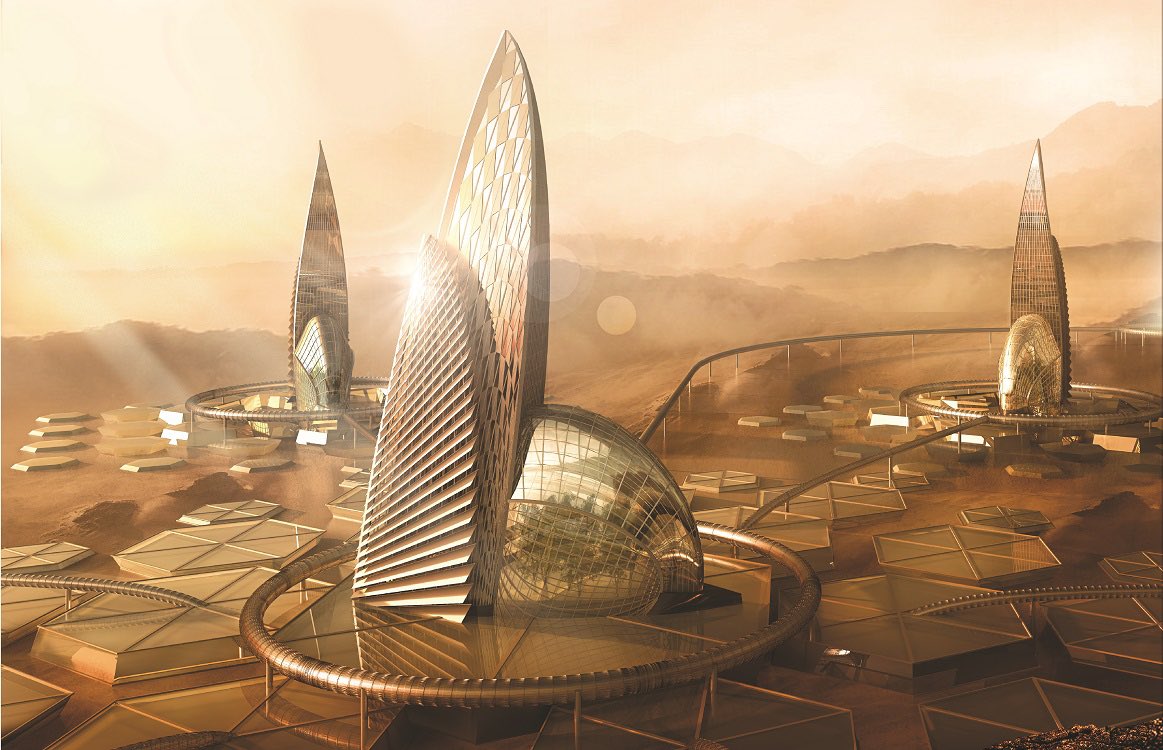

19/ So if people want to be skeptics then fine, but please stop making 1-sided arguments. It is not inherently obvious that Mars will be all that hard. I think it will be straightforward.
As for whether Mars helps reduce existential risk for humanity or not,…
As for whether Mars helps reduce existential risk for humanity or not,…
20/ I agree that settling Mars is *not* one of the most important things we could be doing.
But, we can walk and chew gum at the same time. It won’t be an impact on anything else we do. And it will have synergistic benefits.
But, we can walk and chew gum at the same time. It won’t be an impact on anything else we do. And it will have synergistic benefits.
21/ If Earth-humans are wiped out by pandemic or AI run amok, it might spread to Mars too easily since there will be traffic back and forth. Mars reduces risk of asteroid extinction on Earth, but that is relatively small. Mars helps but it is down the list of important steps.
22/ But the synergy it will create in cislunar space will have tremendous benefit that will make humanity much safer and make Earth healthier. The tech to settle Mars has great overlap with cislunar industry that can help address climate change and more. Economies of scope.
23/ I think it is easy for people to miss the importance of this. We know the global economy is intertwined so what happens in China affects America. The Space economy will be like that, too. Mars will never be just about Mars. It will be about the whole Solar System and Earth.
24/ And some people (not me so much) are just interested in living on Mars. That makes them excited to wake up in the morning and work for the good of humanity. If they do things that increase the funding of space tech, then awesome! The technology benefits the Earth, too.
25/ So I hope I can carve out time to publish the Mars economic analysis soon. I took data from the US government (bureau of labor statistics, commerce for shipping masses & values, etc etc etc) to model how many rockets need to go to Mars to replicate an entire economy.
25/ I assumed that Mars will focus on developing one sector at a time starting with industries that have the highest ratio of mass of production to mass of capital, to minimize the rocket traffic. And bring only enough people for the labor of those sectors plus other necessities.
26/ Then over time build out more and more sectors. Building material and steel are first. Electronics and biotech are filled out later. And Mars can focus on the services sector for massless exports to Earth. The net of expenses less revenues is the amount to be financed.
27/ I was shocked to see how low an amount will need to be financed. Within something like 30 or 40 years*, the Mars settlers will be in less debt than the average American, meaning it will be affordable for all. (*I’m going by memory for something I modeled 1 or 2 years ago.)
28/ So if people want to tell others that cleaning dirt and pumping air and designing architecture that lets in light while putting some mass overhead (blocking particles from space) is SOOOO hard that humans should not try, then please do the modeling and show your work. /end 🧵
• • •
Missing some Tweet in this thread? You can try to
force a refresh