Some thoughts on the failure of Allison Bailey's complaint against Stonewall, sparked by @Broonjunior's thoughtful tweets on the subject yesterday.
1/21
1/21
The complaint was made under s. 111 of the Equality Act 2010, which provides that it is unlawful for a person (SW) to instruct, cause, or induce another person (GCC) to discriminate against a third person (AB).
legislation.gov.uk/ukpga/2010/15/…
2/21
legislation.gov.uk/ukpga/2010/15/…
2/21
By s. 111(8), causing or inducing includes attempting to cause or induce.
3/21
3/21
There were several ways in which SW was said to have contravened s. 111, but the strongest argument for AB centres on the complaint email sent by SW’s Head of Trans Inclusion, Kirrin Medcalf, on 31 October 2019. The email included this passage:
4/21
4/21
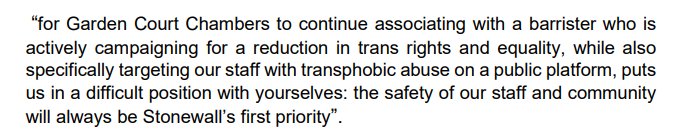
GCC was at the time an SW Diversity Champion, though the ET did not find that KM must have been aware of this when he sent the complaint email.
5/21
5/21
The email was not a frolic of KM’s own. It was drafted on 28 October but not sent until 31 October, and KM accepted in evidence that it was inconceivable he would have sent it in SW’s name after only 5 weeks in the job without the authority of someone more senior.
6/21
6/21
SW appears to have accepted that the complaint email should be treated as its email pursuant to s. 109.
legislation.gov.uk/ukpga/2010/15/…
7/21
legislation.gov.uk/ukpga/2010/15/…
7/21
When KM was asked why he had sent this email, one of his explanations was that he was concerned for the safety of trans people who might visit GCC in the future. That explanation was disbelieved by the ET, which described KM’s reasons as ‘obscure’.
8/21
8/21
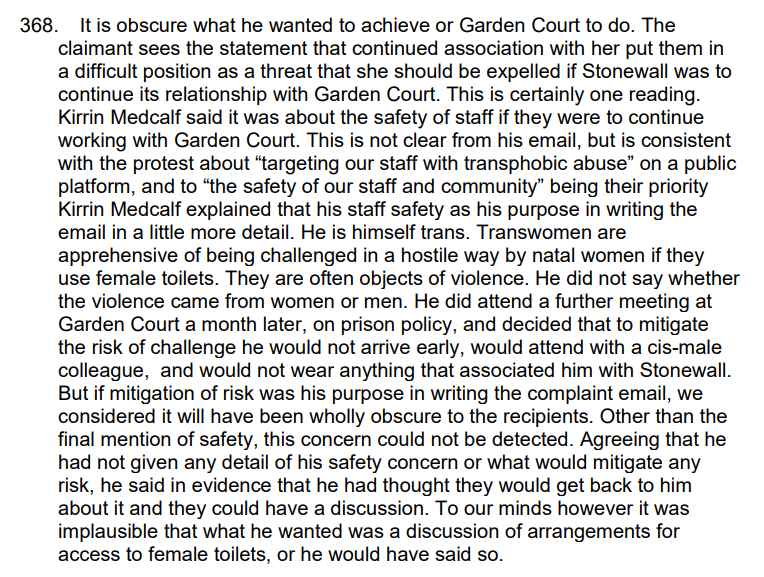
Ultimately, however, the ET found that the email was simply a protest and fell short of even an attempt to induce. In reaching that conclusion, it attached weight to the facts that (a) SW did not follow up on the complaint...
9/21
9/21
...(b) SW’s internal view was that it could not cancel GCC’s Diversity Champions status, and (c) the causal effect on GCC was relatively minor.
10/21
10/21
There is very little case law on s. 111 besides the case cited in the judgment, NHS Trust Development Authority v Saiger. Saiger is a messy case – much of the EAT’s time was taken up with procedural issues and the adequacy of the ET’s reasoning.
bailii.org/uk/cases/UKEAT…
11/21
bailii.org/uk/cases/UKEAT…
11/21
Insofar as the judgment does address the correct interpretation of s. 111, it does so in negative terms.
Saiger tells us that for a party to have contributed to and played a material role in a discriminatory decision does not in itself amount to a breach of s. 111.
12/21
Saiger tells us that for a party to have contributed to and played a material role in a discriminatory decision does not in itself amount to a breach of s. 111.
12/21
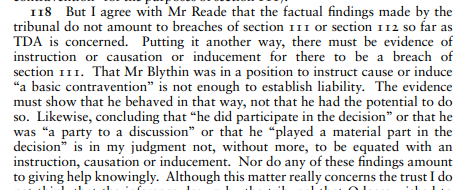
Consider for a moment an EAT case concerning the predecessor provision under the Race Relations Act 1976, CRE v The Imperial Society of Teachers of Dancing (not referred to in Saiger).
13/21
13/21
The facts of the case were that R was looking for someone to work in their office. They called a local school and asked if they had anyone suitable, but said that the school shouldn’t send a BAME person because R had no other BAME employees and they would feel out of place.
14/21
14/21
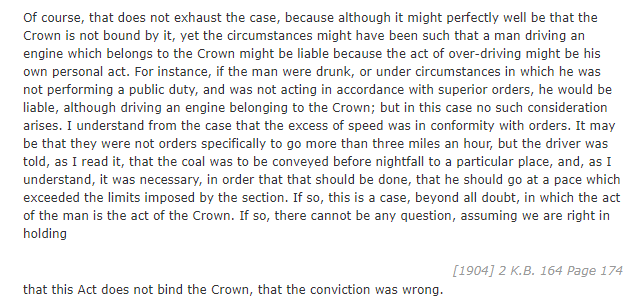
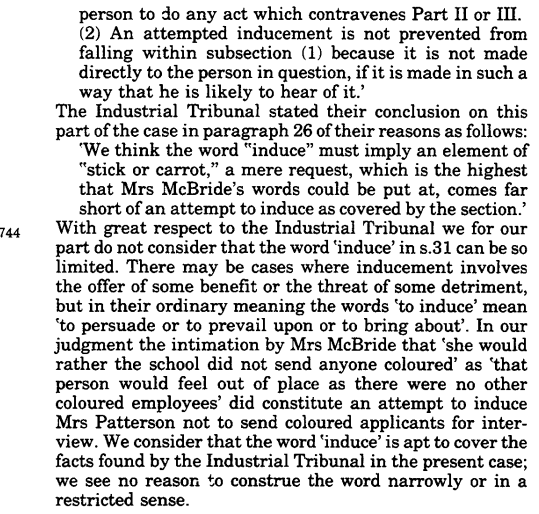
The tribunal held that this was a mere request and therefore not an inducement, primarily because no ‘stick or carrot’ was utilised by R. The EAT disagreed, saying:
15/21
15/21
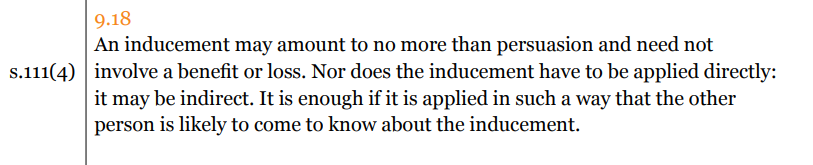
The EHRC’s Code of Practice, which courts and ETs are obliged to take into account, states that ‘an inducement may amount to no more than persuasion and need not involve a benefit or loss.’
16/21
16/21
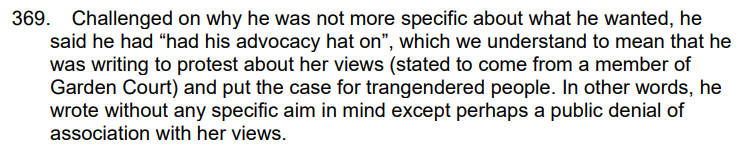
The complaint email was, at minimum, an attempt to persuade GCC to expel AB because of her protected GC beliefs. Medcalf himself said that he was writing with ‘his advocacy hat on’.
17/21
17/21
It did not matter that there was no stick (i.e. no threat to cancel SW’s Diversity Champion status). Since we are dealing with an attempt, it did not matter that the complaint email was not particularly potent in causal terms.
18/21
18/21
The control mechanism that Parliament chose in the EqA was that the person instructing, causing or inducing must be in a position to unlawfully discriminate against the person they are seeking to influence.
19/21
19/21
AB’s argument that SW was in such a position wrt GCC by virtue of providing services to GCC seems to have been at least tacitly accepted by the ET.
20/21
20/21
It might be said this sets the bar too low – that a relatively minor service provider role should not be the point on which SW's liability turns. The way to address that would be to amend the EqA rather than reading ‘attempting to induce’ in an unduly narrow way.
21/21
21/21
PS this is the complaint email in full:
allisonbailey.co.uk/wp-content/upl…
allisonbailey.co.uk/wp-content/upl…
• • •
Missing some Tweet in this thread? You can try to
force a refresh