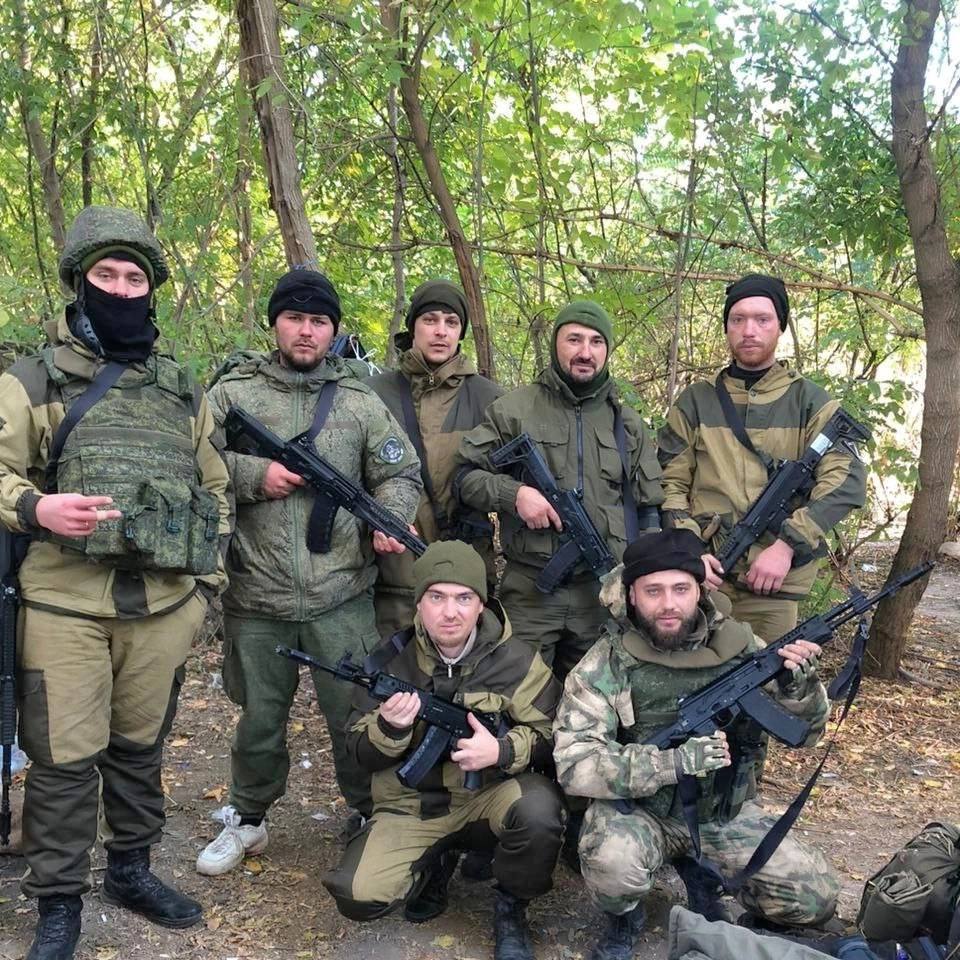
1/ Why do Russian soldiers break on the Ukranian battlefield? This third 🧵 in a series looks at at how their personal experiences of war have prompted some Russian contract soldiers to refuse orders, resign from their contracts and try to go home.
2/ For the first part, a look at the factors motivating ordinary Russian soldiers to fight in Ukraine, see below:
https://twitter.com/ChrisO_wiki/status/1552921299693064194
3/ In the second part, I've looked at the demoralising effect of inadequate training and lack of equipment for volunteers, as well as their supplies being looted before they even reached the front lines:
https://twitter.com/ChrisO_wiki/status/1553322172847951873
4/ It's worth noting at the outset that the nature of the Ukraine war is different from anything that Russia has experienced since the 1940s. Even those who have fought in the Caucasus or Middle East have never seen anything like the full-scale industrial war in Ukraine.
5/ The chances of becoming a casualty in Ukraine are far higher than in any of Russia's post-WW2 conflicts. On present trends, the Ukraine war is likely to become one of the deadliest conflicts globally in the last 200 years. washingtonpost.com/outlook/2022/0…
6/ In my first thread, I noted that many Russian soldiers are motivated by money, ideology, comradeship and/or experience. But none of those matters if you come back in a coffin. Motivation often falters in the face of certain death, especially if it's due to bad leadership. 

7/ I've been looking at the war through the eyes of Viktor Shayga, a Russian who volunteered to join the army as a contract soldier in March 2022. He entered Ukraine in early April and fought with the 752nd Guards Motor Rifle Regiment near Izyum, east of Kharkiv.
8/ Russia has suffered heavy casualties in repeated attempts to capture the villages of Sulyhivka and Dovhen'ke south of Izyum. After 3 months of fighting, Sulyhivka is still contested. (Video shows artillery destroying Russian armour in Dovhen'ke).
9/ Shayga's company consisted of 13 people, supplemented after a week by 13 more newly recruited volunteers who had been sent directly from Russia with minimal training. Before the group moved to the front line, they were given the option of refusing to fight.
10/ "In the morning, our regiment’s zampolit [political officer] arrived. He said we are going to Satan’s ass, so those who want can refuse right here at the farm, since later he won’t be taking anyone back if someone wanted to return.
11/ One man refused – praporshik [ensign] Vasiliy from Moscow. Everyone else went."
It wasn't a good sign that the unit's senior NCO didn't want to fight. Shayga later found that its starshina [first sergeant] also kept himself out of the fighting.
It wasn't a good sign that the unit's senior NCO didn't want to fight. Shayga later found that its starshina [first sergeant] also kept himself out of the fighting.
12/ Their first offensive action was an attempt to take the Ukrainian-held village of Dovhen'ke. However, they came under heavy bombardment as they entered nearby Sulyhivka and got no further.

13/ "As we walked, the Ukrainian army noticed us and started shelling us from Grad [BM-21 multiple rocket launchers] and mortars.
14/ During the second, rather massive shelling I already said goodbye to my life – I thought that was it, that the next bomb will either rip my legs off or kill me instantly. It was really scary."
15/ The aborted attack was postponed until the next day, 20 April. However, there was not much enthusiasm for it among the Russian soldiers.
16/ "Many company commanders in the two battalions of the 752th regiment told their fighters that we are being sent to a sure death, since the Ukrainians are well prepared."
17/ "So they said – decide for yourself if you want to go or not. Four fifths of us (if not more) refused to go. So did I ... because I simply had no physical energy to keep going into an assault."
18/ The regiment did find enough volunteers, but seem to have had no vehicles. Instead they walked 7 km – taking 6 hours – across the open countryside to Dovhen'ke, under constant mortar, shell and tank fire. Many were killed; many more were wounded, including Shayga's commander.

19/ "When we reported to our battalion commander Major Vasyura about dead and wounded, he cursed: ‘leave them and keep advancing!!!’."
20/ The inexperienced officers didn't know what to do and turned to one of the volunteer contract soldiers, a 40-year-old combat veteran, who said: "Guys, we need to fall back, otherwise we will be smashed with mortars and those who stay alive will be finished off".
21/ They retreated to Dovhen'ke, only returning at 23:00. "One of the volunteers, Andrey from Kursk who came together with me said that many simply ran off while retreating. He yelled at them to help pull out the wounded, but they didn’t help."
22/ "He said he wanted to grab an assault rifle and start shooting in their backs… Thus, the grenade launcher platoon commander, Captain Nikolaev who was dragged for 4 hours, died from blood loss."
The next day, almost everyone from Shayga's unit refused to join another attack.
The next day, almost everyone from Shayga's unit refused to join another attack.
23/ Other units attacked Dovhen'ke, but with no more success. In one attack, "8 tanks and infantry entered Dovhen'ke but decided to keep going rather than taking positions, so the tankmen went forward and almost all of them got hit, and then the infantry was also pushed out".

24/ Special forces (spetsnaz) and airborne units also attempted to take Dovhen'ke but were repulsed. A unit of trained reservists arrived and spent a month assaulting the village. "In total, 340 of them arrived in Ukraine. After a month of shelling only 57 remained."
25/ "Moreover, half of the survivors were at the headquarters. Most of them were wounded. They never had a single firefight, all the losses came from Ukrainian artillery fire."
26/ New volunteers were immediately thrown into the attack on Dovhen'ke when they arrived in Ukraine. By May, all of the officers had either been killed, wounded or were refusing to attack.
27/ "There were no more officers so they were picking the most hardened ones among the volunteers (ones who fought in Chechnya and Syria), appointed them as seniors, gave them radios and sent them to assault Dovhen'ke."
28/ In one failed assault, described in the Russian Telegram channel 'Military Informant', a group of volunteers was sent to assist a Russian company – normally about 100 soldiers – that was down to 20 infantrymen, 4 BMP infantry fighting vehicles and one tank.
29/ Fierce Ukrainian resistance pinned the Russians down and forced them to retreat. "The tank had not even begun to work on the positions of the Armed Forces of Ukraine, and the BMP distinguished itself only by shelling its own [side]." The plan of attack quickly failed.
30/ The unit's wounded commander was left in the village with only a grenade to blow himself up. Three Russians were killed. Every surviving Russian combatant was wounded. Not even veterans of the Donbas, Syria, Libya and Chechnya had experienced such intense combat before.
31/ Some of the shell-shocked remnants from the assaults, including Shayga, hitched rides on trucks back to Izyum. Others "scattered around the forests after those insane assaults by our unit."

32/ "They fled because they were immediately thrown into battle and they didn’t even know each other all that well. I’ve heard they now wander in the forests in small groups, not letting anyone approach them. If someone yells at them – ‘We’re yours!’, they start shooting anyway."
33/ Contrary to popular myth, the Russian army doesn't have WW2-style 'blocking units' which shoot deserters. Instead, Shayga says, "one of our PMCs [Private Military Companies = mercenaries] had an objective of collecting such people in the forests and fields of our area."
34/ (This was likely the notorious Wagner Group, whose soldiers were photographed in the forests east of Dovhen'ke in early June.)
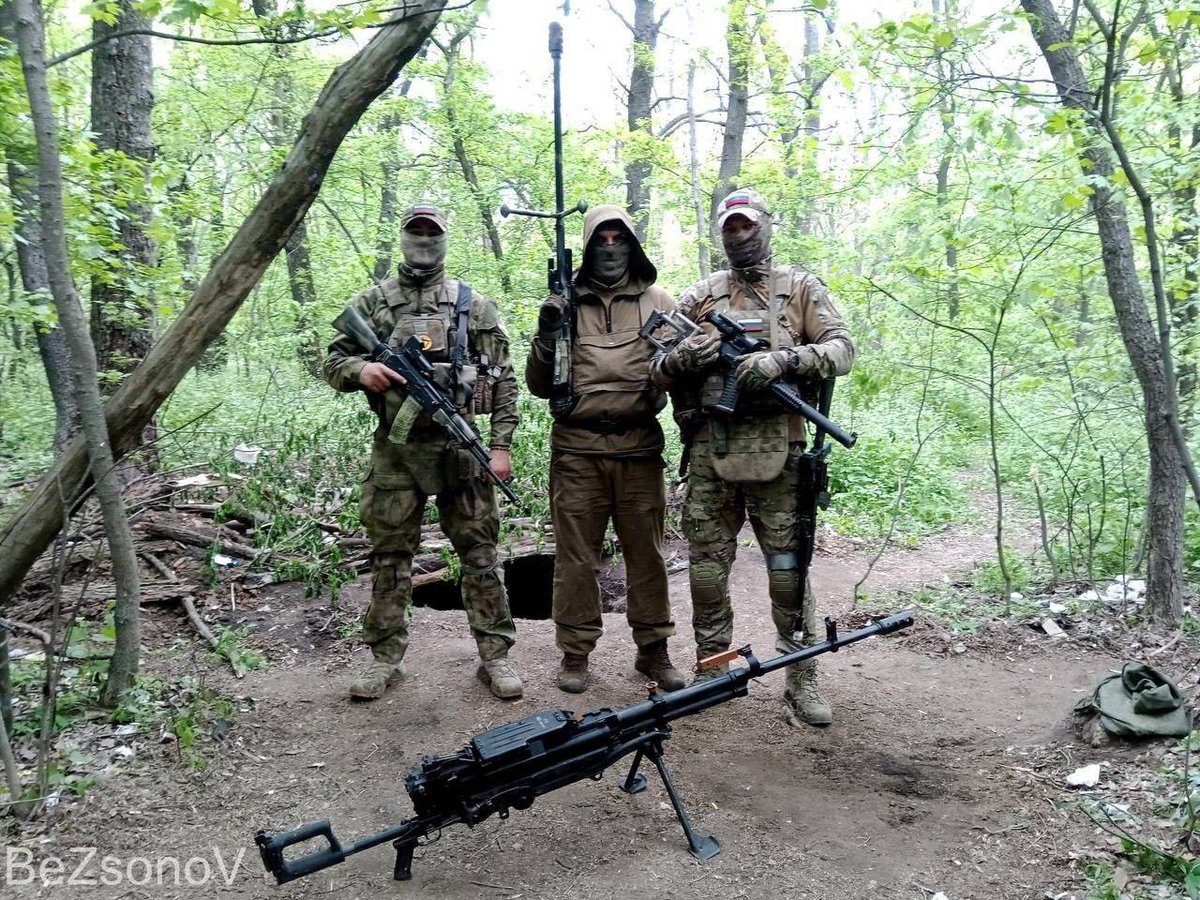
35/ "They picked up two of our guys in shrubbery near Sulyhivka… They fed them, gave them new uniforms, since after two weeks in Sulyhivka their uniform was completely worn out, and brought them to Izyum."
36/ Back in the rear, Shayga and other 'refusers' were used as a labour battalion. "We dug trenches, carried earth bags to reinforce division headquarters, sawed pines for dugouts. Nearly every day they were bringing new ‘refusers’ to us."
37/ A steady stream of arrivals with stories "even more tragic than ours" further demotivated Shayga and his comrades. Coincidentally, the Ukrainian authorities intercepted a phone call from another soldier of the 752nd GMMR talking about his experiences, likely at Sulyhivka:
38/ "There were 107 people [in my company], 10 remain. From them 4 have left, 6 of us have stayed. From the 1st platoon I’m alone left. In the 1st platoon we’ve had 22 people, I am the only one left."
39/ "There was an offensive here two days ago, 752 [regiment] were attacking the ukrops and 25 people died. 25. 25 fucking guys have died. Simply, 25 have died, all “200” [dead]. It’s a complete slaughter. Total ass. What they are telling you on the TV, don’t believe it, don’t."
40/ "It’s a complete ass here. A fuckload of dead, a fuckload of fucked up tanks, it’s a fucking ass."
One of these attacks was filmed by the Ukrainians. Reportedly 5 BMPs and an unknown number of Russian soldiers were destroyed by Ukrainian artillery.
One of these attacks was filmed by the Ukrainians. Reportedly 5 BMPs and an unknown number of Russian soldiers were destroyed by Ukrainian artillery.
41/ After so many failed assaults, the area around Dovhen'ke resembled a slaughterhouse. Shayga heard from troops involved in subsequent attacks that when they approached the village, "very close to it there are bodies of our dead soldiers lying around."
42/ "Some have already begun decomposing and swelling back then. Some also said they saw bodies of our dead piled up in shrubbery, some were also tied to the trees ... They said our wounded were in one of the trenches for three days and no one could pick them up."
43/ Not surprisingly, Shayga is contemptuous of his commanders' decisions – a common theme in many Russian soldiers' accounts of the war. In the next thread, I'll look at what Russian soldiers have said about their side's poor command, tactics and strategy in the war. /end
Translations provided by the estimable @wartranslated – if you're not following him, you should!
• • •
Missing some Tweet in this thread? You can try to
force a refresh