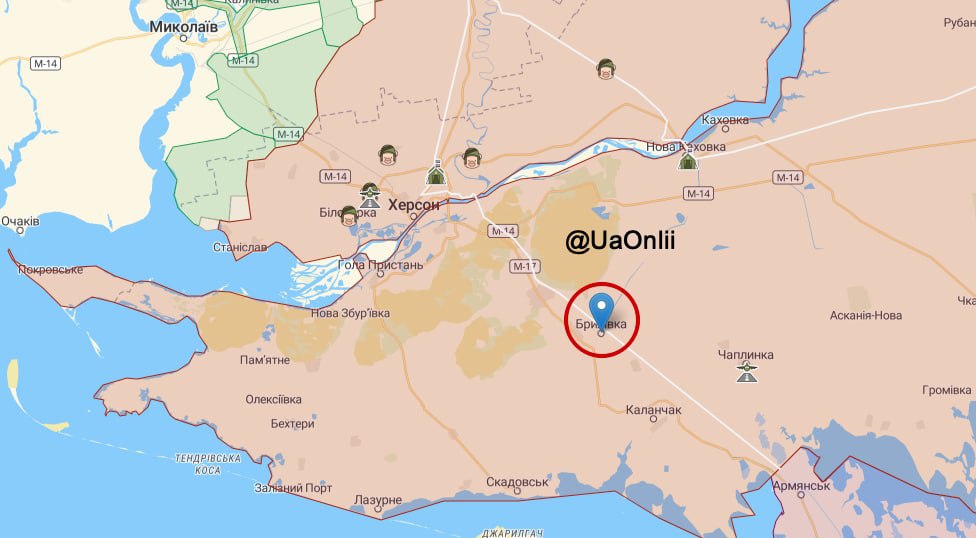
1/ Overnight news of a devastating Ukrainian HIMARS strike against a Russian ammunition train suggests to me that the Ukrainians have been rather clever in exploiting the limitations of the local rail network.
2/ The attack took place at Brylivka railway station, south-east of Kherson. Coincidentally, it's an area I remember from a visit many years ago. The whole area is a vast, flat, arid and frankly mononous farming region watered by irrigation canals.
3/ Brylivka owes its existence to the railway line, which was built in 1944 under Stalin to provide a second rail route to Crimea (the main line is further east, running from Melitopol to Simferopol). The village was founded the following year, presumably to house railway staff.
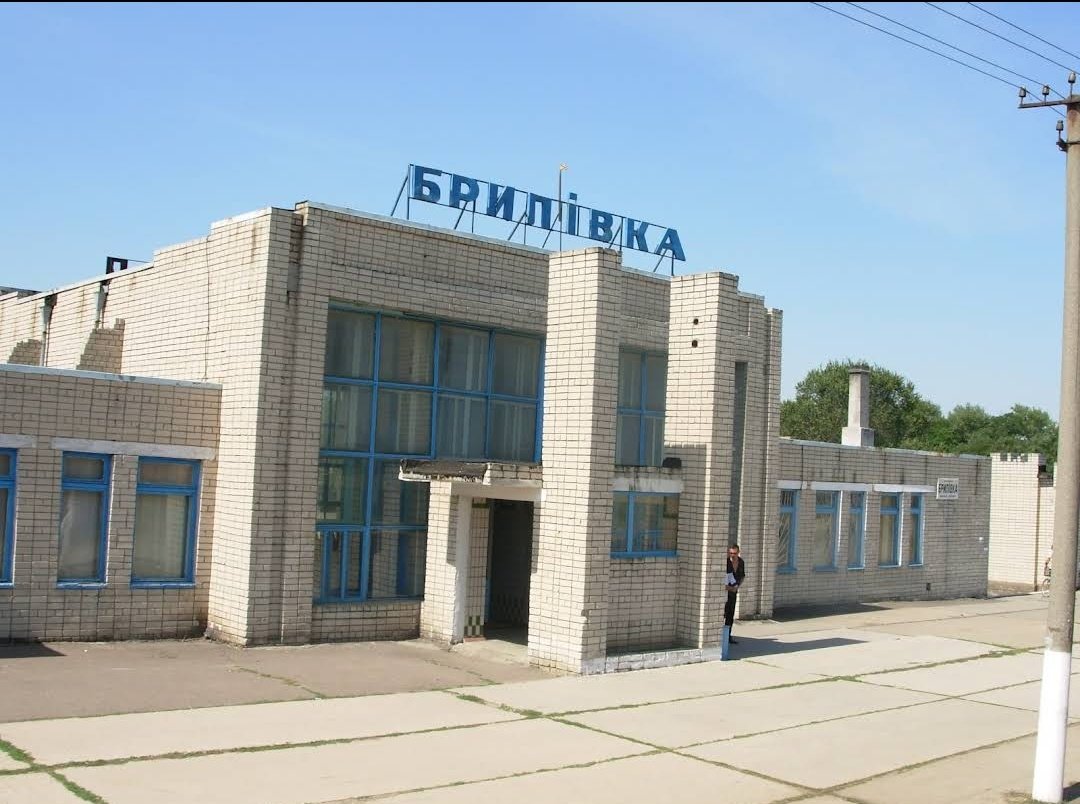
4/ But the line at Brylivka has three peculiarities. First and most importantly, the entire line from Kherson to Dzhankoy is only a single track line. Single track lines have a very limited capacity to carry trains. (Thanks to bueker.net for the map.)
5/ There had been a plan to upgrade the line to double tracks with electrification during the 2010s, but this fell through due to Russia's seizure of the Crimea in 2014.
6/ Second, Brylivka is equipped with a large set of passing loops (or passing sidings) which are long enough for large freight trains. Passing loops allow trains to pass in both directions on a single-line track. The Russian ammo train would have been stopped here.
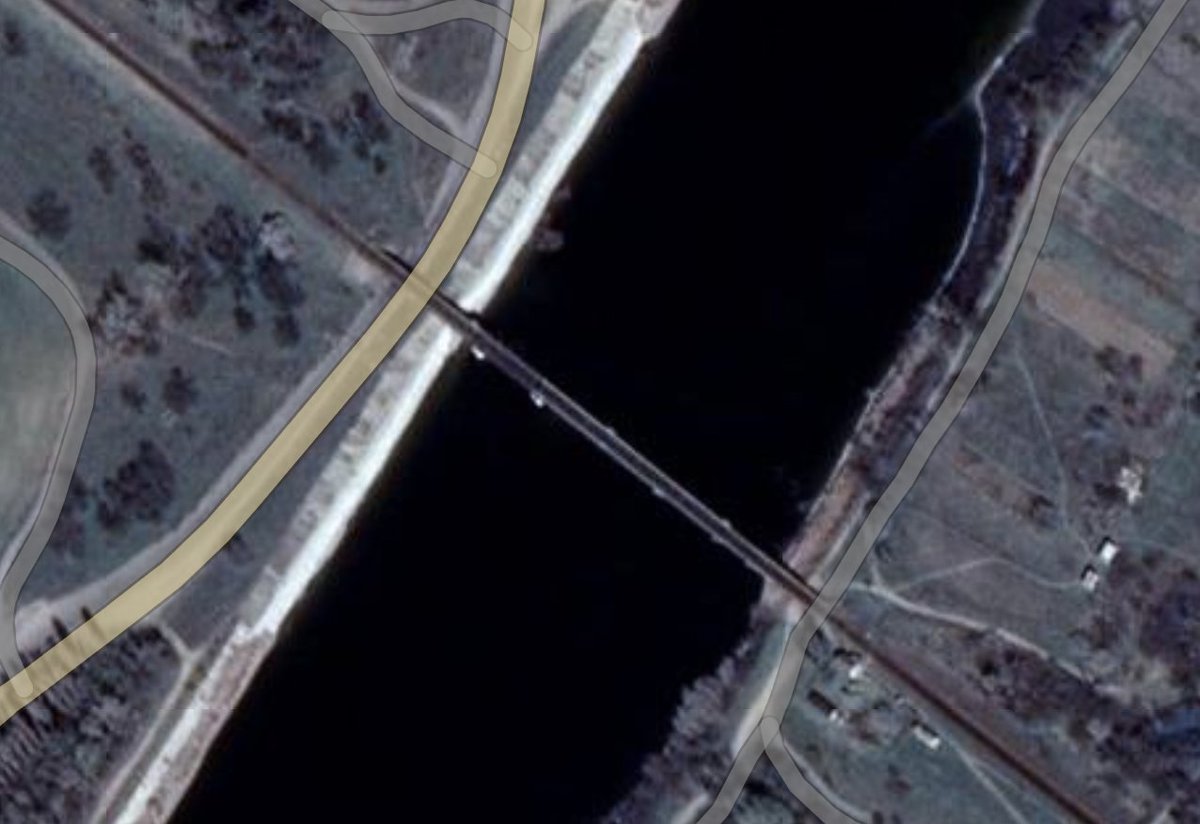
7/ Third, Brylivka is just south of the North Crimean Canal, which waters the entire area (and Crimea). The railway line crosses it on a single-tack bridge – given its strategic importance, I wouldn't be surprised if Mr HIMARS paid it a visit soon.
8/ The line has not been very busy in recent years. Russia's takeover of the Crimea meant that long-distance and freight traffic ceased in 2014. Prior to the 2022 invasion, it reportedly only had 2 passenger trains a day between Kherson and Vadim, the last Ukrainian-held station.
9/ However, given Russia's dependency on railways for its military logistics (as noted by @TrentTelenko and others), the Russians are likely to have been making heavy use of the line to resupply their forces in occupied areas of Kherson oblast.
10/ They have also within the last month reopened the line from Kherson to Dzhankoy for passenger traffic, though I would imagine the timetable will be somewhat disrupted now. ria.ru/20220630/melit…
11/ So I think it's likely that the Ukrainians could predict where the ammo train would be stopping, because the single-track layout of the line likely required a stop at Brylivka's passing loops.
12/ The damage at Brylivka certainly looks severe, though I would imagine the Russians will be able to repair the track within a few days. But there's nothing they can do about the track's layout.
13/ Whatever else happens, the track is likely to remain single, there will continue to be a need for a passing loop at Brylivka, and trains will continue to need to stop there to allow other trains to pass. So this vulnerability isn't going to go away. /end
• • •
Missing some Tweet in this thread? You can try to
force a refresh

1/ Why do Russian soldiers so often try to freeze or play dead when a drone approaches, in the apparent hope that it won't notice them? Russian warbloggers explain that instructors teach them to do so, based on outdated and incorrect assumptions. ⬇️
2/ As Svyatoslav Golikov puts it, the tactic reflects "the instructor sect of witnesses of freezing, which gave birth to the heresy of the pillars of salt, [which] is now also churning out dead possums...
3/ "If soldiers have been frozen like statues on a postcard time after time for months, it means they were fed a single instruction: freeze if you see or hear a kamikaze. Regardless of any circumstances whatsoever. Just freeze.
1/ In fact, not even North Korea does this. The last country to name a warship after a living leader was the Soviet Union with the 1982 Kiev-class aircraft carrier Leonid Brezhnev. This was during the final phase of the Brezhnev cult of personality.
2/ Even for authoritarian states and dictatorships, this is highly unusual. The Kriegsmarine never named a major ship after Adolf Hitler. Imperial Japan had a major taboo against naming ships after living people. No Soviet warship was named after Stalin.
3/ As far as I'm aware no country has *ever* named an entire class of warships after a living leader - not Nazi Germany, Fascist Italy, North Korea, Communist China, or the Soviet Union. So this would be genuinely new ground in terms of state-sponsored sycophancy.
1/ A Russian soldier says that only the "marginalised" – drug addicts, the homeless and the destitute – are joining the Russian army these days . He says that the war continues because people in Russia profit from it and that its aim is to "dominate and humiliate" Ukraine. ⬇️
2/ Former Wagner soldier Ruslan from Dagestan, who is now serving under contract to the Russian Ministry of Defence, tells a friend that many soldiers lack motivation because the goals and reasons for what's happening are unclear to them.
3/ "You ask questions that I don’t have answers to, because even when you ask yourself these questions, you ask yourself: why the fuck am I here? You're trying to find an answer in your head, but there's no answer."
1/ A shadow war is being fought over the Russian army's access to Starlink. The Russians face a constant battle with Starlink itself and Ukrainian hackers deactivating their terminals, and obstruction from the Russian customs service holding up grey imports of Starlink devices.⬇️
2/ Starlink is banned from being exported to Russia, but can be obtained unofficially through grey imports from Central Asia and China. Most Starlink terminals used by Russian forces are obtained by volunteers and shipped across Russia's southern land borders.
3/ However, they are vulnerable to disruption by Starlink itself, which periodically disables terminals located in Russian-held territory, they are targeted by hackers, and the very slow and cumbersome Russian customs process holds up imports for long periods.
1/ When Russia invaded Ukraine in February 2022, the town of Irpin, just west of Kyiv, was the closest that Russia reached to the capital. Its soldiers targeted Christian facilities in the town, destroying buildings and burning Ukrainian-language Bibles in the street. ⬇️
2/ One of the buildings targeted by the Russians was the Field Ministries Training Centre of @MissionEurasia, an international Christian organisation based in Wheaton, Illinois. The group trains missionaries throughout the former Soviet Union and provides humanitarian aid.
3/ After the Russian army reached Irpin on 6 March 2022, the Mission Eurasia training centre was reportedly taken over by Russian special forces, who used it as a barracks and stacked Bibles to barricade windows.
1/ 790 Russian soldiers from a single unit have died at Pokrovsk, according to a Russian combat medic, with another 900 having deserted according to leaked figures. Another soldier from the same unit says that losses are running at 80-90%. ⬇️
2/ The unnamed medic says that she is serving with the 39th Separate Guards Motorised Rifle Brigade (military unit 35390) at Pokrovsk. She describes how she was on the front line with "young guys" aged 19 or 20:
3/ "They were running around, and we had dugouts, I think. And I say No, no, fuck that. They ran, in short, into a Ukrainian minefield and it just tore them apart. Well, it's not like they were 200, dead, none of them died. Well, they were just blown up really badly.