
1/ A 34-year-old former Russian paratrooper, Pavel Filatyev, has published a remarkable in-depth account of his experiences of the Ukraine war. He served with the Feodosia-based 56th Guards Air Assault Regiment and fought in southern Ukraine for two months. A 🧵 follows. 
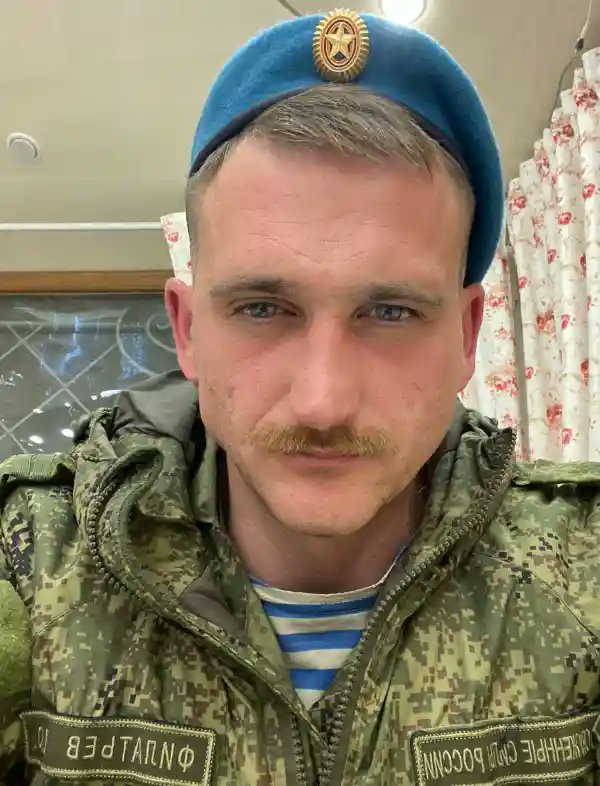
2/ Filatyev was part of the force that captured Kherson in February and was hospitalised with an eye injury after spending more than a month under heavy Ukrainian artillery bombardment near Mykolaiv. By that time, he was completely disillusioned with the war.
3/ While recuperating, Filatyev wrote a scathing 141-page memoir titled 'ZOV' (after the recognition symbols painted on vehicles of the invasion force) and published it on VKontakte (Russian Facebook). Not surprisingly, he's now been forced to flee Russia for his own safety.
4/ I've previously covered Russian soldiers' accounts of their experiences in Ukraine (see below), but Filatyev's is by far the longest and most detailed yet published. No full English translation yet exists AFAIK, so I'll summarise various points here.
https://twitter.com/ChrisO_wiki/status/1556386752524320781
5/ In this first installment, I'll cover FIlatyev's experiences in the six months before the war, when he was going through training as a paratrooper in Crimea with the 56th Guards Air Assault Regiment. It was not a happy experience for him.
6/ Filatyev comes from a military family. After an earlier period of military service, he rejoined the Russian Army in August 2021, joining his father's old unit. Although it was theoretically an elite unit, he found that the soldiers' living conditions were terrible.
7/ He found there were no beds in his company's barracks, which were infested by a pack of stray dogs fed by the dining room staff. He avoided a nearby hostel which he was advised was a "sewer". Another company found a bed for him in their barracks, which lacked a power supply.

8/ Eventually, Filatyev moved to a cheap hotel when Crimea's holiday season ended. As he later wrote, "I had to run like a homeless man from one barracks to another, looking for a bed to sleep in, until I found a place to rent at my own expense [after] 3 weeks."
9/ He also found the unit's food was appalling: "there is not enough food for everyone, the potatoes in the soup on the water are raw, the bread is stale". Basic hygiene was difficult because the water supply was interrupted, resulting in a lack of working showers or toilets.

10/ Filatyev spent ten days waiting for a uniform before being given a summer outfit but no shoes in the right size. In the end, he went out and bought his own. (This is a common situation often resulting from supply chain corruption).
https://twitter.com/ChrisO_wiki/status/1531716477581250560
11/ During his previous military experience, Filatyev had received substantial training in theory, tactics and physical training. He expected to get improved training following Russia's much-vaunted military reforms in the 2010s, but found that the reality was very different.
12/ The company commander was largely absent. The unit's young political officer attempted on his own initiative to give lessons in tactics. One day, the company went to the firing range for target practice, but the training session was a fiasco.
13/ "[We] get up at five in the morning, spend three hours lined up and waiting for the truck, we finally go, we arrive at 12:00, line up, stand, the commanders at the range do not like the way some piece of paper is filled out, the major tears up the sheet and throws it ..."
14/ "He yells with hysterical cries that there will be no firing because of this, the whole company stands and contemptuously looks at the hysterical major with sympathy for the young starshina [sergeant major] who is being discouraged from taking any common-sense initiative ..."
15/ Finally, at 13:00, the target practice got underway in searing midsummer Crimean temperatures. "The heat is 50+, there is no water, we initially drove until lunch, now it turns out that we are here for the whole day, plus night shooting [until] one o'clock in the morning".
16/ The soldiers finally returned to their base exhausted, dehydrated and famished, having only had one dry ration pack for each 3-4 men. As Filatyev comments, "This is not hardening of the body, this is nothing more than sabotage of one's own army."

17/ There was a lengthy delay before any parachute jump practice was organised. In the meantime, a mass COVID outbreak in the unit was dealt with by having positive results "miraculously disappear[ing] somewhere in everyone's tests" despite many soldiers not being vaccinated.
18/ With the onset of winter, the soldiers were given worn-out winter uniforms of the wrong sizes. Filatyev got into trouble by complaining, but in the end privately purchased a jacket for his own use (likely one that had previously been stolen and resold by corrupt depot staff).
19/ Parachute jump practice finally took place in November 2021, but it was another fiasco. Several days were wasted packing parachutes "from morning until 21:00," as it turned out that half of the company did not know how to do it.

20/ The soldiers set off for their jump practice at 02:00 in sub-zero conditions, travelling on open-top trucks. They spent five hours "jumping on the spot ... to warm up somehow". When they jumped, Filatyev found that the drop zone had mistakenly been centred on a cemetery.
21/ Fortunately, Filatyev writes, "it's good that the weather was good, everyone taxied out, no one landed on a cross or anyone's grave." But after he got back to base, he found that he had contracted pneumonia in both lungs, with many comrades also falling ill.
22/ He was sent to a military hospital where he spent a week recovering. While there, he found that his company commander had attempted to cover up his stay in the hospital, presumably to avoid awkward questions about why so many of the unit's members fell sick at once.
23/ By this time, Filatyev was fed up. He wrote a detailed complaint to the Russian Ministry of Defence (MOD) outlining the many violations of regulations and the poor military ethos that he saw, as well as the almost complete lack of training provided to the troops.
24/ "An atmosphere of apathy reigns among contract servicemen," Filatyev complained, "and 90% of them are discussing in the smoking rooms how to finish their contract as soon as possible ... I also heard from a number of officers that they don't want to serve here."

25/ There was also little esprit de corps among the men. "The Russian and airborne unit flags [looked] as if they had gone through a war (only a fortnight ago they were replaced) and the unit staff ... patched them up because there was already a hole in the hole".
26/ The unit raised the flags every morning accompanied by the Russian national anthem, but as Filatyev notes sardonically, "half the servicemen do not sing it". He wrote that "the duty and anti-terrorist units are on duty only on paper" and did not attend morning roll calls.
27/ Filatyev told the MOD that what he had observed over the past 3.5 months "horrifies me ... in fact, I see complete anarchy, there is only a faint hint of combat readiness, [and] I hear a lot of ridicule among the local population about Feodosia VDV [airborne troops]."
28/ Things got worse when Filatyev's unit was reorganised just before the war (in December 2021), becoming the 56th Guards Air Assault Regiment. But it was a regiment only in name, consisting of 2 battalions and a reconnaissance company equivalent in numbers to a platoon.

29/ The units were grossly undermanned on the eve of the war. His own 2nd Airborne Assault Battalion consisted of three companies of 45-60 people each (165 in total), and the amphibious assault battalion also consisted of 165 people. But on paper they had 500 people.
30/ Filatyev blames widespread corruption and a system of photo reports, which enables commanders to hide problems, for this situation. He suggests that as few as 100,000 Russian troops may have invaded Ukraine in February (despite paper numbers of at least 200,000).
31/ When the new regiment was formed, the deputy commander of the Airborne Forces arrived to carry out an inspection. Instead of training, "we stupidly fucked around all day, as usual, instead", lining up uselessly for 7 hours while the officers inspected the regiment's vehicles.

32/ "All this [equipment] is a hundred years old, a lot is not working properly, but on their reports everything was probably fine and this was two months before the special operation." The general showed no interest in the men standing in their worn-out "scarecrow" uniforms.
33/ Filatyev's complaint to the MOD led only to retaliation from his own commander, who was rumoured to have tried to file a criminal complaint against him. Some officers told him that they supported him, "saying that all this is certainly true, but it is useless to complain."
34/ Not surprisingly, Filatyev writes, by January 2022 "the desire to serve has disappeared completely. I realized that our combat capability, to put it mildly, is not very good, we do nonsense, useless chores, dressing up or pretending to have classes".
35/ He concluded that "the Russian army is in a madhouse and everything is for show", despite some people still wanting to make something good of it. He blames middle-ranking career officers "who do not want to lose it all (they are the ones who keep
the rotten system)".
the rotten system)".
36/ In the next installment, I'll cover Filatyev's experiences immediately before and just after the start of the invasion in February 2022. /end
(See below for a link to the original account in Russian.) vk.com/doc365182800_6…
• • •
Missing some Tweet in this thread? You can try to
force a refresh






