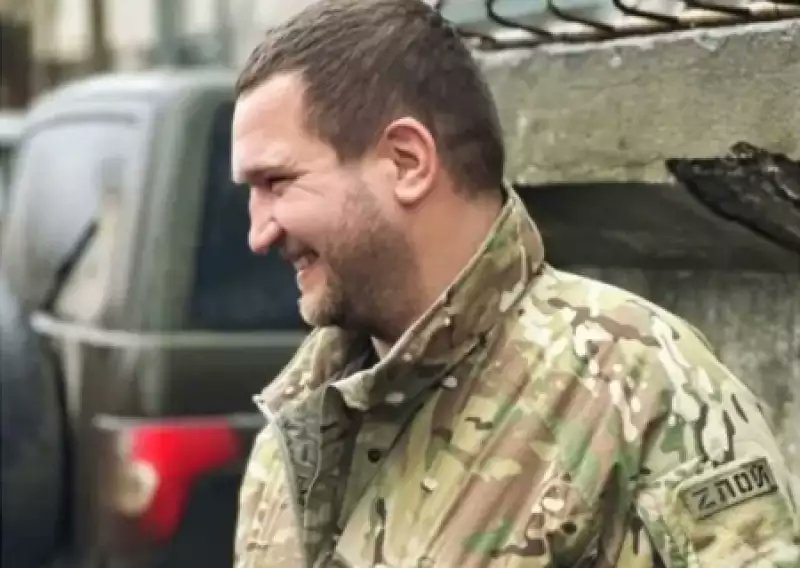
1/ After a hellish month under bombardment in the trenches of southern Ukraine in March-April 2022, Russian paratrooper Pavel Filatyev suffered an eye injury and was evacuated to hospital. This 🧵 describes how he became an anti-war activist after learning why Russia went to war. 
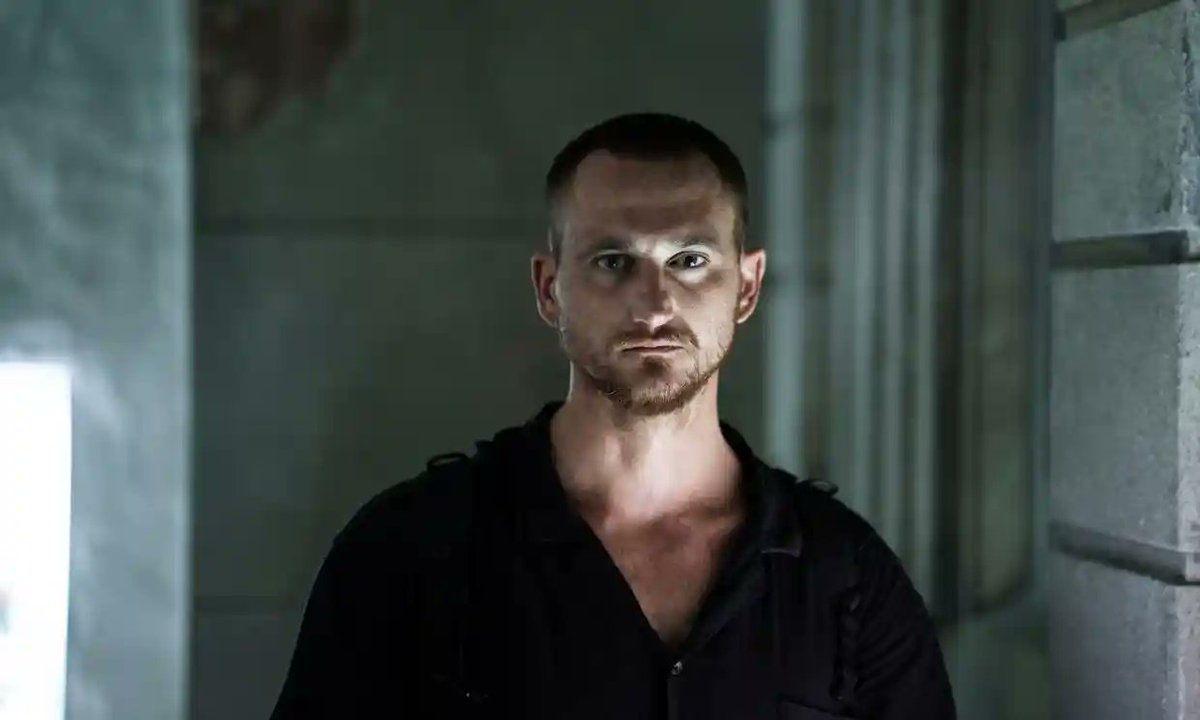
2/ For the first part of Filatyev's story, covering the six months he spent in training with the 56th Guards Air Assault Regiment in Crimea before the war, see the thread below:
https://twitter.com/ChrisO_wiki/status/1560022545356791810
3/ The second part, covering the period immediately before and after the invasion was launched on 24 February, is here:
https://twitter.com/ChrisO_wiki/status/1560355153441705984
4/ And for the third part, highlighting the haphazard and disorganised Russian takeover of Kherson in the face of even less well organised Ukrainian resistance, see below:
https://twitter.com/ChrisO_wiki/status/1560725596765913089
5/ The fourth part deals with Filatyev's experiences of the start of the occupation of Kherson and Russia's disastrous attempt to take Mykolaiv and Odesa:
https://twitter.com/ChrisO_wiki/status/1561024849245573123
6/ Dirt from a nearby shell explosion led to Filatyev contracting keratitis in mid-April 2022, resulting in his evacuation to a military hospital in Sevastopol. Paramedics at the front line had been unable to treat him, or for that matter anyone else, due to a lack of supplies.
7/ The paramedic who authorised his evacuation "asked me to tell the medical unit that he doesn't have any syringes and painkillers, there's not even that on the front line". Filatyev notes that Russian first-aid kits included only a tourniquet, bandage and Promidol tablets.

8/ Leaving the front line brought to an end "two months of mud, hunger, cold, sweat and the sensation of death." He travelled with 20 others on a five-hour bus journey back to Crimea. "The feeling you get when you leave a war zone is indescribable," he wrote.
9/ For Filatyev, "it was at that point that I finally relaxed and thought about the last two months of my life, what it was all about, why I needed it, whether I'd done something good or bad, why I was part of it and how and why I was there in the first place."
10/ The evacuees were met by a medical detachment "mainly consisting of Dagestani women who greeted us with warmth ... One could feel the care and compassion from these women, it was a very strange and already forgotten feeling."
11/ The hospital where Filatyev was taken "was fresh, quiet and cozy, after the trenches it seemed to me that it was better than in hotels like the Radisson or Hilton." He was evaluated and transferred to another, much older, hospital for treatment along with other casualties.
12/ Filatyev was struck by the difference between the two facilities. The Soviet-era hospital was shabby and run-down with one toilet between 40 patients. "There's a massive shortage of doctors in the old, ramshackle hospital, full of wounded in the corridors."
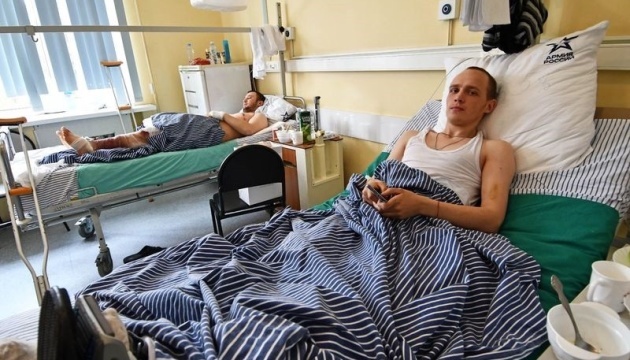
13/ The propaganda he saw on Russian TV in the hospital contradicted his own experiences and those of his fellow wounded. "Watching the news on TV, I could not understand why there is no truth there, the war is almost sanctified and I do not see any objectivity."
14/ He watched the news about the sinking of the missile cruiser Moskva with a survivor. The TV news claimed it had sunk after an accidental explosion, but the sailor told FIlatyev that "two [missiles] hit the hull, the ship began to burn, the crew were evacuated, but not all."
15/ After being discharged from the hospital, he was sent to a barracks for the recently wounded. "There were a hundred people there who had returned from the war and were coming undone after what they had experienced."
16/ One man, a BMP-3 driver, was the sole survivor of a Javelin strike. "The little guy stuttered terribly, uttered one word in 5 to 10 seconds, he said that they wanted to send him to the nuthouse, but he fought back, wrote a refusal of medical assistance and is going home."

17/ The injured soldiers received 3 million rubles ($50,000) each in compensation for their wounds, a payment they derisively nicknamed "Putinskimi". Many spent the money straight away on prostitutes and alcohol, "blowing 100 grand a night (some don't go home for up to 10 days)".
18/ Filatyev was granted two weeks' leave on condition that he return "to save the Nazi-occupied Ukraine". He still felt unwell, with many pains in his body, and his injured eye was still not working properly. He went to a private hospital and paid for another examination.
19/ He was diagnosed with hernias, various musculoskeletal problems and neurasthenia. But the reality was that "in the military hospitals, this is generally considered healthy, they won’t treat it." So he had to pay for medical treatment and medicines at his own expense.
20/ "For two months I tried to get treatment from the army, went to the prosecutor's office, went to the command, to the head of the hospital, wrote to the president. No one cares, no one helped. No insurance, no medical treatment."
21/ He attempted to transfer out of the airborne forces on health grounds but was refused. Eventually he decided to approach the Medical-Military Commission (VVK) for a medical discharge. But this was not successful either.

22/ "After I submitted my documents and went to the doctors, no one sent me an appointment for a medical examination for a month. As a result, they say that they lost my documents ...
23/ "The command said that I was evading service and sent the documents to the prosecutor's office to initiate a criminal case, not caring that they were preventing me from going through a medical examination."
24/ Filatyev blamed his problems on his unit's political officer, who had also ended up in hospital after drunkenly crashing his vehicle. "Just yesterday, he got cocky with impunity and just stood there in front of everybody, stood there and said he didn't care ..."
25/ "Apparently they've been given carte blanche from above. Their goal, for the sake of a new star [i.e. promotion], is to throw as many people back [to the front lines] as possible, albeit without training or equipment."
26/ Filatyev had largely been cut off from information while he was at the front. Now, "gaining access to the telephone and Internet, I greedily absorbed information from everywhere." But he found that "our federal sources were dry and hiding the truth about some other reality."
27/ Filatyev felt an "internal dialogue of a cocktail of conscience, patriotism and common sense". He was angry at bloggers and YouTubers saying that they were ashamed to be Russians and ashamed of Putin's army. "We are not Putin's army, we are the army of Russia", he writes.
28/ "We swore an oath to the Russian people, and ... if you can't get your shit together and go with other people to demand the government (which you elected) abolish the war, then all this shit is on your hands too. Russia is not Putin, Russia is people with RF passports."
29/ "Where were you while we were dying, maimed and suffering deprivation? Where?! You were afraid for your comfort and you couldn't come out to the administration building and say "No to war!" for fear of getting an administrative penalty."

30/ Filatyev also systematically rejects the Russian government's justifications for war. Finland was joining NATO, Japan claimed Russian territory, Turkey had shot down a Russian plane, yet Russia had not attacked any of those countries.
31/ Ukraine was also on the defensive in the Donbas. "So it is not true that Ukraine was going to attack Russia either." He did not blame the Ukrainians for opposing the region's separatism. "[What if] Karelia wanted to become part of Finland, ... Yakutia to the USA?"
32/ Filatyev rejects the claims of Ukraine being under 'Nazi' rule. None of the people he had met in Ukraine before the war "could remember a specific case of someone being hurt or humiliated for having a Russian surname or not being able to speak Ukrainian."
33/ "Communicating with people who escaped from the war in Donetsk and in Lugansk, I have not heard any cases of Nazism that are being shouted about in our media. But they all said that they were fleeing the war and that they just want to live and work in peace."
34/ By now, Filatyev no longer wanted to fight. "Back in Russia I struggled with the strange feeling that I was against the war and that I felt sorry for the people of Ukraine and that I was drawn back, because the most real life opens up in front of in the face of death."
35/ "When you know that at any moment you'll be gone, only at that moment do you understand what life is and how beautiful the world is. I was ashamed to be safe while others sacrifice themselves ..."
36/ "We've all become hostage to many factors, such as revenge, patriotism, money, duty, career, fear of the state." Filatyev condemns the "rabid ones" of both sides who were calling for the destruction of Russia or Ukraine, such as the Russian TV host Vladimir Solovyov.

37/ "The propaganda on both sides only adds fuel to the fire by openly calling for us to destroy each other... Wake up, we are human beings, we are Orthodox, we are not different, we are not enemies, we are pitted like dogs in the arena and we feel the blood and we can't stop!"
38/ "Now is the moment when we have to tell the truth, and the truth is that the majority in both Russia and Ukraine do not want to kill each other. And while this majority sits in silence, more and more people are drawn into the war."
39/ He blames the war on those responsible for Russia's notorious kleptocracy. "All they can do is send their children and mistresses to study and live in the West! Get citizenship there and enjoy real justice there! They want everything that is there!"
40/ "But they are not able to create anything like this in Russia, all they did was plunder and plunder the country, thinking only of themselves! All these reforms and initiatives served only to enrich those who controlled the budget."
41/ Filatyev also appeals to Christian values to oppose the war. "I believe in God, but I do not see God in our [Russian Orthodox] church, which has forgotten the main commandment “Do not kill” and blesses us to kill our Orthodox brothers."

42/ "We had no moral right to attack another country," Filatyev concludes, "especially the people closest to us ... Russian roots are from Kiev, Ukrainians and Russians are the same people, we have many family ties."
43/ "That is why we were hated by everyone in Ukraine, because the betrayal of a 'relative' is much more painful than an outsider." He explains his decision to write his memoir as being necessary to "voice what I think".
44/ "I realise that this gesture of peace will cost me dearly, but I can't shut up my conscience. I'm sure a 'just' court will give me up to life in prison, tell me I've been bought and I'm an agent of the West, but I can't look at it all in silence anymore."
45/ He concludes his memoir with the slogan "НЕТ ВОЙНЕ!" – "NO WAR!".
46/ In the next and final instalment, I'll look at Filatyev's detailed comments on the Russian military system, which provide an interesting insider's view of what's gone wrong with the Russian army and has led to its catastrophically poor performance in the war. /end
Part 6 is here:
https://twitter.com/ChrisO_wiki/status/1561785870163787780
• • •
Missing some Tweet in this thread? You can try to
force a refresh