I and my colleagues have been extracting data from Russian media and social media to understand how both propagandists and social media users discuss the war. The first report is out. Two more will be published later. Some preliminary observations (15):
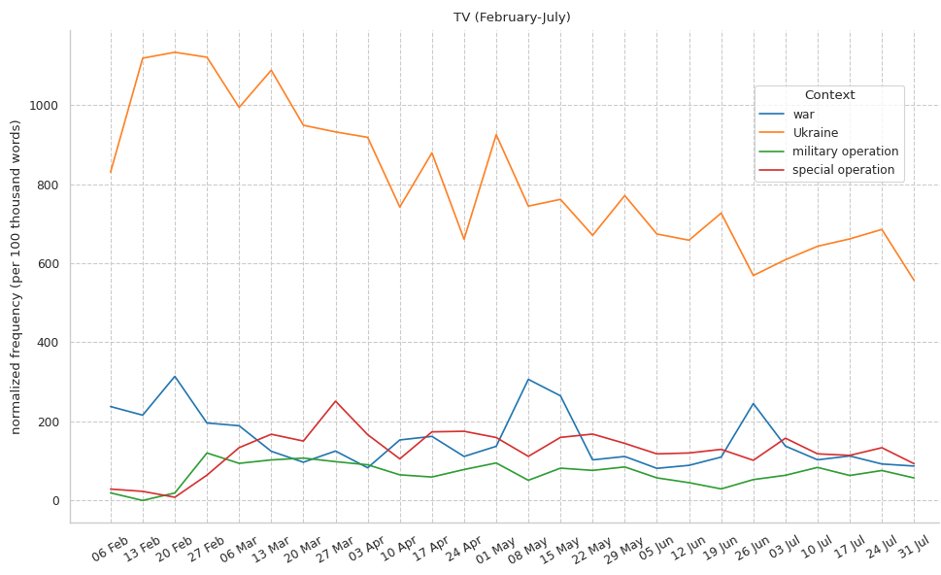
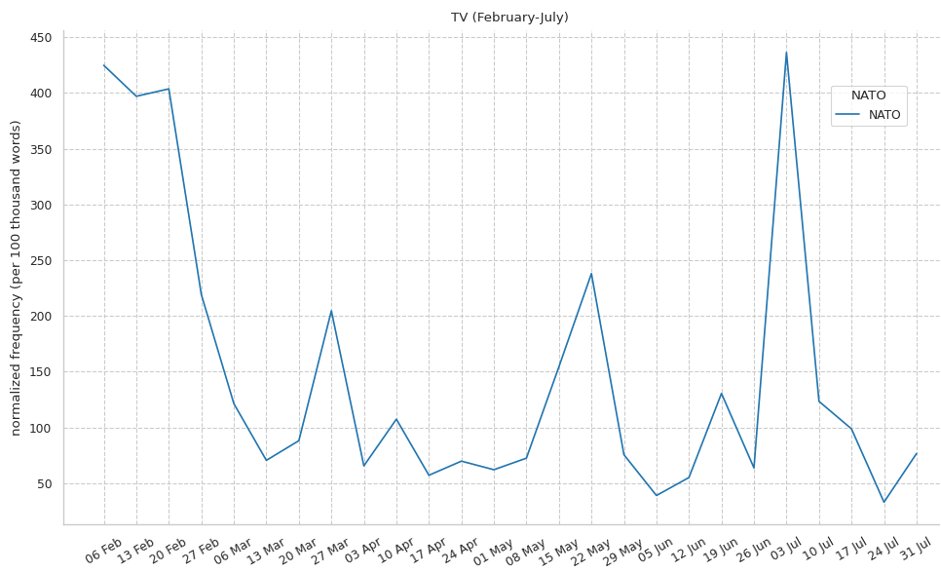
1/ The number of stories about the war on TV has been decreasing since Feb. Still a lot of propaganda, but twice less than in Feb-Mar. The key justifications for the invasion - ‘demilitarization’, ‘denazification’, NATO expansion, Donbas people - are discussed less and less.
2/ ‘Demilitarisation’ and ‘denazification’ used by Putin to legitimise the invasion were frequently used on TV in the beginning of the war to be abandoned by mid-March.
3/ This is not something new. As others report, people were struggling to comprehend the meaning of these words, let alone to embrace them. Some officials can still use them out of inertia, but in general propagandists have failed to explain them and abandoned them.
4/ Other justifications - Donbas people and NATO - are more persistent. Protection of the Donbas people was and is used more frequently than others justifications. The number of references to NATO is lower compared to Feb as well except for the NATO summit in June.
5/ The use of the word ‘war’ is a subject to criminal liability. However, TV propagandists routinely use it! Just not in the way we expect them to.
6/ The war in Ukraine - the one fought by Russia with tanks and missiles - is mentioned rarely. Instead, TV channels discuss other ‘wars’ waged by the West against Russia - ‘information war’, ‘visa war’, ‘sanctions war’.
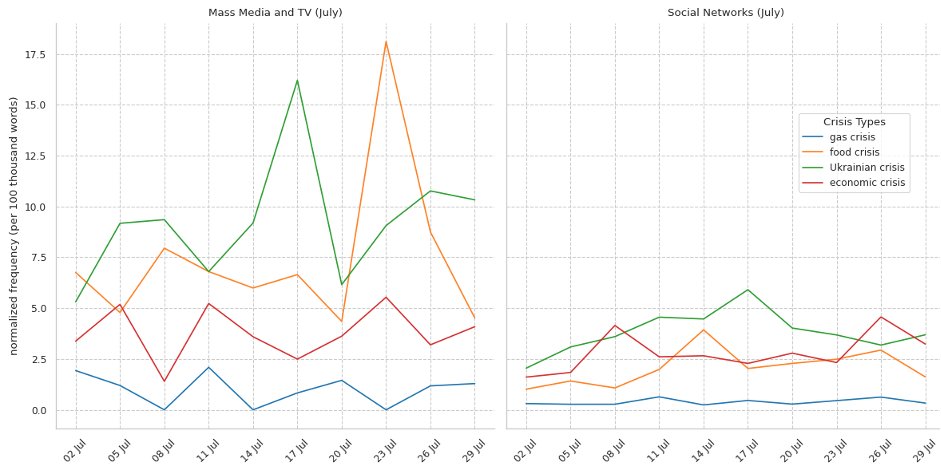
7/ The same with ‘crisis’. Considering deteriorating economy, you would expect them to pay some attention to economic issues. They do. But not to Russia’s economic crisis! They are discussing ‘food crisis’, ‘gas crisis’ - the challenges faced by other countries, not Russia.
8/ We call these crises and wars ’spoiler crises’ and ‘spoiler wars’. Russian TV channels endow words that seem undesirable with new meanings appropriating the vocabulary of critics.
9/ How about social media users? Both TV and social media users are equally interested in Ukraine. However, as noted by many before, the discussion is much freer on social media despite criminal liability for the word ‘war’.
10/ Despite the attempts to portray the ongoing events as a limited operation, social media users discuss it as a war. Judging by manually verified messages, this is also typical for supporters of the authorities.
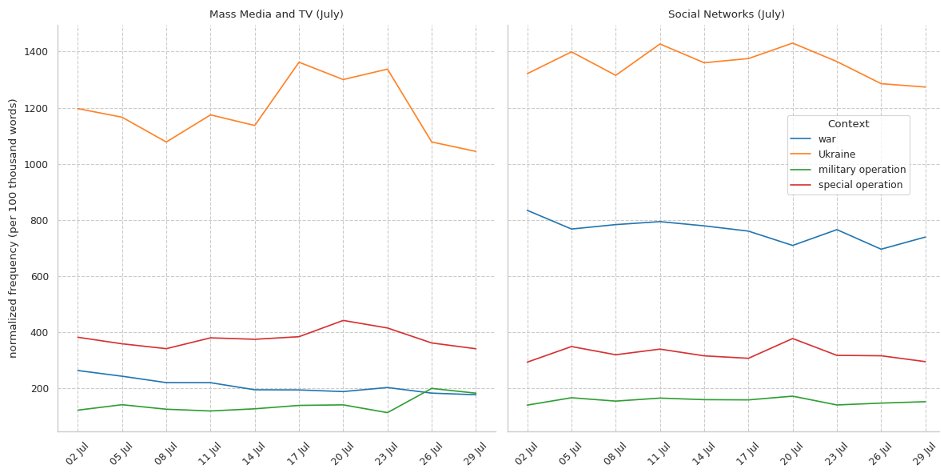
11/ Users are also not very receptive to the official justifications. ‘Demilitarisation’, ‘denazification’, etc are less frequent. Except for the spike in July when a high-level official made a highly quoted statement in response to threats to destroy the Crimean bridge.
12/ Social media users are also less receptive to the rhetoric of ‘spoiler crises’ and discuss economic consequences less.
13/ However, they are quite receptive to polarising hate speech - especially the term ‘fake’. Since social media is a space where verification of information is a challenge, the language of ‘fakes’ spread by propaganda finds fertile soil in social media discussions.
14/ We used Scan Interfax for media (16k messages) and Brand Analystics for social media (408k messages). BA does not scrap data post factum, so no social media data for Feb - Jun. SI can’t scrap data from blocked media, so mass media corpus is skewed towards pro-regime media.
15/ Social media corpus includes only users who indicated Russia as a location. It helps to exclude Russian-speaking users from other countries, but heavily skews the corpus towards Russian domestic social media (Vk, Odn, etc)
Due to pro-war bloggers, Telegram is often seen as the main 🇷🇺 social media. However, it is only one pocket of the vast Russian media space! @Makarmia, @semenaff, and I have analysed how users discuss the war and mobilisation across Telegram, Vkontakte, and Odnoklassniki (11).
1/ VK and OK are at least as important as TG. After FB and IG ban, the audiences of all 3 platforms increased: VK-62%, OK-42%, TG-55%. We were interested in a) ideological spin, b) online astroturfing (Kremlin bots, trolls, etc), and c) reaction to mobilisation across platforms.
2/ We know that OK has a much older audience and is known to be home to many pro-Kremlin groups. Hence, we expected OK to be the most pro-war platform followed by VK, and TG to be the most polarised platform with both anti-war and pro-war narratives.
Reading this avalanche of tweets about Gorbachev, I can’t help but notice how difficult it is for people to handle cognitive dissonance and reconcile contradictory parts of his legacy. Twitter is like a Hollywood blockbuster with heroes and villains and nothing in between.
Suppressing protests in Vilnius, Riga, Baku, Tbilisi, etc? Hiding the news about Chernobyl? Welcoming the annexation of Crimea? Yes.
Believing in democratisation? Nuclear disarmament? Putting his country’s interests above his own interests? Not clinging to power? Triggering the processes which led to the collapse of the empire? Yes.
As opposed to “unity/solidarity” in Ukraine, “kindness" is mentioned by respondents in Russia as their main national trait. Sounds very bizarre in the context of the barbaric war waged by Russia. But I think these results might give us some insight into how propaganda works (4):
1/ Remember all this endless toxic rain with threats to nuke London and DC, insinuations about nazism in Ukraine, and bragging about how great Russian military is winning the war produced by Skabeyeva, Solovyev, etc?
2/ After 3 months of exposure to this intensive militaristic propaganda campaign, the traits we would expect them to mention are “strength”, “bravery”, etc. Yet, these are the least frequently mentioned traits.
Why can Russian politicians claim to fight fascism and make absolutely fascist speeches? Shouldn’t it produce some cognitive dissonance? No, because fascism and nazism are understood differently. This great piece explains why. Key points (8):
1/ Fist, in the USSR, the words “fascism” and “nazism” were not centred around Holocaust. Millions of Soviet citizens were killed, but the official narrative had no place for one group suffering more than another.
2/ According to this narrative, Soviet citizens, with ethic Russians as the “default” Soviet people, were the victims of nazism, not Soviet Jews. The concentration camps were seen as places for extermination of anti-fascists, not Jews.
After reading some newly collected interviewers with war supporters, I am struck again by 2 themes which I frequently encountered before in my work. Instead of undermining the effect of propaganda, media skepticism and personal connections with Ukraine can often amplify it (7).
1/ Intuitively, it seems that people approaching the media with skepticism should not believe propaganda and should not support the war. If they have personal connections with Ukraine, they should believe propaganda less because they have alternative sources of information.
2/ In reality, the effect is often the opposite. There are at least two mechanisms. First, being skeptical of the Russian propaganda, they are sceptical of any information about the conflict. When there is nothing they can trust, they default to national identity.
My previous tweet went viral because it resonated with what most people want today - Putin out of Ukraine (and hopefully in The Hague). Many saw a sign of an off-ramp. Unfortunately, I don't think it is. Some context about how these propagandists shows work in Russia (14).
1/ In the past decade, and especially after 2014, numerous political propagandist talk shows appeared on state television in Russia. They are used to deliver pro-regime narratives to audiences. They focus on criticism of NATO, Ukraine, praising Putin, etc.
2/ But they also represent an innovation in genre. Vera Tolz and Yuriy Teper has come up with the term “agitainment” for it - a mix of ideological messaging and entertaining formats to enhance the effect on the viewer.