1/THREAD
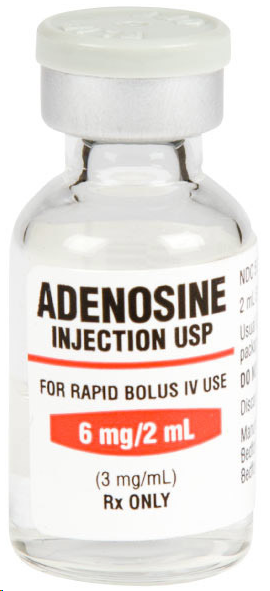
Why would adenosine, a purine nucleoside, be able to treat supraventricular tachycardias (SVT)?
And why are its effects so short lived (e.g. <2 seconds)?
The answers will change the way you think about this drug.
#tweetorial #medtwitter
Why would adenosine, a purine nucleoside, be able to treat supraventricular tachycardias (SVT)?
And why are its effects so short lived (e.g. <2 seconds)?
The answers will change the way you think about this drug.
#tweetorial #medtwitter
2/
Adenosine is an endogenous purine nucleoside that gets incorporated into RNA, ATP, and cAMP.
It has pleomorphic effects as a signaling molecule via A1, A2A, A2B, and A3 receptors.
pubmed.ncbi.nlm.nih.gov/25687993/
Adenosine is an endogenous purine nucleoside that gets incorporated into RNA, ATP, and cAMP.
It has pleomorphic effects as a signaling molecule via A1, A2A, A2B, and A3 receptors.
pubmed.ncbi.nlm.nih.gov/25687993/

3/
Adenosine was first found to be able to terminate supraventricular tachycardias (SVT) in 1927 in animal experiments.
💡It's mechanism of action was unknown.
pubmed.ncbi.nlm.nih.gov/16994064/
Adenosine was first found to be able to terminate supraventricular tachycardias (SVT) in 1927 in animal experiments.
💡It's mechanism of action was unknown.
pubmed.ncbi.nlm.nih.gov/16994064/

4/
Along with vagal maneuvers and other nodal blockers, adenosine, is now used to treat hemodynamically stable, narrow complex SVT, particularly if involving the AV node w/ reentry loops (eg AVNRT).
pubmed.ncbi.nlm.nih.gov/7800009/
Along with vagal maneuvers and other nodal blockers, adenosine, is now used to treat hemodynamically stable, narrow complex SVT, particularly if involving the AV node w/ reentry loops (eg AVNRT).
pubmed.ncbi.nlm.nih.gov/7800009/

5/
Let's return to our first question. Why would a nucleic acid be able to terminate SVT?
It turns out that adenosine, which is produced endogenously by ATP hydrolysis, acts on the SA and AV nodes via A1 receptors.
pubmed.ncbi.nlm.nih.gov/30972618/
Let's return to our first question. Why would a nucleic acid be able to terminate SVT?
It turns out that adenosine, which is produced endogenously by ATP hydrolysis, acts on the SA and AV nodes via A1 receptors.
pubmed.ncbi.nlm.nih.gov/30972618/

6/
Signaling via A1 adenosine receptors in cardiac tissue leads to ⬇️ cAMP activity and opening of hyperpolarizing membrane potassium channels.
🔑This decreases conduction speed through the AV node (aka negative dromotropy).
pubmed.ncbi.nlm.nih.gov/30562103/
Signaling via A1 adenosine receptors in cardiac tissue leads to ⬇️ cAMP activity and opening of hyperpolarizing membrane potassium channels.
🔑This decreases conduction speed through the AV node (aka negative dromotropy).
pubmed.ncbi.nlm.nih.gov/30562103/

7/
Adenosine signaling through A1 receptors also blocks the opening of L-type membrane calcium channels, which further reduces conduction speed through the AV node.
pubmed.ncbi.nlm.nih.gov/2022011/
Adenosine signaling through A1 receptors also blocks the opening of L-type membrane calcium channels, which further reduces conduction speed through the AV node.
pubmed.ncbi.nlm.nih.gov/2022011/

8/
By dramatically slowing conduction in the AV node, adenosine can terminate reentrant circuits/loops that involve the AV node (eg AVNRT).
⚡️That's how it treats SVT.
ncbi.nlm.nih.gov/pmc/articles/P…
By dramatically slowing conduction in the AV node, adenosine can terminate reentrant circuits/loops that involve the AV node (eg AVNRT).
⚡️That's how it treats SVT.
ncbi.nlm.nih.gov/pmc/articles/P…

9/
Let's return to our second question: why is adenosine such an ultra short-acting drug?
💥It turns out that adenosine's half-life in the blood is, incredibly, <1.5 seconds.
pubmed.ncbi.nlm.nih.gov/2539728/
Let's return to our second question: why is adenosine such an ultra short-acting drug?
💥It turns out that adenosine's half-life in the blood is, incredibly, <1.5 seconds.
pubmed.ncbi.nlm.nih.gov/2539728/

10/
For adenosine inactivation to be so fast, it has to happen in the blood.
And that's exactly what occurs...
For adenosine inactivation to be so fast, it has to happen in the blood.
And that's exactly what occurs...
11/
Amazingly, adenosine is rapidly taken up by red blood cells (RBCs) and endothelial cells and inactivated intracellularly, in 2 ways:
1. Deamination by adenosine deaminase to inosine
2. Phosphorylation to adenosine monophosphate
pubmed.ncbi.nlm.nih.gov/2022011/
Amazingly, adenosine is rapidly taken up by red blood cells (RBCs) and endothelial cells and inactivated intracellularly, in 2 ways:
1. Deamination by adenosine deaminase to inosine
2. Phosphorylation to adenosine monophosphate
pubmed.ncbi.nlm.nih.gov/2022011/

12/
Let's conclude with a cool clinical correlate.
Adenosine also causes vasodilation, via similar membrane hyperpolarizing mechanisms as we saw for negative dronotropy in tweet #6.
pubmed.ncbi.nlm.nih.gov/30972618/
Let's conclude with a cool clinical correlate.
Adenosine also causes vasodilation, via similar membrane hyperpolarizing mechanisms as we saw for negative dronotropy in tweet #6.
pubmed.ncbi.nlm.nih.gov/30972618/

13/
This ability to vasodilate explains why adenosine is used during pharmacologic cardiac stress testing.
Vasodilation of normal arterioles "steals" blood away from stenotic segments, inducing myocardial ischemia.
amboss.com/us/knowledge/C…
This ability to vasodilate explains why adenosine is used during pharmacologic cardiac stress testing.
Vasodilation of normal arterioles "steals" blood away from stenotic segments, inducing myocardial ischemia.
amboss.com/us/knowledge/C…

14/
Dipyrimadole, another vasodilator used in stress testing, acts as an adenosine re-uptake inhibitor.
This prolongs and enhances the effects of endogenous adenosine on the myocardium, leading to coronary steal from stenotic coronary segments.
pubmed.ncbi.nlm.nih.gov/22129171/
Dipyrimadole, another vasodilator used in stress testing, acts as an adenosine re-uptake inhibitor.
This prolongs and enhances the effects of endogenous adenosine on the myocardium, leading to coronary steal from stenotic coronary segments.
pubmed.ncbi.nlm.nih.gov/22129171/

15/
Teleologically, adenosine regulates cardiac energy supply/demand, allowing rapid response to ischemia/tissue injury by coronary vasodilation and ⬇️ conduction speed/heart rate.
This may explain why it has such an ultrashort duration of effect.
pubmed.ncbi.nlm.nih.gov/21094127/
Teleologically, adenosine regulates cardiac energy supply/demand, allowing rapid response to ischemia/tissue injury by coronary vasodilation and ⬇️ conduction speed/heart rate.
This may explain why it has such an ultrashort duration of effect.
pubmed.ncbi.nlm.nih.gov/21094127/

16/SUMMARY
🫀Adenosine terminates SVTs by ⬇️ conduction speed through the AV node (negative dromotropy)
🫀Ultrashort duration of action (<2 sec) = rapid inactivation in endothelial cells + RBCs
🫀This reflects its role in regulating response to cardiac ischemia/injury
🫀Adenosine terminates SVTs by ⬇️ conduction speed through the AV node (negative dromotropy)
🫀Ultrashort duration of action (<2 sec) = rapid inactivation in endothelial cells + RBCs
🫀This reflects its role in regulating response to cardiac ischemia/injury
• • •
Missing some Tweet in this thread? You can try to
force a refresh